The WebAssembly Revolution: Bringing Desktop-Class Performance to the Browser
- CipherRoot Software
- 4 gün önce
- 3 dakikada okunur

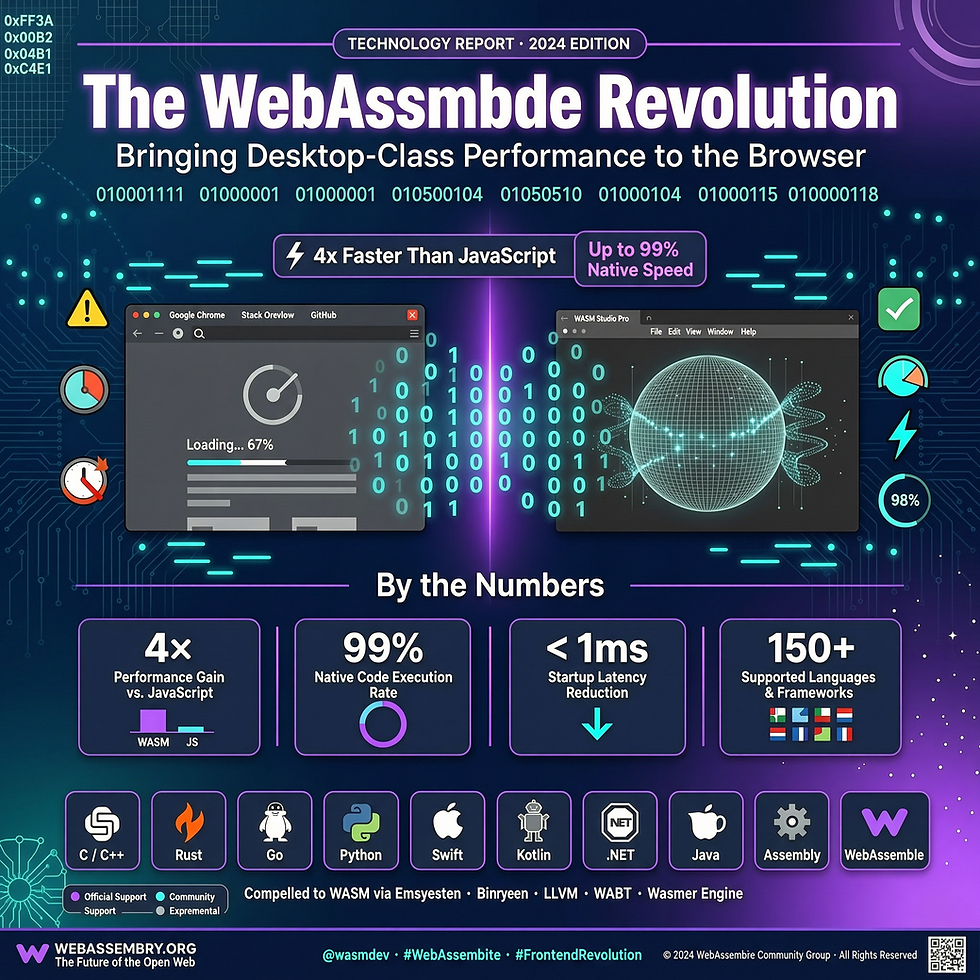
For years, the web browser was viewed as a limited environment. It was a place for static text, stylized layouts, and lightweight scripts. If a developer wanted to build a high-performance utility, a complex simulation, or an interactive 3D rendering engine, the answer was always the same: You must build a native desktop application. JavaScript, despite its incredible evolution, simply wasn't designed to handle heavy, low-level CPU computations.
That limitation is officially dead. Thanks to WebAssembly (Wasm), the boundary between native desktop applications and web platforms has completely dissolved. We are now capable of deploying massive, high-fidelity software ecosystems directly inside a standard web browser with near-native execution speeds.
⚙️ What is WebAssembly? (The Technical Breakdown)
WebAssembly is not a replacement for JavaScript; it is a powerful co-processor. Technically speaking, Wasm is a low-level binary code format designed to run as a high-performance compilation target for languages like C++, Rust, and C#.
When you write a performance-critical script in Rust or C++, you compile that codebase directly into a .wasm file. When a user visits your website, the browser loads this binary file and executes it inside a secure, sandboxed environment at near-native speed.
Unlike JavaScript, which must be parsed, compiled, and optimized at runtime by the browser's engine, WebAssembly is already pre-compiled into compact binary code. This allows the browser to skip the heavy lifting, loading complex logic loops almost instantaneously.
🛠️ The Architectural Impact: Lightweight Yet Uncompromising
From a software development perspective, incorporating WebAssembly into modern web tools allows us to build with a dual-engine mindset:
UI/UX Fluidity: JavaScript handles the browser interface, user inputs, and asynchronous network API calls, ensuring the web experience remains lightweight and responsive.
Heavy Compute Engines: WebAssembly handles the data processing, cryptographic operations, parsing algorithms, and heavy math loops in the background without freezing the browser main thread.
Code Reusability: Developers no longer need to rewrite core desktop software libraries from scratch to bring them to the web. Existing native codebases can be compiled into Wasm, cutting deployment timelines in half.
This specific blueprint of combining lightweight web layouts with heavy, secure local performance is exactly how next-generation privacy utilities and browser-based deployment systems can be built to achieve peak efficiency.
🎮 The Animation and Simulation Shift: Real-Time Web Rendering
For digital creators and CGI animators, WebAssembly is a game-changer. Historically, trying to run a complex physics simulation or smooth 3D rendering inside a browser meant optimization nightmares and massive lag for the end-user.
With Wasm, developers can compile entire desktop game engines (like custom C++ engines or Rust-based renderers) directly for the web. Combined with WebGL and WebGPU, WebAssembly allows browsers to talk directly to the user's graphics card hardware.
The result? You can run complex particle simulations, advanced procedural generation, and real-time lighting calculations directly on a webpage at 60 frames per second, even on mid-range mobile devices. The browser is no longer a document viewer—it is a fully capable rendering pipeline.
🔒 The Security Vector: Sandboxed Control
Whenever high performance is brought to the web, security is the immediate concern. WebAssembly tackles this by operating inside a highly secure, strictly sandboxed execution environment managed by the browser.
Wasm modules cannot arbitrarily access the host machine's file system, memory, or local network ports unless explicitly allowed by the JavaScript wrapper. This means we can deliver near-desktop computing power while maintaining strict, impenetrable privacy and data control. User data remains safely processed within the local browser sandbox, far away from vulnerable cloud-routing vulnerabilities.
Conclusion The web is no longer a platform of compromises. WebAssembly has transformed the browser into a high-performance operating environment capable of running the most demanding software and simulation tools on the planet. By mastering the integration of low-level binary performance with clean, lightweight frontend interfaces, we aren't just building websites—we are engineering the future of decentralized computing.
The era of demanding desktop installs is fading. The desktop experience has migrated to the web.


Yorumlar