Micro-Frontends Architecture: Scaling Complex Web Platforms Without Breaking Code
- CipherRoot Software
- 3 gün önce
- 3 dakikada okunur

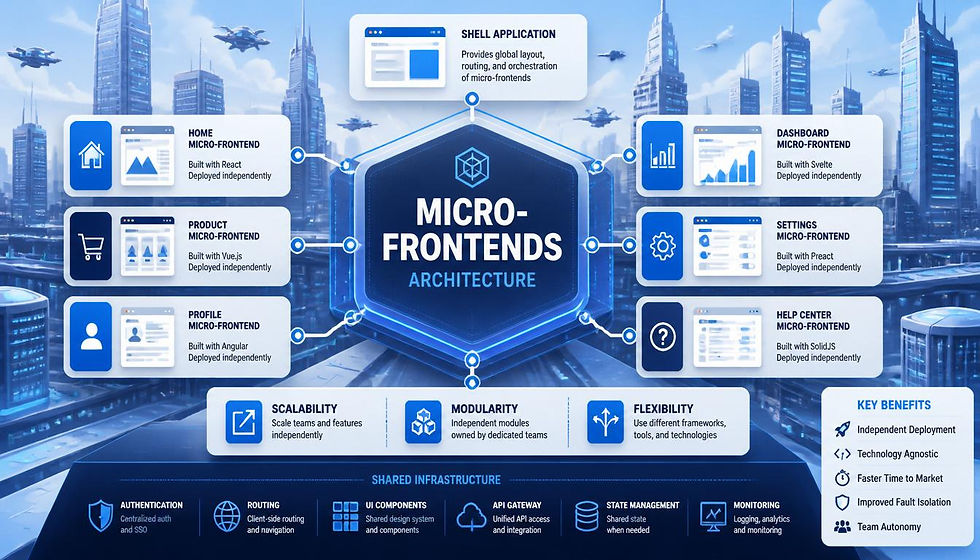
As web applications grow from simple landing pages into massive, enterprise-level digital ecosystems, developers face a monumental challenge: The Monolithic Bottleneck. When dozens of features, layout elements, and data hooks are tightly bound within a single, massive codebase, the entire system becomes fragile. A single minor bug in a secondary layout component can trigger a cascade of fatal errors, crashing the entire user experience.
To solve this critical scaling issue, modern software engineering is undergoing a massive architectural shift. Welcome to the era of Micro-Frontends—an architectural pattern that breaks down monolithic web platforms into independent, autonomous, and highly resilient micro-applications.
🧱 What is Micro-Frontends Architecture?
The core philosophy of micro-frontends is simple: apply the proven concepts of backend microservices directly to the user interface.
Instead of building a web application as one giant block of code, the platform is divided into distinct, vertical slices based on business functionality. For example, a modern simulation platform or software deployment site can be separated into three completely autonomous applications running simultaneously inside the same browser window:
The Navigation Module: Responsible solely for layout routing and identity management.
The Core Tool/Simulator Engine: Running heavy local computation or rendering tasks.
The Analytics & User Profile Panel: Managing asynchronous telemetry and database syncs.
Each of these modules features its own isolated code repository, its own build pipeline, and its own continuous delivery framework. They are brought together seamlessly at runtime by a lightweight container layout wrapper.
🛠️ Technical Implementation: The Integration Strategies
Deploying a micro-frontend architecture successfully requires choosing the right integration layer based on performance goals and local infrastructure requirements:
Runtime Integration via Module Federation: Popularized by modern build tools like Webpack 5, Module Federation allows completely separate compiled applications to dynamically share code and execute logic loops together in the browser at runtime. It completely eliminates the need to download duplicate dependencies, keeping the application light and fast.
Build-Time Integration: Modules are published as independent npm packages and assembled during the final build process. While highly stable, this strategy requires a full system rebuild whenever a single component is updated.
Server-Side Composition: Micro-frontends are assembled on the server before hitting the client browser. This strategy is ideal for optimizing initial page-load times and maximizing Search Engine Optimization (SEO) indexing capabilities.
⚡ The Performance Blueprint: Uncompromising Speed and Hygiene
From a systems optimization perspective, micro-frontends provide a massive leap forward in maintaining pristine code hygiene and responsive user experiences:
Isolated Blast Radiuses: If a bug or a script error occurs inside the analytics module, the container completely isolates the failure. The navigation menu and the main software engine continue running seamlessly without freezing the interface.
Independent Tech Stacks: Because the frontends are decoupled, different modules can use different technologies where appropriate. A heavy, data-intensive rendering pane can be built using optimized C++ compiled to WebAssembly, while the surrounding user management dashboard is built with standard, lightweight React or Vue.
On-Demand Loading: The browser only downloads the specific code blocks required for the active view. If a user never visits the advanced settings panel, that code is never fetched, keeping network bandwidth utilization incredibly efficient.
🔒 The Privacy Vector: Sandboxed Component Security
When building highly secure software utilities and privacy-focused network shields, micro-frontends introduce a brilliant security advantage.
By separating the application into distinct frontend layers, developers can apply strict sandbox protocols to specific modules. For instance, a payment or sensitive data-entry module can be completely isolated from third-party tracking scripts or analytics libraries running in another part of the web layout.
Since the modules share no global state or shared memory pools by default, malicious data injection attacks cannot spread across the application. Security boundaries are drawn directly around individual UI components, ensuring localized network control and absolute data integrity.
Conclusion The age of the unmaintainable web monolith is coming to an end. Micro-frontends architecture provides the scalability, security, and independent deployment cycles necessary to engineer massive web application ecosystems without sacrificing performance or stability.
By breaking down the frontend into highly specialized, isolated, and autonomous code blocks, we are building a decentralized web interface that is inherently modular, lightning-fast, and built to survive the unpredictable demands of tomorrow.


Yorumlar