Beyond the I/O Bottleneck: How DirectStorage Architectures Are Rewriting Data Pipelines
- CipherRoot Software
- 3 gün önce
- 3 dakikada okunur

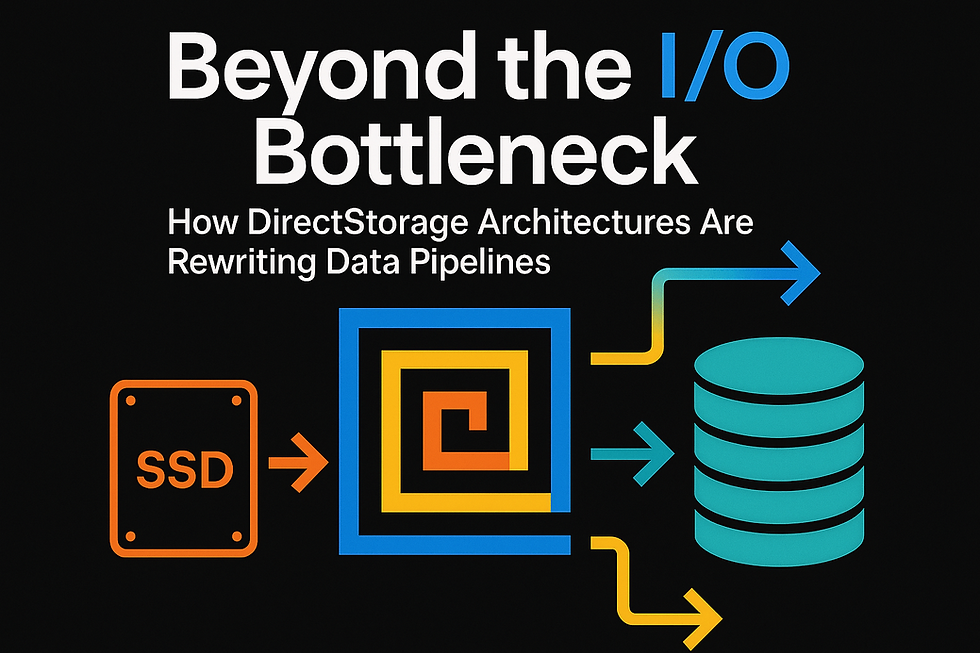
The hardware became faster, but the software data pipeline remained stuck in the early 2000s. The traditional operating system storage architecture has officially become a bottleneck. To break through this wall, software engineering is shifting toward a revolutionary approach: DirectStorage
🛑 The Traditional I/O Bottleneck: Why Fast SSDs Feel Slow
To understand the revolution, we must first look at the traditional, outdated data pipeline that standard operating systems use to load assets into memory.
Historically, when an application needs a texture, a compressed 3D model, or a heavy asset pool from your NVMe SSD, the data must take a long, highly inefficient route:
The Request: The application requests the asset from the storage drive.
The CPU Detour: The compressed data is loaded from the SSD into the system memory (RAM). From there, the Central Processing Unit (CPU) must step in, allocate processing threads, and manually decompress the data packets.
The Final Hop: Once the CPU finishes decompressing the assets, the data is packaged again and transferred across the PCIe bus into the Video RAM (VRAM) of the Graphics Processing Unit (GPU) so it can finally be rendered.
This legacy pipeline requires multiple CPU core cycles just to manage data movement and decompression. When dealing with modern, uncompressed textures or massive data streams, the CPU suffocates under the sheer volume of input/output (I/O) requests, causing the entire application execution loop to stall.
⚡ The DirectStorage Blueprint: Bypassing the CPU
DirectStorage architecture completely re-engineers this pipeline by cutting out the middleman. It creates a direct, high-bandwidth highway from the physical NVMe storage drive straight to the graphics card's VRAM.
Instead of waking up the CPU to handle file requests one by one, DirectStorage utilizes highly parallelized, asynchronous I/O queues. Thousands of asset requests are grouped together and streamed simultaneously across the high-speed PCIe lanes directly to the GPU.
More importantly, the decompression task is stripped away from the CPU entirely.
Modern graphics processors are built with massive parallel compute capabilities, making them thousands of times faster at decompressing asset data than a traditional CPU. By utilizing specialized GPU decompression shaders, the data is unpacked instantly inside the VRAM, right where it needs to be used. The CPU is left 100% free to focus on core application logic, physics loops, and network security tasks.
🛠️ The Developer Angle: Optimizing for Zero-Latency Assets
For backend developers and systems engineers building the next generation of web and desktop utilities, designing for a DirectStorage pipeline requires a structural shift in how we handle data streaming:
Asset Chunking: Files can no longer be packed into giant, monolithic archives. Assets must be intelligently broken down into optimized, granular chunks that can be requested asynchronously at the exact millisecond they are required by the runtime engine.
Non-Blocking Logic Loops: Because data requests no longer block the main thread or cause CPU frame drops, developers can design infinitely more complex background operations, allowing real-time software utilities to update their internal databases silently without interrupting the user layout.
Unified Memory Architectures: Designing systems that adapt to unified memory structures ensures that whether your code runs on a dedicated workstation or a high-end mobile chip, the storage layers are mapped efficiently without duplicating data packets.
🔒 The Security Shield: Protected Memory Sandboxing
Whenever data bypasses traditional operating system kernels and moves directly between hardware components, security and absolute privacy control become paramount.
DirectStorage frameworks handle this by implementing strict, hardware-enforced Memory Sandboxing. Because the data pipeline skips the standard system memory pools during transfer, malicious software or spyware injected into the operating system RAM cannot scan, intercept, or tamper with the assets as they move from the encrypted storage blocks to the secure GPU rendering zone.
At CipherRoot Software, we view this hardware-level data isolation as a cornerstone for future privacy shields. By restricting asset routing to direct, uninterceptable hardware channels, we ensure that sensitive source codes, proprietary simulation assets, and local cryptographic keys remain fully protected from operating system-level vulnerabilities.
Conclusion The legacy methods of moving data through a computer are reaching their absolute end. We can no longer solve processing bottlenecks by simply throwing more clock speed at the CPU. True optimization requires us to rethink the architecture of the data pipeline itself.
By embracing DirectStorage pathways and allowing hardware components to communicate directly with zero friction, we aren't just eliminating loading screens—we are unlocking a future where massive software environments and deep technical utilities operate with the fluid, instantaneous speed of real life.
The bottleneck is broken. The direct data revolution has begun.


Yorumlar