
Web & Browser
What Is the Immersive Experience Engine?
CipherRoot Software8 min read
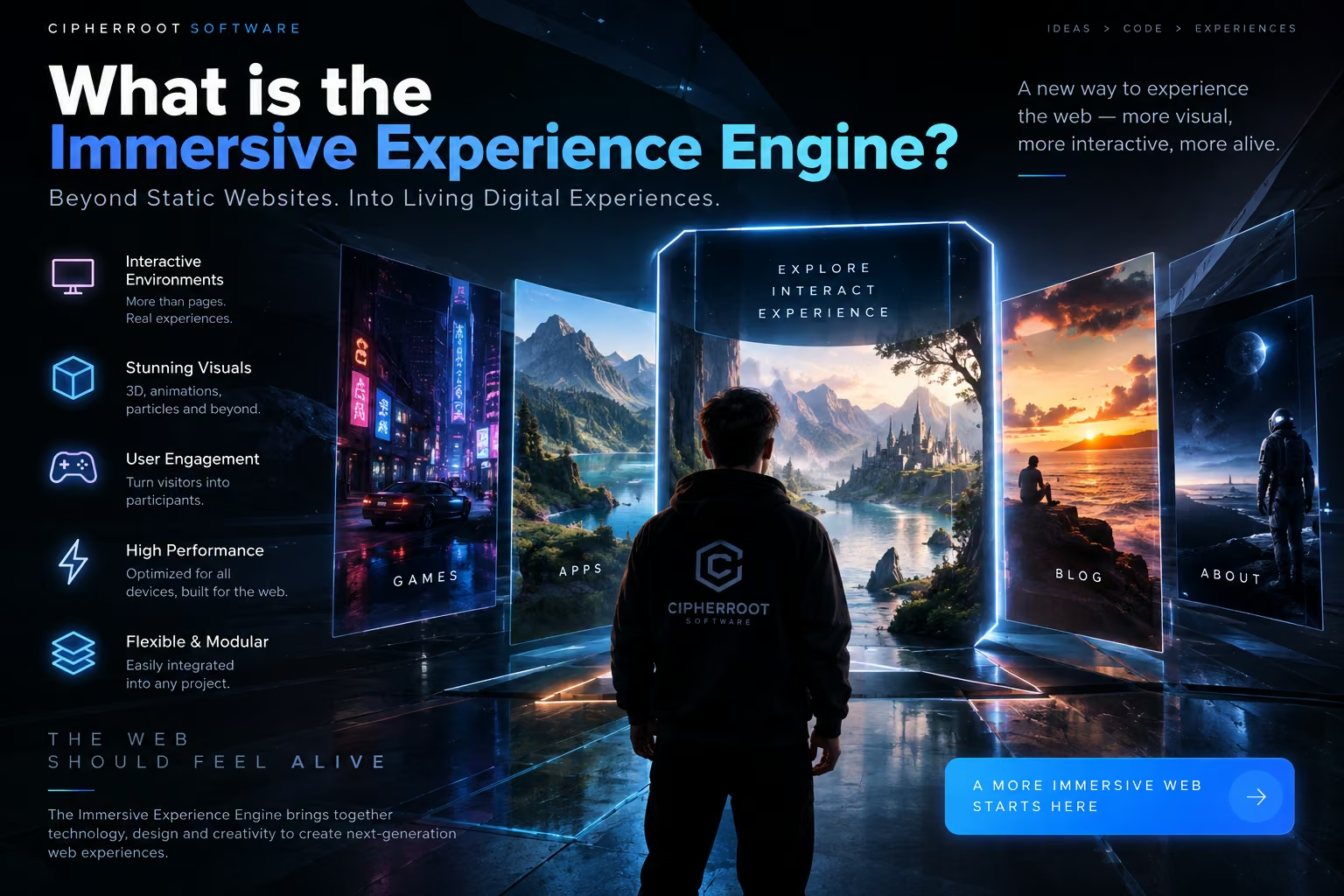
The web is evolving beyond static pages.
For years, websites have been built around a familiar model: navigation menus, text, images, buttons, cards, and traditional layouts. These interfaces are effective, but modern web technology makes it possible to create something more dynamic — experiences that respond to users, change with interaction, and feel more like environments than documents.
This idea is at the heart of the Immersive Experience Engine.
At CipherRoot Software, we use the term Immersive Experience Engine to describe a flexible, modular approach to building interactive digital experiences for the web. The goal is not simply to add more animations to a website. It is to create a system where design, interaction, motion, visuals, sound, content, and performance work together as one experience.
From Websites to Experiences
A traditional website is often structured around pages.
A visitor opens a page, reads information, clicks a button, navigates to another page, and continues through a predefined structure.
An immersive experience can work differently.
Instead of thinking only in terms of pages, we can think in terms of spaces, interactions, states, and reactions.
A user might move through an interactive environment, discover information through animation, interact with objects, trigger visual changes, explore a product visually, or experience content that reacts to their actions.
The website becomes more than a place where information is displayed.
It becomes a place where information is experienced.
What Does “Immersive” Mean?
Immersive does not necessarily mean virtual reality, 3D worlds, or complicated graphics.
An experience can be immersive while remaining completely inside a normal web browser.
Immersion can come from many elements working together:
Visual depth Layered backgrounds, lighting, particles, gradients, 3D elements, and carefully designed composition can create a stronger sense of depth.
Interaction Elements can respond to clicks, movement, scrolling, hovering, dragging, or other user actions.
Motion Transitions and animations can communicate relationships between elements and make an interface feel alive.
Sound When appropriate, sound can become part of the experience rather than simply an optional decoration.
Storytelling Information can be presented progressively, allowing users to discover a product, project, or idea instead of receiving everything at once.
Feedback The interface can react immediately to what the user does, creating a stronger connection between action and response.
The result is not necessarily a more complicated website.
The objective is a more connected experience.
The Idea Behind the Immersive Experience Engine
The Immersive Experience Engine is designed around a simple principle:
Technology should support the experience rather than become the experience.
A visually impressive interface that loads slowly, consumes excessive resources, or becomes difficult to use on mobile devices is not a successful immersive experience.
That is why the concept combines creativity with engineering.
A simplified architecture can be thought of as several connected layers:
User ↓ Interaction Layer ↓ Experience Logic ↓ Visual / Motion Systems ↓ Content ↓ Performance Layer
Each layer has a different role, but they work together.
The interaction layer understands what the user is doing.
The experience logic determines what should happen.
The visual and motion systems communicate that change.
The content layer delivers the information.
The performance layer makes sure everything continues to work efficiently across different devices.
This modular approach also makes the system easier to evolve.
Why Build an Immersive Experience Engine?
Modern websites compete for attention in an environment where users interact with thousands of digital experiences every year.
A standard layout can communicate information effectively, but some products and ideas benefit from a more expressive interface.
A game studio may want visitors to feel the atmosphere of its games.
A creative software company may want to demonstrate its tools rather than simply describe them.
A technology project may need an interface that visually explains a complex concept.
A portfolio may benefit from transforming a collection of projects into an interactive journey.
In these cases, the interface itself can become part of the product.
The Immersive Experience Engine is intended to provide a reusable foundation for these types of experiences.
Beyond Animation
One common misconception is that an immersive website is simply a website with lots of animation.
That is not the goal.
Animation should have a purpose.
A transition can help explain where an element came from.
A visual effect can provide feedback.
A change in lighting can indicate a new state.
An interactive object can reveal additional information.
A scrolling sequence can guide a user through a story.
When every effect has a reason to exist, the experience becomes coherent rather than overwhelming.
Immersion is about interaction and perception, not visual noise.
Designed for the Modern Web
The Immersive Experience Engine is intended to work within the capabilities of the modern browser.
Depending on the project, an experience can use technologies such as:
HTML and CSS JavaScript and TypeScript Canvas WebGL CSS animations and transitions Web audio 3D assets Responsive design systems Modern image formats and optimized media
The exact technology can change from project to project.
The engine concept is intentionally technology-agnostic at the experience level. The implementation should use the tools that provide the best balance between visual quality, responsiveness, maintainability, and performance.
Performance Is Part of the Experience
A beautiful experience is not useful if it performs poorly.
This is especially important on mobile devices, where hardware, network conditions, battery usage, and screen sizes can vary significantly.
Immersive interfaces therefore need performance strategies from the beginning.
Examples include:
Lazy loading Heavy visual assets should not necessarily load before they are needed.
Optimized images Modern formats and appropriate dimensions can dramatically reduce unnecessary data.
Progressive experiences A page can begin with lightweight content and progressively introduce more complex visual elements.
Efficient rendering Animations and effects should avoid unnecessary work.
Responsive behavior Desktop and mobile experiences may need different layouts rather than simply shrinking the same interface.
Graceful degradation When a device cannot support a particular effect efficiently, the experience should remain usable.
Performance is not a separate task performed after the design.
Performance is part of the design.
One System, Many Experiences
Another important idea behind the Immersive Experience Engine is reusability.
Instead of building every interactive website completely from scratch, common systems can be designed as reusable modules.
For example:
Immersive Experience Engine │ ├── Scene System ├── Interaction System ├── Motion System ├── Visual Effects ├── Audio Layer ├── Content System ├── Responsive System └── Performance Manager
A future project might use only a few of these components.
Another project could use almost all of them.
This modular structure allows immersive experiences to evolve without forcing every project to become a completely new technical system.
Immersive Design Across Devices
An immersive experience should not assume that every visitor uses a large desktop monitor.
The experience needs to adapt to:
Desktop Large visual compositions, detailed interactions, wider scenes, and more complex layouts.
Tablet A balance between touch interaction and visual space.
Mobile Simplified layouts, touch-friendly controls, smaller visual scenes, and carefully controlled effects.
This means responsive immersive design is more than changing width values.
The interaction model itself may need to change.
A hover interaction that works on desktop might need to become a tap interaction on mobile.
A large 3D scene might need a simplified mobile version.
A complex navigation system might need to become a compact interface.
The experience remains recognizable while adapting to its environment.
Where Can It Be Used?
The Immersive Experience Engine can be applied to many different types of digital projects.
Games
Game websites can showcase gameplay, characters, worlds, mechanics, and community features through interactive presentations rather than static screenshots alone.
Creative Software
Software products can demonstrate their workflows visually, allowing visitors to understand what the application does before downloading it.
Product Experiences
Products can be presented through interactive 3D views, animations, demonstrations, and guided exploration.
Portfolios
Creative portfolios can transform collections of projects into interactive stories.
Technology Websites
Complex technologies can be explained through visual systems that allow users to explore concepts instead of reading long technical descriptions immediately.
Digital Storytelling
Stories can combine text, visuals, motion, audio, and interaction into a single browser-based experience.
The Difference Between an Interface and an Experience
An interface answers a question:
“Where do I click?”
An experience asks a broader question:
“What should this feel like while I am here?”
Both matter.
Navigation still needs to be clear.
Buttons still need to be understandable.
Content still needs to be readable.
Accessibility still matters.
Performance still matters.
But an experience can go further by connecting these elements into something cohesive.
The interface becomes part of the storytelling.
Building Experiences Without Losing Usability
Immersion should never make a website difficult to use.
A successful immersive experience should still provide:
Clear navigation Readable typography Responsive layouts Accessible interactions Fast initial loading Predictable controls Useful feedback Compatibility across devices
The objective is not to replace usability with spectacle.
It is to combine usability with expression.
The Future of the Web
The web has continually evolved from simple documents into interactive applications, social platforms, games, creative tools, and increasingly sophisticated digital environments.
The next step does not necessarily mean that every website needs to become a virtual world.
Instead, it may mean that websites become more contextual, responsive, interactive, and expressive.
A product page can become a demonstration.
A portfolio can become a journey.
A game website can become an extension of the game.
A technology article can become an interactive visualization.
A brand can create an environment instead of simply displaying a logo.
This is the direction behind the Immersive Experience Engine.
Our Vision
The Immersive Experience Engine is a concept for building the next generation of web experiences at the intersection of technology, design, creativity, and interaction.
It is not about adding effects for the sake of effects.
It is about creating digital spaces where content, technology and interaction feel connected.
The web does not have to remain a collection of static pages.
It can become more visual.
More responsive.
More interactive.
More human.
The web should feel alive.
Immersive Experience Engine — built for a more interactive web.