
Future & Research
Wearable AI Devices: The Future of Technology That Moves With You
CipherRoot Software10 min read
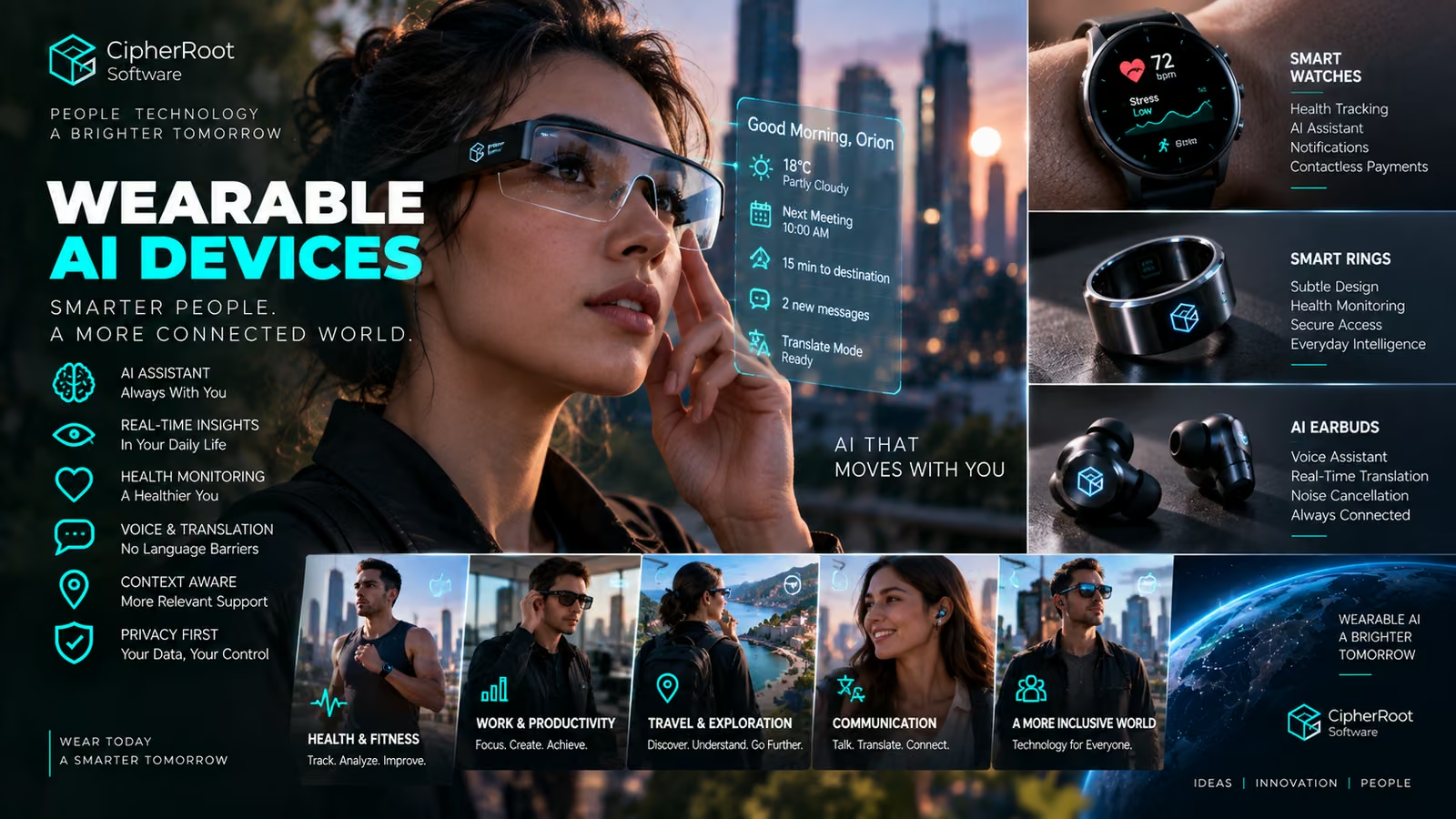
Technology Is Getting Closer to Us
For decades, computers lived on desks.
Then they moved into our pockets.
Now they are beginning to move onto our bodies.
Wearable technology is evolving from simple fitness trackers and smartwatches into increasingly intelligent devices capable of understanding context, processing information, and interacting with users in more natural ways.
This new generation is often described as wearable AI.
Instead of requiring people to constantly reach for a phone or computer, wearable AI devices can place digital information closer to where people actually experience the world.
Smart glasses can provide visual information.
AI earbuds can provide voice-based assistance.
Smart rings can collect data and provide subtle interactions.
Smartwatches can act as compact personal computers on the wrist.
The common idea is simple:
Technology should move with the user.
What Are Wearable AI Devices?
Wearable AI devices are body-worn technologies that combine sensors, connectivity, computing, and artificial intelligence.
They can take many forms, including:
Smart glasses AI-powered earbuds Smartwatches Smart rings Health and fitness devices Voice-enabled wearables Specialized industrial wearables
Unlike traditional wearable devices that mainly record information, AI-enabled systems can increasingly interpret that information and provide useful responses.
A wearable does not simply collect data.
It can potentially understand context and respond to the situation.
AI Assistants That Are Always Nearby
One of the biggest possibilities of wearable AI is the personal assistant.
Phones require interaction.
You need to unlock the screen, open an application, and type or speak a request.
A wearable can make interaction much more immediate.
A user could speak naturally to an AI assistant while walking, working, traveling, or performing another activity.
The assistant could potentially help with:
Reminders Information retrieval Navigation Communication Translation Scheduling Note taking Everyday questions
The result is a different relationship with technology.
Instead of opening an app whenever information is needed, information can become part of the user's surrounding experience.
Smart Glasses and Augmented Reality
Smart glasses are one of the most exciting categories of wearable AI.
A pair of glasses can potentially combine cameras, microphones, speakers, sensors, and displays into a single device.
This creates possibilities that are difficult to achieve with smartphones alone.
Imagine walking through a new city and receiving navigation information without constantly looking down at a screen.
Or imagine seeing contextual information about a machine while working on it.
AI could analyze the user's surroundings and provide information based on what is currently visible.
This could transform the concept of a computer from something we look at into something we experience through.
Real-Time Translation
Language is one area where wearable AI could become especially useful.
AI-powered audio wearables can potentially assist with real-time translation between languages.
Imagine having a conversation with someone who speaks another language while hearing translated speech through your earbuds.
Smart glasses could potentially combine visual recognition, speech processing, and translation into one continuous experience.
This could make travel, international communication, education, and cross-cultural collaboration easier.
The technology will still have limitations, especially with accents, background noise, cultural context, and ambiguous language.
But the direction is significant.
The language barrier could become increasingly digital rather than physical.
Wearables and Health Monitoring
Wearable devices are already widely used for tracking physical activity and other forms of personal data.
AI can make this information more useful by identifying patterns over time.
A wearable can collect information continuously.
AI can then analyze the accumulated data and help users understand trends and changes.
Possible applications include:
Activity tracking Sleep-related insights Heart-rate trends Workout analysis Recovery patterns Personalized reminders Lifestyle monitoring
However, health-related wearable data needs to be handled carefully.
Sensors are not perfect, and consumer devices should not automatically be treated as replacements for professional medical evaluation.
The value of AI in this area is often its ability to help users understand patterns in their own data.
Smart Rings and Invisible Computing
Not every AI wearable needs a screen.
Smart rings represent a different philosophy.
They are small, discreet, and designed to remain almost invisible during everyday activities.
A ring can potentially monitor certain signals, interact with connected systems, or provide authentication and other functions without requiring a larger device.
This is part of a broader trend toward invisible computing.
Instead of carrying more screens, users may eventually interact with technology through subtle devices that simply become part of everyday clothing and accessories.
AI Earbuds Are Becoming More Than Headphones
Wireless earbuds have already become sophisticated computing devices.
Adding AI capabilities expands their role.
Instead of simply playing music, intelligent earbuds can potentially provide voice interaction, translation, contextual assistance, and communication tools.
Because earbuds sit directly next to the user's ears, voice becomes a natural interface.
You do not need to look at anything.
You simply speak.
This can be particularly useful while walking, exercising, commuting, or working.
The interface disappears.
The assistant remains available.
Context Awareness
The real power of wearable AI may come from context awareness.
A smart system does not only need to know what the user said.
It also needs to understand what is happening around the user.
For example:
Where are they?
What are they looking at?
What are they doing?
What information did they request earlier?
What devices are nearby?
What information is relevant right now?
A context-aware wearable could make interactions more natural by reducing unnecessary questions and providing information at the appropriate moment.
This could become one of the defining characteristics of future AI wearables.
Wearable AI in the Workplace
Wearable AI could have significant applications beyond consumer electronics.
Workers in industrial, logistics, construction, maintenance, healthcare, and other environments could use intelligent wearables to access information without leaving their task.
Smart glasses could display instructions.
Voice assistants could provide technical documentation.
AI could help workers identify equipment components.
Remote experts could potentially collaborate through wearable interfaces.
This could turn the wearable into a hands-free information system.
Instead of stopping work to consult a computer, the computer becomes part of the worker's environment.
AI Wearables for Travel
Travel is another natural application.
A wearable AI assistant could potentially combine:
Navigation Translation Local information Camera-based recognition Voice assistance Travel planning
A traveler could ask for directions, understand a sign in another language, or receive information about a nearby location without constantly switching between applications.
The experience could become more fluid.
The technology stays in the background.
The environment remains the focus.
Accessibility and Inclusion
Wearable AI also has the potential to improve accessibility.
Voice interfaces can provide alternatives to traditional screen-based interaction.
Smart glasses could potentially describe visual environments or display enhanced information.
Real-time transcription could assist people who have difficulty hearing.
Translation and text recognition could help users interact with unfamiliar environments.
The most valuable wearable technologies may therefore not be those with the most impressive specifications.
They may be the ones that make everyday tasks easier for the widest range of people.
Privacy Becomes a Major Issue
There is an important difference between carrying a smartphone and wearing a device that can constantly observe its surroundings.
Cameras, microphones, location systems, and sensors can generate highly sensitive information.
A wearable AI device may know:
Where you go.
What you hear.
What you see.
Who you interact with.
What you ask.
Potentially, even what your daily routines look like.
This creates serious privacy considerations.
Users need clear controls over data collection and sharing.
Manufacturers also need secure storage, strong authentication, careful data policies, and transparent explanations of how information is processed.
A smarter wearable must also be a privacy-conscious wearable.
Local AI vs Cloud AI
Another important technical question is where AI processing happens.
Some functions can potentially run directly on the device.
This is known as local or on-device AI.
Other tasks may require cloud computing.
Each approach has advantages.
Local processing can reduce latency and limit the amount of sensitive data sent elsewhere.
Cloud processing can provide access to more powerful models and larger computing resources.
Future wearable platforms may combine both.
Simple tasks can happen locally.
More demanding tasks can be processed through the cloud when necessary.
This creates a balance between performance, privacy, battery life, and capability.
Battery Life Remains a Challenge
Advanced AI requires computing power.
Computing power requires energy.
That creates one of the biggest challenges for wearable AI.
A device worn throughout the day needs to remain small, comfortable, and lightweight.
Large batteries are not practical for many wearable designs.
Future progress will therefore depend on more efficient chips, optimized AI models, low-power sensors, better wireless technologies, and improved battery technology.
The best wearable AI device may not be the one with the most powerful processor.
It may be the one that delivers useful intelligence while consuming very little power.
The Rise of Personalized AI
Wearables can become highly personal because they remain with the user throughout the day.
Over time, an AI system could potentially learn patterns such as:
Preferred routines Common locations Frequently used commands Communication preferences Typical schedules Device usage patterns
This could make the assistant increasingly personalized.
Instead of a generic AI assistant, the wearable could become a system that understands how its particular user interacts with technology.
Personalization could be extremely useful.
It also makes privacy and data control even more important.
Wearable AI and the Internet of Things
Wearables do not need to operate alone.
They can become part of a larger connected ecosystem.
A smartwatch could communicate with a smartphone.
Smart glasses could connect to a vehicle.
Earbuds could communicate with a home assistant.
A wearable could authenticate the user to a smart building.
This creates a broader Internet of Things ecosystem in which the human becomes another connected node.
The wearable becomes the interface between the person and the digital environment.
The Future of Human-Computer Interaction
For decades, interaction with computers has been dominated by keyboards, mice, and touchscreens.
Wearable AI introduces new possibilities.
Voice.
Vision.
Gesture.
Movement.
Context.
Environmental awareness.
These interfaces can reduce the distance between humans and computers.
Instead of explicitly telling a computer everything it needs to know, future systems may understand more of the surrounding situation automatically.
That could make computing feel less like operating a machine and more like interacting with an intelligent environment.
The Challenges Ahead
Wearable AI still has significant technical challenges.
AI systems can make mistakes.
Sensors can produce inaccurate measurements.
Speech recognition can fail in noisy environments.
Battery life can limit continuous usage.
Connectivity can disappear.
Devices can become uncomfortable if they are too large or heavy.
Privacy and security can become more difficult as the amount of collected information increases.
The industry therefore needs to balance intelligence, convenience, privacy, reliability, and simplicity.
The best wearable technology will likely be technology that feels effortless.
A World Where AI Moves With You
Imagine waking up and putting on a pair of AI glasses.
Your assistant quietly provides information about your day.
Your earbuds handle communication and translation.
Your smartwatch monitors activity and notifications.
Your ring provides authentication.
Your devices communicate with your home, vehicle, and digital services.
None of these devices needs to dominate your attention.
They simply work around you.
This is the larger vision behind wearable AI.
Technology becomes less visible while becoming more deeply integrated into everyday life.
Conclusion
Wearable AI devices represent a major evolution in personal technology.
Smart glasses, AI earbuds, smartwatches, rings, and other connected devices are moving computing away from traditional screens and closer to the human body.
The future is likely to involve AI systems that can see, hear, understand context, communicate naturally, and provide information exactly when it is needed.
But the technology must evolve responsibly.
Privacy needs to remain under user control.
AI systems need to be transparent about their limitations.
Hardware needs to become smaller and more energy efficient.
And convenience should never come at the cost of trust.
The ultimate goal is not to create more gadgets.
It is to create technology that quietly helps people do more, understand more, and stay connected without getting in the way.
The smartphone changed how we carry technology.
Wearable AI could change how technology experiences the world with us.
Smarter devices. More natural interaction. AI that moves with you.