
Systems & Infrastructure
The Science of Digital Twins: How Virtual Models Are Changing the Real World
CipherRoot Software10 min read
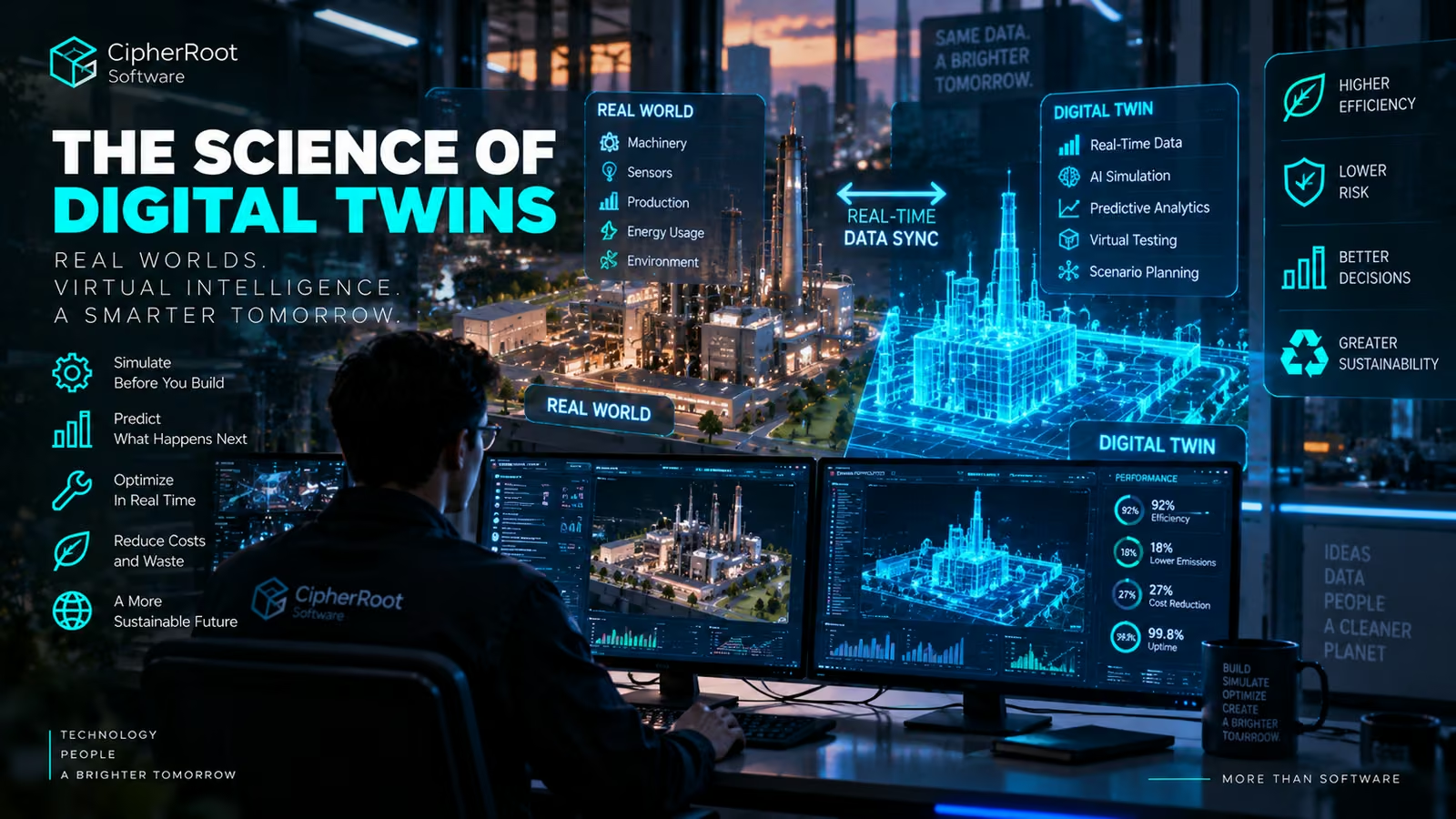
The Physical World Gets a Digital Copy
Imagine being able to create a digital version of a factory, aircraft engine, vehicle, building, or even an entire city.
Now imagine that this digital version is continuously connected to the real object.
When something changes in the physical world, the virtual model changes too.
When engineers want to test a new idea, they can first experiment with the digital version.
This is the basic concept behind digital twins.
A digital twin is more than a three-dimensional model. It is a digital representation of a physical object, process, or system that can use real-world data to understand its current condition, simulate possible scenarios, and support better decisions.
Digital twins are becoming an important part of modern engineering, manufacturing, energy, transportation, construction, and many other industries.
What Is a Digital Twin?
A digital twin connects a physical system with a digital representation.
The physical system generates data through sensors, machines, cameras, software, or other sources.
That data is transferred into the digital environment, where software can analyze it.
The digital model can then be used for:
- Monitoring
- Simulation
- Prediction
- Optimization
- Testing
- Maintenance
- Planning
The key idea is the continuous relationship between the physical and digital worlds.
A simple 3D model shows what something looks like.
A digital twin is designed to help show how something behaves.
How Digital Twins Work
A digital twin generally consists of several connected layers.
The Physical Object
This is the real-world system.
It could be a manufacturing machine, wind turbine, aircraft engine, warehouse, building, vehicle, or industrial facility.
Sensors and Data Collection
Sensors collect information about the physical system.
Depending on the application, this may include:
- Temperature
- Pressure
- Vibration
- Speed
- Energy consumption
- Location
- Humidity
- Equipment status
Data Communication
The collected information needs to move between the physical system and the digital environment.
This can involve industrial networks, wireless connections, IoT platforms, cloud infrastructure, or edge computing systems.
The Digital Model
Software represents the physical system digitally.
The model can contain information about the object's structure, behavior, components, operating conditions, and historical performance.
Analytics and Simulation
AI, machine learning, physics-based simulation, and analytical software can process the information.
This allows the digital twin to answer questions such as:
What is happening now?
Why is it happening?
What might happen next?
What would happen if we changed something?
That final question is where digital twins become particularly powerful.
Real-Time Data Makes the Twin Valuable
A digital twin becomes significantly more useful when it is connected to current data.
Consider a factory machine.
A static digital model might show the machine's dimensions, components, and technical specifications.
A connected digital twin could additionally show the machine's current temperature, vibration, energy consumption, production rate, and operational state.
The digital system is no longer simply describing the machine.
It is observing the machine.
This creates a bridge between physical reality and digital intelligence.
Digital Twins and Artificial Intelligence
Artificial intelligence can add another layer of intelligence to digital twins.
A digital twin may generate or receive enormous amounts of operational data.
Machine learning systems can analyze this information to detect patterns that humans might not notice immediately.
For example, an AI model could learn what normal equipment behavior looks like.
When the machine begins behaving differently, the system can identify the deviation.
This can support:
- Anomaly detection
- Predictive maintenance
- Performance optimization
- Failure prediction
- Demand forecasting
- Automated decision support
The digital twin provides the environment and data.
AI provides additional analytical capabilities.
Together, they can create a much more intelligent representation of a physical system.
Predicting Problems Before They Happen
One of the most important applications of digital twins is predictive maintenance.
Traditional maintenance often follows fixed schedules.
A machine may be inspected after a certain number of operating hours.
But two identical machines may experience very different operating conditions.
One may remain healthy for a long time.
Another may develop problems much earlier.
A digital twin can track the actual condition of each machine.
By analyzing sensor data and historical behavior, predictive systems can identify warning signs before a serious failure occurs.
This can allow maintenance teams to investigate problems earlier rather than waiting for production to stop.
Testing Without Risking the Real System
Digital twins can also create a safe environment for experimentation.
Suppose an engineer wants to increase the operating speed of a production line.
Changing the real system immediately could introduce risks.
Instead, the engineer can simulate the change in the digital environment.
The digital twin can help explore possible effects on:
- Production speed
- Energy usage
- Equipment stress
- Temperature
- Material flow
- Maintenance requirements
This does not guarantee that a simulation perfectly predicts reality.
However, it can provide valuable information before a physical change is made.
The basic principle is powerful:
Test digitally before changing physically.
Digital Twins in Manufacturing
Manufacturing is one of the most natural applications for digital twins.
A factory contains machines, production lines, robots, storage systems, energy infrastructure, and logistics processes.
Each of these systems generates data.
A digital twin can combine the information into a unified virtual representation.
Manufacturers can then use the model to monitor production and study possible improvements.
For example, engineers could simulate a new production layout before moving physical equipment.
This can help identify potential bottlenecks before they become expensive real-world problems.
Digital Twins in Smart Cities
The concept can also be expanded beyond individual machines.
A city can be represented digitally.
A smart-city digital twin could combine information about:
- Roads
- Traffic
- Public transportation
- Buildings
- Energy networks
- Water systems
- Environmental conditions
- Infrastructure
City planners could use the virtual model to explore possible changes.
What happens if traffic patterns change?
How would a new transportation route affect congestion?
What happens to energy demand when a new development is added?
A digital twin can provide a simulation environment for exploring these questions.
Digital Twins in Energy
Energy infrastructure is another major area of opportunity.
Power plants, wind farms, solar installations, batteries, transmission systems, and distribution networks can all generate large quantities of operational data.
Digital twins can help operators visualize performance and identify abnormal behavior.
For renewable energy systems, the digital twin could combine equipment data with environmental conditions such as wind speed, sunlight, and temperature.
This can support maintenance planning and performance optimization.
Digital Twins in Transportation
Vehicles and transportation infrastructure can also benefit from digital modeling.
A vehicle digital twin can represent information about its components, operating conditions, and maintenance history.
For complex systems such as aircraft, the amount of data involved can be enormous.
Engineers can use digital models to monitor component behavior, simulate operating conditions, and study potential maintenance requirements.
The same principle can extend to rail networks, ports, logistics centers, and autonomous transportation systems.
Digital Twins and Robotics
Robots operate in physical environments, but their behavior is controlled by software.
This makes robotics particularly well suited to digital twin technology.
A virtual representation of a robot can simulate movement, payloads, trajectories, environmental conditions, and interaction with other machines.
Engineers can test robot behavior digitally before deploying changes to the physical machine.
In large robotic facilities, a digital twin can also represent the entire fleet.
This creates the possibility of optimizing robot movement, charging schedules, maintenance, and task allocation from a shared digital environment.
Edge Computing and the Digital Twin
Not every digital twin needs to send every piece of information to a distant cloud server.
Some systems require very fast responses.
Edge computing can process data closer to where it is generated.
For example, an industrial machine may need to detect a dangerous condition within milliseconds.
Processing that information locally can reduce latency.
Cloud systems can still handle larger-scale analysis, historical data, and long-term optimization.
This creates a powerful architecture:
Edge for speed. Cloud for scale. Digital twins for understanding.
Digital Twins Are Not Just 3D Models
One common misunderstanding is treating digital twins as sophisticated 3D graphics.
Visualization can certainly be part of a digital twin, but it is not the core concept.
The important elements are the data, relationships, behavior, and connection to the physical system.
A digital twin could exist without a visually impressive 3D interface.
It could instead be represented through dashboards, graphs, simulations, databases, or software models.
The visualization is the window.
The digital model underneath is the real engine.
The Challenge of Accurate Simulation
Digital twins are powerful, but they have limitations.
A digital model is still a model.
It depends on the quality of its data and assumptions.
If sensors provide incomplete information, the digital twin may not accurately represent reality.
If a simulation uses incorrect assumptions, its predictions may also be misleading.
This means the quality of a digital twin depends heavily on:
- Accurate sensor data
- Reliable models
- Good system architecture
- Continuous validation
- Correct assumptions
- Proper data management
The better the connection between the physical and digital worlds, the more useful the twin becomes.
Cybersecurity and Digital Twins
Connecting physical infrastructure to digital systems also creates cybersecurity considerations.
A digital twin may contain sensitive operational information.
If connected to industrial systems, it could potentially expose information about equipment, processes, performance, or infrastructure.
Protecting digital twins therefore requires strong security.
Authentication, access control, encryption, monitoring, network segmentation, and secure data pipelines can all become important.
The more powerful the digital twin, the more carefully its digital connections need to be protected.
The Future: Living Digital Models
The long-term vision of digital twins is much broader than simply creating virtual copies.
Future digital twins may become living digital models that continuously evolve with their physical counterparts.
A building could understand its energy behavior.
A factory could understand its production behavior.
A vehicle could understand its mechanical condition.
A city could understand its infrastructure.
AI could analyze all of these systems continuously and identify possible improvements.
This creates a world where physical systems are accompanied by intelligent digital counterparts throughout their entire lifecycles.
Digital Twins and Autonomous Systems
Digital twins could become especially important as autonomous systems become more common.
An autonomous machine needs to understand its environment.
A digital twin can provide an additional layer of context.
Instead of seeing only individual sensor readings, an autonomous system can potentially operate within a broader model of the environment.
This could be valuable for:
- Autonomous factories
- Smart buildings
- Robotics
- Self-monitoring infrastructure
- Autonomous transportation
- Energy networks
The physical system acts.
The digital system observes, simulates, and analyzes.
AI can connect the two.
A New Way to Understand the Real World
Digital twins represent a fundamental shift in how we interact with complex physical systems.
Instead of relying only on physical observation, engineers and organizations can build digital environments that mirror real-world behavior.
This allows them to monitor systems continuously, test ideas safely, predict possible problems, and explore different scenarios.
The concept is simple to describe.
The technology required to implement it is not.
It combines sensors, software engineering, data infrastructure, simulation, AI, communication networks, and domain-specific knowledge.
That complexity is exactly what makes digital twins so interesting.
Conclusion
Digital twins are becoming an important bridge between the physical and digital worlds.
They transform real-world systems into dynamic digital models that can be monitored, analyzed, simulated, and optimized.
From factories and energy networks to vehicles, robots, buildings, and cities, the technology can provide a new way to understand complex systems before making decisions in the physical world.
The future of digital twins will likely depend on better sensors, faster computing, more capable AI, stronger connectivity, and increasingly accurate simulations.
The ultimate goal is not to create a perfect copy of reality.
It is to create a digital model that is useful enough to help us understand reality better.
Build it.
Connect it.
Simulate it.
Learn from it.
Then make the real world smarter.