
Future & Research
The Rise of Service Robots: How Robots Are Becoming Part of Everyday Life
CipherRoot Software12 min read
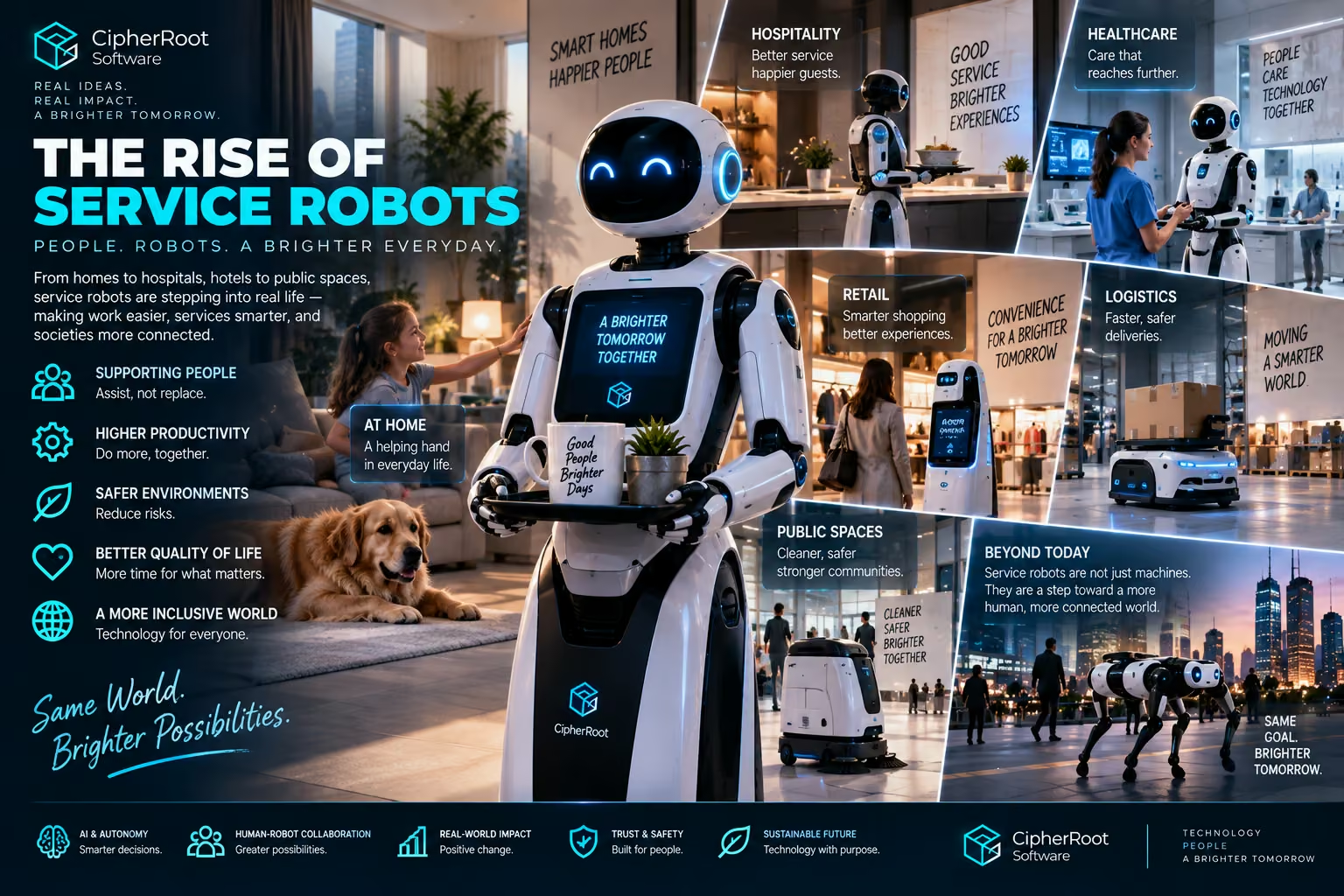
Robots Are Leaving the Factory
For many years, the word “robot” was strongly associated with industrial manufacturing.
Robotic arms assembled cars.
Automated machines welded metal.
Factories used robots to perform repetitive and highly precise tasks.
But robotics is moving beyond the factory floor.
A new generation of machines is being designed to interact directly with people and operate in everyday environments.
These machines are known as service robots.
They can assist customers, transport goods, clean buildings, provide information, support workers, and perform other tasks in environments designed primarily for humans.
The rise of service robotics represents an important shift.
Robots are no longer only machines that make products.
They are becoming machines that serve people.
What Are Service Robots?
A service robot is a robotic system designed to perform useful tasks for humans outside traditional industrial manufacturing.
They can be found in environments such as:
Homes Hotels Restaurants Hospitals Retail stores Warehouses Airports Offices Public spaces
Some service robots are autonomous.
Others operate with human supervision.
Some move through physical environments while others remain stationary and interact through screens, microphones, cameras, or robotic arms.
Their forms can vary enormously.
A service robot may look like a small mobile vehicle, a humanoid machine, a robotic arm, or a compact automated device.
Artificial Intelligence Gives Robots More Awareness
Movement alone does not make a robot useful.
A service robot needs to understand what is happening around it.
Artificial intelligence can help robots process information from cameras, microphones, LiDAR, motion sensors, and other systems.
AI-powered robots can potentially:
Recognize people Identify objects Understand spoken instructions Navigate environments Detect obstacles Interpret visual information Plan routes Adapt to changing situations
This is a major difference from older robotic systems.
A traditional automated machine can repeat a fixed task.
A modern service robot increasingly needs to interpret the environment before deciding what to do.
Robots in Hotels and Hospitality
Hotels are an interesting environment for service robots because many tasks are repetitive but occur in spaces designed for human interaction.
Service robots can potentially assist with:
Room-service delivery Luggage transportation Guest information Navigation Reception support Cleaning
A delivery robot could transport an item from the hotel kitchen to a guest's room.
A mobile information robot could help visitors find elevators, restaurants, or conference rooms.
The robot handles the repetitive movement.
Hotel employees can focus more on hospitality and situations that require human interaction.
Robots in Restaurants
Restaurants are also experimenting with automation.
Service robots can assist with tasks such as:
Carrying dishes Delivering food Clearing tables Transporting ingredients Cleaning certain areas
The goal is not necessarily to automate the entire restaurant.
Instead, robots can reduce the amount of repetitive movement employees have to perform.
This can create a hybrid workflow.
Humans interact with guests.
Robots handle selected transportation tasks.
The restaurant becomes more technologically coordinated without removing the human experience that customers value.
Healthcare Robots
Healthcare presents another important application.
Hospitals and care facilities contain many repetitive transportation tasks.
Robots can potentially move:
Medicines Supplies Equipment Meals Laundry Samples
This can reduce the amount of time staff spend transporting materials.
More advanced systems may also assist with navigation, monitoring, rehabilitation, or communication.
Healthcare robotics must be designed with particularly strong safety and reliability requirements.
A robot operating around patients cannot behave like a machine in a controlled factory.
It needs to understand people, obstacles, movement patterns, and unexpected situations.
Cleaning Robots Are Becoming More Capable
Cleaning robots are one of the most familiar forms of service robotics.
Robotic vacuum cleaners have already introduced autonomous navigation into many homes.
Larger commercial systems can clean floors in offices, airports, shopping centers, and other facilities.
The next generation of cleaning robots can combine:
Mapping + Computer Vision + Sensors + AI + Autonomous Navigation
This allows machines to operate for longer periods with less direct supervision.
Cleaning is particularly suitable for robotics because many tasks are repetitive and predictable.
Robots in Retail
Retail environments contain many opportunities for service automation.
Robots can potentially assist with:
Inventory movement Shelf monitoring Stock transportation Customer information Cleaning Delivery Security-related monitoring
A robot equipped with cameras can potentially scan shelves and identify missing or misplaced products.
Mobile robots can transport items between storage and sales areas.
Customer-facing robots can provide information or help visitors navigate a large store.
Retail robotics is therefore not limited to one function.
It can become part of the entire store ecosystem.
Logistics and Delivery
The growth of online commerce has increased demand for faster and more efficient logistics.
Service robots can help move goods through warehouses, distribution centers, and neighborhoods.
Autonomous mobile robots can transport packages internally.
Delivery robots can handle short-distance transportation.
Drones can potentially move certain lightweight items through the air.
The result is a growing ecosystem of machines designed to reduce manual transportation.
The larger vision is autonomous logistics.
Instead of moving goods through every stage using people and conventional vehicles, software can coordinate fleets of specialized robotic systems.
Public Spaces
Service robots are also being explored for public environments.
Airports, shopping centers, museums, campuses, and other large facilities can benefit from robots that provide navigation, information, cleaning, or transportation.
A visitor may interact with a robot to find a specific location.
A cleaning robot may operate after hours.
A delivery robot may move supplies between buildings.
These systems can become particularly useful in large environments where repetitive movement consumes significant staff time.
The Importance of Navigation
A factory robot often operates inside a carefully controlled space.
A service robot usually does not have that luxury.
It may have to navigate:
People Furniture Doors Elevators Hallways Vehicles Unexpected obstacles
This makes navigation one of the central challenges in service robotics.
Robots may combine maps, cameras, LiDAR, GPS, inertial sensors, and AI-based perception to determine where they are and how they should move.
The goal is not simply to find the shortest path.
It is to find a path that is safe, practical, and adaptable.
Human-Robot Interaction
Service robots work around people.
That means interaction matters almost as much as movement.
A robot should be able to communicate what it is doing.
It may use:
Voice Displays Lights Sounds Gestures Facial expressions Mobile applications
Humans also need to understand how to interact with the machine.
A robot that is technically capable but confusing to use will struggle in real-world environments.
The best service robots may therefore be designed around a simple principle:
Technology should feel natural.
Humanoid Robots and General-Purpose Assistance
Humanoid robots represent one of the most ambitious directions in service robotics.
Instead of designing a separate robot for every specific task, engineers are exploring machines that can operate in environments already built for humans.
Doors, stairs, shelves, tools, kitchens, and workplaces are all designed around human bodies.
A humanoid robot could potentially use the same environments without requiring everything to be redesigned.
This does not mean humanoid robots are ready to perform every household or commercial task reliably.
Many engineering challenges remain.
But the concept is significant because it aims for general-purpose physical assistance.
Robots in the Home
The home may eventually become one of the largest environments for service robotics.
Current robotic vacuums and lawn-care systems already demonstrate the concept.
Future systems could potentially help with:
Cleaning Carrying objects Home monitoring Household organization Simple assistance Interaction with smart-home systems
A household robot could also communicate with other connected devices.
The robot might receive instructions from a home AI system and use information from sensors around the house.
This would turn the robot into part of a larger smart-home ecosystem.
Elder Care and Assistance
Service robots may also support people who need help with everyday activities.
A robot could potentially provide reminders, carry objects, assist with simple routines, or connect a person with remote support.
Such systems must be designed carefully.
Human care involves empathy, trust, judgment, and emotional connection.
Robots may assist with practical tasks, but they should not be treated as automatic replacements for human care.
The strongest systems may complement caregivers rather than eliminate human contact.
Service Robots and Accessibility
Robotics can also contribute to accessibility.
Machines can help people perform tasks that may otherwise require significant physical effort.
Examples could include:
Carrying items Opening or delivering objects Providing voice-based interaction Navigating environments Assisting with routine activities
This highlights an important principle.
The value of robotics is not only productivity.
It can also be independence.
The Role of Remote Human Supervision
Autonomous systems do not always need to operate completely alone.
A robot can handle routine situations independently and request human assistance when it encounters something unusual.
For example, a robot may stop when:
A route is completely blocked It cannot identify an object A door cannot be opened A safety condition is uncertain A technical problem occurs
A remote operator can then intervene.
This creates a useful model:
Autonomy for normal situations. Human assistance for exceptional situations.
It allows robots to operate at scale while retaining human oversight.
Service Robots Need Strong Security
A robot operating in a public environment is both a physical machine and a connected computer.
It may contain:
Cameras Microphones Location systems Network connections User accounts Cloud services
This creates cybersecurity risks.
A compromised robot could potentially expose information, disrupt operations, or be manipulated in dangerous ways.
Security therefore needs to be part of the design.
Authentication, encrypted communication, access controls, software updates, monitoring, and secure hardware can all become important.
Privacy in Shared Environments
Service robots may operate around people who are not the robot's users.
A robot in a hotel, hospital, or public building may capture information about people simply because they pass nearby.
This creates privacy questions.
What information is collected?
How long is it stored?
Where is it processed?
Who can access it?
Can sensitive information be deleted?
These questions become increasingly important as robots gain more sophisticated perception capabilities.
Battery Life and Continuous Operation
A service robot must have enough energy to perform its tasks.
Battery capacity affects:
Operating time Payload Speed Sensor usage AI computing Charging frequency
A robot that needs to stop constantly for charging may be inefficient.
Future progress in batteries, low-power computing, charging infrastructure, and energy management will therefore influence how useful service robots become.
Autonomous charging stations could also allow robots to return to a charging point automatically.
Service Robots and Sustainability
Robotics can contribute to efficiency by reducing unnecessary movement and optimizing repetitive tasks.
For example, autonomous logistics systems can coordinate routes and reduce wasted transportation.
Cleaning robots can operate according to schedules rather than requiring constant manual deployment.
Smart systems can monitor energy and resource consumption.
But robots also have environmental costs.
Manufacturing electronics requires materials and energy.
Batteries have environmental impacts.
Robots consume electricity during operation.
Sustainability therefore depends on the complete lifecycle of the system.
Service Robots Will Work Alongside Humans
The future of service robotics is unlikely to be entirely human-free.
Many services depend on communication, empathy, creativity, and judgment.
Robots can handle repetitive physical tasks.
Humans can handle situations where flexibility and emotional intelligence are important.
A hotel might use robots to transport luggage while employees welcome guests.
A hospital might use robots to move supplies while medical staff focus on patients.
A warehouse might use autonomous robots to move goods while workers manage exceptions and complex operations.
The future is likely to be human-robot collaboration rather than simple replacement.
Robots Will Become More Intelligent
The next major development is not simply better mechanical design.
It is better intelligence.
A service robot needs to understand:
What is around me?
What is happening?
What is my task?
What should I do next?
Is the current situation safe?
AI can help answer these questions.
Multimodal systems may combine vision, language, audio, and sensor data to create richer understanding.
This could make robots more capable of handling environments they were not specifically programmed for.
The Rise of General-Purpose Robots
The long-term goal is increasingly moving toward general-purpose machines.
Instead of one robot for cleaning and another for delivery, imagine a platform capable of learning multiple tasks.
The same robot might:
Clean a room in the morning.
Transport objects in the afternoon.
Assist with inventory later.
This would require significant improvements in perception, manipulation, planning, learning, safety, and reliability.
But if those problems are solved, the economics of robotics could change dramatically.
One versatile platform could perform many different types of work.
A Robot-Powered Service Economy
The broader trend points toward something larger than individual robots.
We may eventually see service ecosystems consisting of:
Robotic workers
AI assistants
Autonomous vehicles
Delivery systems
Smart buildings
Cloud software
Human supervisors
These systems can coordinate through software.
A customer request could trigger a sequence of automated actions.
A robot could receive a task.
An AI system could plan the route.
Another system could monitor safety.
A human could intervene only when necessary.
This is the beginning of an autonomous service economy.
The Challenge of Trust
People need to feel comfortable around robots.
A machine may be technically capable, but users still need confidence that it will behave predictably.
Trust depends on:
Safety Reliability Transparency Privacy Security Clear communication
A robot that surprises people is difficult to trust.
A robot that clearly communicates its intentions can be easier to understand.
Design therefore matters as much as engineering.
The Service Robot of Tomorrow
Imagine entering a hotel.
A service robot notices that you need directions and guides you toward the elevator.
Another robot transports luggage.
Behind the scenes, an autonomous system moves supplies between the kitchen and storage areas.
Later, cleaning robots maintain public spaces.
A logistics robot delivers a package to a guest.
Human staff remain focused on hospitality, management, and situations requiring personal attention.
Nobody thinks of the building as a collection of robots.
It simply works.
That is the real goal of service automation.
Conclusion
Service robots are expanding the role of robotics from factories into everyday environments.
They can assist with cleaning, delivery, hospitality, healthcare logistics, retail, transportation, and many other tasks.
Artificial intelligence is making these machines increasingly capable of understanding environments, navigating around people, and adapting to changing conditions.
The future will not necessarily be about replacing every human task with a robot.
It will be about identifying where machines can provide useful assistance.
Robots can handle repetition.
AI can provide perception and decision support.
Humans can provide judgment, empathy, creativity, and responsibility.
Together, they can create a new kind of service environment.
The rise of service robots is not simply the story of machines becoming more advanced.
It is the story of robotics becoming more useful, visible, and integrated into everyday life.
The factory robot changed manufacturing.
The service robot may change how we live, work, travel, shop, and receive care.
Robots are no longer just building the future.
They are beginning to become part of it.