
Systems & Infrastructure
The Rise of Edge AI: Bringing Artificial Intelligence Closer to the Real World
CipherRoot Software8 min read
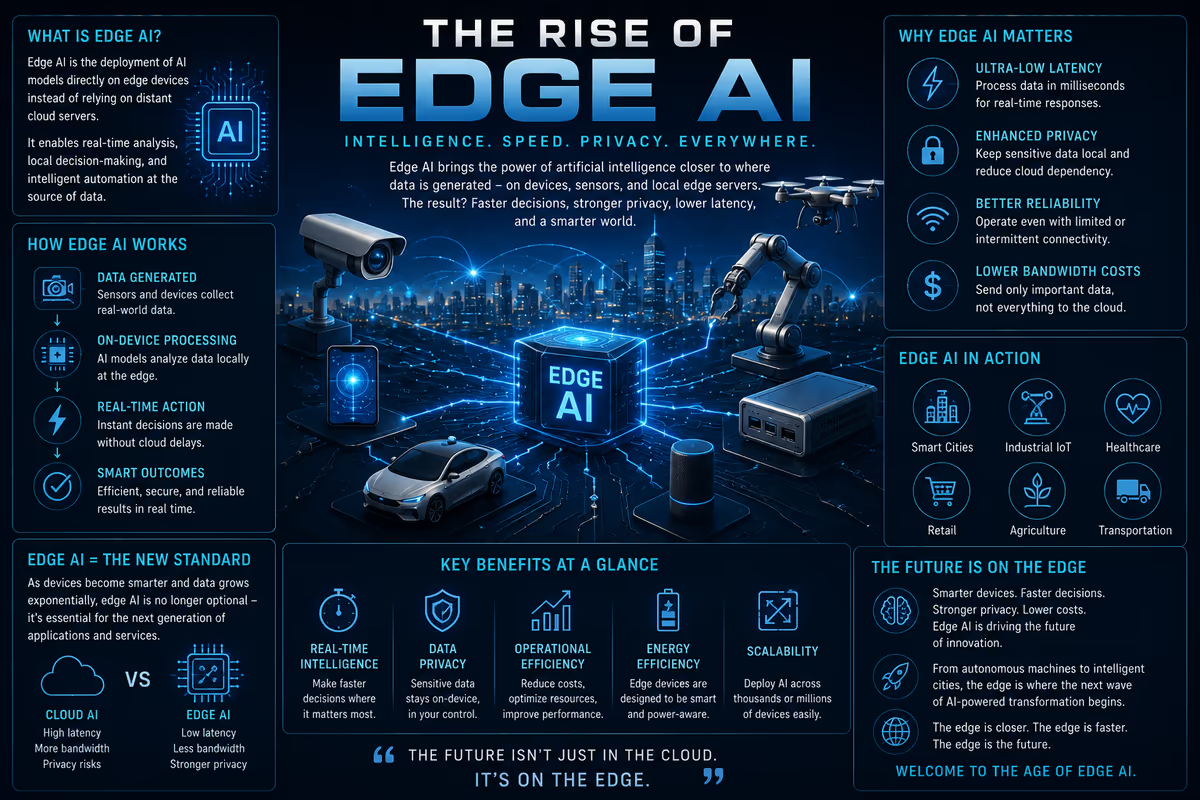
Artificial intelligence has traditionally depended on powerful cloud servers. Data is collected by a device, sent through the internet to a remote data center, processed by an AI model, and then returned to the device.
But a new approach is changing this architecture.
Edge AI brings artificial intelligence directly to the devices where data is generated.
Instead of sending every piece of information to the cloud, AI models can increasingly run on smartphones, cameras, vehicles, industrial machines, robots, drones, and other edge devices.
This shift could fundamentally change how intelligent systems operate.
What Is Edge AI?
Edge AI refers to running artificial intelligence models directly on or near the device that generates the data.
A traditional cloud-based system might work like this:
Device → Internet → Cloud AI → Internet → Device
An Edge AI system can instead process information locally:
Device → AI Processing → Immediate Action
The difference may seem simple, but it can have major consequences for speed, privacy, reliability, and infrastructure costs.
Why Is Edge AI Becoming Important?
The number of connected devices is growing rapidly.
Smartphones, cameras, vehicles, industrial sensors, robots, drones, medical devices, and household electronics can generate enormous quantities of data.
Sending all of this information to the cloud can create several problems.
It can require:
- More bandwidth
- Greater network infrastructure
- Higher cloud-processing costs
- Additional latency
- Continuous connectivity
Edge AI addresses some of these challenges by processing information closer to its source.
Faster Decisions
One of the biggest advantages of Edge AI is speed.
When an AI model runs locally, the device does not always need to send information to a remote server and wait for a response.
This can be particularly important for applications where milliseconds matter.
Consider an autonomous vehicle.
The system may need to recognize an obstacle immediately.
Waiting for information to travel to a distant server and return would introduce unnecessary delay.
Local AI can analyze sensor information directly inside the vehicle.
Edge AI and Privacy
Another major advantage is data privacy.
Sensitive information does not always need to leave the device.
For example, a smartphone could process certain voice commands locally instead of sending every recording to a remote server.
Similarly, a security camera could analyze video on the device and transmit only relevant events.
This can reduce the amount of raw personal information traveling across networks.
However, local processing does not automatically guarantee privacy. Devices still need strong security, encryption, responsible data handling, and careful software design.
Edge AI in Smartphones
Modern smartphones contain increasingly powerful processors capable of running AI models locally.
This allows devices to perform tasks such as:
- Image enhancement
- Speech recognition
- Translation
- Object recognition
- Generative AI features
- Personalized recommendations
As mobile processors become more capable, more AI workloads can move from the cloud directly onto the phone.
This could make AI features faster and potentially more private.
Edge AI in Autonomous Vehicles
Autonomous vehicles are one of the clearest examples of why edge computing matters.
A vehicle continuously processes information from cameras, radar, lidar, GPS, and other sensors.
The vehicle needs to understand its surroundings and respond rapidly.
Edge AI can process this information directly inside the vehicle.
The cloud can still provide useful services such as map updates, fleet analysis, and software updates, but immediate driving decisions can remain local.
Smart Cities
Edge AI could also transform cities.
Imagine thousands of intelligent devices monitoring traffic, infrastructure, energy usage, and public systems.
Instead of sending every camera frame and sensor measurement to a centralized cloud system, local AI could analyze information near the source.
For example, an intelligent traffic system could detect congestion and adjust traffic signals in real time.
This could reduce network traffic while improving response times.
Industrial Edge AI
Factories are becoming increasingly automated.
Machines can use sensors to monitor temperature, vibration, pressure, movement, and other parameters.
Edge AI can analyze this information directly on industrial equipment.
One important application is predictive maintenance.
An AI system could identify unusual machine behavior and warn operators before a failure occurs.
Instead of discovering a problem after a machine breaks, manufacturers could potentially identify warning signs earlier.
Edge AI and Robotics
Robots need to understand their environments.
A warehouse robot, for example, may need to identify objects, avoid obstacles, navigate around people, and make decisions continuously.
Running these functions locally can reduce dependence on a constant internet connection.
This is particularly important for robots operating in environments where connectivity may be unreliable.
The future of robotics will likely combine local AI processing with cloud-based intelligence.
Drones
Drones are another natural application for Edge AI.
A drone can use onboard AI to recognize objects, analyze terrain, detect obstacles, and make decisions during flight.
This reduces the need to continuously transmit large amounts of video to a remote server.
It can also make autonomous operation more practical in environments where network connectivity is limited.
Healthcare
Edge AI could have important applications in healthcare devices.
Medical equipment can generate sensitive information that may benefit from local processing.
An intelligent device could analyze certain signals locally and identify potential patterns that require attention.
Local processing can reduce latency and potentially limit unnecessary transmission of sensitive information.
However, medical AI requires particularly strong validation, security, and regulatory oversight.
AI should support healthcare professionals rather than replace clinical judgment.
Edge AI vs Cloud AI
Edge AI and cloud AI should not necessarily be viewed as competitors.
They are often complementary.
Cloud AI
Cloud systems are ideal for:
- Large models
- Massive datasets
- Complex training
- Centralized analysis
- Large-scale computing
Edge AI
Edge systems are ideal for:
- Low latency
- Local decision-making
- Limited connectivity
- Privacy-sensitive processing
- Real-time applications
The future may therefore involve a hybrid architecture.
Edge handles immediate decisions.
Cloud handles large-scale intelligence.
The Role of Specialized AI Chips
The growth of Edge AI depends heavily on hardware.
Traditional CPUs are not always optimized for modern AI workloads.
New processors increasingly include specialized AI accelerators designed to perform neural-network operations efficiently.
These technologies can provide more AI performance while consuming relatively little power.
This is particularly important for battery-powered devices such as smartphones, wearables, drones, and robots.
Energy Efficiency
Running AI locally requires electricity.
For small devices, energy efficiency is therefore extremely important.
Future Edge AI processors will need to deliver more intelligence while consuming less power.
This is driving research into:
- Neural processing units
- Model compression
- Quantization
- Efficient architectures
Specialized accelerators
The goal is simple:
More intelligence per watt.
AI Models Are Getting Smaller
Historically, powerful AI models often required large cloud servers.
But researchers are developing increasingly efficient models that can run on smaller devices.
Techniques such as model compression and quantization can reduce computational and memory requirements.
This makes it possible to deploy useful AI capabilities on hardware that would previously have been considered too limited.
Edge AI and the Internet of Things
The Internet of Things connects enormous numbers of physical devices to networks.
Edge AI could turn these connected devices into intelligent systems.
Instead of simply collecting data, sensors could interpret information locally.
A sensor could detect an abnormal condition.
A camera could identify an event.
A machine could recognize a developing problem.
A device could make a decision without waiting for a remote server.
This transforms the Internet of Things into something closer to an intelligent physical infrastructure.
Challenges of Edge AI
Edge AI is powerful, but it also introduces challenges.
Devices have limited computing resources compared with large data centers.
AI models must often be optimized for specific hardware.
Security is another major concern because edge devices can physically exist in environments where attackers may gain access to them.
Software updates and model management can also become complicated when thousands or millions of devices are deployed.
The technology therefore requires strong hardware security, efficient software, and reliable update systems.
The Future of Edge AI
As AI becomes increasingly integrated into physical devices, Edge AI could become almost invisible.
People may not think about whether an AI model is running locally or in the cloud.
They will simply expect devices to understand their environment and respond instantly.
A future home could contain intelligent appliances.
Cars could continuously analyze their surroundings.
Robots could operate autonomously.
Smart glasses could understand what users see.
Factories could detect problems before equipment fails.
All of these systems could rely on AI operating directly at the edge.
Edge AI and the Future of Computing
For decades, computing has moved between centralized and decentralized architectures.
The cloud centralized enormous amounts of processing power.
Edge AI is bringing some of that intelligence back to the devices themselves.
The result could be a hybrid world where intelligence exists everywhere:
Cloud AI → Large-scale intelligence
Edge AI → Local intelligence
Humanoid robots → Physical intelligence
Smart devices → Embedded intelligence
These systems could work together to create a much more responsive digital environment.
Final Thoughts
Edge AI represents an important evolution in artificial intelligence.
Instead of sending every piece of information to a distant data center, devices can increasingly process data themselves.
This can provide faster decisions, reduced latency, improved privacy, lower bandwidth requirements, and greater independence from the internet.
From smartphones and autonomous vehicles to drones, robots, factories, healthcare devices, and smart cities, Edge AI could become a fundamental layer of future technology.
The cloud will remain essential.
But intelligence will no longer live only in the cloud.
The future of AI is not just centralized in massive data centers.
It is moving closer to us—into the devices, machines, vehicles, and robots that surround us every day.