
Future & Research
The Rise of Autonomous Vehicles: How Self-Driving Technology Is Changing Transportation
CipherRoot Software16 min read
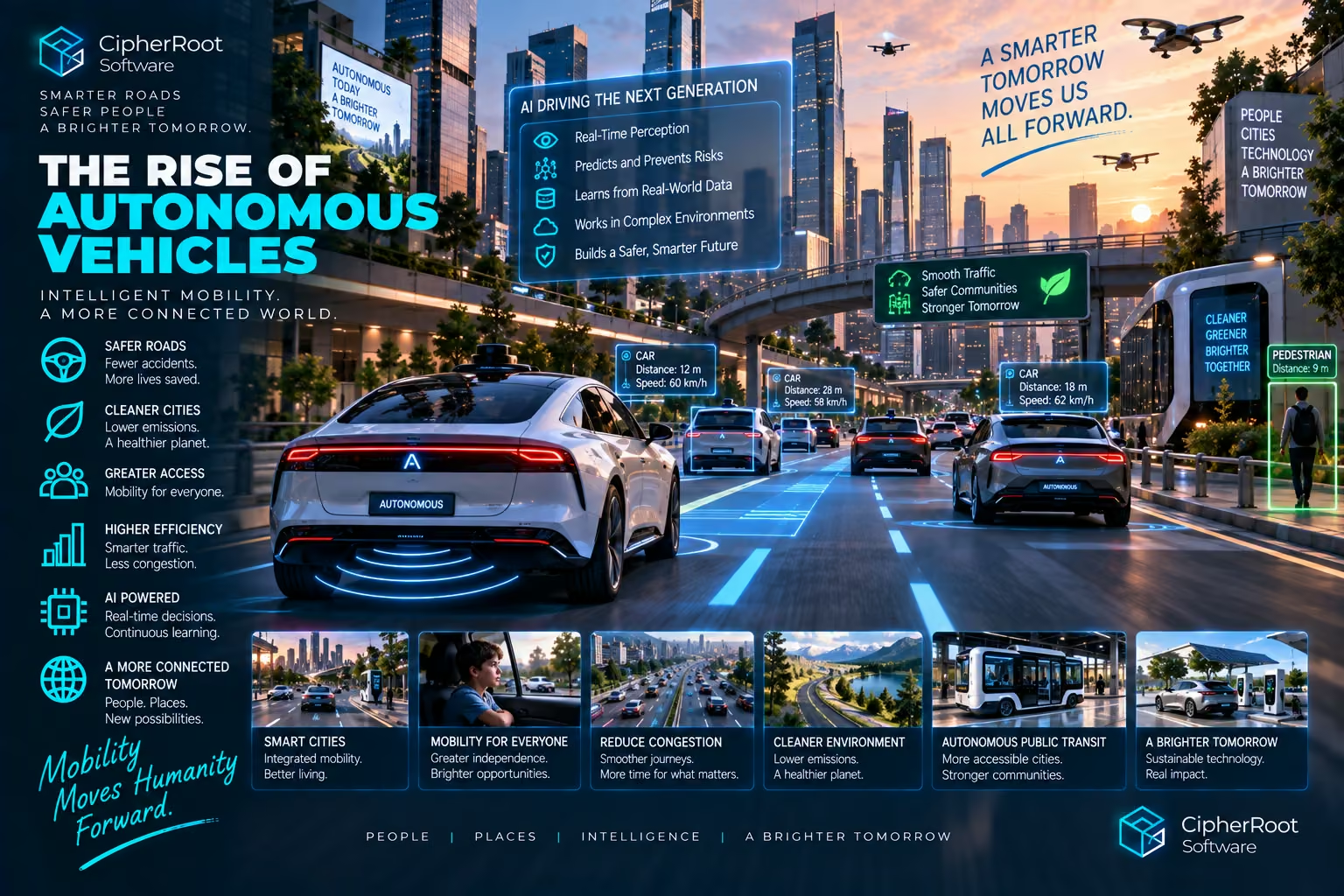
Transportation Is Entering a New Era
For more than a century, transportation has depended on one central element:
The human driver.
People control cars, trucks, buses, taxis, and other vehicles.
But this model is beginning to change.
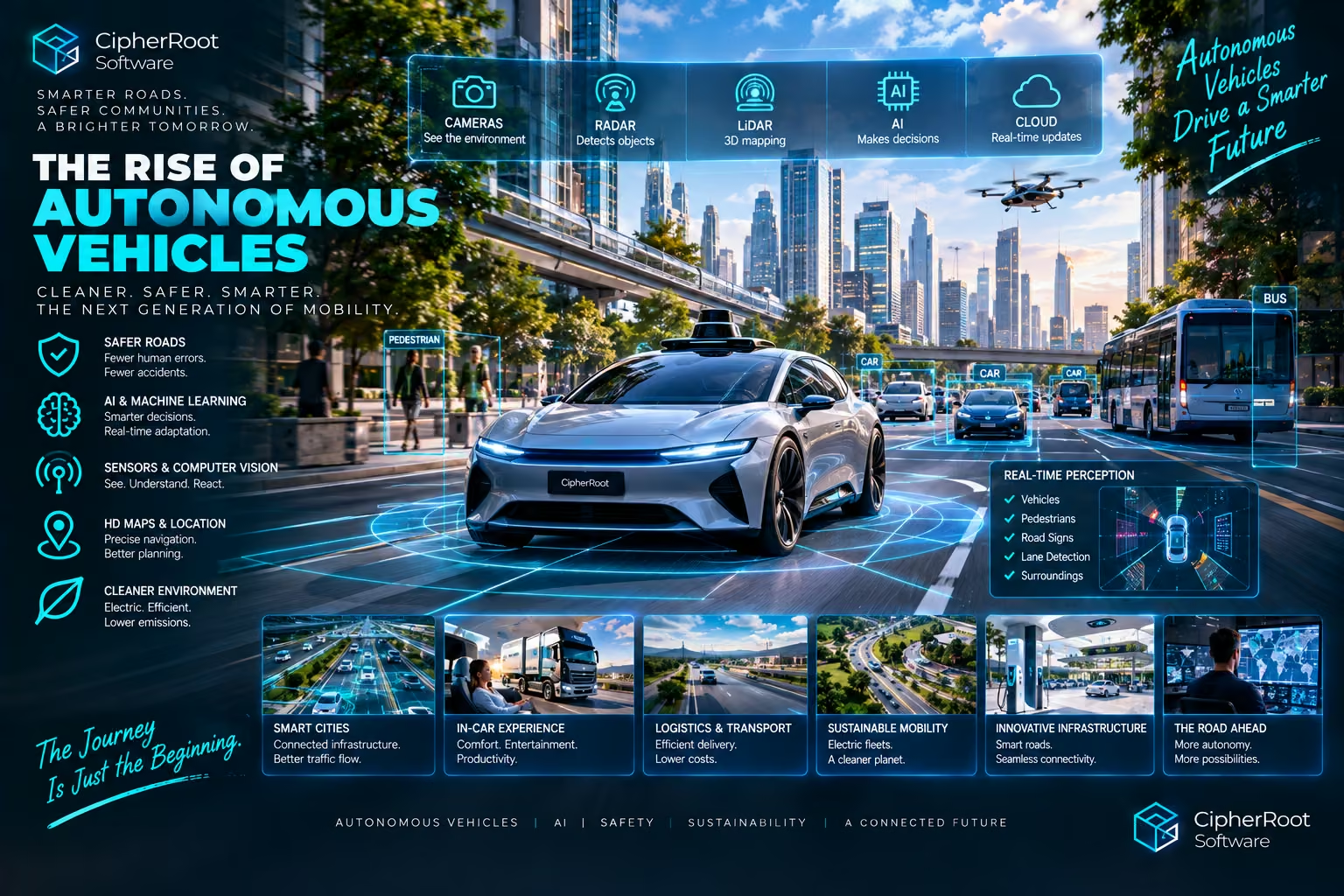
Artificial intelligence, computer vision, radar, LiDAR, high-definition maps, powerful processors, and connected infrastructure are enabling vehicles to understand their surroundings and perform increasingly advanced driving tasks.
This is the foundation of autonomous driving.
The long-term vision is a transportation system in which vehicles can perceive roads, understand traffic, plan routes, and make driving decisions with progressively less human intervention.
The transformation is not simply about cars driving themselves.
It is about building a new form of intelligent mobility.
What Are Autonomous Vehicles?
Autonomous vehicles are vehicles that can perform some or all driving functions using automated systems.
The technology can support tasks such as:
- Steering
- Acceleration
- Braking
- Lane positioning
- Parking
- Navigation
- Obstacle detection
- Traffic monitoring
Different systems provide different levels of automation.
Some technologies assist a human driver.
More advanced systems are designed to perform larger portions of the driving task under specific conditions.
This distinction is important because autonomous driving is not one single technology.
It is a spectrum of capabilities.
Artificial Intelligence Is the Core
An autonomous vehicle needs to understand a constantly changing environment.
Artificial intelligence helps process information from multiple sensors and determine what the vehicle should do.
The system may need to recognize:
Roads
Vehicles
Pedestrians
Bicycles
Traffic lights
Road signs
Lane markings
Construction areas
Obstacles
The vehicle then needs to predict how these elements may move and decide how to respond.
This creates a continuous loop:
Perceive → Understand → Predict → Plan → Act
The process happens repeatedly while the vehicle is moving.
Cameras Give Vehicles Vision
Cameras are among the most important sensors in autonomous driving systems.
They can capture visual information about the road and surrounding environment.
Computer vision can use camera data to identify:
- Traffic signs
- Lane markings
- Vehicles
- Pedestrians
- Cyclists
- Traffic signals
- Road conditions
Multiple cameras can provide different viewing angles.
AI can then combine this information into a more complete interpretation of the environment.
In many ways, cameras give the vehicle something similar to visual perception.
But a camera alone is not enough.
Radar Helps Measure Distance and Motion
Radar systems can detect objects and estimate their distance and relative movement.
This can be useful when visibility is poor or when precise distance information is needed.
Radar can complement camera systems by providing additional information about surrounding objects.
The combination of different sensors creates a stronger perception system than relying on only one source of information.
LiDAR and 3D Perception
LiDAR uses laser pulses to measure distances and construct detailed representations of the surrounding environment.
It can provide three-dimensional information about:
- Vehicles
- Buildings
- Roads
- Pedestrians
- Obstacles
This can help an autonomous vehicle understand the geometry of its surroundings.
LiDAR is one of several technologies being considered for advanced perception systems, and different vehicle architectures may use different combinations of sensors.
Sensor Fusion
No sensor is perfect.
Cameras can be affected by lighting.
Radar provides different types of information.
LiDAR can contribute detailed depth information.
GPS can lose accuracy.
This is why autonomous vehicles can use sensor fusion.
Sensor fusion combines information from different systems to create a more reliable estimate of the environment.
The vehicle does not simply ask:
“What does the camera see?”
It asks:
“What do all available sensors indicate is happening?”
This is a much more powerful approach.
Understanding the Road
Recognizing objects is only the beginning.
A vehicle must also understand the road environment.
For example:
A pedestrian may be standing near a crosswalk.
A vehicle may be approaching an intersection.
A traffic light may be changing.
A parked car may suddenly begin moving.
A road lane may disappear because of construction.
The vehicle needs to interpret relationships between these events.
This is where AI-based scene understanding becomes critical.
Predicting What Happens Next
Driving is partly a prediction problem.
A vehicle does not only react to what is happening now.
It must estimate what other road users may do next.
Will the pedestrian cross?
Will the cyclist continue straight?
Will the car merge?
Will another driver stop?
These predictions are uncertain.
An autonomous driving system therefore needs to account for multiple possible outcomes.
The goal is not perfect prediction.
It is safe decision-making under uncertainty.
Planning the Driving Path
Once the vehicle understands the environment, it needs to determine how to move.
A route planner can consider:
- Traffic
- Road geometry
- Speed limits
- Obstacles
- Other vehicles
- Pedestrians
- Destination
- Vehicle capabilities
The system then generates a path.
But the best path is not necessarily the shortest.
It should also satisfy safety and operational constraints.
This makes autonomous driving a continuous optimization problem.
Real-Time Decision Making
A self-driving system needs to make decisions quickly.
The environment can change in fractions of a second.
A nearby vehicle may brake.
A pedestrian may step into the road.
A lane may become blocked.
The system needs to process new information continuously and update its plan.
This is why computing performance is critical.
The vehicle is effectively running a complex AI system in real time.
High-Definition Maps
Maps are another important component.
Traditional navigation maps primarily help vehicles understand where roads are.
Autonomous systems may require much more detailed information about road geometry and infrastructure.
High-definition maps can potentially contain information about:
- Lane boundaries
- Intersections
- Traffic signals
- Road geometry
- Curbs
- Road markings
However, maps can become outdated.
Construction and road changes happen constantly.
Future systems therefore need to combine map information with real-time perception.
Autonomous Vehicles and GPS
Positioning systems help vehicles determine where they are.
But GPS alone is often not accurate enough for all autonomous-driving situations.
Vehicles can combine positioning with:
- Inertial sensors
- Cameras
- Maps
- LiDAR
- Other localization technologies
This creates a more robust understanding of location.
The vehicle must know not only:
“Which street am I on?”
but potentially:
“Exactly where am I within the road environment?”
Autonomous Parking
Parking is one of the earliest areas where automation has become practical.
Systems can help vehicles:
- Detect parking spaces
- Steer automatically
- Reverse into spaces
- Monitor nearby obstacles
More advanced systems can potentially handle parking without continuous driver input under defined conditions.
Parking is a useful example of how automation can begin with a narrow task before expanding into more complex environments.
Autonomous Public Transportation
Autonomous technology is not limited to private cars.
It can also be applied to:
- Buses
- Shuttles
- Campus transportation
- Industrial transport
- Airport mobility
These environments can sometimes be easier to control because routes are limited or operating conditions are more structured.
Autonomous public transportation could eventually become part of smart-city systems.
Autonomous Trucks
Long-distance trucking is another major area of interest.
A large portion of logistics depends on trucks moving goods between warehouses, distribution centers, ports, and businesses.
Autonomous systems could potentially automate selected parts of long-haul transportation.
For example, highways may offer more predictable conditions than dense city streets.
The long-term logistics model could combine autonomous driving with human-operated vehicles for more complex environments.
Autonomous Delivery Vehicles
Smaller autonomous vehicles can also support local delivery.
These systems may transport:
- Food
- Groceries
- Packages
- Supplies
A delivery platform can coordinate routes and assign vehicles according to location and availability.
This connects autonomous driving with the broader rise of delivery robots and intelligent logistics.
Connected Vehicles
Autonomous vehicles become even more interesting when they are connected.
Vehicles can exchange information with:
- Cloud systems
- Traffic infrastructure
- Navigation platforms
- Fleet-management systems
- Charging networks
This creates a connected transportation ecosystem.
A vehicle does not need to rely entirely on its own sensors.
It can also receive information from the wider digital environment.
Vehicle-to-Everything Communication
Connected mobility can involve communication between vehicles and infrastructure.
This concept is often described as V2X, or vehicle-to-everything communication.
Potential connections include:
Vehicle → Vehicle
Vehicle → Infrastructure
Vehicle → Network
Vehicle → Pedestrian-related systems
This can provide additional context for traffic coordination and road awareness.
Connectivity does not replace onboard perception.
It adds another information layer.
Smart Cities and Autonomous Vehicles
Autonomous transportation could become closely connected with smart-city infrastructure.
Traffic lights can be coordinated.
Road sensors can provide information.
Parking systems can communicate with vehicles.
Charging stations can share availability.
Public transportation can be synchronized.
The city becomes part of the vehicle's digital environment.
This creates a broader vision:
Smart roads + connected vehicles + AI + intelligent infrastructure
Autonomous Vehicles and Traffic Efficiency
One possible benefit of connected autonomous transportation is more coordinated traffic movement.
If vehicles communicate effectively and respond to traffic conditions intelligently, they may be able to reduce unnecessary acceleration, braking, or route inefficiencies.
However, the real effect depends on many factors:
- Vehicle adoption
- Traffic demand
- Road design
- Infrastructure
- Routing behavior
- Human-driven traffic
Autonomous vehicles do not automatically eliminate congestion.
They become part of a larger traffic system.
Electric Autonomous Vehicles
Autonomous driving is also closely connected to electric mobility.
Electric vehicles provide digital control over many vehicle functions and can be integrated with software-driven systems.
An autonomous electric vehicle can combine:
AI
Sensors
Software
Battery systems
Connected infrastructure
This creates a highly digital transportation platform.
The vehicle becomes both a mobility system and a computing platform.
Autonomous Charging
Electric vehicles may eventually combine autonomy with intelligent charging.
A vehicle could potentially:
Drive to a charging location.
Navigate into position.
Connect with charging equipment.
Return to service.
Fleet systems could coordinate charging according to demand and vehicle availability.
For autonomous commercial fleets, this type of automation could become increasingly useful.
Accessibility and Mobility
Autonomous transportation could potentially provide new mobility options for people who cannot drive independently.
The technology could support greater access to:
- Work
- Education
- Healthcare
- Shopping
- Social activities
However, accessibility depends on vehicle design, infrastructure, cost, and availability.
Autonomy is only one part of the mobility equation.
Autonomous Vehicles and Safety
Safety is one of the most important areas in autonomous driving.
The system must behave safely when:
- Sensors disagree
- Visibility is poor
- Another driver behaves unpredictably
- The road changes
- A technical component fails
- Connectivity disappears
A robust autonomous vehicle should have fallback behavior.
The system should be able to enter a safer state when it cannot confidently continue.
Redundancy Matters
Critical autonomous systems need redundancy.
If one sensor fails, another may still provide information.
If one computing component becomes unavailable, another may take over certain tasks.
If connectivity is lost, onboard systems still need to maintain safe operation within their capabilities.
Redundancy is a fundamental part of safety engineering.
The goal is not to assume that everything will work perfectly.
It is to prepare for failure.
Cybersecurity
An autonomous vehicle is essentially a moving computer network.
It may contain:
- Cameras
- Sensors
- Communication systems
- Control software
- Cloud connections
- Mobile applications
This creates cybersecurity risks.
A compromised vehicle could potentially be affected at the software level and the physical level.
Security therefore needs to cover the entire system.
Strong authentication, encrypted communication, secure software updates, network isolation, and continuous monitoring are increasingly important.
Software Updates
Vehicles used to remain mostly unchanged after leaving the factory.
Modern connected vehicles can receive software updates throughout their operating life.
This can improve features, fix problems, and introduce new capabilities.
But it also creates new responsibilities.
Updates must be securely delivered.
Compatibility must be tested.
Critical systems need safeguards against corrupted or malicious software.
The vehicle becomes a long-term software platform.
Privacy in Autonomous Vehicles
Autonomous vehicles can collect large amounts of information.
Sensors can observe:
- Roads
- Pedestrians
- Vehicles
- Locations
- Routes
The vehicle may also generate information about the driver's activities or travel patterns.
This creates privacy concerns.
The data necessary for safe operation should be carefully distinguished from information collected for other purposes.
Users need clear explanations of how vehicle data is stored, processed, and shared.
The Role of Human Drivers
During the transition toward higher automation, humans remain central.
Many systems still require drivers to supervise or take control under certain conditions.
This creates an important challenge:
A human who has spent a long period relying on automation may need to respond immediately when manual control becomes necessary.
Human-machine interface design is therefore critical.
Drivers need clear information about:
What the vehicle is doing.
What the vehicle expects from the driver.
When the driver must intervene.
Human-Machine Collaboration
The future of transportation may not be human versus autonomous system.
It may be a collaboration.
The vehicle handles repetitive driving tasks.
The human supervises and manages the broader journey.
AI processes environmental information.
The human makes decisions when the situation falls outside the system's capabilities.
This hybrid approach can allow automation to increase gradually.
The Autonomous Vehicle as a Robot
A useful way to understand autonomous vehicles is as mobile robots.
They have:
Sensors
to perceive the environment.
AI models
to interpret information.
Planning systems
to decide what to do.
Actuators
to control the vehicle.
Communication systems
to connect with the outside world.
This places autonomous vehicles in the same technological family as delivery robots, drones, and other intelligent machines.
Digital Twins of Vehicles
Digital twins can also play a role in autonomous transportation.
A virtual representation of a vehicle can contain information about:
- Hardware
- Software
- Sensor performance
- Maintenance
- Energy usage
- Driving behavior
Engineers can use these digital models for testing and simulation.
This can help evaluate changes before deploying them to the physical fleet.
Simulation Is Essential
Autonomous systems need to encounter an enormous variety of situations.
It is impossible to physically test every scenario on public roads.
Simulation can help.
Engineers can create virtual environments containing:
- Different weather
- Traffic patterns
- Road layouts
- Pedestrians
- Unexpected obstacles
- Rare edge cases
The AI system can then be tested against these conditions.
Simulation does not replace real-world testing.
It provides another layer of validation.
Rare Events and Edge Cases
One of the hardest challenges in autonomous driving is the unusual situation.
A strange road layout.
An unexpected obstacle.
An unusual vehicle.
A complex construction area.
A rare combination of events.
These scenarios may occur infrequently, but they can be extremely important.
Autonomous systems need to be designed to handle uncertainty rather than only ideal situations.
The Future of Autonomous Fleets
The biggest transformation may occur not with individual cars, but with fleets.
Imagine a city containing thousands of autonomous vehicles.
An AI platform monitors:
- Vehicle locations
- Demand
- Battery levels
- Traffic
- Maintenance status
It can assign vehicles to tasks dynamically.
A vehicle with low battery returns for charging.
Another vehicle takes over a nearby trip.
A maintenance system identifies a potential issue.
The fleet operates as one coordinated system.
Autonomous Mobility as a Service
Instead of owning a vehicle, people could increasingly access mobility when they need it.
A user requests a ride.
A nearby autonomous vehicle arrives.
The passenger enters.
The vehicle reaches the destination.
The system then continues to another task.
This creates a model in which transportation behaves more like a digital service than a privately owned machine.
The Future City Could Be Designed Around Autonomous Mobility
If autonomous vehicles become widespread, cities may rethink transportation infrastructure.
Parking demand could change.
Pickup zones could become more important.
Road layouts could evolve.
Traffic signals could become more connected.
Public transportation could integrate with autonomous fleets.
Charging infrastructure could become more automated.
The physical city could gradually adapt to the digital transportation system.
Environmental Impact
Autonomous vehicles may contribute to efficiency in certain scenarios, particularly when combined with electric propulsion and coordinated routing.
However, the environmental impact is not automatic.
It depends on:
- Vehicle type
- Energy source
- Occupancy
- Fleet utilization
- Travel demand
- Manufacturing
- Infrastructure
A system that makes each individual trip easier could still increase total travel.
The environmental outcome depends on the entire mobility system.
The Road Ahead
Autonomous driving is developing through many overlapping technologies.
AI is improving perception and decision-making.
Sensors are becoming more capable.
Computing hardware is becoming more powerful.
Maps and localization are becoming more precise.
Connectivity is expanding.
Simulation is becoming more sophisticated.
Together, these technologies are creating a transportation system that can increasingly understand its environment.
What Will the Future Car Look Like?
The vehicle of the future may look familiar from the outside.
Four wheels.
Seats.
Windows.
Lights.
But inside, it could function very differently.
The cabin may become a workspace, entertainment environment, or relaxation space.
The vehicle may continuously communicate with infrastructure.
AI may manage many aspects of the journey.
The steering wheel itself may become less central in some highly automated designs.
The car changes from a machine that you operate into a digital mobility platform.
A Day in Autonomous Transportation
Imagine leaving home.
Your vehicle already knows the destination.
It checks traffic and chooses a route.
Sensors monitor surrounding vehicles.
The system adjusts speed continuously.
You work during the journey.
The vehicle reaches the destination.
Later, it picks up another passenger or returns to a charging station.
A fleet-management system coordinates the entire process.
The vehicle is no longer simply transportation.
It is part of a larger intelligent network.
Conclusion
The rise of autonomous vehicles represents one of the largest potential transformations in transportation.
Artificial intelligence gives vehicles the ability to interpret complex environments.
Cameras, radar, LiDAR, and other sensors provide information.
Software plans routes and predicts movement.
Connectivity connects vehicles to infrastructure.
Digital twins and simulation help engineers test increasingly complex systems.
But autonomous transportation is not just a technology problem.
Safety, cybersecurity, privacy, infrastructure, regulation, accessibility, and human-machine interaction all matter.
The future will likely develop gradually.
Different levels of automation will coexist.
Some vehicles will remain human-driven.
Others will provide advanced assistance.
More autonomous systems will operate in specific environments and use cases.
Eventually, highly automated fleets may become part of everyday transportation in places where the technology and infrastructure support them.
The key transformation is broader than the phrase self-driving car suggests.
It is the creation of a transportation ecosystem in which vehicles can:
See
Understand
Predict
Plan
Communicate
Act
And increasingly, they can do these things as part of a connected system.
The road of the future may not simply belong to drivers.
It may belong to people, AI, robots, and intelligent infrastructure working together.
Smarter roads. Intelligent vehicles. A new era of mobility.