
Future & Research
The Future of Virtual Reality: How VR Will Transform the Way We Experience the World
CipherRoot Software6 min read
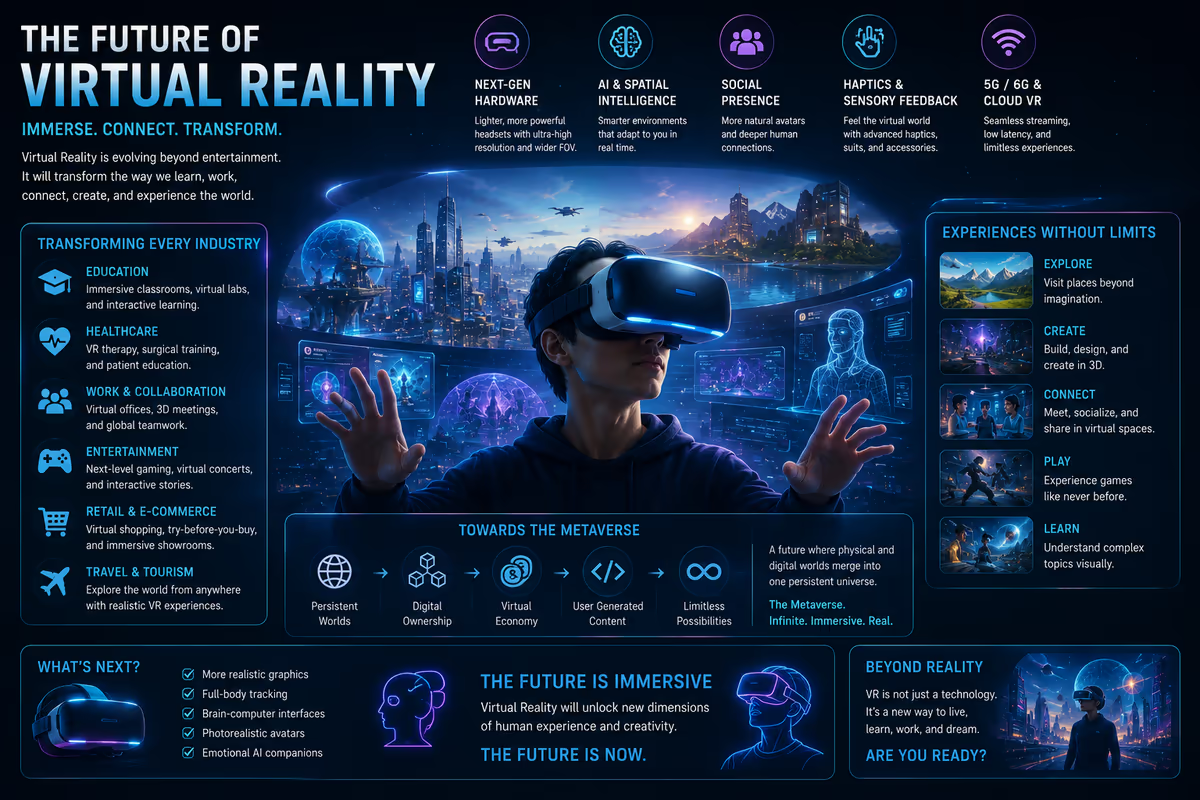
Virtual reality has evolved from an experimental technology into a rapidly growing digital platform. Modern VR headsets can place users inside interactive environments where they can explore, communicate, create, learn, and work.
But today's virtual reality is only the beginning.
As hardware becomes lighter, graphics become more realistic, artificial intelligence becomes more capable, and high-speed networks become more accessible, VR could fundamentally change how humans interact with digital environments.
The future of VR may not simply be about playing games.
It could become a new way to learn, work, communicate, create, and experience the world.
What Is Virtual Reality?
Virtual reality is a technology that creates an immersive digital environment around the user.
Unlike a traditional computer screen, VR surrounds the user's field of view and tracks movements so that digital environments respond to physical actions.
A VR system typically combines:
- Head-mounted displays
- Motion tracking
- Spatial audio
- Hand or controller tracking
- 3D graphics
- Real-time rendering
Together, these technologies create the feeling of being inside a digital environment rather than simply looking at one.
The Next Generation of VR Headsets
One of the biggest limitations of current VR systems is hardware.
Headsets can be heavy, expensive, and uncomfortable during long sessions.
Future devices are expected to become:
- Smaller
- Lighter
- More powerful
- More energy efficient
- Higher resolution
- Wider field of view
- More comfortable
Advances in display technology could eventually make virtual environments look significantly more realistic.
The boundary between a digital image and the physical world could become increasingly difficult to distinguish.
Artificial Intelligence and VR
Artificial intelligence could become one of the most important technologies powering future virtual reality.
AI can generate environments, characters, objects, dialogue, and interactive experiences.
Imagine entering a virtual world and simply saying:
"Create a futuristic city surrounded by mountains."
Instead of downloading a predefined environment, an AI system could generate the experience dynamically.
AI could also create intelligent virtual characters capable of holding natural conversations and responding to users in real time.
This could make VR environments feel much more alive.
More Natural Interaction
Today's VR systems commonly use controllers.
Future systems could rely much more heavily on natural interaction.
Hand tracking, eye tracking, voice recognition, body tracking, and potentially brain-computer interfaces could allow users to interact with virtual environments without traditional controllers.
You could look at an object, reach toward it, and interact naturally.
The interface would become almost invisible.
Haptic Feedback
Seeing and hearing a virtual object is only part of immersion.
The next major development is the ability to feel virtual environments.
Advanced haptic controllers, gloves, suits, and other wearable devices could provide physical feedback.
Users might feel:
- The texture of an object
- The impact of an interaction
- Resistance when touching something
- Environmental vibrations
- Physical movement
Although convincing full-body haptics remain technically difficult, progress could make virtual experiences significantly more immersive.
VR in Education
Education could become one of the most valuable applications of virtual reality.
Instead of reading about ancient civilizations, students could walk through reconstructed historical cities.
Instead of studying the human heart from a textbook, medical students could explore a detailed three-dimensional model.
Students could travel through space, examine microscopic structures, or perform simulated experiments.
VR can transform learning from something primarily visual and theoretical into something interactive.
Virtual Healthcare
Virtual reality is already being investigated and used in various healthcare contexts.
Future VR systems could support medical training, rehabilitation, therapy, patient education, and other healthcare applications.
Medical students could practice procedures in simulated environments without putting real patients at risk.
Patients could also use carefully designed virtual experiences as part of certain therapeutic or rehabilitation programs under professional guidance.
The Future of Work
Remote work could evolve beyond video calls.
Instead of seeing colleagues as small rectangles on a screen, workers could meet inside shared three-dimensional environments.
Virtual offices could provide:
- 3D meeting rooms
- Interactive presentations
- Virtual whiteboards
- Shared models
- Collaborative workspaces
Employees from different countries could interact inside the same virtual environment.
The office could become a digital space rather than a physical building.
Social VR
Human beings are naturally social.
Future VR platforms could create much stronger feelings of presence than traditional social media.
Users could meet as realistic avatars, attend virtual events, explore environments together, or simply spend time with friends.
AI-generated characters could also become part of these environments, creating new forms of digital interaction.
However, maintaining healthy boundaries between virtual and real-world experiences will remain important.
VR and Gaming
Gaming will almost certainly remain one of VR's biggest markets.
Future games could combine:
- Photorealistic environments
- AI-generated worlds
- Full-body tracking
- Advanced haptics
- Intelligent NPCs
- Realistic physics
- Shared virtual environments
Instead of controlling a character from outside the world, players could increasingly feel like they are physically inside the game.
Cloud VR and High-Speed Networks
High-quality VR requires enormous amounts of computing power.
Future cloud technologies could allow some of this processing to happen remotely rather than entirely inside the headset.
High-speed networks could stream complex virtual environments to lightweight devices.
This could eventually reduce the need for extremely powerful hardware on the user's head.
The combination of AI + cloud computing + high-speed networks + VR could create highly scalable virtual environments.
The Metaverse
The concept of the metaverse has attracted enormous attention, although the idea is still evolving.
A mature metaverse could potentially consist of persistent digital environments where people can work, socialize, create, play, and own digital assets.
However, building such a system requires more than VR hardware.
It also requires:
- Interoperability
- Digital identity
- Secure payments
- Persistent environments
- User-generated content
- Strong privacy protections
Whether one unified metaverse emerges or many interconnected virtual worlds develop remains uncertain.
The Challenges of Virtual Reality
VR still has significant limitations.
Hardware cost remains a barrier.
Some users experience motion sickness or discomfort.
Long sessions can cause fatigue.
Privacy is another important issue because VR systems can potentially collect detailed information about movement, gaze, voice, and behavior.
As VR becomes more immersive, protecting this information will become increasingly important.
What Could VR Look Like in 2035?
By the mid-2030s, VR could be significantly different from today's technology.
Headsets may become smaller and lighter.
AI could generate environments in real time.
Avatars could become much more realistic.
Hand and eye tracking could become standard.
Haptic technology could provide increasingly convincing physical feedback.
Brain-computer interfaces could potentially provide additional interaction methods.
Virtual spaces could become a normal part of education, entertainment, professional collaboration, and social communication.
Beyond Reality
Virtual reality is no longer simply about escaping the real world.
Its most interesting future may be about expanding what humans can experience.
A student could explore another planet.
An engineer could walk through a machine before it is built.
A doctor could practice a complex procedure in simulation.
Friends thousands of kilometers apart could meet inside the same virtual environment.
A creator could build entire worlds without needing physical materials.
The possibilities are enormous.
Final Thoughts
Virtual reality is evolving from a gaming technology into a broader computing platform.
The combination of artificial intelligence, advanced displays, haptic feedback, spatial computing, cloud technology, and potentially brain-computer interfaces could create experiences that feel dramatically more natural and immersive.
The biggest transformation may not be the headset itself.
It may be the disappearance of the traditional screen as the primary way humans interact with digital information.
Instead of looking at a digital world through a screen, we may eventually step inside it.
The future of computing may not be something we look at.
It may be somewhere we enter.