
Future & Research
The Future of Space Colonies: Humanity Beyond Earth
CipherRoot Software8 min read
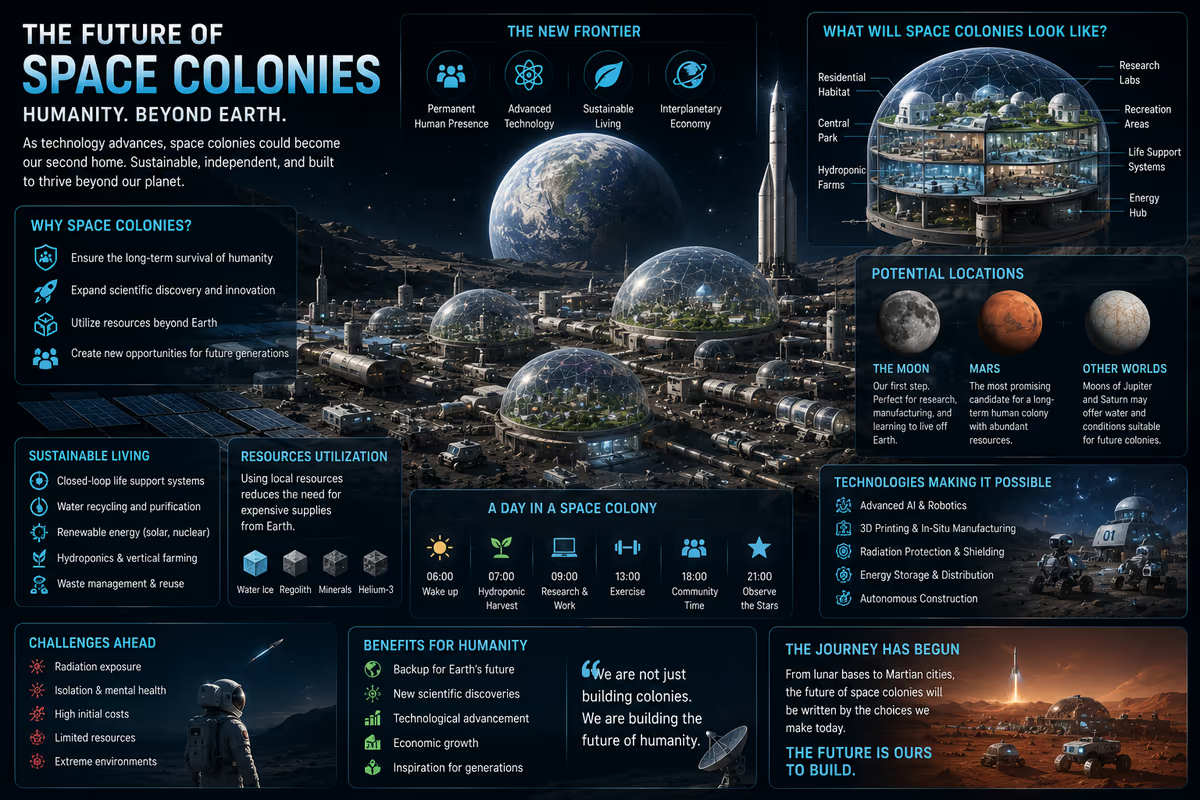
For most of human history, Earth was the only home we knew.
Today, that is beginning to change. Advances in reusable rockets, robotics, artificial intelligence, life-support systems, autonomous construction, and space exploration are bringing humanity closer to a future in which permanent settlements beyond Earth could become possible.
A space colony is more than a temporary research station. It would need to provide people with shelter, energy, food, water, healthcare, communication, and protection from an extremely hostile environment.
The question is no longer simply "Can humans go to space?"
The much bigger question is:
"Can humans learn to live there?"
What Is a Space Colony?
A space colony is a permanent or semi-permanent human settlement located beyond Earth.
Future settlements could potentially be established on:
- The Moon
- Mars
- Asteroids
- Orbital habitats
- Other locations in the Solar System
The first settlements would likely depend heavily on supplies and technology from Earth.
Over time, however, the goal would be to produce more resources locally and become increasingly self-sufficient.
The Moon: Humanity's First Step
The Moon is the most obvious candidate for early permanent settlements because it is relatively close to Earth.
A lunar base could serve as a research facility, technological testing ground, and staging point for deeper exploration.
Future lunar settlements could include:
- Research laboratories
- Habitats
- Solar-energy systems
- Communication stations
- Robotic construction systems
- Resource-processing facilities
The Moon could become a laboratory for learning how to build and maintain human settlements away from Earth.
Mars: The Next Great Frontier
Mars is considerably more difficult to reach and survive on than the Moon, but it offers something particularly important: a planetary environment with a day length relatively similar to Earth's and resources that could potentially support long-term human activity.
A future Martian settlement might contain pressurized habitats, laboratories, greenhouses, energy systems, workshops, and underground structures.
Robots would likely play a major role before humans arrive.
They could prepare landing areas, transport equipment, construct basic infrastructure, and investigate local resources.
Living Under a Dome
The futuristic image of humans living under enormous glass domes is visually appealing, but real space habitats would require much more sophisticated protection.
Mars has a thin atmosphere and lacks Earth's natural level of protection from radiation.
Habitats could therefore require substantial shielding.
Possible solutions include:
- Covering structures with local soil
- Building underground
- Using specialized radiation-resistant materials
- Designing habitats with multiple protective layers
In other words, the future Martian city may look less like a glass metropolis and more like a carefully engineered underground or partially buried settlement.
Growing Food in Space
Food is one of the biggest challenges for a permanent colony.
Transporting every kilogram of food from Earth would be expensive and impractical for large populations.
Space colonies would therefore need some form of local food production.
Hydroponic and controlled-environment agriculture could allow plants to grow with carefully managed amounts of water, nutrients, light, and energy.
Future colonies could potentially use vertical farming systems to maximize production while minimizing space.
A successful settlement would need to turn agriculture into part of its life-support system.
Water Is Everything
Water is essential for life, agriculture, industrial processes, and potentially the production of rocket propellant.
This makes local water resources extremely valuable.
Researchers are particularly interested in accessible water ice on the Moon and Mars.
A future settlement could process local ice into usable water and potentially separate it into hydrogen and oxygen for other applications.
The ability to use local resources rather than transporting everything from Earth is known as in-situ resource utilization, and it could be fundamental to sustainable space exploration.
Energy for a Space Colony
Every space settlement needs reliable energy.
Solar power is an obvious option, particularly in locations where sunlight is abundant.
Large solar arrays could provide electricity for habitats, laboratories, vehicles, communication systems, and industrial equipment.
Energy storage would also be critical because solar availability can vary depending on location and environmental conditions.
Future colonies could combine multiple energy sources and storage technologies to create more resilient power systems.
Robots Will Build Before Humans
One of the most important technologies for future colonies may be robotics.
Sending humans to construct every piece of infrastructure would be expensive and dangerous.
Instead, autonomous or remotely operated robots could arrive first.
They could potentially:
Survey the environment.
Identify useful resources.
Prepare construction areas.
Build initial structures.
Install solar panels.
Transport equipment.
Prepare habitats for human arrival.
This creates an important principle for future space exploration:
Robots may build the first homes before humans move in.
Artificial Intelligence in Space Colonies
AI could become the operational brain of a future settlement.
Communication delays make direct human control from Earth increasingly difficult as distance increases.
A Martian settlement, for example, cannot depend on Earth for every small decision.
AI systems could help manage:
- Energy distribution
- Environmental monitoring
- Robotics
- Agriculture
- Maintenance
- Navigation
- Resource management
- Emergency detection
Humans would remain responsible for major decisions, but intelligent automation could allow a colony to operate more independently.
3D Printing and Local Manufacturing
Transporting spare parts from Earth would be expensive.
For that reason, future colonies could rely heavily on advanced manufacturing and 3D printing.
Instead of sending thousands of different components, a settlement might produce certain tools, replacement parts, structures, and equipment locally.
Using local materials would make this even more powerful.
Over time, manufacturing could become one of the foundations of an independent space economy.
What Would Daily Life Look Like?
Life in a space colony would be very different from life on Earth.
A typical day could involve working inside pressurized habitats, maintaining equipment, monitoring crops, conducting research, exercising, communicating with Earth, and managing robotic systems.
Recreation would also be important.
A successful colony cannot be designed purely as a machine for survival.
People need communities, privacy, entertainment, social interaction, and a sense of belonging.
The psychological side of space colonization may be just as important as the engineering.
The Challenges Ahead
Building a permanent space colony will not be easy.
Major challenges include:
- Radiation exposure
- Extreme temperatures
- Limited resources
- Isolation
- Communication delays
- Medical emergencies
- Psychological health
- Equipment failures
- High transportation costs
- Dependence on complex technology
A colony would need redundancy.
If one critical system fails, another system must be available.
On Earth, a broken machine can sometimes be replaced within hours.
On Mars, the replacement may be millions of kilometers away.
From Base to City
The first settlement beyond Earth would probably be small.
Perhaps a few habitats.
Then additional laboratories.
Then farms, workshops, power systems, storage facilities, and transportation networks.
As the population grows, the settlement could become more complex.
Eventually, if technology and economics allow it, a research station could evolve into a genuine extraterrestrial community.
The transition might look something like:
Research outpost → permanent base → industrial settlement → growing community → space city
That process could take decades or much longer.
A Multi-Planetary Civilization?
The ultimate vision goes beyond individual colonies.
If humanity eventually establishes permanent communities on multiple worlds and in orbital habitats, civilization would no longer exist exclusively on Earth.
Earth could remain the cultural and population center while the Moon, Mars, and orbital settlements develop their own specialized roles.
Some locations could focus on science.
Others could specialize in manufacturing, mining, energy production, or exploration.
A network of settlements could eventually emerge across the Solar System.
The Economic Future of Space
Space colonization will also require an economic foundation.
Building settlements requires enormous amounts of equipment, energy, transportation, and infrastructure.
Commercial spaceflight, satellite services, resource utilization, manufacturing, scientific research, and other industries could help create the economic ecosystem necessary for long-term development.
A space economy may therefore develop gradually rather than appearing all at once.
Humanity's Long-Term Future
There is also a philosophical reason to think about space colonies.
Earth is our home, and protecting it must remain a priority.
Space colonization should not be treated as an excuse to neglect our planet.
Instead, becoming capable of living beyond Earth could represent another stage in human technological development.
It could expand scientific knowledge, create new opportunities, and provide future generations with possibilities that currently seem almost unimaginable.
Final Thoughts
The first space colonies will not look like the giant futuristic cities shown in science-fiction movies.
They will probably begin with small habitats, robotic construction systems, limited resources, and enormous engineering challenges.
But every civilization begins somewhere.
A lunar research base could become a permanent settlement.
A Martian outpost could become a village.
A village could eventually become a city.
And perhaps, many generations from now, those cities could become part of a civilization spread across multiple worlds.
The journey begins with technology, but it ultimately depends on something much older:
the human desire to explore beyond the horizon.
Earth is our beginning. It may not have to be our only home.