
Future & Research
The Future of Smart Homes: How AI Is Creating More Intelligent Living Spaces
CipherRoot Software11 min read
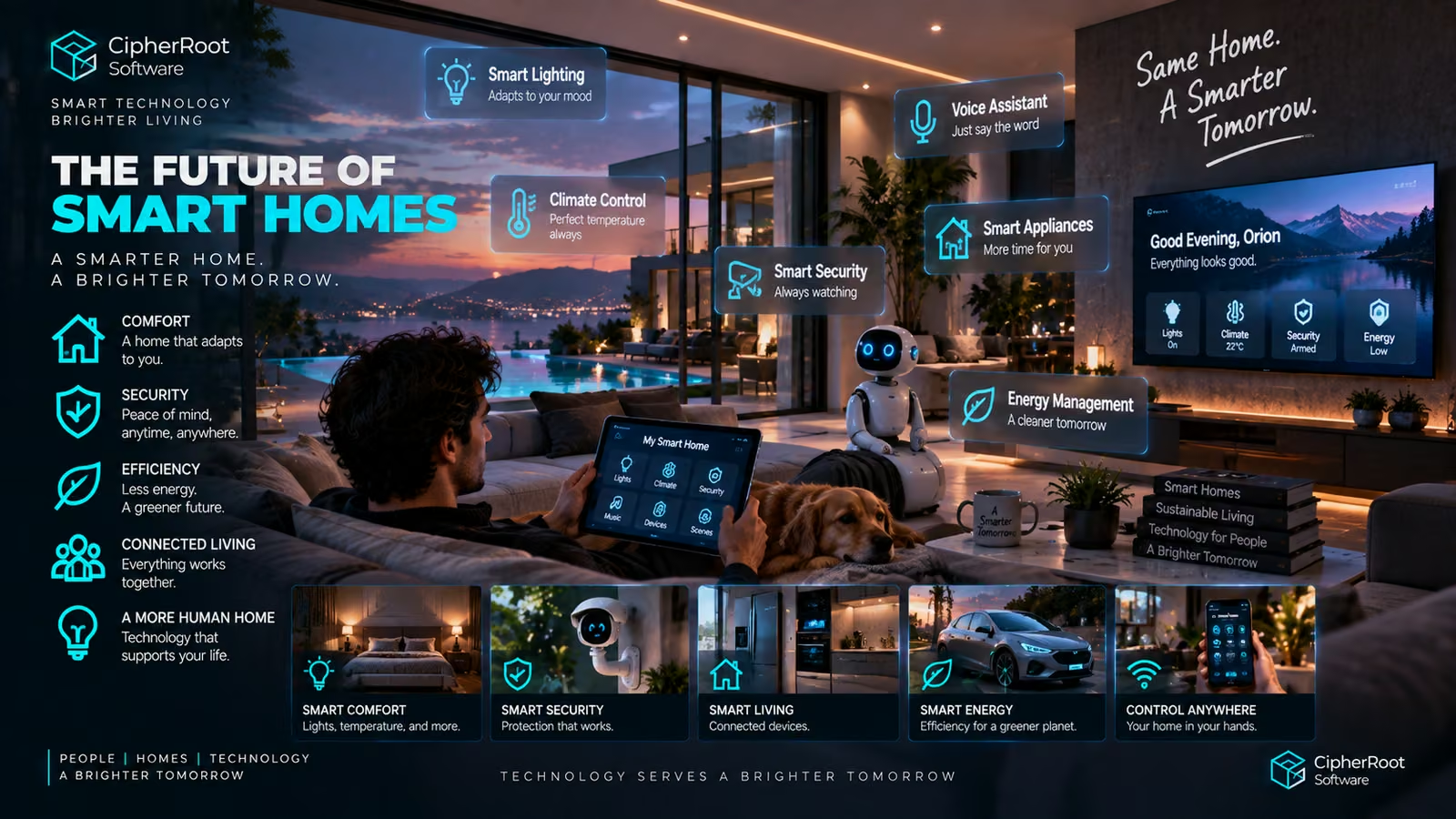
The Home Is Becoming Intelligent
A home used to be a place that simply provided shelter.
Then electricity changed the way homes worked.
Televisions, refrigerators, washing machines, security systems, and air conditioning introduced another generation of household technology.
The internet connected these devices.
Now artificial intelligence is beginning to connect them in a much more intelligent way.
The smart home of the future will not simply contain more connected devices.
It will be able to understand routines, respond to changing conditions, automate tasks, and coordinate the systems around us.
The house itself is becoming part of the computing environment.
What Is a Smart Home?
A smart home is a living environment containing connected devices and systems that can be monitored, controlled, or automated.
These may include:
Smart lighting Thermostats Security cameras Door locks Smart appliances Entertainment systems Energy-management devices Sensors Home assistants Robots
Traditional smart-home systems often require the user to control each device individually.
The next generation can move toward greater coordination.
Instead of saying:
“Turn off the lights.”
the user may simply leave the room.
The system can understand the context and decide what should happen automatically.
AI Is the Brain of the Smart Home
Artificial intelligence can transform a collection of connected devices into a more coordinated system.
AI can analyze information from sensors and connected devices to recognize patterns.
For example, a smart home may learn:
When residents usually wake up.
When they leave the house.
Which rooms they use most often.
How the temperature changes throughout the day.
How much electricity different appliances consume.
Which devices are normally active at specific times.
Over time, software can use these patterns to automate everyday routines.
The home becomes less dependent on manual commands.
Smart Lighting
Lighting is one of the simplest examples of home automation.
Traditional smart lighting allows users to turn lights on and off remotely.
More advanced systems can adjust lighting automatically according to time, occupancy, activity, or preferences.
A smart system could gradually reduce brightness in the evening.
It could turn lights on when someone enters a room.
It could coordinate lights with entertainment or work modes.
The technology becomes less about controlling individual bulbs and more about creating the right environment.
Intelligent Climate Control
Heating and cooling can represent a significant portion of a home's energy use.
Smart climate systems can combine sensors, schedules, and AI-based analysis to manage indoor temperatures more efficiently.
A future system could consider:
Indoor temperature Outdoor weather Occupancy Time of day User preferences Energy demand
Instead of maintaining the same temperature throughout the day, the system could adapt to how the home is actually being used.
The goal is not simply maximum automation.
It is comfortable automation with less unnecessary energy use.
Smart Security
Home security is another major area of development.
Connected cameras, motion sensors, door locks, and alarms can already communicate with mobile applications.
AI can add another layer of interpretation.
Computer-vision systems can potentially distinguish between different types of activity and reduce unnecessary alerts.
For example, a security system could differentiate between a person approaching the entrance and ordinary movement caused by environmental conditions.
More intelligent systems may also recognize unusual patterns across multiple sensors.
Security becomes less about one device and more about understanding the entire environment.
Smart Appliances
Kitchen and household appliances are also becoming increasingly connected.
Refrigerators, ovens, washing machines, robotic vacuum cleaners, and other devices can communicate with home networks.
The next step is coordination.
An intelligent home could know that the washing machine has finished.
It could recognize that the house is empty.
It could adjust certain systems automatically.
A smart appliance might also provide maintenance alerts before a mechanical problem becomes a complete failure.
The objective is to make the home operate more efficiently without requiring constant user attention.
Home Robots
Robotics may become one of the most visible changes in future homes.
Robotic vacuum cleaners already perform basic autonomous tasks.
Future household robots could become more capable.
They may eventually assist with:
Cleaning Monitoring Transporting objects Basic household tasks Elderly assistance Pet interaction Home organization
The challenge is much greater than building a robot that can move.
A useful home robot needs to understand spaces, recognize objects, navigate safely, interact with people, and respond appropriately to unexpected situations.
This is where AI and robotics meet.
The Home as a Connected Ecosystem
The biggest transformation will happen when devices stop operating as isolated products.
Imagine a home where:
The door recognizes a resident.
The lights adjust automatically.
The climate system changes temperature.
The entertainment system pauses.
The security system switches modes.
The robot assistant begins its routine.
All of this can happen through connected software.
The user does not need to control each individual device.
The devices coordinate with each other.
This is the real meaning of an intelligent home.
Natural Voice Interaction
Touchscreens and smartphone applications are useful, but voice can provide a more natural interface for many tasks.
A user can speak without walking to a control panel.
Future home assistants may understand conversational requests such as:
“Make the living room a little warmer.”
“Turn the lights down.”
“Is the front door locked?”
“Start the washing machine when energy demand is lower.”
The system can interpret the request and communicate with the appropriate devices.
The interface becomes less technical.
The user simply speaks normally.
Context-Aware Automation
Context awareness could become one of the defining technologies of the smart home.
A context-aware system does not simply react to commands.
It considers what is happening.
For example, if someone enters the house carrying groceries, the system might recognize the situation through connected devices and automatically activate the relevant lighting and climate settings.
If the user is watching a movie, notifications could be reduced.
If everyone leaves, unnecessary systems could be powered down.
The house becomes responsive to situations, not only commands.
Smart Energy Management
Energy management could become increasingly important as homes become more connected.
A future home may contain:
Solar panels Home batteries Smart appliances Electric vehicles Heat pumps Connected meters
AI can help coordinate these systems.
For example, a smart home could use stored energy at certain times and charge a battery when conditions are more favorable.
An electric vehicle could be scheduled to charge according to household energy requirements.
Appliances could potentially be coordinated to reduce unnecessary demand.
The home becomes a small energy-management system.
Smart Homes and Renewable Energy
The combination of smart homes and renewable energy creates additional possibilities.
Solar generation changes throughout the day.
Household demand also changes.
A connected system can monitor both.
During periods of high solar generation, certain flexible loads could potentially operate.
When solar production is lower, the system could rely more heavily on stored energy or other available sources.
The important idea is synchronization.
Generate intelligently. Store intelligently. Consume intelligently.
Smart Homes and Electric Vehicles
Electric vehicles can become part of the home ecosystem.
The vehicle is no longer simply transportation.
It can also function as a connected energy asset depending on the technology and infrastructure available.
Future systems may coordinate vehicle charging with home energy demand.
In some architectures, bidirectional charging could potentially allow energy to move between the vehicle and the home.
This creates a much more dynamic relationship between transportation and residential energy.
Home Digital Twins
Digital twins can also move into residential environments.
A digital representation of a home could model:
Rooms Devices Energy usage Temperature Security systems Appliances Maintenance conditions
Such a digital model could help software understand the home as a complete system.
It could also allow simulations.
For example:
What happens if the thermostat is changed?
How much energy would a new appliance use?
What happens to indoor temperature if a room is left open?
A digital twin can provide a virtual environment for testing changes before applying them physically.
Predictive Maintenance at Home
Most household appliances are repaired after something breaks.
Future smart homes could move toward predictive maintenance.
Sensors can monitor equipment behavior.
AI can detect unusual changes.
A system may recognize that a motor is vibrating differently or that energy consumption has increased unexpectedly.
Instead of waiting for complete failure, the home could alert the user that maintenance may be needed.
This can turn maintenance from a reactive process into a proactive one.
Smart Homes for Accessibility
Intelligent homes can also make everyday environments more accessible.
Voice control can provide an alternative to physical switches.
Automated doors and lighting can reduce physical effort.
AI assistants can help users navigate connected systems.
Smart sensors can provide additional information about the home environment.
Home robotics may eventually provide even greater independence for people who need assistance with routine activities.
The most valuable smart-home technologies may therefore be those that make everyday life easier for the widest range of users.
Privacy Is a Major Challenge
A home is one of the most private places in a person's life.
Smart devices can collect information about:
Movement Voice Location Daily routines Energy consumption Device usage
This creates a significant privacy responsibility.
Users need to understand what information is being collected and how it is used.
Home systems should provide clear controls for:
Data collection
Data storage
Device access
Remote monitoring
Cloud processing
Privacy should be built into the architecture rather than added after the system is deployed.
Cybersecurity in the Smart Home
Every connected device introduces another potential security point.
A poorly secured camera, appliance, router, or smart lock can create problems for the wider network.
Future smart homes therefore need strong cybersecurity.
Important components include:
Secure authentication Device isolation Encrypted communication Software updates Access controls Network monitoring
A smart home should not become a home that attackers can control remotely.
Intelligence and security need to develop together.
Local AI vs Cloud AI
Another important question is where the home's AI processing takes place.
Some information can be processed directly on local devices.
Other tasks can use cloud-based AI systems.
Local processing can provide lower latency and may reduce the need to send sensitive information outside the home.
Cloud systems can offer access to larger models and more computing resources.
Future smart homes will likely use a combination of both.
Simple and privacy-sensitive operations can happen locally.
More demanding tasks can use connected cloud services when appropriate.
Smart Homes Will Need Better Interoperability
One of the biggest frustrations with smart-home technology is that different devices do not always work well together.
A truly intelligent home needs devices that can communicate reliably.
The long-term goal is not to create dozens of independent applications.
It is to build a connected ecosystem where compatible devices can coordinate through shared standards and secure interfaces.
Interoperability may therefore become one of the most important factors in smart-home adoption.
The Future Home May Predict Your Needs
The most advanced smart homes may become predictive rather than reactive.
Instead of waiting for users to issue commands, systems could anticipate recurring needs.
For example, the home may learn that a resident usually prepares for work at a certain time.
It could gradually adjust lighting, temperature, and other systems around that routine.
The goal is not to control the resident.
It is to reduce unnecessary interaction with technology.
The best automation may be the automation you barely notice.
Smart Homes and Human Comfort
There is a risk in making homes too automated.
A house filled with sensors and automated routines can become complicated rather than convenient.
Technology should therefore remain understandable.
Residents should be able to override automated decisions.
They should know what the system is doing.
They should be able to control important functions manually when necessary.
The future smart home should be intelligent without becoming intrusive.
The Autonomous Home
The long-term vision is an autonomous home.
Imagine a house that can:
Monitor itself.
Manage energy.
Adjust climate.
Coordinate appliances.
Maintain security.
Track maintenance.
Interact with robots.
Communicate with vehicles.
Learn recurring routines.
A homeowner could still control everything manually, but most routine operations would happen automatically.
The home behaves more like an intelligent system than a collection of products.
A Day in the Smart Home of Tomorrow
Imagine waking up.
The bedroom lighting gradually becomes brighter.
The climate system adjusts according to the morning temperature.
Your AI assistant provides your schedule.
The kitchen prepares the environment for breakfast.
You leave.
The home recognizes that nobody is inside and reduces unnecessary energy consumption.
Later, you return.
The security system changes mode.
The lights turn on.
The temperature adjusts.
A home robot begins a cleaning routine.
You sit down and simply say:
“Make the house comfortable.”
The system coordinates everything else.
That is the ultimate goal of smart-home technology.
Not more buttons.
Fewer buttons.
Conclusion
The future of smart homes is not simply about connecting more appliances to the internet.
It is about creating an intelligent ecosystem where devices, software, AI, sensors, robotics, and energy systems work together.
Artificial intelligence can help homes understand routines and respond to changing conditions.
Robotics can bring physical automation into everyday environments.
Smart energy systems can coordinate consumption and generation.
Digital twins can provide virtual models of the home.
Connected security systems can provide continuous monitoring.
But the most important principles will remain human-centered.
Privacy must be protected.
Security must be built in.
Users must remain in control.
Automation should reduce complexity rather than create more of it.
The smartest home may ultimately be the one that does not constantly remind you how smart it is.
It simply works.
Smarter homes. Simpler living. Technology that works quietly in the background.
The future of the home is not just connected. It is intelligent.