
Future & Research
The Future of Smart Glasses: How AI Could Change the Way We See the World
CipherRoot Software11 min read
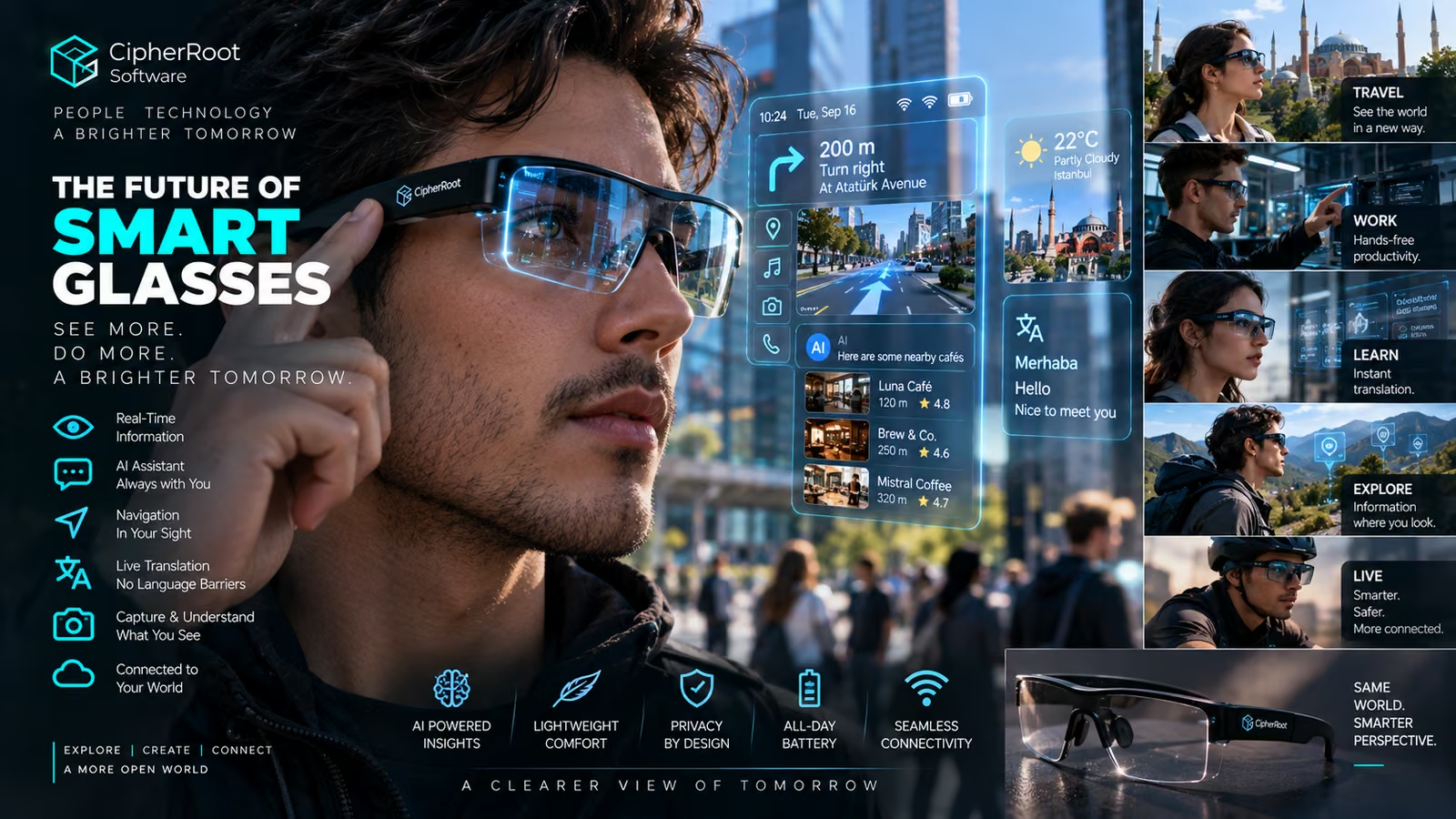
A New Way to Experience Technology
For decades, people have interacted with computers through screens.
First came desktop monitors.
Then laptops.
Then smartphones.
Now technology is moving toward something much closer to the human experience: smart glasses.
Smart glasses combine traditional eyewear with cameras, microphones, speakers, sensors, connectivity, and increasingly powerful artificial intelligence.
The technology is evolving quickly. In 2026, companies including Meta, Google, Samsung, and Qualcomm are developing AI-powered and intelligent eyewear platforms, moving the concept beyond simple wearable displays.
The long-term idea is fascinating:
Instead of looking down at technology, we may eventually be able to interact with information while keeping our eyes on the world around us.
What Are Smart Glasses?
Smart glasses are wearable computers designed in the form of eyewear.
Depending on the product, they may include:
Cameras Microphones Speakers Wireless connectivity Motion and environmental sensors AI processors Displays or projection systems Touch or gesture controls Voice assistants
Some smart glasses operate primarily through audio and cameras without putting information directly in front of the user's eyes.
Others can include displays that overlay digital information onto the physical environment.
This distinction is becoming important as the industry develops multiple categories of intelligent eyewear.
Google's 2026 Android XR plans, for example, describe both audio glasses and display glasses, with different ways of delivering AI assistance.
AI Is Changing the Concept of Glasses
Traditional wearable electronics mostly collect data or display notifications.
AI-powered glasses can potentially do much more.
They can interpret what the user is seeing, understand spoken requests, analyze context, and provide information at the moment it becomes useful.
Imagine looking at a sign and asking:
“What does this say?”
The camera captures the sign.
Computer vision identifies the text.
AI interprets it.
The translation is then delivered through the glasses.
The entire interaction can happen without taking a smartphone out of your pocket.
This is the beginning of ambient computing—technology that becomes integrated into the environment instead of demanding constant attention.
Smart Glasses as an AI Assistant
One of the biggest opportunities is creating an AI assistant that is always nearby.
Instead of sitting inside a smartphone application, the assistant can become part of the user's daily environment.
A person could ask for:
Directions Weather information Reminders Translations Explanations General information Calendar details Communication assistance
Google says its upcoming Android XR intelligent eyewear is designed to let users get help from Gemini while remaining hands-free and focused on the surrounding environment.
Meta is also expanding AI capabilities across its glasses, including visual understanding and hands-free assistance.
The important change is not simply having another AI interface.
It is having an AI system that can see what you see and hear what you hear.
Computer Vision Meets Everyday Life
Smart glasses can act as mobile computer-vision platforms.
Their cameras can observe the environment and provide visual information to AI systems.
Potential applications include:
Object recognition
The glasses could help identify objects and provide contextual information.
Text recognition
Signs, menus, documents, labels, and other text could be interpreted automatically.
Visual assistance
AI can describe elements of an environment or help a user understand what is in front of them.
Navigation
Directions could be provided based on the user's current location and surroundings.
Computer vision therefore becomes much more useful when it is connected to a wearable device that is already looking in the user's direction.
Navigation Without Looking at a Phone
Smartphones changed navigation forever.
But using a phone while walking still requires looking away from the environment.
Smart glasses could move navigation into the user's field of view—or provide directions through audio.
Instead of repeatedly checking a map, a user could receive contextual guidance while continuing to walk naturally.
This is particularly interesting for unfamiliar cities.
A future system could potentially combine:
GPS + computer vision + maps + AI + real-time context
to create navigation that feels more like having a digital guide rather than following a blue line on a screen.
Meta is also developing pedestrian navigation capabilities for its displayless AI glasses.
Real-Time Translation
Language translation could become one of the most practical applications of smart glasses.
Today's translation tools already allow people to translate text and speech.
Smart glasses could make the experience more natural.
A traveler could hear another language and receive translated speech through the glasses.
A displayed subtitle could appear while someone is speaking.
Text on signs could be translated immediately.
This could be particularly useful for tourism, international business, education, and everyday communication.
Meta has already been expanding live translation capabilities across its AI glasses, while Google has highlighted translation and hands-free assistance as part of its intelligent-eyewear vision.
Smart Glasses for Work
The technology could have major implications beyond consumer entertainment.
Imagine a technician repairing a complicated machine.
Instead of looking through a manual, the worker could see instructions or ask an AI assistant for help while keeping both hands available.
Smart glasses could potentially provide:
Equipment information Maintenance instructions Remote expert assistance Step-by-step procedures Safety information Product identification Technical documentation
This creates a new concept:
Hands-free computing.
The screen is no longer something attached to a desk.
It becomes part of the worker's environment.
Smart Glasses in Education
Education could also change.
A student could look at an object and ask an AI assistant to explain it.
A language learner could see real-time translations.
A science student could view contextual information about a physical experiment.
An augmented-reality system could display interactive models over real-world objects.
The classroom could therefore become a combination of physical and digital information.
Instead of learning only through screens or books, students could interact with digital information while examining the real world.
Accessibility and Assistive Technology
Smart glasses may also become valuable accessibility tools.
A wearable camera connected to AI can potentially recognize text, describe objects, identify surroundings, and provide spoken information.
This can create alternative ways of interacting with environments that are difficult to navigate using conventional interfaces.
Meta, for example, has described use of its AI glasses to assist blind veterans with tasks such as reading documents and understanding their surroundings.
Accessibility may become one of the strongest arguments for wearable AI because the technology can transform information from something visual into something conversational and auditory.
Smart Glasses and the Internet of Things
Future glasses may not operate alone.
They could become a central interface for connected devices.
Imagine looking at your home and interacting with:
Smart lighting Security systems Appliances Vehicles Robots Computers Industrial equipment
The glasses could understand the environment and provide an interface for controlling it.
This would turn wearable technology into a bridge between humans and the Internet of Things.
The user becomes the center of the connected ecosystem.
The Rise of Displayless AI Glasses
An interesting trend is that intelligent eyewear does not necessarily require a visual display.
A camera, microphone, speaker, AI assistant, and smartphone connection can already provide many useful capabilities.
This approach has an important advantage.
The glasses can look more like ordinary eyewear.
They can be lightweight and less visually distracting.
Google's planned intelligent eyewear explicitly includes audio glasses as one category, alongside display-enabled glasses.
This could be an important step toward making AI glasses feel like ordinary everyday products rather than futuristic gadgets.
Displays and Augmented Reality
Display-based smart glasses represent the more futuristic side of the technology.
Instead of simply hearing information, users can potentially see digital information layered over the physical world.
A display might show:
Navigation arrows Translated text Notifications Interactive controls Object information Maps Work instructions Real-time data
The ultimate goal is not necessarily to cover the world with graphics.
It may be to show the right information at the right moment.
That distinction will determine whether augmented reality feels useful or overwhelming.
Privacy Will Become a Central Issue
Smart glasses introduce an important privacy question.
The device may contain cameras and microphones that operate in public spaces.
The wearer knows when they are using the glasses.
People around them may not.
This makes privacy design extremely important.
Manufacturers need clear indicators and controls around recording and data collection.
Meta, for example, describes a capture LED on its AI glasses that indicates when content is being captured, and says covering or disabling the LED disables the camera.
As smart glasses become more capable, privacy will need to be considered not only from the user's perspective but also from the perspective of everyone around the device.
AI Processing and Personal Data
Smart glasses can generate highly personal data.
They may process:
Voice Images Location Conversations Activity patterns Search requests Personal preferences
Some AI processing can happen locally on the device, while other workloads can use connected smartphones or cloud infrastructure.
The balance between performance and privacy will become increasingly important.
The ideal system should make it clear:
What is being recorded?
Where is it processed?
What is stored?
Who can access it?
As wearable AI becomes more personal, user control over data becomes increasingly important.
Battery Life and Hardware Design
Smart glasses face a difficult engineering challenge.
They need to be:
Light enough to wear comfortably.
Powerful enough to run sensors and AI.
Small enough to resemble ordinary glasses.
And capable of working for long periods.
Every additional component consumes space and energy.
Cameras require power.
Wireless communication requires power.
AI computation requires power.
Displays require even more power.
This means future innovation will depend heavily on efficient processors, specialized AI hardware, better batteries, improved sensors, and optimized software.
Qualcomm's 2026 Snapdragon AR1 Gen 1 platform, for example, is being positioned for new intelligent-eyewear products from Samsung and Google.
Smart Glasses Will Need Better AI Models
A wearable AI assistant cannot rely only on generic language understanding.
It needs to understand the physical environment.
That means combining multiple types of AI:
Language models for conversation.
Computer vision for understanding images.
Speech recognition for listening.
Speech synthesis for responding.
Location intelligence for navigation.
Multimodal AI for combining all of these inputs.
This is why smart glasses may become an important showcase for multimodal AI.
The AI is no longer interacting with text alone.
It is interacting with the real world.
The Future of Human-Computer Interaction
For decades, humans adapted themselves to computers.
We learned keyboards.
We learned menus.
We learned touch interfaces.
Smart glasses could reverse that relationship.
Instead of asking users to interact with software through rigid interfaces, AI can understand natural language, visual context, and human behavior.
The interaction becomes more conversational.
More contextual.
More immediate.
The computer starts adapting to the human.
What Will Smart Glasses Become?
The long-term future is difficult to predict.
Smart glasses could remain primarily companion devices for smartphones.
They could evolve into powerful AR computers.
They could become personal AI assistants.
Or several different categories could coexist.
Google's Android XR strategy already points toward an ecosystem that spans headsets and different types of intelligent eyewear.
Qualcomm is likewise building platforms intended to help manufacturers create personal AI devices beginning with smart glasses.
What seems increasingly likely is that the category will continue expanding rather than following one single design.
A World Seen Through Intelligent Glasses
Imagine waking up and putting on your glasses.
Your assistant quietly tells you the day's schedule.
You walk outside.
The glasses recognize your destination and provide directions.
You enter a store.
The system translates unfamiliar information.
You meet someone speaking another language.
Real-time translation helps you communicate.
At work, your glasses provide technical information without requiring a laptop.
Later, you explore a new city while AI provides contextual information about the places around you.
The technology remains close to you, but it does not constantly demand your attention.
That is the real promise.
Technology that helps you experience the world instead of pulling you away from it.
Conclusion
Smart glasses are evolving from experimental wearable technology into a broader category of AI-powered personal computing.
Current products already demonstrate capabilities such as hands-free photography, voice assistants, audio interaction, visual understanding, and translation, while new platforms are adding display-based experiences and deeper XR integration.
The future will depend on solving several difficult problems: battery life, comfort, privacy, security, AI reliability, display technology, and social acceptance.
But the direction is fascinating.
The smartphone put computing in our pockets.
Smart glasses could put computing in our field of view, in our ears, and inside our everyday environment.
The biggest change may not be that glasses become smarter.
It may be that computers finally become less visible.
See more. Understand more. Experience the world in a new way.
The future of computing may be right in front of our eyes.