
Systems & Infrastructure
The Future of Smart Factories: How Intelligent Manufacturing Is Changing Industry
CipherRoot Software13 min read
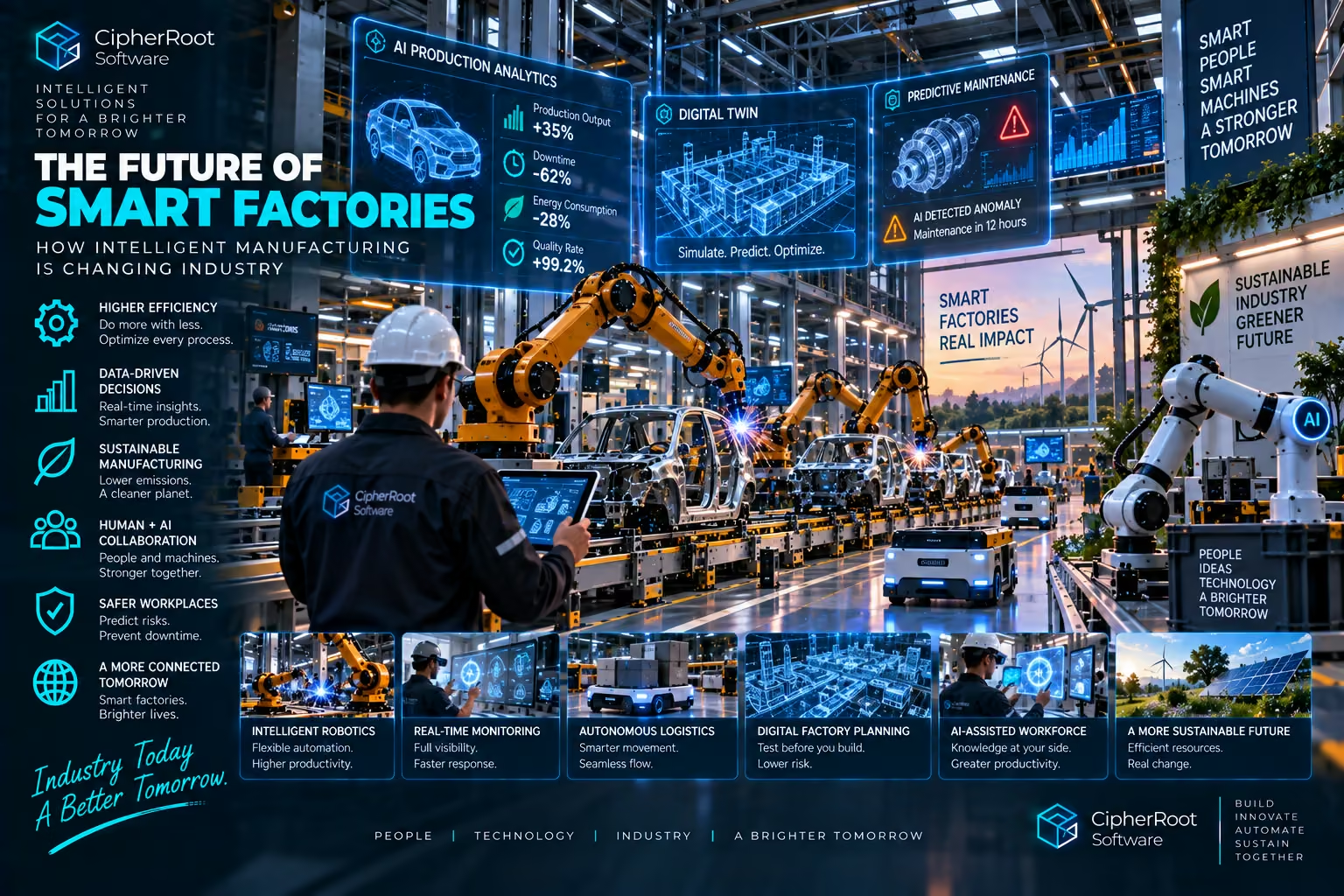
The Factory Is Becoming Intelligent
Manufacturing has always evolved with technology.
Machines increased production capacity.
Electricity transformed factory operations.
Computers introduced digital control.
Industrial robots automated repetitive physical tasks.
Now artificial intelligence, connected sensors, advanced robotics, edge computing, and digital twins are creating a new generation of manufacturing environments.
These are often called smart factories.
A smart factory does not simply automate production.
It connects machines, software, data, and people so that the entire production environment can become more visible, adaptable, and responsive.
The factory of the future will not only produce products.
It will increasingly understand its own operations.
What Is a Smart Factory?
A smart factory is a manufacturing environment that uses connected technologies to monitor, analyze, and optimize production.
A modern smart factory can combine:
Industrial robots IoT sensors Artificial intelligence Machine vision Cloud computing Edge computing Digital twins Industrial software Autonomous mobile robots Real-time analytics
These systems can communicate with one another.
A sensor detects a change.
The data is analyzed.
Software identifies a potential problem.
An operator receives an alert.
A robot or machine may then respond according to predefined rules.
This creates a continuous digital feedback loop.
From Automated Factory to Smart Factory
Automation and smart manufacturing are closely related, but they are not exactly the same.
A traditional automated system can execute a predefined process.
A smart system can also collect and interpret information about that process.
For example:
Traditional automation: A machine performs the same operation repeatedly.
Smart automation: The machine performs the operation while sensors monitor performance and software analyzes the results.
This additional layer of intelligence can make production more adaptable.
Artificial Intelligence at the Center
Artificial intelligence is becoming an important analytical layer for smart factories.
Factories can generate enormous quantities of data from:
Machines Sensors Cameras Production software Maintenance systems Supply-chain platforms
AI can analyze these signals and look for patterns.
It may help identify:
Equipment anomalies
Production bottlenecks
Quality problems
Energy inefficiencies
Demand changes
The goal is not to make every factory decision automatic.
It is to give operators and engineers more useful information.
The Industrial Internet of Things
The Industrial Internet of Things, or IIoT, connects machines and sensors to digital networks.
A factory might contain thousands of sensors measuring:
Temperature Pressure Vibration Speed Energy use Machine status Production counts
Previously, much of this information may have remained inside individual machines.
In a smart factory, the data can become part of a larger operational system.
The factory begins to behave like a connected information network.
Real-Time Monitoring
A smart factory needs visibility.
Managers and operators need to know what is happening now.
Real-time dashboards can show:
Production output Machine availability Downtime Quality metrics Energy consumption Material movement
AI can then help prioritize the information that requires attention.
Instead of looking through thousands of data points, an operator can focus on the most important events.
Predictive Maintenance
Unexpected machine failure can stop an entire production line.
Predictive maintenance uses sensor data and analytics to identify early signs of equipment problems.
For example, an abnormal change in vibration or temperature may indicate that a component needs inspection.
AI can compare current behavior with historical patterns.
This can help maintenance teams move from:
Repair after failure
toward:
Identify potential failure earlier
Predictive maintenance cannot guarantee that machines will never break.
But it can improve maintenance planning and reduce some unexpected downtime.
Machine Vision and Quality Control
Computer vision is another major component of smart manufacturing.
Cameras can inspect products as they move through production.
AI models can analyze images and identify certain visual defects.
Applications can include:
Surface inspection Assembly verification Product classification Label inspection Packaging control Dimensional analysis
This allows quality inspection to become an integrated part of production rather than only a final checkpoint.
Continuous Quality Loops
A smart factory can create a continuous quality-feedback process.
The system detects a defect.
It identifies when and where the defect appeared.
Production data is analyzed.
Engineers investigate the related process.
The system can then use the result to improve future production.
This creates a cycle:
Produce → Inspect → Analyze → Improve → Produce
The factory is constantly learning about its own processes.
Digital Twins
Digital twins are becoming increasingly valuable in smart manufacturing.
A digital twin is a digital representation of a physical machine, production cell, or factory.
The digital model can represent:
Equipment Production lines Energy use Material flow Machine states Maintenance information
Engineers can use digital twins to simulate changes before applying them to the real factory.
This can reduce some of the risk associated with changing physical production systems.
Simulating the Factory Before Changing It
Imagine moving a robot to a different location on a production line.
In a traditional environment, engineers may need to test the change physically.
With a digital twin, they can first simulate:
Will the robot collide with another machine?
Will production slow down?
Will material flow improve?
Will the new configuration create a bottleneck?
Virtual testing can make experimentation more efficient.
The factory can be optimized digitally before physical changes are made.
Autonomous Mobile Robots
Smart factories increasingly include mobile robots as well as fixed robotic arms.
Autonomous mobile robots, or AMRs, can move materials around the facility.
They can transport:
Raw materials Components Tools Finished goods Packaging
Instead of following one fixed route, autonomous systems can use sensors and navigation software to adapt to changing environments.
This makes internal logistics more flexible.
Intelligent Warehouses
The smart factory does not stop at production.
Warehouses can become part of the same digital ecosystem.
Inventory systems can track items in real time.
Robots can move goods.
AI can forecast demand.
Software can optimize storage locations.
Connected systems can synchronize warehouse activity with production.
This creates a continuous chain:
Supplier → Warehouse → Factory → Distribution → Customer
Information flows alongside physical products.
AI-Powered Production Planning
Manufacturing schedules can become highly complex.
Production teams need to consider:
Customer demand Machine availability Material supply Workforce Maintenance Delivery deadlines
AI can analyze these variables and help generate production plans.
When conditions change, schedules can be updated.
For example, if a machine becomes unavailable, the system can identify how the change affects the rest of the production plan.
This can make factories more adaptable.
Energy Management
Smart factories can also monitor energy consumption in detail.
Machines, lighting, climate systems, compressed air, and other equipment all contribute to total energy use.
AI can identify unusual consumption patterns and highlight inefficient processes.
Production schedules can sometimes be adjusted to reduce unnecessary energy demand.
This turns the factory into not only a production system but also an energy-management system.
Sustainable Manufacturing
Smart technology can support more efficient manufacturing.
Better quality control can reduce waste.
Predictive maintenance can help extend equipment lifetimes.
Optimized production can reduce unnecessary machine operation.
Intelligent logistics can reduce unnecessary material movement.
But smart technology itself consumes energy and requires electronics and infrastructure.
Sustainability therefore needs to be considered across the full lifecycle of the factory.
Human-Robot Collaboration
Smart factories will not necessarily become completely robotic.
Human workers remain essential for:
Engineering Maintenance Quality Problem solving Safety Process improvement Production management
Robots are particularly useful for repetitive and physically demanding tasks.
Humans are often better suited to situations requiring flexible judgment.
The smart factory therefore becomes a collaborative environment.
People + Robots + AI + Software
work together.
Cobots in the Smart Factory
Collaborative robots, or cobots, are designed for selected applications where humans and robots can work in close proximity under appropriate safety controls.
A worker might perform an inspection or dexterous task while the robot handles repetitive movement.
This can reduce physical strain and improve consistency.
The most effective collaboration depends on proper task design, risk assessment, and safety engineering.
Edge Computing
Smart factories often need immediate responses.
A machine-control system may not be able to wait for information to travel to a remote cloud environment.
Edge computing processes data closer to where it is generated.
This can support:
Low-latency decisions Local analytics Faster anomaly detection Reduced network traffic
Cloud computing can still provide large-scale storage and analysis.
The future factory may use both.
Edge for immediate action.
Cloud for broader intelligence.
AI Agents in Manufacturing
The next generation of smart factories may use AI agents to manage multi-step digital workflows.
An industrial AI agent could potentially:
Detect an abnormal machine condition. Gather related sensor data. Compare it with historical patterns. Identify possible causes. Prepare a maintenance recommendation. Create a work order. Request human approval. Track the result.
This moves AI from simple analysis toward operational assistance.
However, physical manufacturing systems require carefully restricted permissions.
Smart Factories Need Cybersecurity
A connected factory is also a larger digital attack surface.
Industrial systems may include:
PLCs Robots Cameras Sensors Servers Cloud services Remote-access systems
A cyberattack can potentially affect physical production.
Cybersecurity therefore needs to be part of the smart-factory architecture.
Important measures can include:
Network segmentation
Strong authentication
Secure remote access
Monitoring
Protected industrial protocols
Secure software updates
The more connected the factory becomes, the more important cybersecurity becomes.
Safety and Smart Automation
Industrial intelligence should never come at the expense of physical safety.
A robot should operate within defined limits.
Safety systems should remain available even when network connectivity fails.
Human operators need clear information about machine states and alerts.
Automation should also have safe failure modes.
A smart machine must not only be intelligent.
It must know how to fail safely.
Data Quality Matters
Smart factories depend heavily on data.
But collecting more data does not automatically improve production.
Sensor data can be incomplete.
Measurements can be inaccurate.
Systems can use different formats.
Historical records can contain errors.
AI models can therefore produce poor conclusions when their inputs are unreliable.
Data governance becomes an essential part of smart manufacturing.
The Importance of Interoperability
Factories contain equipment from many different manufacturers.
One machine may use one communication protocol.
Another may use a completely different system.
A truly connected factory needs these systems to work together.
Interoperability standards and well-designed industrial interfaces can make integration easier.
The goal is not to create a collection of isolated smart machines.
It is to create one connected production environment.
The Factory Becomes Software-Defined
As industrial systems become more connected, software gains a larger role in determining how production operates.
Production schedules can change digitally.
Robot tasks can be updated.
AI models can be deployed.
Digital twins can be updated.
Machine performance can be analyzed remotely.
This makes manufacturing increasingly software-defined.
The physical factory remains essential.
But its behavior is increasingly coordinated by software.
Smart Factories and Supply Chains
Factories do not operate independently.
Production depends on supply chains.
If materials are delayed, production may need to change.
If customer demand changes, output may need to be adjusted.
AI systems can connect factory data with supply-chain information.
This can improve visibility across the larger production ecosystem.
The future factory will therefore communicate with:
Suppliers
Warehouses
Ports
Transport systems
Retailers
Customers
Manufacturing becomes part of a larger digital network.
Mass Personalization
Traditional mass production focused on producing large numbers of identical products.
Digital manufacturing allows greater flexibility.
A smart factory can potentially handle multiple product configurations with less manual reprogramming.
AI can help optimize scheduling and robotics can adjust between predefined tasks.
This creates the possibility of mass personalization.
Customers can receive more customized products without every production process becoming completely manual.
The Small Smart Factory
Smart manufacturing is not limited to enormous corporations.
Smaller manufacturers can adopt intelligent technologies gradually.
A business can start with:
Machine monitoring
Then add:
Predictive maintenance
Then:
Automated inspection
Then:
Robotic material handling
Each stage can provide measurable benefits before the next stage is introduced.
A factory does not need to become fully autonomous overnight.
The Smart Factory Workforce
As manufacturing technology evolves, worker skills evolve as well.
Future factory teams may increasingly need knowledge of:
Robotics Data analysis Industrial software AI Sensors Automation Cybersecurity
This does not mean every employee needs to become a programmer.
It means workers need to understand how the systems around them operate.
Training and continuous learning become part of the smart-factory model.
The Factory of Tomorrow
Imagine entering a smart factory in the future.
Robotic systems are assembling products.
Autonomous vehicles move components between workstations.
Computer vision checks every product.
Sensors continuously monitor machines.
AI analyzes production data.
A digital twin models the facility in real time.
Energy systems adjust consumption.
An AI agent identifies an unusual machine pattern and prepares a maintenance request.
Human engineers supervise the system and investigate complex events.
The factory continuously observes itself.
That is the real promise of smart manufacturing.
A Continuous Learning Environment
The smartest factories may eventually operate as continuous learning systems.
Every production cycle generates new information.
The information improves the models.
The models improve decisions.
Better decisions improve production.
The results create more data.
The cycle continues.
Data → Intelligence → Action → Results → Better Data
Manufacturing becomes a feedback system.
Challenges Ahead
Building a smart factory is not easy.
Companies need to deal with:
Legacy equipment
Older machines may be difficult to connect.
Integration costs
Different systems need to communicate.
Cybersecurity
More connectivity creates more digital risk.
Workforce development
Employees need new skills.
AI reliability
Models can make mistakes.
Operational complexity
More systems mean more components to manage.
Smart manufacturing therefore requires careful planning.
Technology alone is not enough.
The Future of Manufacturing
The factory of the future will likely combine several technologies rather than depend on one.
Artificial intelligence
for analysis and decision support.
Robotics
for physical automation.
IoT
for continuous sensing.
Computer vision
for quality and perception.
Digital twins
for simulation and optimization.
Edge computing
for real-time processing.
Cloud platforms
for large-scale data and coordination.
Together, these systems create a new manufacturing architecture.
From Smart Factory to Autonomous Factory
The long-term direction may be toward increasingly autonomous operations.
A highly automated factory could potentially:
Monitor itself.
Optimize production.
Detect problems.
Schedule maintenance.
Coordinate robots.
Manage inventory.
Adjust energy use.
Respond to changing demand.
Humans would remain responsible for high-level objectives, engineering, safety, oversight, and exceptional situations.
The factory becomes increasingly self-managing.
Conclusion
The future of smart factories is not simply about replacing people with machines.
It is about creating connected manufacturing environments where people, robots, AI, sensors, and software work together.
AI can identify patterns.
Robots can perform physical tasks.
Computer vision can inspect products.
Digital twins can simulate changes.
Predictive maintenance can identify developing problems.
Autonomous mobile robots can transform internal logistics.
Edge computing can support real-time decisions.
Connected software can coordinate the entire operation.
The result is a factory that can see more, understand more, and respond more intelligently.
But the most successful smart factories will not be defined only by how much technology they contain.
They will be defined by how well that technology improves:
Quality
Safety
Efficiency
Flexibility
Sustainability
Human work
The industrial revolution taught factories to automate.
The digital revolution taught them to connect.
The AI revolution is teaching them to understand.
The factory of tomorrow may therefore be more than automated.
It may be adaptive, connected, predictive, and increasingly autonomous.
Smarter factories. Better production. Intelligent industry.
The future of manufacturing is becoming a system that can learn from every machine, every process, and every production cycle.