
Future & Research
The Future of Robotic Surgery: Where AI and Surgery Meet
CipherRoot Software14 min read
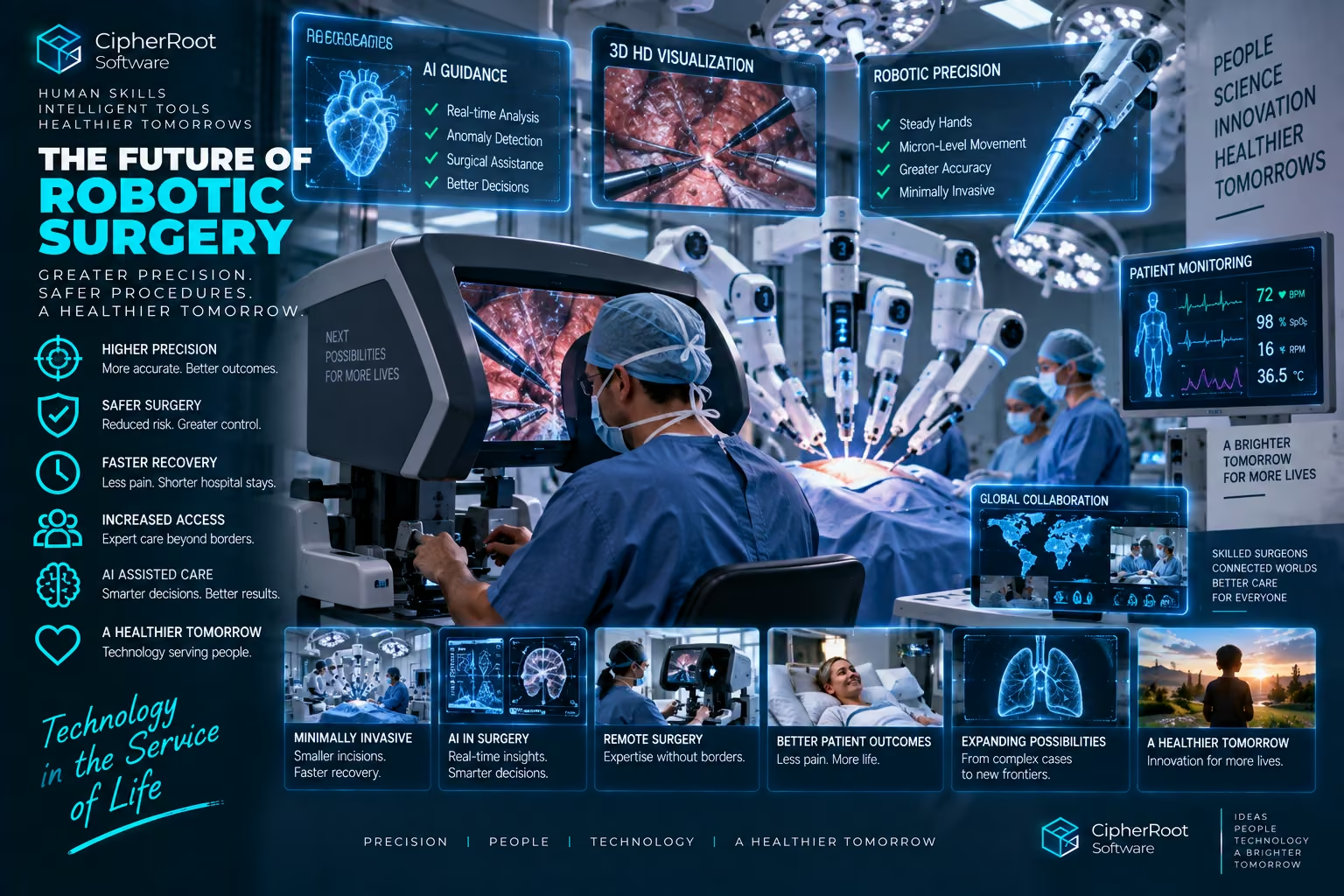
Surgery Is Entering a New Technological Era
Surgery has always evolved alongside technology.
Better instruments made procedures more precise.
Medical imaging gave surgeons a clearer view of anatomy.
Minimally invasive techniques reduced the size of some surgical incisions.
Computer systems introduced digital navigation and advanced visualization.
Now robotics and artificial intelligence are bringing another layer of technological change to the operating room.
Modern robotic surgery can give surgeons highly controlled instruments, three-dimensional visualization, and computer-assisted movements. The FDA describes robotically assisted surgical devices as systems controlled by surgeons rather than independent robots performing surgery on their own.
The next stage is more ambitious.
Researchers are exploring systems that can recognize anatomy, understand surgical context, provide real-time guidance, and eventually perform increasingly autonomous subtasks under carefully controlled conditions.
The future of robotic surgery may therefore be defined by a partnership:
Human expertise + robotic precision + artificial intelligence.
What Is Robotic Surgery?
Robotic surgery generally refers to computer-assisted surgical systems that allow a trained surgeon to control instruments through robotic mechanisms.
A typical system can include:
A surgeon console Robotic arms A camera or endoscope Specialized surgical instruments Control software Visualization systems
The robotic system translates the surgeon's movements into precise instrument movements.
This can be useful for minimally invasive procedures and for working in confined anatomical spaces.
Despite the name, today's commonly used systems are not generally autonomous surgeons.
The person remains in control.
Why Use Robotic Systems?
Robotic platforms can provide capabilities that support the surgeon during complex procedures.
These can include:
Three-dimensional visualization
A high-resolution view of the surgical field can provide detailed visual information.
Precise instrument control
Robotic mechanisms can translate surgeon movements into controlled instrument motion.
Small-incision procedures
Robotic systems can support minimally invasive approaches in appropriate procedures.
Ergonomics
The surgeon can control instruments from a dedicated console instead of working directly with conventional laparoscopic handles.
The actual advantages vary according to the procedure, technology, surgeon, and clinical setting.
Robotic surgery is not automatically better for every operation. The FDA specifically advises that robotically assisted surgery may not be appropriate in every situation and that patients should discuss its risks and benefits with their healthcare provider.
Artificial Intelligence Enters the Operating Room
The next major development is the integration of AI.
A robotic system can move an instrument precisely.
AI can provide additional interpretation.
Computer-vision systems can analyze the surgical field.
Machine-learning models can identify anatomical structures.
AI can help detect certain patterns.
Predictive systems can highlight potential risks.
This transforms robotics from a mechanical platform into a more intelligent system.
The goal is not necessarily to remove the surgeon.
It is to give the surgeon more information at the right moment.
AI-Powered Surgical Vision
One of the most promising areas is computer vision.
During an operation, cameras continuously capture information about the surgical field.
AI models can potentially analyze this information in real time.
Possible capabilities include:
Anatomical recognition Tissue segmentation Instrument tracking Surgical-phase recognition Detection of certain visual events Navigation assistance
Research reviewed in Nature Reviews Electrical Engineering describes large vision models as a promising direction for advancing robotic surgical systems, particularly in tasks involving image understanding and downstream surgical support.
Recognizing Anatomy
Human anatomy is highly complex.
Organs and tissues can vary from patient to patient.
During surgery, structures may move, deform, or become partially obscured.
AI-based vision systems are being researched to identify anatomical structures and provide additional visual guidance.
For a surgeon, this could eventually mean that critical structures are highlighted or contextualized automatically.
The system becomes another set of computational eyes.
Real-Time Surgical Guidance
Imagine a robotic platform that continuously analyzes the surgical field.
It recognizes anatomical structures.
It tracks the instruments.
It identifies the current stage of the operation.
It provides relevant information to the surgeon.
It can warn when an action approaches a predefined safety boundary.
This is very different from autonomous surgery.
The AI is supporting the human rather than replacing the human.
A 2026 review in Nature Reviews Urology identifies assistive systems that improve perception, anticipate risks, and provide standardized feedback as among the most credible near-term directions for surgical AI.
Precision at a Smaller Scale
Robotic mechanisms can provide highly controlled movements.
Future systems may become even more precise as sensors, actuators, control algorithms, and instruments improve.
This could be particularly valuable for procedures involving delicate anatomy.
The goal is not simply smaller movements.
It is controlled movement combined with an understanding of the environment.
Precision + perception is more powerful than precision alone.
Better Visualization
Visualization is central to modern robotic surgery.
Future systems may combine multiple information sources into one surgical interface.
A surgeon could potentially see:
Live camera images Anatomical models Preoperative imaging AI-generated annotations Surgical navigation information Instrument position Patient monitoring data
Instead of switching between different screens, the information could be integrated into a more unified environment.
This could turn the operating console into a sophisticated surgical command center.
Digital Twins and Surgery
Digital-twin technology could also become relevant.
A patient's anatomy can potentially be represented through detailed digital models derived from medical imaging.
The model could help simulate aspects of a procedure before the operation begins.
Surgeons could explore:
Surgical access Anatomical relationships Instrument trajectories Possible approaches
The digital model would not replace the patient's actual anatomy.
It could provide an additional planning environment.
The larger idea is:
Understand the operation digitally before entering the operating room.
AI and Surgical Training
Robotic systems can also become powerful training platforms.
A digital environment can record instrument movements and procedure data.
AI can analyze performance and provide feedback.
Trainees could potentially practice specific skills repeatedly while receiving objective measurements.
Research in robotic surgery is increasingly exploring AI-assisted assessment and feedback as a way to support training and improve consistency.
This could create a new model of surgical education:
Practice → Measure → Analyze → Improve → Repeat
Learning From Surgical Data
Every procedure produces information.
Instrument movements.
Video.
Timing.
Procedure phases.
Anatomical interaction.
The challenge is turning this information into useful knowledge.
AI systems can analyze large datasets to identify patterns.
Over time, researchers may be able to understand which techniques are associated with particular outcomes or which moments in a procedure are especially challenging.
This could help improve training, planning, and decision support.
But collecting and using surgical data requires careful privacy protection and governance.
Robotic Surgery and Minimally Invasive Procedures
Robotic platforms can support minimally invasive approaches in selected procedures.
The potential advantages depend heavily on the specific operation and patient.
Smaller access points can be one component of minimally invasive surgery, but the overall outcome depends on many factors.
The future of robotic surgery is therefore not simply:
“Smaller incisions.”
It is:
Better visualization + controlled movement + improved navigation + appropriate clinical decision-making.
Remote Surgery
Another fascinating possibility is remote surgery.
Robotic systems can physically separate the surgeon's controls from the instruments operating on the patient.
This creates the technical foundation for telesurgery.
Future communication networks could make remote collaboration more responsive.
However, remote surgery presents major requirements around:
Network reliability Latency Cybersecurity Redundancy Fail-safe systems Regulatory oversight
A network failure in an ordinary video call is inconvenient.
A network failure during a critical surgical task is a completely different problem.
Global Collaboration
Even when surgery itself is not performed remotely, connectivity can support collaboration.
A specialist could potentially assist another team through connected systems.
Medical imaging and surgical video could support remote consultation.
AI tools could provide additional contextual information.
This could help connect specialized expertise across geographic boundaries where the infrastructure and medical systems permit it.
The technology may therefore support not only surgery but also distributed surgical knowledge.
AI and Surgical Robotics Will Need Human Oversight
The more autonomous a system becomes, the more important oversight becomes.
Today's routine robotic surgery remains under direct surgeon control.
Researchers are developing systems capable of increasingly autonomous subtasks, but full autonomy remains an active research area with substantial technical and clinical challenges.
This suggests a gradual path:
Assistance → Guidance → Shared control → Task-specific autonomy
rather than an immediate jump to completely independent robotic surgeons.
Autonomous Surgical Tasks
Researchers are exploring whether robots could eventually perform carefully defined tasks independently.
For example, a robot might eventually be capable of a narrow, repetitive step under supervision.
The important word is task-specific.
A complete surgical procedure involves many changing variables.
Soft biological tissue can deform.
Patient anatomy varies.
Unexpected bleeding can change the situation.
The operating environment is not perfectly predictable.
This makes complete autonomy much harder than automating a repetitive factory process.
Soft Tissue Is Especially Difficult
One of the major engineering challenges is the behavior of living tissue.
Rigid industrial objects are comparatively predictable.
Human tissue can stretch, move, deform, bleed, and change during a procedure.
Research into autonomous surgical robotics has identified tissue modeling and the lack of large, high-quality datasets as important barriers to greater autonomy.
A future surgical AI therefore needs more than visual recognition.
It needs an understanding of physics, anatomy, and changing tissue behavior.
Physics-Aware AI
Future surgical systems may combine machine learning with physical models.
Instead of relying entirely on statistical patterns, the system could incorporate knowledge about:
Tissue deformation Instrument forces Anatomical constraints Movement dynamics Surgical mechanics
This could make AI models more useful in environments where purely visual pattern recognition is not enough.
Research is increasingly exploring physics-aware and multimodal approaches for this reason.
Haptic Feedback
Human surgeons rely on more than vision.
Touch also provides information.
Robotic systems have historically faced challenges in reproducing natural tactile sensation.
Future systems may incorporate more advanced force and tactile feedback.
This could help surgeons perceive properties of tissue through the robotic interface.
Better sensing could also provide AI systems with additional information.
The surgical robot could potentially understand not only what tissue looks like, but also how it behaves when manipulated.
Safety-Centered Autonomy
Autonomy in surgery cannot be designed like autonomy in a video game.
A system must know its operational limits.
It needs reliable fallback behavior.
It needs to detect uncertainty.
It needs to stop or request human intervention when necessary.
This creates the concept of safety-centered autonomy.
The robot should not merely ask:
“Can I do this?”
It should also ask:
“Do I have enough confidence and information to do this safely?”
Explainable Surgical AI
Surgeons need to trust technology, but trust should not mean blind acceptance.
An AI system should ideally communicate why it is generating an alert or recommendation.
For example:
“Anatomical structure detected.”
“Instrument approaching predefined boundary.”
“Current visual pattern differs from expected anatomy.”
Clear feedback can help the surgeon understand how the AI is contributing.
The goal is collaboration rather than mystery.
Cybersecurity in Robotic Surgery
Surgical robots are connected medical systems.
That means cybersecurity is part of patient safety.
Potential vulnerabilities can exist in:
Robotic control systems Hospital networks Remote connections Software Medical data Communication infrastructure
Security measures need to be designed into the system from the beginning.
Strong authentication, network segmentation, secure updates, monitoring, and controlled remote access can become essential.
A highly intelligent surgical robot still needs highly secure infrastructure.
Patient Data and Privacy
AI systems can require large amounts of data for development and validation.
Medical data is extremely sensitive.
Patient information may include:
Medical histories Imaging Laboratory data Genetic information Surgical video Biometric information
Future surgical AI will therefore require strong data governance.
Research also needs appropriate privacy-preserving methods when data is shared across institutions.
The goal is to advance science without treating patients' information as an unlimited resource.
Regulation Will Shape the Technology
Medical robotics operates within a regulated environment.
A system designed for one surgical task may face different requirements from a general-purpose autonomous platform.
As AI becomes more deeply integrated into surgical systems, regulators will need ways to evaluate systems whose behavior can become more adaptive.
The FDA already regulates robotically assisted surgical devices according to their intended uses and emphasizes appropriate training for users.
Future autonomous capabilities will require equally careful evaluation.
Accountability in Autonomous Surgery
If a robotic system becomes more autonomous, responsibility becomes more complicated.
Who is accountable for a decision?
The surgeon?
The hospital?
The manufacturer?
The software developer?
The system operator?
These questions cannot be solved through engineering alone.
They require clear clinical protocols, regulation, documentation, and legal frameworks.
Greater autonomy therefore needs greater clarity about responsibility.
AI Could Help Standardize Surgical Feedback
One challenge in surgery is measuring performance consistently.
Different surgeons may have different techniques.
AI can potentially analyze procedural data and provide objective feedback.
This could help identify:
Efficient movements Unnecessary motion Delays Technical errors Difficult procedure phases
The goal is not to turn surgery into a robotic checklist.
It is to create better information for training and continuous improvement.
The Future Operating Room
Imagine entering an operating room in the future.
The robotic platform prepares the instruments.
The patient's digital model is available.
AI identifies relevant anatomy.
The surgeon controls the main procedure.
Real-time visual analysis highlights important structures.
The system monitors instrument position.
A digital twin provides additional context.
Remote specialists can collaborate when necessary.
AI continuously analyzes the procedure and provides carefully designed alerts.
The human remains responsible.
The machines provide precision, perception, and computational support.
From Robot-Assisted to Human-Centered Robotics
The future of surgical robotics is not simply about increasing autonomy.
It is about creating systems that understand the needs of the surgical team.
The machine should adapt to the workflow.
The interface should reduce cognitive burden.
AI should provide useful information without overwhelming the surgeon.
Automation should focus on tasks where it can deliver measurable value.
This is the foundation of human-centered surgical robotics.
The Road to Autonomous Surgery
Full autonomous surgery remains a long-term research direction rather than the normal state of today's surgical practice.
A 2026 review in Nature Reviews Urology describes autonomy in surgery as specialty-dependent and still early, particularly for complex soft-tissue procedures.
Researchers are exploring incremental approaches that combine imitation learning, reinforcement learning, multimodal models, and vision-language-action systems.
This suggests that surgical autonomy will likely develop gradually.
Specific tasks may become automated before entire procedures.
That gradual approach may be essential for safety and validation.
What Will the Surgeon of the Future Do?
The surgeon of the future may spend less time controlling every tiny mechanical movement.
Instead, more attention may go toward:
Planning Decision-making Patient-specific strategy AI supervision Managing unexpected events Communication Complex judgment
The surgeon remains the person responsible for understanding the patient as a whole.
The robotic system becomes an increasingly sophisticated instrument.
AI Will Not Make Every Decision
It is tempting to imagine a future in which an AI system simply decides what operation should happen.
Real medicine is more complicated.
Patients have different goals.
Anatomy varies.
Risks differ.
Treatment choices involve clinical evidence, professional judgment, patient preferences, and circumstances.
AI can provide information.
It cannot automatically determine what matters most to every patient.
The human decision-making process remains central.
A New Partnership in Medicine
The future of robotic surgery may ultimately be defined by partnership.
The surgeon brings:
Experience
Judgment
Communication
Clinical responsibility
The robot brings:
Precision
Stable instrument control
Repeatability
Advanced visualization
AI brings:
Pattern recognition
Data analysis
Contextual assistance
Real-time computational support
These strengths are different.
That is precisely why combining them is so powerful.
Conclusion
Robotic surgery is evolving from mechanically assisted procedures toward increasingly intelligent human-machine systems.
Today's robotically assisted surgical systems are generally controlled directly by trained surgeons.
The next generation is being shaped by artificial intelligence, computer vision, advanced sensing, digital modeling, surgical navigation, and increasingly sophisticated autonomy research.
The path forward will not be simple.
Soft tissue is unpredictable.
Medical data is sensitive.
AI can make mistakes.
Cybersecurity is critical.
Regulation must evolve.
Accountability must remain clear.
And patient safety must remain the central measure of progress.
The future operating room may therefore not be a place where robots replace surgeons.
It may be a place where surgeons work with machines capable of seeing more, analyzing more, and moving with extraordinary precision.
The robot provides the hands.
AI provides additional computational intelligence.
The surgeon provides the judgment.
Precision. Intelligence. Human expertise.
The future of surgery may not be autonomous medicine.
It may be human-centered intelligence with robotic precision.