
Systems & Infrastructure
The Future of Industrial Automation: Building Smarter Factories
CipherRoot Software11 min read
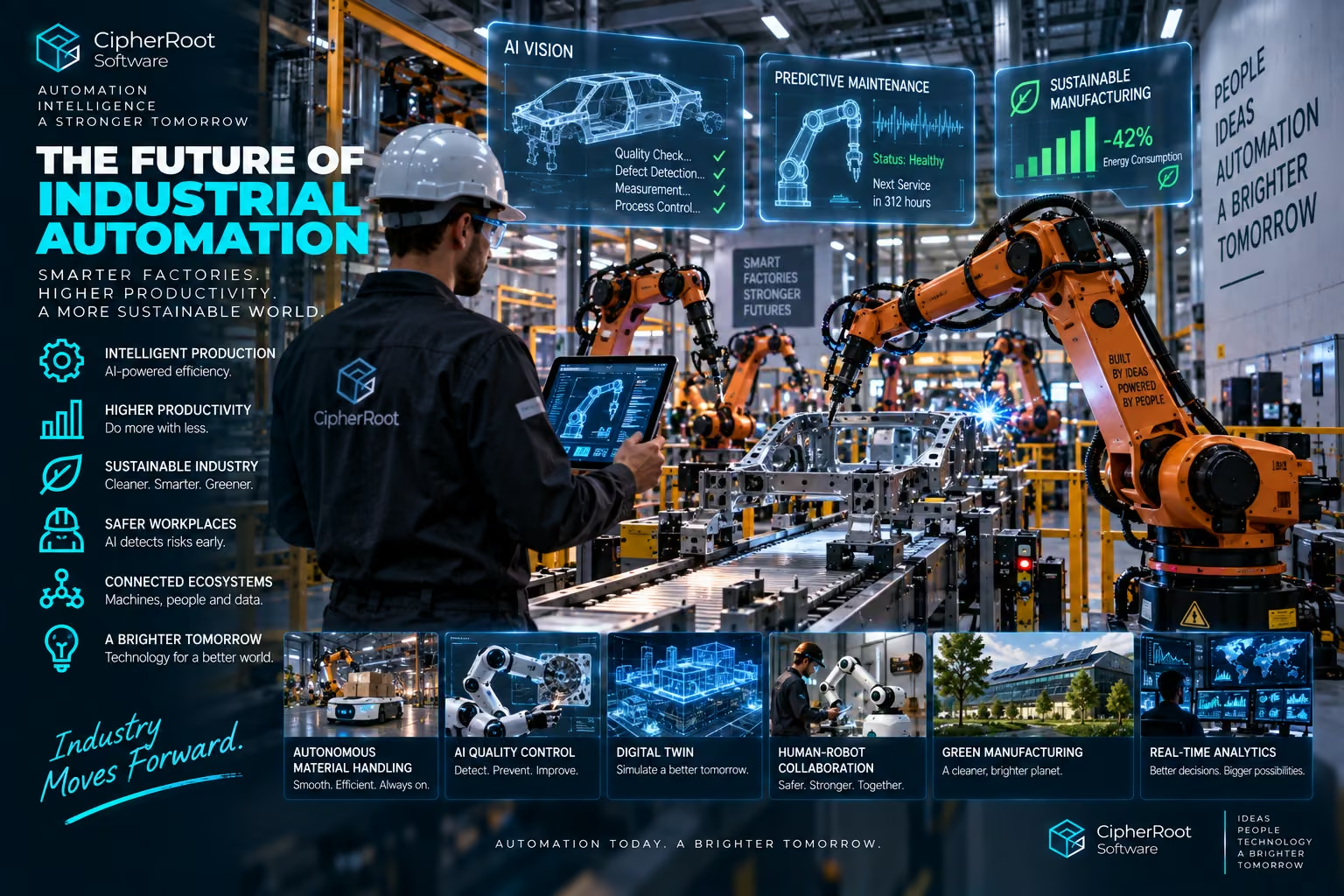
Industry Is Entering a New Automation Era
Industrial automation has been transforming manufacturing for decades.
Machines replaced some repetitive manual operations.
Programmable controllers gave factories more precise control.
Industrial robots increased speed and consistency.
Computer networks connected machines and production systems.
Now a new generation of technologies is changing automation once again.
Artificial intelligence, advanced robotics, computer vision, digital twins, edge computing, and real-time analytics are creating factories that can do more than simply follow predefined instructions.
They can increasingly observe, analyze, optimize, and adapt.
This is the next phase of industrial automation.
What Is Industrial Automation?
Industrial automation is the use of technology to control machines, processes, and production systems with reduced manual intervention.
It can include:
Industrial robots Programmable logic controllers Sensors Machine vision Automated conveyor systems Motion-control systems Industrial software Autonomous mobile robots Process-control systems
Traditional automation focuses heavily on repeatability.
A machine receives instructions and performs a task.
Modern intelligent automation adds another layer.
The system can collect data, analyze operating conditions, and adjust certain processes according to defined objectives.
From Automation to Intelligent Automation
Traditional automation can be extremely effective when conditions remain predictable.
But modern factories are rarely completely predictable.
Product variants change.
Demand changes.
Machines age.
Materials vary.
Unexpected events occur.
Intelligent automation combines automation with analytics and AI to make systems more responsive.
Instead of simply asking:
“What should the machine do?”
the system can also ask:
“What is happening right now?”
“Is this normal?”
“What is likely to happen next?”
“How should the process adapt?”
This is the foundation of intelligent industry.
Artificial Intelligence as the New Control Layer
AI can analyze enormous amounts of operational data.
Factories can generate information from sensors, machines, cameras, production software, maintenance systems, and logistics platforms.
A human team cannot manually examine every signal continuously.
AI can.
Machine-learning systems can identify patterns associated with:
Equipment degradation Quality problems Production anomalies Energy inefficiency Process variation Changing demand
This makes AI a powerful analytical layer above traditional automation.
The machine still performs the physical task.
AI helps interpret the conditions around that task.
Machine Vision
Computer vision is one of the most important technologies in modern automation.
Cameras can inspect components as they move through production lines.
AI models can analyze the images and identify specific visual patterns.
Applications include:
Defect detection Product identification Position verification Assembly inspection Surface analysis Packaging inspection
Machine vision can make quality control faster and more consistent.
It can also provide data that feeds back into the larger production system.
Predictive Maintenance
Unexpected equipment failure can interrupt an entire production line.
Traditional maintenance often relies on fixed schedules.
Predictive maintenance instead monitors the condition of equipment.
Sensors can track:
Vibration Temperature Pressure Motor load Energy consumption Operating cycles
AI can analyze these signals and identify changes that may indicate developing problems.
Maintenance teams can then investigate the equipment before a major failure occurs.
This creates an important shift:
Maintain based on condition, not only on calendar schedules.
Real-Time Analytics
Modern automation systems increasingly depend on real-time information.
A factory may need to know immediately:
Which machines are operating?
Which products are being produced?
Where are bottlenecks appearing?
How much energy is being consumed?
Which equipment is showing abnormal behavior?
Real-time dashboards can bring these signals together.
AI can then identify patterns and highlight important events.
This can help operators make faster and better-informed decisions.
Digital Twins and Industrial Automation
Digital twins provide another major capability.
A digital twin is a digital representation of a physical machine, production cell, facility, or process.
The virtual model can receive information from the physical system.
This creates a way to monitor real-world behavior digitally.
Engineers can use the model to:
Simulate changes Test layouts Analyze performance Study equipment behavior Explore production scenarios
A digital twin can therefore become an important link between engineering and operations.
Test Before You Change the Factory
Changing physical production systems can be expensive.
Moving machines, modifying workflows, or changing process parameters can create operational risks.
A digital model allows some of these changes to be evaluated virtually first.
For example, engineers can test whether a new robot placement creates a bottleneck.
They can simulate material flow.
They can compare production scenarios.
The basic principle is powerful:
Simulate first. Deploy second.
Autonomous Mobile Robots
Industrial automation is no longer limited to fixed robotic arms.
Autonomous mobile robots can move materials through factories and warehouses.
They can transport:
Components Tools Finished products Packaging Raw materials
Using sensors and navigation software, these robots can move through changing environments.
They can also communicate with production systems and receive tasks dynamically.
This creates more flexible internal logistics.
Human-Robot Collaboration
Industrial robots are becoming increasingly collaborative.
Cobots are designed for applications where humans and robotic systems work in closer proximity under appropriate safety conditions.
A human may perform tasks requiring judgment and dexterity.
The robot handles repetitive movement.
This allows manufacturers to divide work according to the strengths of each participant.
Humans provide flexibility.
Robots provide consistency.
AI can provide additional perception and decision support.
The Connected Factory
The future factory will contain many more connected systems.
Machines will communicate with software.
Robots will communicate with scheduling systems.
Sensors will communicate with analytics platforms.
Maintenance platforms will communicate with production systems.
This connectivity can create a unified operational environment.
Instead of isolated machines, factories become connected ecosystems.
The value comes from the relationships between the systems.
Edge Computing in Industrial Automation
Some industrial decisions must happen very quickly.
Sending every data point to a distant cloud service may introduce unnecessary latency.
Edge computing allows data to be processed close to where it is generated.
A factory can therefore use:
Edge computing for fast local decisions
and
Cloud infrastructure for larger-scale analysis and long-term storage.
This architecture can support real-time control while still enabling broader data analytics.
Energy Management
Energy efficiency is becoming increasingly important in industrial operations.
Factories use electricity for machinery, heating, cooling, compressed air, lighting, and other processes.
Automation systems can monitor energy consumption continuously.
AI can identify:
Unexpected energy spikes Inefficient machines High-demand periods Opportunities for optimization
Production schedules can potentially be adjusted to improve energy utilization.
However, efficiency depends on the entire production system.
AI does not automatically make a factory sustainable.
Good engineering does.
Sustainable Industrial Automation
Automation can help reduce material waste and improve resource efficiency.
Precise robotic operations can reduce errors.
Machine vision can detect defects earlier.
Predictive maintenance can help extend equipment life.
Smarter logistics can reduce unnecessary movement.
Energy-management systems can identify inefficient operation.
These benefits can contribute to more sustainable manufacturing.
But automation equipment also requires energy, electronics, metals, and batteries.
The full lifecycle of the technology needs to be considered.
Cybersecurity Becomes Industrial Safety
A modern factory is no longer only a physical environment.
It is also a digital network.
Industrial controllers, robots, cameras, sensors, cloud platforms, and production software may all be connected.
That makes cybersecurity critical.
A cyberattack can potentially affect physical operations as well as digital information.
Industrial automation therefore requires:
Strong authentication Network segmentation Secure remote access Software-update controls Continuous monitoring Protected industrial protocols
Cybersecurity is not separate from factory safety.
It is becoming part of it.
The Role of Data
Data is the foundation of intelligent automation.
But collecting more data is not enough.
Data must be:
Accurate
Relevant
Secure
Available
Understandable
A sensor producing unreliable readings can lead to unreliable decisions.
AI systems are only as useful as the information they receive.
This means factories need strong data infrastructure alongside advanced automation technology.
AI and Quality Control
Quality control is moving from the end of the production line into the production process itself.
Instead of waiting until the final inspection, connected systems can detect problems while production is still happening.
This can allow factories to respond more quickly.
A defect is identified.
The system investigates the process.
An operator is alerted.
The affected equipment can be inspected.
The process can potentially be corrected before large quantities of defective products are produced.
Quality becomes a continuous feedback loop.
Adaptive Production
One of the most important goals of future automation is flexibility.
Customer demand can change quickly.
Products can have many variations.
Supply chains can be disrupted.
Factories therefore need systems that can adapt.
AI-assisted scheduling can help adjust production plans.
Robots can switch between defined tasks.
Autonomous logistics systems can change routes.
Software can coordinate multiple production systems.
This creates a factory that is more responsive to its environment.
The Future of Industrial Software
Industrial automation increasingly depends on software.
Production systems need to communicate.
Machines need to exchange data.
AI systems need access to operational information.
Digital twins need continuous updates.
Operators need clear dashboards.
This means industrial software is becoming an increasingly important part of manufacturing infrastructure.
The factory of tomorrow may be defined as much by its software architecture as by its physical machines.
AI Agents in Industrial Operations
The next stage may involve AI agents capable of handling multi-step operational workflows.
An AI agent could potentially:
Detect an abnormal production condition. Gather related machine data. Compare the event with historical patterns. Identify possible causes. Prepare a recommended action. Create a maintenance task. Request human approval. Track the outcome.
This could reduce the time between detecting a problem and responding to it.
However, agentic systems require strict permissions and clear safety boundaries.
Physical systems cannot be treated like ordinary software.
Humans Will Remain Part of the System
Greater automation does not remove the need for people.
Factories still need:
Engineers Technicians Operators Maintenance teams Safety professionals Quality specialists Managers
As automation improves, human roles may shift.
Workers may spend less time performing repetitive manual operations and more time supervising, troubleshooting, optimizing, and maintaining complex systems.
The future factory is therefore better understood as a human-machine collaboration environment.
The Changing Industrial Workforce
New technologies also create demand for different skills.
Workers may increasingly need knowledge of:
Robotics Industrial software Data analysis AI systems Sensors Cybersecurity Automation engineering
Training becomes an important part of industrial transformation.
Technology changes quickly.
The workforce needs mechanisms for learning quickly as well.
Flexible Robotics
Traditional robots are often highly specialized.
A future generation of robots may become more adaptable.
AI-powered perception systems can help robots identify different objects.
Software-controlled tools can allow machines to switch between tasks.
This creates more flexible production cells.
Instead of building a separate machine for every small variation, a manufacturer may use configurable robotic systems.
That can become valuable in factories producing many product types.
Automation Across Industries
Industrial automation is not limited to one sector.
It is used across:
Automotive
Electronics
Food and beverage
Pharmaceuticals
Logistics
Aerospace
Energy
Consumer goods
Chemical processing
Different industries use different technologies, but the broader trend remains the same:
More sensing.
More connectivity.
More software.
More intelligence.
The Fully Intelligent Factory
Imagine a factory where every major system is connected.
Robots automatically receive production tasks.
Computer vision inspects products.
Autonomous vehicles move materials.
Sensors monitor equipment.
AI analyzes production data.
Digital twins simulate planned changes.
Energy systems monitor consumption.
Cybersecurity systems monitor the network.
Human engineers supervise the entire operation.
When conditions change, the factory adapts.
That is the vision of intelligent industrial automation.
Challenges Ahead
The transition to intelligent automation is not simple.
Companies need to consider:
Cost
Advanced equipment requires investment.
Integration
New systems must work with existing infrastructure.
Security
More connectivity creates more attack surfaces.
Skills
Employees need training to work with new technologies.
Reliability
Automation systems must operate consistently.
Safety
Machines must behave safely around people.
The technology is only one part of the transformation.
Implementation is equally important.
Automation and Business Resilience
A resilient factory can continue operating when conditions change.
Automation can help by providing visibility and flexibility.
If one machine becomes unavailable, software may identify alternative production routes.
If demand changes, scheduling can adjust.
If equipment begins failing, maintenance can be planned.
If supply conditions change, logistics can adapt.
The goal is not simply maximum efficiency.
It is the ability to continue operating under changing conditions.
The Factory of Tomorrow
The industrial facility of the future may look familiar at first.
There will still be machines.
There will still be production lines.
There will still be engineers and technicians.
But underneath the physical structure will be a much more intelligent digital layer.
Sensors will collect information.
AI will interpret it.
Software will coordinate systems.
Robots will perform physical tasks.
Digital twins will simulate changes.
Humans will supervise and guide the process.
The intelligence of the factory will exist across the entire ecosystem.
Conclusion
The future of industrial automation is not simply about adding more robots to factories.
It is about connecting machines, data, AI, software, people, and physical processes into one intelligent system.
AI can identify patterns.
Computer vision can inspect products.
Predictive maintenance can anticipate equipment problems.
Digital twins can simulate changes.
Autonomous robots can transform logistics.
Edge computing can support real-time decisions.
Industrial software can connect the entire operation.
Together, these technologies are creating a new generation of manufacturing environments.
The factory of the future will not simply be automated.
It will be connected, adaptive, data-driven, and increasingly intelligent.
Automation taught machines to repeat.
Modern AI is helping machines understand.
The next step is combining both.
Smarter factories. More flexible production. Stronger industrial systems.
The future of industry is not just automated.
It is intelligent.