
Future & Research
The Future of Humanoid Workers: How Humanoid Robots Could Transform the Workplace
CipherRoot Software16 min read
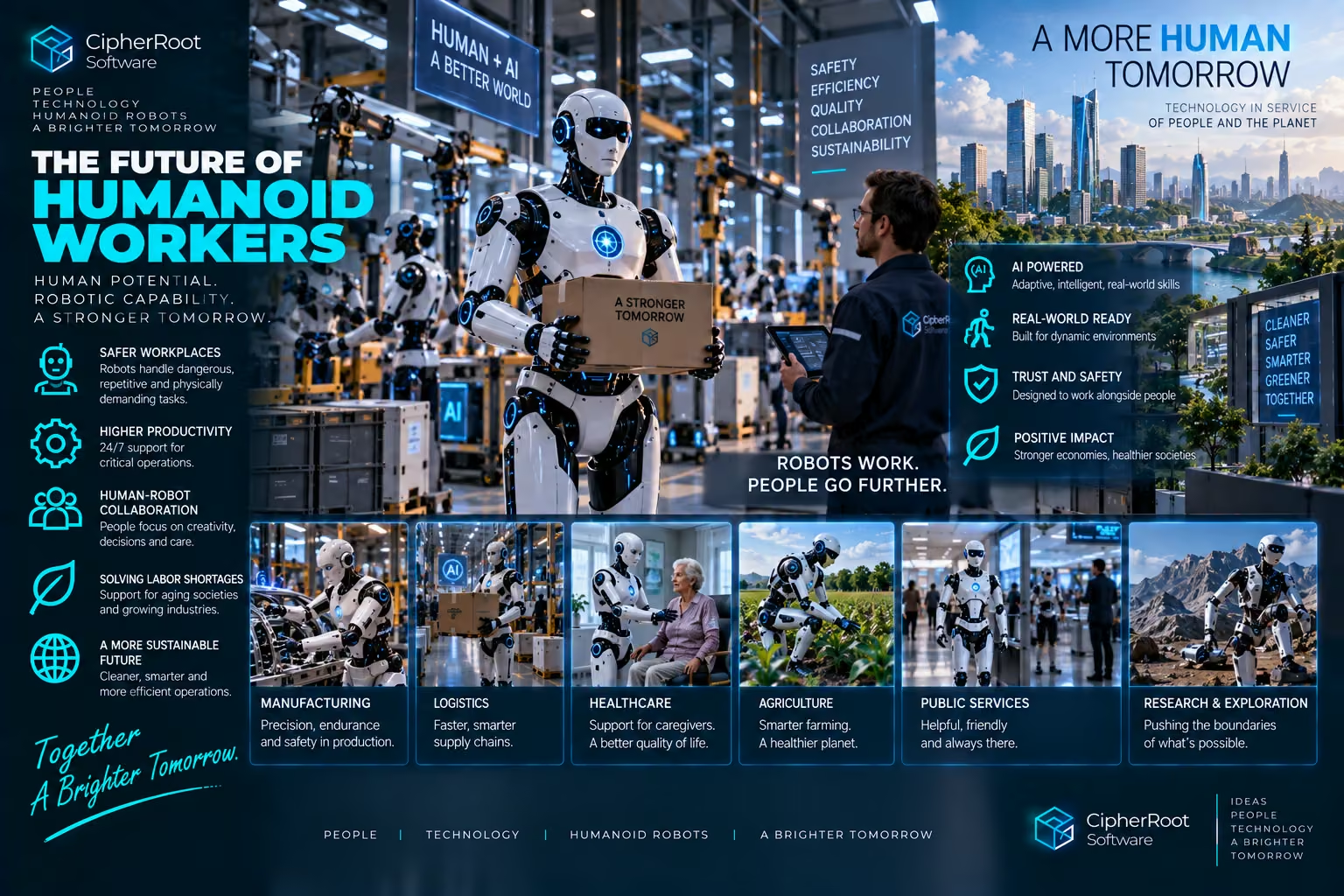
A New Kind of Worker Is Emerging
For generations, machines have helped humans perform work.
Factories introduced mechanical systems.
Computers transformed office work.
Industrial robots automated repetitive production.
Now robotics is moving toward a much more ambitious concept:
The humanoid worker.
Humanoid robots are machines designed with human-like physical structures that can potentially operate in environments created for people.
They may have two arms, two legs, hands, cameras, sensors, onboard computing, and AI-powered software.
The reason this design is interesting is simple.
The modern world has already been built around the human body.
Doors have handles.
Stairs have steps.
Shelves have human-height layouts.
Tools are designed for human hands.
Workstations are designed around human movement.
A humanoid robot could potentially use many of these environments without requiring everything to be rebuilt.
What Is a Humanoid Worker?
A humanoid worker is a robotic system designed to perform useful physical tasks in environments intended for humans.
The term does not necessarily mean that the robot must look exactly like a person.
The important characteristics are usually:
- Human-compatible movement
- Robotic manipulation
- Perception systems
- Autonomous navigation
- AI-based decision support
- Interaction with tools and environments
A humanoid robot may eventually be able to move through a workplace, recognize objects, carry materials, use equipment, and complete predefined tasks.
The technology is still developing, and capabilities can vary significantly between robotic platforms.
Why Build Humanoid Robots?
Why create a robot with a human-like body instead of simply building a specialized machine?
Because many environments are already optimized for humans.
Imagine a warehouse designed around human workers.
A robot with a conventional industrial arm may be extremely effective at one station.
A humanoid robot could potentially move between different areas and perform several tasks using the same infrastructure.
This creates a powerful concept:
One physical platform. Multiple tasks. Existing environments.
AI Gives Robots More Intelligence
A physical robot needs more than motors.
It needs to understand what is happening around it.
Artificial intelligence can help process information from:
- Cameras
- Depth sensors
- Force sensors
- Microphones
- Position systems
- Motion sensors
AI can help a robot recognize objects, interpret instructions, plan actions, and respond to changing conditions.
The process can look like:
Perceive → Understand → Plan → Act → Evaluate
This is very different from a traditional machine that simply repeats a fixed movement.
Humanoid Robots Need to Understand the World
Human environments are unpredictable.
A box can be moved.
A chair can be in a different place.
A person can walk unexpectedly into the robot's path.
An object can fall.
A door can be partially closed.
Humanoid workers therefore need strong environmental awareness.
Computer vision can help identify objects.
AI can interpret the scene.
Navigation systems can plan movement.
The robot then needs to act while remaining within its safety limits.
Hands May Be the Most Important Part
Walking looks impressive.
But useful work often depends on manipulation.
Humanoid hands may eventually need to:
- Pick up objects
- Open containers
- Use tools
- Press buttons
- Sort materials
- Handle packages
- Manipulate small components
Human environments contain enormous variety in object shapes.
A versatile robotic hand therefore needs to be more than strong.
It needs dexterity.
Learning Physical Skills
Traditional robots are often explicitly programmed for specific motions.
AI-based robotics is exploring systems that can learn from demonstrations, simulation, and large datasets.
A robot could potentially observe how a task is performed and learn a related movement strategy.
For example:
A person demonstrates how to place an object.
The robot analyzes the movement.
The system creates a plan.
The robot practices.
The task is refined through feedback.
This creates a different development model:
Demonstrate → Learn → Practice → Improve
Humanoid Workers in Manufacturing
Manufacturing is one of the most obvious applications.
Humanoid robots could potentially assist with:
- Material handling
- Assembly
- Packaging
- Machine tending
- Inspection
- Repetitive physical work
The major advantage would be flexibility.
Instead of building a dedicated robot for every new process, a general-purpose platform could potentially be adapted through software, tools, and AI.
However, many manufacturing tasks will continue to be better suited to specialized automation.
Humanoid robots are most interesting where flexibility matters.
Logistics and Warehouses
Warehouses are full of physical tasks.
Workers move packages.
Shelves are loaded and unloaded.
Containers are transported.
Products are sorted.
Humanoid robots could potentially assist with some of these activities.
A robot could pick up a package, walk to another location, place it on a shelf, and return for another task.
The same robot could potentially perform different activities during the same shift.
This flexibility could be valuable in changing warehouse environments.
Healthcare Support
Healthcare contains many repetitive logistics tasks.
A humanoid system could potentially transport supplies, move equipment, or assist with routine operational work.
Future systems may also support caregivers by handling selected physical tasks.
The distinction is important.
Healthcare is not simply a logistics environment.
Patient interaction requires empathy, clinical knowledge, communication, and professional responsibility.
Humanoid robots may assist healthcare workers without replacing the human relationship at the center of care.
Agriculture
Farming presents difficult physical environments.
Fields can be uneven.
Weather changes.
Objects can vary significantly.
Humanoid robots could potentially perform certain tasks that are difficult to automate using fixed machinery.
Possible applications include:
- Carrying materials
- Inspection
- Harvest support
- Equipment interaction
- Agricultural monitoring
AI could help robots identify plants, objects, and environmental conditions.
Agriculture could therefore become another environment where general-purpose robotics provides useful flexibility.
Construction
Construction sites are highly dynamic.
Workers move materials, use tools, inspect structures, and perform many different tasks.
Humanoid robots could eventually assist with selected repetitive or physically demanding work.
A robot might:
Carry materials.
Move tools.
Perform simple repetitive assembly.
Inspect predefined areas.
Assist with site logistics.
The key challenge is reliability.
Construction environments are far less controlled than factories.
Humanoid Workers in Public Services
Humanoid robots could also operate in:
- Airports
- Shopping centers
- Hotels
- Offices
- Transportation hubs
- Public facilities
A robot could assist with navigation, delivery, information, or routine maintenance.
Public environments introduce an additional challenge:
People are unpredictable.
A humanoid worker needs to move safely among large numbers of people without creating confusion or risk.
Working Alongside Humans
The strongest use case may not be replacing human workers.
It may be working alongside them.
A human can handle:
- Judgment
- Creativity
- Communication
- Leadership
- Complex problem solving
A humanoid robot can handle:
- Repetition
- Physical movement
- Material transport
- Routine inspection
- Physically demanding tasks
AI can help coordinate the two.
This creates a new workplace structure:
Human + Humanoid Robot + AI
AI as the Robot's Cognitive Layer
A humanoid robot can be thought of as several systems working together.
Body
Motors, joints, hands, and physical structure.
Sensors
Cameras, depth sensors, force sensors, and other measurement systems.
AI
Perception, reasoning, planning, and learning.
Control
Software that translates decisions into physical movement.
Communication
Interfaces for humans and other machines.
This layered architecture is what makes humanoid workers possible.
Natural Language Instructions
One of the most important developments may be the ability to communicate with robots naturally.
Instead of programming a robot manually, a worker could say:
“Move those boxes to the storage area.”
The AI system would need to identify:
Which boxes?
Which storage area?
What route?
What handling method?
Is the task safe?
The robot then performs the operation.
This creates a much more accessible interface.
Natural language becomes a control layer for physical machines.
Robots That Learn New Tasks
The long-term vision is not just robots that perform known tasks.
It is robots that can learn new ones.
Imagine introducing a humanoid robot to a new workplace.
A human demonstrates a process.
The robot observes.
AI analyzes the demonstration.
The system practices in simulation.
The robot performs the task physically.
Human feedback improves the behavior.
This could dramatically reduce the time required to deploy robots in new environments.
Simulation Will Be Essential
Training physical robots in the real world can be slow and expensive.
Simulation offers a safer environment for experimentation.
Robots can practice:
- Walking
- Picking
- Balancing
- Tool use
- Navigation
- Object manipulation
Virtual environments can generate large numbers of training situations.
After simulation, robots can be evaluated in controlled physical environments.
This creates a bridge between digital training and physical performance.
Digital Twins of Humanoid Workers
A digital twin can also represent a humanoid robot digitally.
Engineers can simulate:
- Joint movement
- Battery consumption
- Tool use
- Task planning
- Collision scenarios
- Workspace layouts
A digital twin can help identify problems before they occur in the physical robot.
The virtual model becomes a training and engineering environment.
Battery Life Is a Major Constraint
Humanoid robots need significant energy.
Walking requires power.
Moving arms requires power.
Running cameras and AI processors requires power.
Carrying heavy objects requires even more.
Battery technology therefore plays a major role in humanoid robotics.
A useful worker must operate long enough to be practical.
Autonomous charging stations could become part of future robot workplaces.
The robot could work.
Return to charge.
Resume the task.
Maintenance Becomes Important
Humanoid robots have many moving parts.
Joints, motors, gear systems, sensors, batteries, and mechanical components can wear over time.
Predictive maintenance can monitor robot health.
AI can analyze:
- Motor temperatures
- Vibration
- Battery performance
- Movement accuracy
- Energy consumption
The system can identify unusual behavior before a component fails completely.
Humanoid Robots and Safety
Safety becomes particularly important when robots operate beside people.
The robot needs to understand its surroundings.
It should control speed and force appropriately.
It should stop when uncertainty becomes too high.
It should have emergency systems.
It should operate within clearly defined limits.
A humanoid robot is a physical machine, so software mistakes can have physical consequences.
Safety therefore needs to be built into both hardware and AI systems.
Cybersecurity for Humanoid Workers
A connected humanoid robot is also a computer.
It may contain:
- Cameras
- Microphones
- Network interfaces
- Cloud connections
- AI models
- Control software
A compromised robot could create both digital and physical risks.
Security measures can include:
Strong authentication
Encrypted communication
Secure software updates
Access controls
Network segmentation
Continuous monitoring
The more capable the robot becomes, the more important cybersecurity becomes.
Privacy in the Workplace
Humanoid robots may continuously see and hear their environment.
This raises privacy questions.
What should the robot remember?
Should it record conversations?
How long should images be stored?
Who can access the data?
Can employees be monitored through robotic systems?
These questions should be addressed before deployment.
A robot should not automatically collect everything simply because it can.
The Impact on Jobs
Humanoid robotics will inevitably change some jobs.
Some repetitive tasks may become increasingly automated.
Other roles may focus more on:
- Robot supervision
- Maintenance
- Engineering
- AI operations
- Safety
- Workflow design
The effect will vary by industry and task.
The important question is not simply whether a job disappears.
It is how the overall structure of work changes.
Humans May Become Robot Supervisors
A future warehouse worker may spend less time physically carrying packages and more time coordinating automated systems.
A technician may supervise a fleet of humanoid robots.
An engineer may train robots for new tasks.
A maintenance specialist may diagnose robotic failures.
This creates a new category of work:
Managing physical AI systems.
The Rise of Robotic Fleets
One humanoid robot is interesting.
A fleet is much more transformative.
Imagine hundreds of robots operating across a facility.
An AI management system can coordinate:
- Tasks
- Locations
- Battery levels
- Maintenance
- Priorities
One robot handles a delivery.
Another performs inspection.
A third returns to charge.
The system dynamically assigns work.
The workplace becomes a robotic ecosystem.
Multi-Robot Collaboration
Humanoid robots may eventually work together.
One robot could bring materials.
Another could perform assembly.
A third could inspect the finished product.
AI can coordinate their actions.
This can create production systems that are more flexible than isolated machines.
The robots become a team.
The Humanoid Worker as a General-Purpose Platform
This may be the biggest idea behind humanoid robotics.
Instead of:
One machine → One task
the goal becomes:
One platform → Many tasks
The robot's capabilities can be expanded through software, tools, and AI.
A manufacturing task today.
A logistics task tomorrow.
A maintenance task later.
This could create a fundamentally different automation model.
The Economic Challenge
Flexibility has a cost.
Humanoid robots require sophisticated hardware, software, sensors, batteries, maintenance, and AI infrastructure.
For a highly repetitive task, a specialized machine may still be more economical.
Humanoid workers become more attractive when:
- The environment changes frequently
- Tasks vary
- Human infrastructure already exists
- Labor is difficult to source
- Physical flexibility has significant value
Economics will therefore be one of the major factors determining adoption.
Humanoid Robots and Labor Shortages
Some industries face difficulties finding enough workers for physically demanding or repetitive tasks.
Humanoid robots could potentially help fill selected operational gaps.
This does not mean robots solve every workforce problem.
But they may provide additional capacity where the technology is practical.
The impact will depend on cost, reliability, safety, regulation, and actual task performance.
The Future Office May Have Physical AI
Most AI systems today operate digitally.
Humanoid robots bring AI into physical spaces.
An intelligent system can now:
See.
Move.
Carry.
Manipulate.
Interact.
Learn.
This represents an important transition.
Artificial intelligence is no longer limited to screens.
It is becoming physical.
Home Humanoid Assistants
The workplace is only one possible destination.
Humanoid robots could eventually enter homes.
They may help with:
- Cleaning
- Carrying objects
- Household organization
- Simple assistance
- Interaction with smart-home systems
The home is much less predictable than a factory.
Furniture moves.
Children play.
Pets walk around.
Objects are left in unusual locations.
This makes home robotics one of the hardest challenges for general-purpose machines.
Humanoid Robots and Elder Assistance
Humanoid systems could potentially help older adults with certain physical tasks.
A robot might carry objects, retrieve items, or assist with household routines.
But assistance should not be confused with replacing human care.
Human relationships remain essential.
Robots may become useful tools for independence and practical support while caregivers continue to provide the human connection.
The Ethical Side of Humanoid Workers
More capable robots create deeper ethical questions.
Should a robot always obey a human command?
What happens when an instruction is unsafe?
How should robots behave around children?
How should companies use workplace data collected by robots?
How much autonomy should a robot receive?
Who is responsible when the system makes an error?
These questions need answers before systems become deeply integrated into society.
Humans Must Remain in Control
A useful principle is straightforward:
People define the objectives. Robots execute within defined boundaries.
A humanoid worker should not have unlimited authority.
Human supervisors should be able to:
- Pause operations
- Change tasks
- Restrict permissions
- Review actions
- Shut down systems
Autonomy becomes safer when it exists inside clear limits.
The Future of Humanoid Training
Training could become a continuous process.
A robot performs a task.
The system measures performance.
AI identifies errors.
The robot retrains in simulation.
The updated behavior is deployed.
Performance is measured again.
This creates:
Work → Data → Learning → Improvement
Over time, fleets of robots could share certain learned improvements through carefully managed software systems.
A Day With Humanoid Workers
Imagine arriving at a modern warehouse.
Humanoid robots are already working.
One is unloading materials.
Another transports packages.
A third checks inventory.
A human operator monitors the fleet.
An AI system identifies a workflow bottleneck.
The operator approves a revised task allocation.
Several robots change their assignments.
Later, one robot reports a mechanical issue.
It moves to a charging and maintenance station.
Another robot takes over its task.
The operation continues.
Humans are not watching every movement.
They are supervising the system.
The Smart Factory of the Future
The same model can extend into manufacturing.
Humanoid workers can interact with human-scale tools and workstations.
AI systems coordinate production.
Machine vision checks quality.
Digital twins simulate changes.
Autonomous logistics systems move components.
Humans supervise the overall operation.
The factory becomes a combination of:
Robotics + AI + Data + Human Expertise
The Most Important Shift
The biggest change may not be that robots become human-like.
It may be that robots become general-purpose.
A specialized machine is excellent at one thing.
A general-purpose humanoid platform could potentially perform many different tasks.
That flexibility could change how companies think about automation.
Instead of designing every process around a machine, companies may increasingly design workflows around adaptable machines.
What Comes Next?
The development of humanoid workers will likely depend on progress in several areas:
AI
Better perception, planning, and learning.
Robotics
More reliable movement and manipulation.
Batteries
Longer operating time.
Sensors
Better understanding of the environment.
Simulation
Faster and safer training.
Manufacturing
Lower-cost robotic hardware.
Safety
More reliable human-robot interaction.
No single breakthrough is enough.
The systems need all of these pieces to work together.
Conclusion
Humanoid workers represent one of the most ambitious directions in robotics.
They combine artificial intelligence, computer vision, sensors, advanced motion control, robotic hands, autonomous navigation, and increasingly sophisticated learning systems.
Their potential applications extend across:
Manufacturing
Logistics
Healthcare support
Agriculture
Construction
Public services
Homes
The biggest attraction is flexibility.
Humanoid robots are being designed to operate in environments that were already built for people.
But the path to widespread adoption is not automatic.
Robots must become reliable.
They must be safe.
They need useful battery life.
They need strong cybersecurity.
They need responsible data practices.
And businesses need to determine where humanoid flexibility actually creates economic value.
The future workplace may therefore not be a world filled entirely with robots.
It may be a world where humans and humanoid machines work together.
People provide creativity, judgment, communication, leadership, and responsibility.
Robots provide physical capability, repetition, endurance, and scalable assistance.
AI connects the two.
The most interesting future is not:
Humans vs. Robots.
It is:
Humans + Robots + AI.
The factory worker of the future may not only operate machines.
They may supervise an entire fleet of them.
The workplace is changing.
The next generation of workers may not all be biological.
Humanoid robotics is bringing artificial intelligence into the physical world—and the story is only beginning.