
Future & Research
The Future of Human Augmentation: How Technology Could Expand Human Potential
CipherRoot Software12 min read
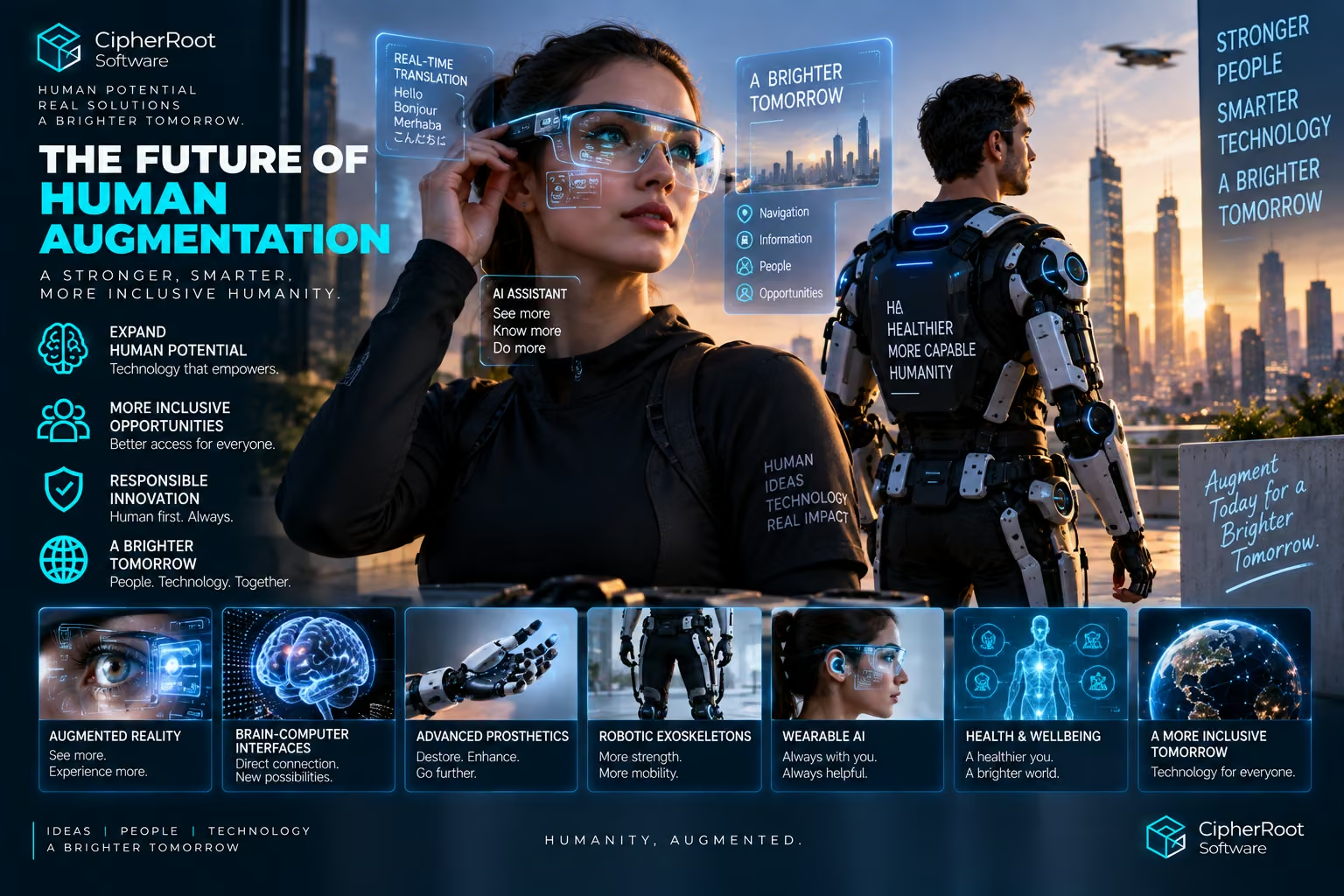
Technology Is Moving Closer to the Human Body
For thousands of years, humans have created tools to overcome physical and cognitive limitations.
We built vehicles to move faster.
We created machines to lift heavier objects.
We developed computers to process information.
Now technology is moving closer to the body itself.
Wearable computers, AI assistants, robotic systems, augmented reality, prosthetic technologies, and advanced interfaces are creating a new field known broadly as human augmentation.
The idea is not simply to make machines more powerful.
It is to explore how technology can help people see more, move better, understand more, communicate faster, and perform tasks that were previously difficult or impossible.
What Is Human Augmentation?
Human augmentation refers to technologies designed to enhance, restore, or extend human capabilities.
These technologies can affect different aspects of human ability:
- Physical strength
- Mobility
- Vision
- Hearing
- Memory and information access
- Communication
- Dexterity
- Decision support
- Environmental awareness
Some forms of augmentation are already familiar.
Eyeglasses improve vision.
Hearing devices assist hearing.
Prosthetic systems can restore physical function.
The next generation could combine these ideas with AI, robotics, sensors, and connected computing.
From Tools to Intelligent Augmentation
Traditional tools extend human capabilities from the outside.
A hammer increases the effectiveness of a person's physical effort.
A calculator expands numerical capability.
A smartphone provides access to enormous amounts of information.
AI introduces a new layer.
Instead of simply giving people information, an intelligent system can analyze information and help interpret it.
This creates a shift from:
Tool → Assistant → Intelligent augmentation
The technology increasingly works alongside the user rather than simply waiting for manual commands.
AI as a Cognitive Assistant
One of the most important forms of future augmentation may be cognitive rather than physical.
People have limited attention and memory.
AI systems can process much larger quantities of information.
An AI assistant could potentially help users:
- Organize information
- Recall relevant details
- Summarize documents
- Translate languages
- Compare options
- Identify patterns
- Prepare decisions
- Retrieve information instantly
The objective is not to make humans think less.
It is to reduce the amount of mental effort spent on repetitive information processing.
Human judgment remains important.
The machine provides additional cognitive support.
Wearable AI
Wearable devices are becoming increasingly intelligent.
Smartwatches, smart glasses, earbuds, rings, and other connected devices can place computing directly onto the body.
This can make technology more immediate.
A wearable AI system could potentially understand:
Where you are.
What you are doing.
What you are looking at.
What you are asking.
Which information might be useful.
This leads to the concept of context-aware computing.
Instead of requiring the user to constantly explain the situation, the system can use available context to provide more relevant assistance.
Smart Glasses and Augmented Reality
Smart glasses could become one of the most visible forms of human augmentation.
A display in the user's field of view can provide digital information without requiring a separate screen.
Possible applications include:
- Navigation
- Real-time translation
- Technical instructions
- Object recognition
- Remote collaboration
- Training
- Accessibility
- Contextual information
Imagine a technician looking at a machine and seeing relevant maintenance information directly in their field of view.
The physical object remains unchanged.
The information surrounding it becomes richer.
Augmented Reality for Learning
Human augmentation could also transform education.
A student studying biology might see a three-dimensional model over a physical textbook.
A trainee mechanic could see instructions over a real engine.
A medical student could explore a detailed anatomical visualization.
A language learner could see translations in real time.
The key advantage is combining digital information with physical experience.
Learning becomes more interactive.
Instead of simply reading about something, people can potentially see and manipulate information in context.
Robotic Exoskeletons
Physical augmentation is another major area.
Powered exoskeletons are being developed to assist human movement and physical tasks.
These systems can potentially support:
- Lifting
- Walking assistance
- Rehabilitation
- Industrial work
- Mobility
An exoskeleton can combine sensors, motors, and control systems to respond to the user's movement.
The challenge is making the machine feel natural.
A useful system should ideally move with the person rather than forcing the person to adapt to the machine.
Prosthetics Are Becoming More Intelligent
Modern prosthetic technology is also evolving.
Sensors and advanced control systems can provide more precise interaction between the user and the device.
Future prosthetic systems may increasingly combine:
Sensors + AI + robotics + human-machine interfaces
to provide more natural movement.
Research into neural interfaces is also exploring ways to allow signals from the nervous system to interact with external devices.
This could eventually create more direct forms of control.
Brain-Computer Interfaces
One of the most ambitious forms of human augmentation is the brain-computer interface, or BCI.
BCI research explores ways to translate neural activity into commands that can control external systems.
Possible applications include:
- Assistive communication
- Prosthetic control
- Accessibility
- Rehabilitation
- Human-computer interaction
This technology is still developing and presents major scientific, technical, medical, ethical, and safety challenges.
But the concept is profound.
Instead of controlling a machine through a keyboard, touchscreen, or voice, humans could potentially interact with computers through neural signals.
Human-Machine Communication
The future of augmentation may depend heavily on better interfaces.
Today, communication with machines often requires explicit commands.
Type.
Click.
Tap.
Speak.
Future interfaces could become more natural.
Computers may interpret:
- Voice
- Eye movement
- Hand gestures
- Body movement
- Environmental context
- Neural signals
This could reduce the distance between intention and action.
The closer the interface gets to natural human behavior, the less the technology feels like a separate machine.
Vision Augmentation
Human vision can also be enhanced through technology.
Cameras and computer vision systems can provide information that ordinary eyesight cannot.
A wearable system could potentially recognize:
- Text
- Objects
- Locations
- Signs
- People
- Environmental features
For some users, this can provide accessibility support.
For others, it can provide contextual information.
The distinction between “seeing” and “understanding what is seen” becomes increasingly interesting when AI is involved.
Hearing and Audio Augmentation
The same principle applies to hearing.
AI-powered audio systems can process sound and provide additional information.
Future systems may be able to isolate important voices from noisy environments, translate speech, transcribe conversations, or provide contextual audio cues.
Instead of simply amplifying sound, intelligent systems can potentially interpret sound.
This is another example of augmentation moving from simple amplification toward intelligent assistance.
Memory and Information Augmentation
Humans cannot remember everything.
Digital systems can store enormous amounts of information.
Future AI assistants may act as external memory systems.
A person could potentially ask:
“When did we discuss this?”
“Where did I save that document?”
“What was the name of the person I met yesterday?”
An AI system connected to appropriate personal information could help retrieve relevant context.
This raises enormous privacy questions.
A digital memory can be useful.
A digital memory that records everything can also become intrusive.
The Privacy Problem
Human augmentation can make technology deeply personal.
A device worn on the body may collect information about:
- Location
- Voice
- Vision
- Movement
- Communication
- Daily routines
- Personal preferences
The more information the system knows, the more useful it may become.
But the same information can also become highly sensitive.
This creates a fundamental design challenge:
How much should an augmentation system know?
Privacy must therefore be considered from the beginning.
User Control Matters
Human augmentation should remain under human control.
Users should know what the system is doing.
They should be able to turn features off.
They should be able to inspect important permissions.
They should have meaningful control over their own data.
This becomes especially important for systems capable of continuous sensing.
A technology designed to help people should not quietly remove their ability to control the technology.
Security Becomes Personal
When computing moves onto the human body, cybersecurity becomes more personal.
A compromised smartphone is a serious problem.
A compromised wearable or assistive device could be far more consequential.
Security for human-augmentation systems may need to protect:
- Personal data
- Device identity
- Sensor information
- AI models
- Communication channels
- Software updates
- Physical controls
Strong authentication and secure architecture will become increasingly important.
Human Augmentation in the Workplace
Workplaces could become major environments for augmentation.
Workers could use intelligent wearables to access information without leaving their task.
Technicians could receive real-time instructions.
Warehouse workers could receive navigation assistance.
Engineers could visualize digital models next to physical equipment.
Industrial exoskeletons could assist with demanding tasks.
Remote experts could collaborate with workers through augmented interfaces.
This can turn the workplace into a hybrid environment where physical activity and digital information are tightly connected.
Augmentation and Creativity
Human augmentation does not have to focus only on productivity.
It can also expand creative possibilities.
Artists could use spatial interfaces.
Musicians could interact with new forms of digital instruments.
Filmmakers could visualize virtual environments.
Designers could manipulate three-dimensional objects in augmented space.
Creators may eventually interact with digital information almost as naturally as they interact with physical materials.
Technology becomes another medium for expression.
Human Augmentation and Accessibility
Accessibility may be one of the most meaningful areas of human augmentation.
A technology that restores or improves a person's ability to communicate, move, hear, or interpret their environment can have enormous practical value.
Examples include:
- Intelligent prosthetics
- Assistive communication systems
- AI vision tools
- Smart hearing systems
- Mobility assistance
- Adaptive interfaces
This is a reminder that augmentation is not only about creating superhuman capabilities.
Sometimes augmentation simply means helping someone regain capabilities that were lost.
Could Augmentation Create Superhuman Abilities?
This is where the subject becomes more speculative.
What happens when technology goes beyond restoring or assisting natural human abilities?
Imagine:
Robotic limbs stronger than biological limbs.
AI memory systems capable of instant retrieval.
Vision systems capable of analyzing information beyond normal perception.
Wearables that provide continuous translation.
Exoskeletons that dramatically increase physical endurance.
These possibilities raise difficult social and ethical questions.
Who has access to augmentation?
What happens when enhanced and non-enhanced people compete?
Should certain augmentations be regulated?
Could augmentation create new forms of inequality?
These questions will become more important as the technology matures.
The Difference Between Assistance and Enhancement
It is useful to distinguish between two broad goals.
Restoration
Helping someone regain a capability they have lost.
Enhancement
Extending a capability beyond typical human performance.
The first is already familiar in medicine and accessibility.
The second moves into a much more complicated social and ethical territory.
The future of augmentation may include both.
Society will need to decide how different applications should be governed.
The Future of Neural Interfaces
Neural interfaces could eventually become a major step toward more direct human-computer interaction.
A future interface might allow people to control software, robotics, or communication systems using neural signals.
But neural data is exceptionally sensitive.
A system capable of interpreting brain activity introduces questions that ordinary wearable technology does not.
Who owns neural data?
How is it protected?
Can it be stored?
Can it be sold?
Can users revoke access?
These issues will require careful consideration as research progresses.
Humans + AI + Robotics
The most powerful form of augmentation may come from combining several technologies.
Imagine:
AI understands the user's intent.
A wearable provides information.
A robotic device performs the physical action.
A cloud system provides additional computation.
A smart environment responds automatically.
The human becomes the center of a larger intelligent system.
This is not one device.
It is an ecosystem.
A New Definition of the Interface
For decades, the computer interface was a screen.
Then touchscreens made interaction more direct.
Voice assistants removed the need for physical controls.
Augmented reality is bringing information into physical space.
Neural interfaces explore an even more direct path.
The long-term evolution may look something like:
Screen → Voice → Vision → Context → Intent
The closer technology gets to understanding intent, the less explicit interaction may be required.
The Future of Human Potential
Human augmentation is ultimately about expanding what people can do.
It can help workers perform physical tasks.
It can help users access information.
It can support people with disabilities.
It can improve communication.
It can enhance creativity.
It can connect humans with intelligent machines.
But greater capability also creates greater responsibility.
The technology must remain understandable, secure, private, and controllable.
Enhancement should not come at the cost of human autonomy.
A Day in an Augmented Future
Imagine starting the day wearing lightweight AI glasses.
Your assistant provides your schedule.
Your earbuds translate a conversation.
Your wearable helps you navigate a busy city.
At work, augmented information appears next to physical equipment.
An exoskeleton assists with a demanding task.
An AI system summarizes technical information.
At the end of the day, your digital assistant organizes everything you need to remember.
The technology does not replace you.
It works alongside you.
It becomes an extension of your capabilities.
Conclusion
The future of human augmentation will bring together artificial intelligence, robotics, wearable computing, augmented reality, assistive technologies, and potentially neural interfaces.
Some forms of augmentation are already part of everyday life.
Others remain active areas of research and development.
The most important question is not simply how powerful these technologies can become.
It is how responsibly they can become part of human life.
The best augmentation technology should expand capability without reducing autonomy.
It should provide assistance without becoming intrusive.
It should make people more capable without making them dependent on systems they cannot control.
The future may not belong to humans or machines separately.
It may belong to the systems we build when the two become increasingly connected.
Stronger tools. Smarter interfaces. Greater human potential.
The next generation of technology may not simply work for humanity.
It may become an extension of what humanity can do.