
Future & Research
The Future of Delivery Robots: How Autonomous Delivery Could Transform Cities
CipherRoot Software5 min read
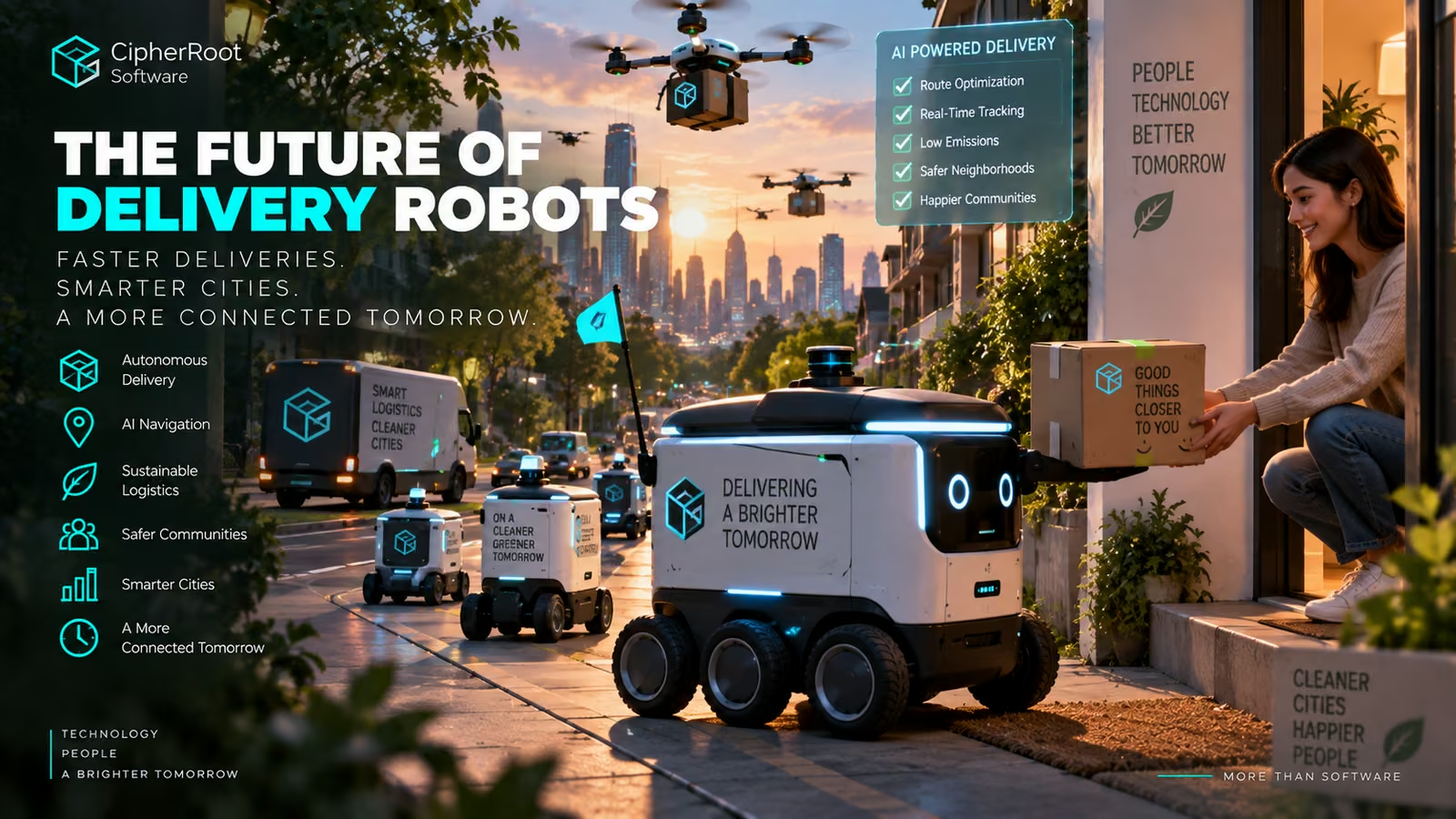
The Delivery Revolution Is Moving to the Sidewalk
The way people buy and receive products has changed dramatically over the past two decades.
Online shopping has made it possible to order almost anything from a smartphone. Warehouses have become increasingly automated, logistics networks have become more data-driven, and companies are constantly looking for ways to move products faster and more efficiently.
Now the next step is reaching the final destination.
This is where delivery robots enter the picture.
Autonomous ground robots and delivery drones are being developed to transport food, packages, groceries, medicine, and other goods with reduced human intervention.
The idea sounds futuristic, but the technology behind it is already being developed across robotics, artificial intelligence, computer vision, mapping, and autonomous navigation.
The future of delivery may not always involve a person knocking on the door.
Sometimes, a robot may do it.
What Are Delivery Robots?
Delivery robots are autonomous or semi-autonomous machines designed to transport goods from one location to another.
Ground-based delivery robots generally travel along sidewalks, pedestrian paths, private roads, or controlled environments.
They can use a combination of:
- Cameras
- LiDAR and other sensors
- GPS
- Computer vision
- Artificial intelligence
- Mapping systems
- Obstacle detection
- Wireless connectivity
- Remote supervision
A typical delivery robot can receive an order, calculate a route, travel to its destination, navigate around obstacles, and notify the customer when it arrives.
Some systems can also lock their cargo compartments until the authorized recipient unlocks them.
AI Is the Brain Behind Autonomous Delivery
A delivery robot needs to understand its environment.
Roads and sidewalks are not perfectly predictable.
People walk in different directions. Cars stop unexpectedly. Bicycles pass by. Construction areas appear. Weather conditions change.
Artificial intelligence can help robots interpret this environment.
Computer vision systems can identify objects such as:
- Pedestrians
- Vehicles
- Bicycles
- Traffic signs
- Curbs
- Crosswalks
- Road barriers
- Other robots
AI can then help the system decide how to move safely through the environment.
This is one of the biggest differences between a traditional delivery vehicle and an autonomous robot.
A conventional machine follows instructions.
An autonomous machine has to interpret the world around it.
Last-Mile Delivery Is the Biggest Opportunity
In logistics, the final part of a journey is often called the last mile.
A package may travel hundreds or thousands of kilometers before reaching a local distribution center.
The final trip from that location to a customer's home is comparatively short, but it can be operationally complicated.
A delivery vehicle may need to make multiple stops, search for parking, navigate traffic, and spend time moving between addresses.
Small autonomous delivery robots offer another possibility.
Instead of using a full-size vehicle for every short trip, companies could potentially deploy smaller robots for nearby deliveries.
This could make local delivery networks more flexible.
Delivery Robots for Food and Groceries
Food delivery is a natural application for autonomous robots.
A small robot can transport a meal from a restaurant to a nearby customer without requiring a human driver for the entire trip.
The same concept can apply to groceries.
Imagine ordering a small number of products from a nearby store and having an autonomous robot bring them directly to your building.
For short-distance deliveries, a robot could potentially spend most of its time moving through local streets and sidewalks rather than sitting in traffic.
This could create a new model of neighborhood-scale logistics.
Delivery Drones Add Another Dimension
Ground robots are not the only technology changing delivery.
Drones offer an entirely different approach.
A delivery drone can travel through the air rather than navigating roads and sidewalks.
For certain applications, aerial delivery could reduce travel time and avoid traffic entirely.
Potential use cases include:
- Small packages
- Food
- Medical supplies
- Emergency deliveries
- Remote-area logistics
However, drones also face their own technical, environmental, and operational challenges.
Airspace management, weather, battery capacity, safety, noise, and local regulations all influence where and how delivery drones can operate.
The future logistics network may therefore include both ground robots and aerial robots, with each technology handling different types of deliveries.
Smart Navigation and Real-Time Routing
An autonomous robot does not simply need a map.
It needs a route that makes sense right now.
Temporary road closures, crowds, construction, weather, and unexpected obstacles can all change the best path.
AI-powered routing systems can continuously evaluate conditions and adjust navigation.
A delivery robot could theoretically choose between multiple routes based on:
- Distance
- Estimated travel time
- Pedestrian density
- Road conditions
- Delivery priority
- Battery level
- Temporary obstacles
This can turn delivery routing into a continuously changing optimization problem.
Battery Technology Matters
A delivery robot is only useful if it can complete its tasks reliably.
Battery technology therefore plays an important role.
Robots need enough energy to travel their routes while also powering sensors, computers, communication systems, and motors.
Future improvements in battery technology could increase operating range and reduce charging downtime.
Charging infrastructure could also become more intelligent.
A delivery fleet could automatically return to charging stations based on battery levels, workload, and expected demand.
In a mature autonomous delivery network, even charging could become part of the automation system.
Swarms of Delivery Robots
The long-term future could involve large fleets of autonomous robots rather than individual machines.
Imagine a city where thousands of delivery robots continuously move between stores, restaurants, warehouses, and homes.
A central logistics platform could coordinate the fleet.
The system could determine:
Which robot is closest?
Which robot has enough battery?
Which robot should collect the package?
Which route is most efficient?
Should the robot return immediately or accept another order nearby?
This creates a concept similar to an autonomous logistics swarm.
Each robot would operate independently while remaining part of a much larger network.
Delivery Robots and Smart Cities
Autonomous delivery technology could become closely connected to smart-city infrastructure.
Traffic systems, digital maps, charging stations, warehouses, parking areas, and buildings could all communicate with delivery platforms.
For example, a smart building might provide a secure robotic delivery area.