
Systems & Infrastructure
The Future of Cloud Computing: Building the Infrastructure of Tomorrow
CipherRoot Software8 min read
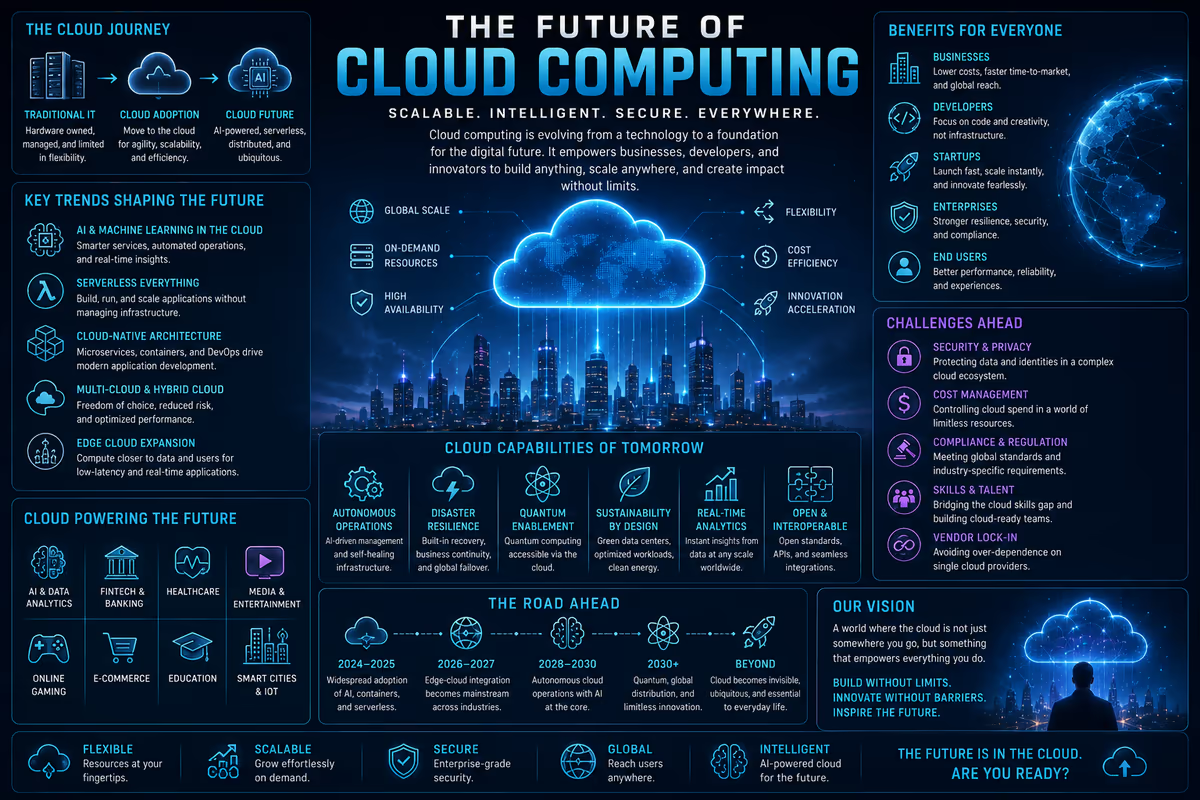
Cloud computing has transformed the way software, businesses, and digital services operate.
Instead of purchasing and maintaining large amounts of physical hardware, organizations can access computing power, storage, databases, and artificial intelligence services through the internet.
But cloud computing is still evolving.
The next generation of cloud infrastructure will increasingly combine artificial intelligence, edge computing, serverless architecture, automation, advanced security, and distributed computing.
The cloud of the future may become so deeply integrated into everyday technology that users barely notice it exists.
What Is Cloud Computing?
Cloud computing provides computing resources through remote infrastructure rather than requiring every organization or user to own all of the hardware themselves.
These resources can include:
- Computing power
- Storage
- Databases
- Networking
- AI services
- Security systems
- Development platforms
- Data analytics
Instead of purchasing a server for every application, developers can provision resources when they need them and scale them as demand changes.
This flexibility has become one of the defining characteristics of modern software development.
From Traditional IT to the Cloud
Traditional IT infrastructure often required companies to purchase servers, networking equipment, storage systems, and other hardware.
Capacity had to be estimated in advance.
If demand suddenly increased, the existing infrastructure might not be sufficient.
Cloud computing introduced a different model.
Organizations can increasingly scale resources according to demand.
This has made it easier for startups and independent developers to launch digital products without building an entire data center.
AI-Powered Cloud Computing
Artificial intelligence is becoming deeply connected with cloud infrastructure.
Cloud providers can offer access to powerful AI models, GPUs, data-processing systems, and machine-learning platforms.
This allows developers to build AI applications without necessarily owning expensive specialized hardware.
AI can also help cloud platforms manage themselves.
Future systems could automatically:
- Detect infrastructure problems
- Optimize resource allocation
- Predict demand
- Reduce unnecessary costs
- Detect security threats
- Adjust workloads
- Recover from certain failures
The cloud is becoming not only a place where applications run, but also an intelligent infrastructure layer.
Serverless Computing
Serverless computing changes how developers think about infrastructure.
Instead of managing traditional servers directly, developers can deploy application functions that run when needed.
The platform handles much of the underlying infrastructure.
This can be particularly useful for applications with unpredictable traffic.
A small application might use very little computing power most of the time but suddenly experience thousands of requests.
Serverless infrastructure can automatically scale according to demand.
Cloud-Native Applications
Modern applications are increasingly designed specifically for cloud environments.
Cloud-native architectures often use technologies such as:
- Containers
- Microservices
- Kubernetes
- Serverless functions
- APIs
- Automated deployment systems
Instead of building one enormous application, developers can divide systems into smaller services that can be developed and scaled independently.
This can make large applications more flexible, although it also introduces additional complexity.
The Rise of Edge Cloud
Cloud computing does not mean every computation must happen in a distant data center.
Edge computing brings processing closer to users and devices.
This is particularly important for applications that require very low latency.
Examples include:
- Autonomous vehicles
- Robotics
- Industrial systems
- Smart cities
- AR and VR
- Real-time analytics
The future will likely combine centralized cloud infrastructure with distributed edge computing.
Cloud + Edge
The relationship between cloud and edge computing can be viewed as complementary.
Cloud: handles large-scale computation, storage, AI training, and centralized analysis.
Edge: handles fast local processing and real-time decisions.
For example, a smart factory could process immediate sensor information locally while sending aggregated information to the cloud for long-term analysis.
This hybrid architecture could become increasingly common.
Cloud Computing and Quantum Technology
Quantum computing remains an emerging field, but cloud platforms could make access to quantum systems easier.
Rather than requiring organizations to purchase and operate experimental quantum hardware, cloud platforms can potentially provide remote access to quantum processors.
This could allow researchers and developers to experiment with quantum algorithms without owning the underlying machines.
Quantum computing is still developing, and practical applications at large scale remain an active area of research.
Sustainable Cloud Computing
Data centers consume significant amounts of electricity and require sophisticated cooling systems.
As cloud demand increases, energy efficiency will become increasingly important.
Future data centers may focus on:
- More efficient processors
- Improved cooling
- Renewable electricity
- Better workload optimization
- Energy-aware scheduling
- Higher server utilization
AI could also help optimize energy consumption by dynamically moving workloads according to available resources.
The future of cloud computing will therefore involve not only performance, but also efficiency.
Cloud Security
As more information moves into cloud environments, security becomes increasingly important.
Organizations need to protect:
- Customer data
- Financial information
- User accounts
- APIs
- Applications
- Infrastructure
Future cloud security systems will increasingly use automation and AI to detect unusual behavior and identify potential threats.
However, security will never be completely automatic.
Strong authentication, access controls, encryption, monitoring, secure development practices, and human oversight will remain essential.
Multi-Cloud and Hybrid Cloud
Organizations do not always want to depend on a single cloud provider.
Multi-cloud strategies allow businesses to use services from multiple providers.
Hybrid cloud architectures combine private infrastructure with public cloud resources.
These approaches can provide flexibility and redundancy, although they also create additional management complexity.
Future cloud platforms will need better interoperability between different environments.
Cloud Computing for Developers
The cloud has dramatically changed software development.
A developer can build an application on a local computer and deploy it to global infrastructure without purchasing physical servers.
Modern developers can access:
- Databases
- Authentication
- Storage
- AI APIs
- Serverless functions
- Monitoring
- Deployment platforms
This has lowered the barrier to building software.
A small team can now create services that can potentially reach users around the world.
Cloud Gaming
Cloud computing is also changing entertainment.
Cloud gaming allows games to run on powerful remote hardware while the player's device receives the rendered experience over the network.
This can reduce the need for extremely powerful local hardware.
However, network latency, bandwidth, and connection stability remain important limitations.
As networks improve, cloud gaming could become increasingly practical for more users.
Cloud Computing and Smart Cities
Future cities could rely heavily on cloud infrastructure.
Traffic systems, energy networks, public transportation, environmental sensors, and infrastructure monitoring could generate enormous amounts of data.
Cloud platforms could analyze this information and help cities optimize operations.
Combined with Edge AI, the result could be a distributed intelligent city infrastructure.
Autonomous Cloud Infrastructure
One of the most interesting possibilities is the emergence of increasingly autonomous cloud systems.
Imagine infrastructure that continuously monitors itself.
A system detects increased traffic.
It automatically adds computing resources.
Traffic decreases.
The system scales down.
A server begins showing abnormal behavior.
The system moves workloads elsewhere.
A security system detects suspicious activity.
Additional protection is automatically activated.
This is the direction toward self-managing infrastructure.
The Future of Cloud Applications
Future applications may not be tied to a single server or data center.
Instead, applications could operate across a distributed network of:
Cloud → Edge → Devices → AI systems
This architecture could make applications more responsive and resilient.
Users may not even know where a particular computation occurs.
The system simply chooses the most appropriate location automatically.
What Could Cloud Computing Look Like in 2035?
By the mid-2030s, cloud computing could become even more invisible.
Users may interact with applications without thinking about servers, storage, or infrastructure.
Behind the scenes, intelligent systems could automatically manage:
- Computing resources
- AI workloads
- Security
- Data storage
- Energy consumption
- Network routing
- Application scaling
The cloud could become less like a destination and more like an invisible global computing layer.
Challenges Ahead
Cloud computing still faces important challenges.
These include:
- Cybersecurity
- Privacy
- Infrastructure costs
- Energy consumption
- Vendor lock-in
- Regulatory requirements
- Network dependency
- Skills shortages
Organizations will need to balance convenience with control.
Moving everything to the cloud is not automatically the correct solution for every workload.
Good architecture depends on the specific requirements of the application.
The Bigger Picture
Cloud computing is evolving from simple remote infrastructure into a distributed computing ecosystem.
AI makes it more intelligent.
Edge computing makes it faster.
Serverless architecture makes it more flexible.
Automation makes it more autonomous.
Advanced security makes it safer.
Together, these technologies could create a computing environment that is available almost everywhere.
Final Thoughts
The future of cloud computing will not simply be about bigger data centers.
It will be about intelligent, distributed, automated, and increasingly invisible infrastructure.
Cloud platforms will continue to power applications, artificial intelligence, games, businesses, scientific research, and connected devices.
At the same time, edge computing will bring intelligence closer to users and machines.
The distinction between cloud, edge, and device computing may eventually become less important to the end user.
Everything will simply work together.
The cloud is no longer just somewhere on the internet.
It is becoming the invisible infrastructure behind the digital world.