
Systems & Infrastructure
The Future of Blockchain: What Comes Next for Decentralized Technology?
CipherRoot Software11 min read
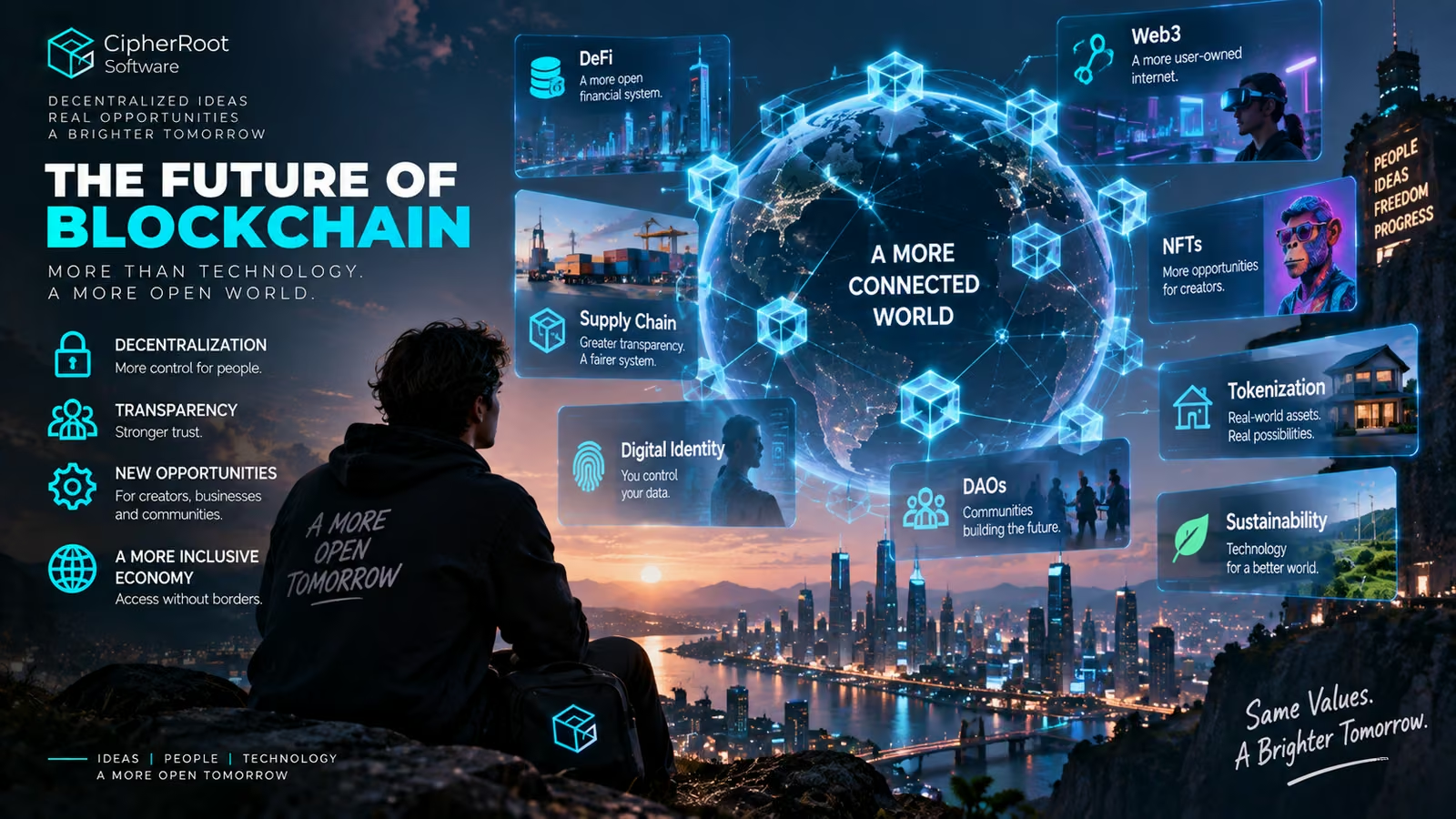
Blockchain Is Entering a New Phase
Blockchain technology began as a new way to record digital transactions without relying entirely on a central authority.
Its most famous application was cryptocurrency.
But the technology has continued to evolve.
Today, blockchain is being explored for financial services, digital identity, supply-chain tracking, tokenization, decentralized applications, gaming, digital credentials, and machine-to-machine transactions.
This suggests that the next phase of blockchain may be less about cryptocurrency alone and more about programmable trust and digital ownership.
The most important question is no longer:
“What can blockchain do for cryptocurrency?”
It is:
“Where can decentralized infrastructure provide something traditional software cannot?”
What Makes Blockchain Different?
Traditional applications usually rely on centralized infrastructure.
A company controls the database.
A platform controls the account system.
A payment provider manages the transaction record.
Blockchain introduces another model.
Instead of relying entirely on one organization, network participants can maintain and verify a shared record according to the rules of the protocol.
Depending on the blockchain, this can provide properties such as:
- Shared verification
- Programmable transactions
- Digital ownership
- Transparent records
- Distributed operation
These properties do not automatically make blockchain better for every application.
They simply make it useful for a different class of problems.
Smart Contracts Will Remain Important
Smart contracts are one of the most important technologies in the blockchain ecosystem.
They are software programs deployed on blockchain networks that execute predefined logic.
This makes it possible to create applications where certain actions happen automatically when their conditions are satisfied.
A smart contract can potentially:
- Transfer digital assets
- Manage payments
- Track ownership
- Operate decentralized applications
- Coordinate agreements
- Control access to digital resources
Smart contracts turn blockchain from a simple ledger into a programmable platform.
That programmability will remain central to the future of the technology.
Tokenization Could Connect Digital and Physical Assets
One of the most interesting developments is tokenization.
Tokenization means representing an asset, right, or claim through a digital token.
Depending on the legal and technical design, tokenized systems can be used to represent:
- Securities
- Real estate interests
- Collectibles
- Tickets
- Memberships
- Digital certificates
- Other real-world assets
The appeal is that digital tokens can be transferred, tracked, and potentially integrated into automated software systems.
However, a blockchain token does not automatically create legal ownership of a physical asset.
The legal connection has to exist outside the blockchain as well.
This distinction will become increasingly important as tokenization moves from experimentation toward real-world applications.
The Next Generation of Digital Identity
Online identity remains fragmented.
People often create separate accounts across dozens of services and repeatedly provide the same personal information.
Blockchain-based identity systems are exploring another model.
Users can potentially hold verifiable credentials and selectively present specific information when needed.
For example, a digital system could verify that someone has a particular qualification without requiring every detail of their identity.
This approach can potentially improve portability and user control.
Privacy, security, usability, and legal recognition will determine how far these systems can go.
The Evolution of Decentralized Finance
Decentralized finance, or DeFi, has demonstrated how blockchain can be used to build financial applications directly on programmable networks.
Smart contracts can support functions such as:
- Asset exchange
- Lending
- Borrowing
- Settlement
- Liquidity management
- Automated financial operations
The sector has also demonstrated that programmable finance introduces new technical and economic risks.
Smart-contract bugs, market volatility, poor design, wallet security problems, and other vulnerabilities can lead to significant losses.
The future of DeFi will therefore depend heavily on better security, usability, risk management, and infrastructure.
Blockchain and Web3
Web3 is often used to describe a broader vision of an internet where users can have greater control over digital identity, assets, and participation.
Different projects define Web3 differently.
Some focus on decentralized applications.
Others focus on digital ownership, community governance, or token-based ecosystems.
The important idea is that blockchain can provide a foundation for digital assets that are not necessarily controlled by a single application.
A user may hold an asset independently and use it across multiple compatible systems.
Whether that becomes mainstream depends on practical factors such as usability, security, developer adoption, and user demand.
Blockchain in Supply Chains
Supply chains involve many independent organizations.
A product can pass through manufacturers, logistics companies, warehouses, distributors, and retailers.
Each organization may keep its own records.
Blockchain can provide a shared record for selected supply-chain events.
This can support traceability for information such as:
- Manufacturing events
- Product movement
- Inspection records
- Shipment milestones
- Ownership transfers
But blockchain does not guarantee that information entered into the system is true.
A dishonest or incorrect input can still be recorded permanently.
The real value comes from combining blockchain with trustworthy data sources, secure processes, and reliable verification.
Blockchain Gaming and Digital Ownership
Gaming is another field where blockchain has been heavily explored.
Traditional games typically keep player inventories and digital items inside centralized databases.
Blockchain can represent certain digital assets as tokens.
That can enable experiments with:
- Player-owned assets
- Digital collectibles
- Tokenized items
- Secondary marketplaces
- Cross-platform asset concepts
The challenge is creating experiences where blockchain adds genuine value.
A game still needs strong gameplay.
Technology alone does not create an engaging product.
DAOs and Digital Organizations
Decentralized autonomous organizations, or DAOs, use smart contracts and governance mechanisms to coordinate participants.
Participants can potentially vote on proposals, allocate shared resources, or manage community-controlled systems.
DAOs introduce interesting questions around:
- Governance
- Voting systems
- Incentives
- Legal responsibility
- Security
- Decision-making
The technology is still evolving, but the concept points toward a broader trend:
Some organizational processes can be expressed as software.
Interoperability Will Be Essential
The blockchain ecosystem contains many networks.
Without interoperability, users can experience fragmented digital environments.
One network may contain an asset.
Another may contain an application.
A third may provide a different execution environment.
Future infrastructure will increasingly need secure communication between these networks.
Interoperability can help create a more connected ecosystem where users do not need to understand the technical differences between every chain.
The long-term goal is not a world of isolated blockchains.
It is a connected network of networks.
Layer-2 Networks and Scalability
Blockchain networks need to process more activity without sacrificing important properties such as security and decentralization.
This is one reason Layer-2 technologies have become so important.
Instead of processing every operation directly on the base layer, some systems can process activity through secondary networks and periodically settle information back to the underlying blockchain.
This can improve throughput and reduce transaction costs for certain workloads.
As blockchain adoption grows, scalability solutions will become an increasingly important part of the overall architecture.
Privacy Will Become More Important
Blockchain is often associated with transparency.
But transparency is not always desirable.
Financial records, identity information, business activities, and personal data can require privacy.
Future blockchain systems may increasingly use cryptographic techniques that allow information to be verified without exposing more data than necessary.
Zero-knowledge technologies are an important example of this approach.
The goal is to combine:
Privacy + Verification + Usability
rather than sacrificing one for another.
Blockchain and Artificial Intelligence
AI and blockchain solve different kinds of problems.
AI is focused on computation, pattern recognition, prediction, and generation.
Blockchain is focused on shared state, verification, ownership, and programmable transactions.
This makes them potentially complementary.
AI agents could use blockchain-based wallets.
Smart contracts could manage payments between autonomous software systems.
AI services could be paid programmatically.
Blockchain could provide transaction records for certain AI-related interactions.
This could become particularly interesting as software agents become capable of performing increasingly complex tasks.
Machine-to-Machine Payments
Imagine software that can pay other software.
An autonomous vehicle could pay for charging.
A robot could pay for access to a service.
An AI agent could purchase computing resources.
A machine could automatically settle a transaction after completing a task.
These scenarios require systems that can authenticate, transact, and settle without constant human intervention.
Blockchain-based infrastructure could potentially support some of these machine-to-machine economies.
Humans define the rules.
Software executes the transactions.
Blockchain and the Internet of Things
The Internet of Things connects billions of physical devices.
Sensors, vehicles, industrial machines, smart appliances, and other devices increasingly communicate with digital platforms.
Blockchain can potentially provide a mechanism for certain device identities, records, transactions, or shared states.
For example, devices could theoretically use programmable systems to prove events or trigger transactions.
This does not mean every IoT device needs a blockchain.
In many cases, conventional databases will remain more efficient.
The key is identifying situations where distributed verification or shared ownership actually provides value.
Security Is Still the Foundation
Blockchain applications are only as strong as their weakest component.
Potential weaknesses can exist in:
- Smart contracts
- Wallets
- Private keys
- Bridges
- APIs
- Exchanges
- User interfaces
- Governance systems
This means blockchain security must be addressed at multiple levels.
The cryptography may be strong while an application built around it remains vulnerable.
Future adoption will therefore depend on better development practices, auditing, testing, monitoring, and user protection.
Energy and Efficiency
Blockchain networks do not all use the same consensus mechanism.
Their energy requirements can therefore vary significantly.
Some systems rely on computationally intensive proof-of-work mechanisms.
Others use alternatives such as proof of stake.
Future blockchain infrastructure will continue to explore ways to improve efficiency, scalability, and environmental performance.
As blockchain becomes part of larger digital infrastructure, efficiency will matter as much as security.
Regulation Will Shape the Industry
Blockchain operates within the real world.
Financial systems, identity systems, asset ownership, taxation, consumer protection, and business activity are governed by laws and regulations.
The rules differ between jurisdictions and continue to develop.
This means the future of blockchain will be shaped by both:
Technology
and
Regulation
Projects that interact with real-world financial or ownership systems will need to consider legal structures alongside their technical architecture.
Blockchain Will Not Replace Traditional Databases
Blockchain is not a universal replacement for centralized databases.
Traditional databases remain excellent for many applications.
They are efficient, fast, and flexible.
Blockchain becomes more interesting when there is a specific need for shared verification, decentralized control, programmable ownership, or transparent state transitions.
In many modern applications, the ideal architecture may combine both.
A traditional database can handle application data.
A blockchain can handle selected verifiable transactions.
The best system is often the one that uses each technology where it makes the most sense.
The Future May Be Invisible
One of the most important signs of technological maturity is when users stop thinking about the underlying infrastructure.
Most people do not think about databases when using an application.
They simply use the application.
Blockchain could eventually work the same way.
Users may buy tickets, verify credentials, transfer assets, use financial services, or interact with digital marketplaces without consciously thinking about the blockchain underneath.
The technology becomes infrastructure.
The interface becomes simple.
That could be one of the biggest changes in the next phase of blockchain adoption.
Blockchain and Autonomous Software
As AI agents become more capable, blockchain could provide infrastructure for autonomous digital transactions.
An AI system could potentially have controlled access to a wallet.
It could purchase approved services.
It could receive payments.
It could interact with smart contracts.
It could maintain an auditable transaction history.
This does not mean autonomous AI should have unlimited financial authority.
Permissions, spending limits, identity, monitoring, and human oversight would be essential.
But the concept is significant.
The internet may eventually contain software that not only communicates, but also transacts and coordinates economically.
What Could the Blockchain of Tomorrow Look Like?
The blockchain ecosystem of the future may contain:
High-throughput networks Designed for specialized applications and large transaction volumes.
Layer-2 systems Providing scalable execution while using underlying networks for settlement and security.
Interoperability layers Connecting different blockchain environments.
Privacy technologies Allowing selective disclosure and confidential computation.
Tokenized assets Connecting digital tokens with real-world financial and commercial systems.
AI agents Interacting with decentralized applications and programmable payment systems.
Digital identity Giving users more portable and verifiable credentials.
These components could form a larger decentralized software ecosystem.
The Biggest Challenge: Real Utility
Blockchain has already generated enormous attention.
The next phase will need something more difficult:
Useful products.
Technology becomes durable when people use it because it solves a real problem.
A blockchain application should provide a meaningful advantage in areas such as:
- Ownership
- Settlement
- Transparency
- Interoperability
- Programmability
- Decentralization
- Verification
Adding blockchain without a reason does not create value.
The strongest applications will be the ones where decentralization is not a slogan but a functional part of the architecture.
Conclusion
The future of blockchain is likely to be broader, more specialized, and more deeply integrated with ordinary software.
Smart contracts can make digital transactions programmable.
Tokenization can connect digital systems with selected real-world assets.
Decentralized identity can explore new models for credentials and data control.
DeFi can continue developing programmable financial infrastructure.
Interoperability can connect different networks.
AI can bring intelligent agents into decentralized systems.
And blockchain infrastructure itself can become increasingly invisible to end users.
The technology is still evolving.
Not every current idea will survive.
Not every application needs a blockchain.
But the underlying concept remains powerful:
Digital systems can create shared, programmable, verifiable records without relying entirely on a single central database or authority.
The next chapter of blockchain may therefore be less about speculation and more about infrastructure.
Programmable ownership. Decentralized coordination. Smarter digital systems. A new foundation for the connected world.