
Future & Research
The Future of Biotechnology: Engineering the Next Generation of Life
CipherRoot Software7 min read
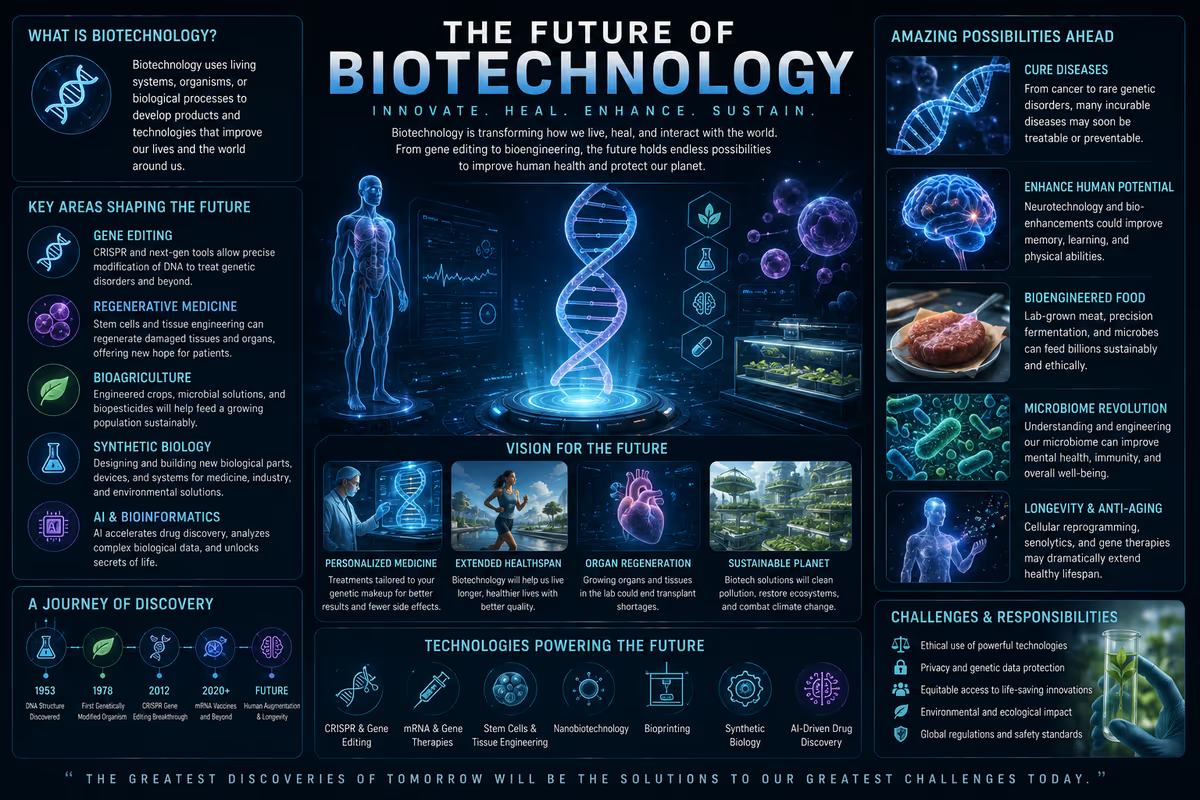
Biotechnology is moving from the laboratory into almost every part of modern life.
Scientists can now modify genetic material, engineer cells, develop biological medicines, grow tissues, analyze enormous biological datasets, and design organisms for specific purposes. Combined with artificial intelligence, automation, and advanced computing, biotechnology could become one of the defining technologies of the 21st century.
The future of biotechnology is not simply about treating disease.
It could change how we grow food, manufacture materials, protect ecosystems, and understand the human body itself.
What Is Biotechnology?
Biotechnology uses living organisms, cells, biological systems, or biological processes to develop useful products and technologies.
Modern biotechnology includes fields such as:
- Genetic engineering
- Gene therapy
- Synthetic biology
- Regenerative medicine
- Bioinformatics
- Biomanufacturing
- Agricultural biotechnology
- Microbiome research
These fields are increasingly connected with artificial intelligence and advanced computing.
Gene Editing
One of the most important developments in modern biotechnology is precise gene editing.
Technologies such as CRISPR have given researchers new ways to modify DNA.
Scientists are investigating gene-editing approaches for a range of medical applications, including certain inherited diseases.
The long-term potential is enormous.
Instead of treating some conditions only after symptoms appear, future medicine may be able to address certain biological causes at the genetic level.
However, gene editing also raises significant ethical and safety questions, particularly when changes could be inherited by future generations.
Regenerative Medicine
Another major area is regenerative medicine.
Researchers are investigating ways to repair or replace damaged tissues using stem cells, tissue engineering, biomaterials, and other biological technologies.
The long-term vision is remarkable.
Instead of relying exclusively on donated organs, medicine could potentially grow or engineer replacement tissues for individual patients.
Researchers are studying approaches involving tissues such as:
- Skin
- Cartilage
- Blood vessels
- Heart tissue
- Nerve tissue
- Other complex biological structures
Much of this work remains experimental, but progress could eventually transform transplantation and recovery from serious injuries.
Personalized Medicine
People respond differently to the same treatment.
Genetics, environment, lifestyle, age, and other factors can influence how the body responds to medicine.
Biotechnology combined with AI could make healthcare increasingly personalized.
Instead of relying entirely on generalized treatment strategies, doctors could potentially use genetic and biological information to select therapies that are more appropriate for individual patients.
This could lead to more precise treatments and potentially reduce unnecessary side effects.
AI and Bioinformatics
Modern biology generates enormous quantities of data.
DNA sequences, protein structures, cellular measurements, medical records, and laboratory experiments can produce datasets that are extremely difficult to analyze manually.
Artificial intelligence can help researchers identify patterns within this information.
AI is already becoming an important tool for areas such as:
- Protein analysis
- Drug discovery
- Genetic research
- Disease modeling
- Biological prediction
- Laboratory automation
The combination of AI and biotechnology could significantly accelerate scientific research.
AI-Powered Drug Discovery
Developing new medicines can be expensive and time-consuming.
Researchers need to identify promising molecules, understand how they interact with biological targets, evaluate potential toxicity, and eventually conduct extensive testing.
AI can help researchers analyze molecular information and prioritize promising candidates for further investigation.
It does not eliminate the need for laboratory experiments or clinical trials.
Instead, it can help scientists decide where to look first.
Synthetic Biology
Synthetic biology takes biotechnology one step further.
Rather than simply studying biological systems, researchers can design or modify biological components for specific purposes.
Potential applications include:
- New medicines
- Sustainable materials
- Industrial chemicals
- Environmental technologies
- Biological sensors
- Alternative manufacturing systems
In the future, biological systems could increasingly become part of industrial production.
The Future of Food
Biotechnology could also transform how food is produced.
Researchers are developing technologies involving:
- Precision fermentation
- Cultivated meat
- Improved crops
- Alternative proteins
- Microbial production
- Controlled-environment agriculture
These technologies could potentially reduce resource consumption and create new food-production systems.
However, economic viability, regulation, consumer acceptance, and environmental impact will determine which technologies become widely adopted.
Biotechnology and Agriculture
Agriculture faces major challenges from climate change, water scarcity, pests, soil degradation, and a growing global population.
Biotechnology could help develop crops with desirable characteristics such as improved resistance to diseases, drought tolerance, or greater efficiency under particular growing conditions.
Microbial technologies could also support soil health and agricultural productivity.
The goal is not simply to produce more food.
It is to produce food more efficiently while reducing environmental pressure.
The Microbiome Revolution
Humans are home to enormous communities of microorganisms, particularly in the digestive system.
Scientists are increasingly studying the relationship between the microbiome and human health.
Future biotechnology could potentially allow researchers to better understand and influence microbial communities.
This could lead to new approaches for managing certain diseases and improving health.
The microbiome remains a complex field, and many proposed applications still require substantial research.
Extending Healthy Lifespans
One of the most ambitious areas of biotechnology is aging research.
Scientists are investigating biological mechanisms associated with aging, including cellular damage, senescence, metabolism, and genetic regulation.
Future therapies could potentially target some of these mechanisms.
The realistic goal is not necessarily to make humans immortal.
A more scientifically grounded objective is to extend healthy lifespan—helping people remain healthier for longer.
Biotechnology and the Environment
Biotechnology may also become an important environmental tool.
Engineered microorganisms and biological processes could potentially help with:
- Waste treatment
- Pollution reduction
- Sustainable chemical production
- Carbon management
- Ecosystem restoration
- Renewable materials
Biological systems can perform complex chemical processes under relatively mild conditions, making them attractive for certain sustainable manufacturing applications.
The Bioeconomy
As biotechnology becomes more capable, a larger bioeconomy could emerge.
Instead of manufacturing everything from fossil-based chemical processes, some products could be produced using engineered organisms or biological systems.
Factories of the future might combine:
Biology + AI + Robotics + Automation
A biological production facility could continuously monitor cells, optimize conditions, and adjust processes automatically.
This would represent a major shift in manufacturing.
The Ethical Questions
Powerful biotechnology also creates powerful ethical questions.
Who should have access to advanced genetic therapies?
How should genetic information be protected?
What limits should exist around human genetic modification?
How should biological technologies be regulated?
How do we prevent powerful technologies from increasing inequality?
These questions cannot be solved by scientists alone.
Researchers, governments, ethicists, companies, and the public will all have a role in determining how biotechnology develops.
Safety and Responsible Innovation
Biotechnology requires careful safety standards.
A technology capable of changing biological systems must be developed with rigorous testing, oversight, and containment procedures where appropriate.
Innovation should not mean moving quickly without understanding the consequences.
The most successful biotechnology companies and research institutions of the future will likely be those that combine ambitious innovation with strong safety practices.
What Could Biotechnology Look Like in 2035?
By the mid-2030s, biotechnology could be increasingly integrated into everyday life.
We may see broader use of:
- Personalized medicine
- AI-assisted drug discovery
- Advanced gene therapies
- Lab-grown biological products
- Precision agriculture
- Engineered microbes
- Automated laboratories
- Regenerative medicine
Some technologies will succeed.
Others will fail.
And entirely new applications will probably emerge that we cannot predict today.
The Bigger Picture
Biotechnology is fundamentally different from many previous technological revolutions.
Computers manipulate information.
Robots manipulate physical objects.
Biotechnology allows us to work directly with living systems.
That makes it extraordinarily powerful.
It also means that the future of biotechnology will require a careful balance between innovation, safety, ethics, and responsibility.
Final Thoughts
The future of biotechnology could change medicine, agriculture, manufacturing, food production, and environmental protection.
Gene editing could help address certain genetic diseases.
Regenerative medicine could transform tissue repair.
AI could accelerate biological discovery.
Synthetic biology could create new manufacturing systems.
Biotechnology could even help humanity build a more sustainable relationship with the planet.
We are entering an era in which biology itself is becoming increasingly programmable.
The greatest challenge will not simply be learning how to engineer life.
It will be deciding how responsibly we should use that ability.
The next technological revolution may not be built from silicon alone. It may be built from biology.