
AI & Machine Learning
The Future of AI Startups: Building the Next Generation of Intelligent Software
CipherRoot Software12 min read
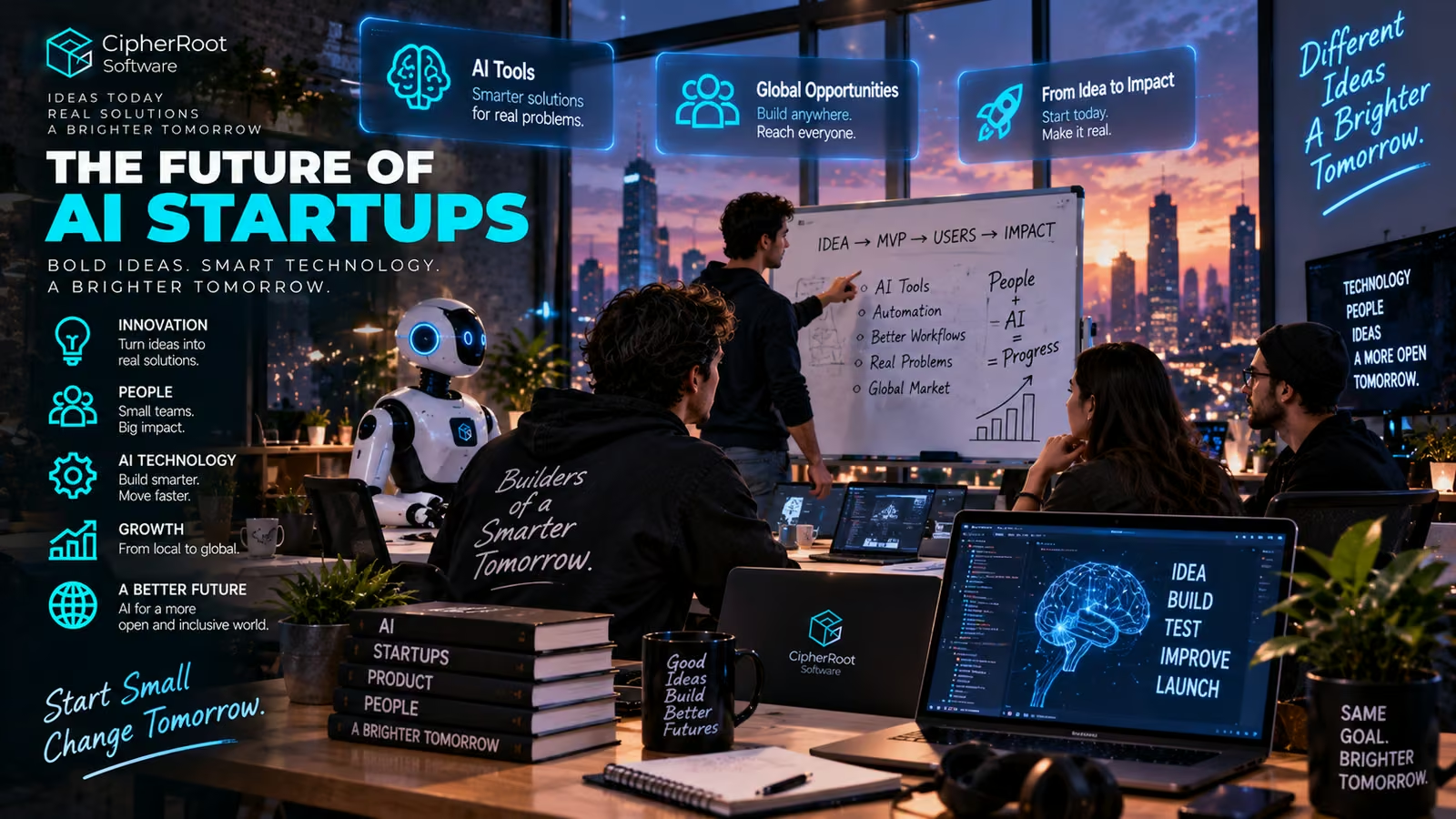
AI Is Creating a New Startup Era
Every major technology shift creates new businesses.
The internet created new forms of commerce.
Smartphones created mobile-first companies.
Cloud computing changed how software is built and deployed.
Artificial intelligence is now creating another wave of entrepreneurship.
AI startups are building products that can understand language, analyze data, generate content, automate workflows, interact with customers, control software, and increasingly operate across digital and physical environments.
But the future of AI startups will not simply be about creating another chatbot.
The bigger opportunity is building useful systems around intelligence.
What Makes an AI Startup Different?
A traditional software company generally creates rules that tell software what to do.
An AI startup may build systems that learn patterns from data or use pre-trained models to perform tasks that previously required human input.
This changes the product-development process.
Instead of building every behavior manually, developers can combine:
AI models Data Software Automation APIs User interfaces Business workflows
The result can be software that behaves more dynamically.
The product is no longer only a set of predefined functions.
It can become a system capable of interpreting information and generating responses.
From AI Features to AI-Native Products
Many software companies are adding AI features to existing products.
That can be useful.
But an AI-native startup begins with a different question:
What becomes possible when intelligence is part of the product from the beginning?
Instead of adding an AI writing assistant to an existing application, a startup could build an entire workflow around automated content operations.
Instead of adding a chatbot to customer support, it could build an AI system that handles an entire support pipeline.
Instead of adding image recognition to a manufacturing platform, it could build a complete AI-driven inspection system.
The difference is significant.
AI is no longer a feature.
AI becomes the architecture of the product.
Small Teams Can Build Powerful Products
One of the most interesting effects of AI is the amount of work a small team can potentially accomplish.
Modern development tools can help a small group with:
Software development Research Design Marketing Documentation Customer support Data analysis Testing
AI can reduce the amount of repetitive work required across these functions.
A small startup can therefore experiment faster.
A founder may be able to move from an idea to a working prototype without building a large organization first.
That does not remove the difficulty of building a successful company.
It changes where the difficulty lies.
The challenge becomes less about producing a prototype and more about creating something people genuinely need.
The Age of AI Agents
One of the biggest developments in AI software is the transition from assistants to agents.
A basic AI assistant answers a question.
An AI agent can potentially complete a sequence of tasks.
For example, an agent could:
Receive a user request. Understand the objective. Search relevant information. Use connected software. Perform approved actions. Evaluate the result. Escalate unusual situations.
This opens the door to a new generation of startups.
Companies can build AI systems for sales, research, support, logistics, finance, software development, operations, and other specialized workflows.
The product is no longer simply information.
It is digital work performed by software.
Vertical AI Startups
General-purpose AI is powerful, but many valuable opportunities exist in specialized industries.
A startup can build AI specifically for:
Healthcare administration Manufacturing Agriculture Logistics Construction Financial operations Legal workflows Education Retail Media production
Domain-specific products can combine AI with specialized knowledge, workflows, regulations, and data.
This can make them significantly more useful than a generic AI tool for a particular business problem.
The future may therefore contain thousands of specialized AI systems rather than a small number of applications trying to solve everything.
The Importance of Data
AI startups often talk about models.
But data can be just as important.
A strong model with poor data can produce poor results.
A startup that understands a specific domain may have access to valuable proprietary datasets, customer workflows, or real-world feedback.
This creates a potential competitive advantage.
A useful AI startup may therefore build a cycle:
Users → Data → Better system → Better product → More users
This feedback loop can become increasingly valuable over time.
Of course, data must be collected and used responsibly, with appropriate privacy, security, and legal controls.
The Real Moat May Be the Workflow
AI models are becoming increasingly accessible.
That means simply having access to a model may not be enough to create a durable business advantage.
The stronger advantage may come from everything surrounding the model.
For example:
Proprietary data Workflow integration Specialized knowledge User experience Distribution Customer relationships Operational expertise
A startup that understands how a customer actually works can build a much more useful system than one that simply connects an AI model to a chat interface.
The model is important.
The workflow is the product.
AI Startups and Software Development
AI is also changing how AI startups build themselves.
Developers can use AI-assisted tools for:
Code generation Debugging Testing Documentation Code review Architecture exploration
This can shorten development cycles.
A team can test more ideas in the same amount of time.
Prototypes become cheaper.
Iteration becomes faster.
But faster development creates another challenge.
A team can produce software quickly without necessarily producing good software.
Security, reliability, scalability, testing, and maintainability remain critical.
AI can accelerate engineering.
It does not replace engineering discipline.
AI Startups Will Need Better Product Design
As AI systems become more capable, the user interface becomes more important.
Traditional software often relies on buttons, forms, menus, and fixed workflows.
AI products can introduce conversational interfaces, natural-language commands, and adaptive experiences.
But conversational does not automatically mean simple.
Users still need to understand:
What the system is doing.
Why it produced a result.
What information it used.
What actions it can take.
How to correct mistakes.
Good AI product design therefore needs to combine intelligence with clarity.
Building Trust Into AI Products
An AI startup can have an impressive technology stack and still fail if customers do not trust the product.
Trust depends on several factors.
Reliability
Does the system produce useful results consistently?
Transparency
Can users understand what the system is doing?
Security
Is sensitive information protected?
Privacy
Is user data handled responsibly?
Control
Can humans review or override important actions?
These questions become more important as AI products become increasingly autonomous.
AI Security Will Become a Startup Opportunity
As AI systems become more integrated into businesses, new security problems will appear.
Startups may build products focused on:
AI security monitoring Prompt and input protection Data leakage prevention Model evaluation AI identity management Agent permissions Secure AI infrastructure Automated security testing
The same technology that creates new capabilities can create new attack surfaces.
This means cybersecurity and AI will increasingly develop together.
AI Startups and Robotics
The future of AI startups is not limited to software.
Robotics is creating opportunities for companies building intelligent physical systems.
Startups can develop AI-powered robots for:
Manufacturing Agriculture Warehousing Delivery Cleaning Hospitality Inspection Home assistance
The combination of AI and robotics is particularly powerful because software intelligence can now influence physical actions.
The startup is no longer building only an application.
It is building a machine that can perceive, decide, and act.
AI Startups in the Physical World
The most interesting AI applications may eventually live outside traditional computer screens.
Smart glasses.
Autonomous vehicles.
Service robots.
Industrial machines.
Agricultural systems.
Smart infrastructure.
Wearable devices.
These products require AI to interact with real environments.
That creates new engineering challenges involving sensors, hardware, communication, safety, and physical reliability.
For startups, this means the AI opportunity is expanding into the real world.
The Global Startup Opportunity
AI software can often be distributed globally from the beginning.
A developer in one country can build a product for customers on the other side of the world.
Cloud infrastructure allows software to scale across regions.
AI models can work across multiple languages and markets.
This creates a powerful opportunity for small companies.
A startup does not always need to begin by dominating one local market.
It can potentially build a product with international users from the start.
Localization, regulation, support, payments, and cultural differences still matter.
But software distribution has never been this global.
AI Startups and Open-Source Technology
Open-source models and tools can significantly lower barriers for experimentation.
Developers can access models, libraries, frameworks, and infrastructure that previously required large research teams.
This allows startups to focus on product development rather than rebuilding every technical component themselves.
Open-source ecosystems can also accelerate innovation because developers can inspect, modify, and improve the underlying technology.
The trade-off is that startups need to think carefully about licensing, security, infrastructure costs, and long-term maintenance.
The Economics of AI Startups
Building an AI company can have unique cost structures.
AI systems may require significant computing resources.
Inference costs can matter.
Data storage can grow quickly.
Specialized hardware may be expensive.
This means successful AI startups need to understand the economics of each workflow.
A product may look technically impressive but become difficult to operate profitably if every customer action requires expensive computation.
Efficient models, caching, routing, smaller specialized models, and thoughtful architecture can therefore become business advantages.
AI Startups Need a Real Problem
Technology is exciting.
But a startup is still a business.
The most important question remains:
What problem are you solving?
A good AI startup may begin with a frustrating manual process.
Maybe employees spend hours processing documents.
Maybe customers wait too long for support.
Maybe a company cannot analyze its data efficiently.
Maybe a physical operation is too repetitive or dangerous.
AI becomes valuable when it reduces a meaningful problem.
The technology is the engine.
The customer problem is the destination.
From MVP to Intelligent Product
The first version of an AI startup does not need to be perfect.
A simple product can be used to discover:
What users actually need.
Where the AI fails.
Which workflow creates value.
Which features are unnecessary.
Which tasks should remain human-controlled.
This creates an iterative loop:
Build → Test → Learn → Improve
AI makes this loop faster, but the principle is the same as in traditional product development.
Listen to users.
Measure outcomes.
Fix problems.
Repeat.
The Human Founder Still Matters
AI can generate code.
AI can analyze markets.
AI can create marketing material.
AI can assist with customer support.
AI can help research competitors.
But AI does not automatically decide what company should exist.
Founders still need to understand:
Customer needs Market timing Product strategy Distribution Business models Partnerships Risk Leadership
The human vision remains important.
AI can accelerate execution.
It does not replace purpose.
Responsible AI Startups
The next generation of AI companies will also need to take responsibility seriously.
Products can influence decisions, automate actions, and process sensitive information.
Startups therefore need to consider:
Privacy
Security
Bias
Transparency
Reliability
Human oversight
Responsible design should not be something added after a product becomes successful.
It should be part of the architecture from the beginning.
The Future of AI Startup Teams
Traditional startups often divide responsibilities into engineering, product, design, marketing, and operations.
AI may blur these boundaries.
A small team can use intelligent tools across almost every function.
One person may prototype software, create design concepts, analyze user feedback, and prepare marketing experiments with AI assistance.
This does not eliminate specialization.
It increases the leverage of each specialist.
The startup of the future may therefore be smaller, more automated, and more multidisciplinary.
The AI-Native Company
The most interesting AI startups may not look like traditional software companies at all.
Imagine a company where:
AI agents handle customer support.
AI systems analyze operations.
AI tools generate internal reports.
Software agents manage routine workflows.
Robots handle physical tasks.
Humans focus on strategy, creativity, relationships, and important decisions.
The company itself becomes an intelligent system.
This is the concept of the AI-native organization.
AI is not just inside the product.
It is inside the company.
What Will the Next AI Startups Build?
The possibilities are enormous.
We may see startups building:
AI coworkers Systems that perform specific professional workflows.
Personal AI systems Assistants that manage information and everyday tasks.
AI robotics platforms Software that gives physical machines greater intelligence.
Industry-specific copilots AI systems designed around specialized professional environments.
Autonomous business infrastructure Systems that coordinate complex operational processes.
AI security platforms Tools that protect increasingly autonomous software.
Human-AI creative platforms Systems that help people create media, design, music, and interactive experiences.
AI-powered scientific tools Systems that help researchers analyze data and explore possibilities.
The next wave may be defined not by one category, but by thousands of specialized applications.
The Biggest Advantage of AI Startups
The defining opportunity is leverage.
A small company can potentially use software to perform work that previously required large teams.
A small development group can prototype quickly.
A small marketing team can create more content.
A small operations team can automate repetitive workflows.
A small startup can serve customers across borders.
This does not guarantee success.
But it changes the starting point.
The cost of experimentation can become much lower.
And when experimentation becomes cheaper, more ideas can be tested.
Conclusion
The future of AI startups will not be determined solely by who has the largest model.
It will be shaped by companies that understand real problems and build reliable systems around artificial intelligence.
The strongest opportunities may emerge where AI meets:
Business workflows.
Specialized knowledge.
Robotics.
Data.
Automation.
Cybersecurity.
Human creativity.
The startup model itself is changing.
Small teams can build more.
AI can automate more.
Software can become more autonomous.
Physical machines can become more intelligent.
And products can become increasingly personalized.
But the fundamentals remain remarkably traditional.
Find a real problem.
Build something useful.
Listen to customers.
Protect their trust.
Improve continuously.
Technology changes.
Good entrepreneurship does not.
Bold ideas. Intelligent systems. Small teams. Global possibilities.
The next generation of companies may not simply use AI.
They may be built around it from the ground up.