
AI & Machine Learning
The Future of AI Regulation: Building Rules for an Intelligent World
CipherRoot Software15 min read
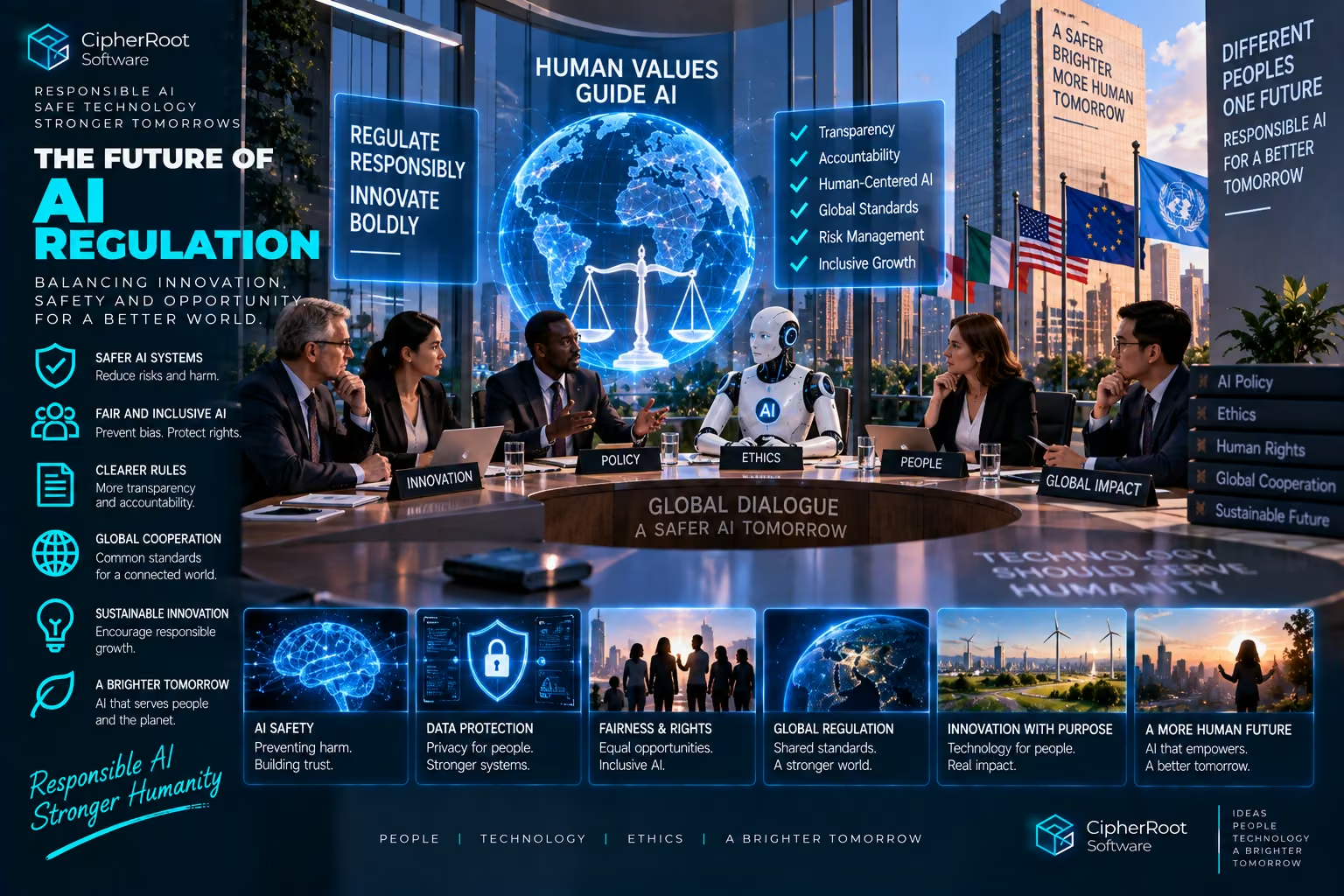
Artificial Intelligence Needs a New Generation of Rules
Artificial intelligence is developing faster than many traditional technology regulations were designed to handle.
AI systems can now generate text, images, audio, and video.
They can analyze large datasets.
They can assist with software development.
They can support scientific research.
They can interact with customers.
Increasingly, AI systems can also perform actions through connected software and automated workflows.
This creates enormous opportunities.
It also creates new questions.
How should AI systems be evaluated?
Who is responsible when an AI system causes harm?
When should people be told they are interacting with AI?
How should sensitive information be protected?
Which applications require stronger safeguards?
These questions are driving the development of a new field of technology governance:
AI regulation.
What Is AI Regulation?
AI regulation refers to laws, standards, frameworks, policies, and technical requirements designed to govern the development and use of artificial intelligence.
Regulation can address issues such as:
Safety Privacy Transparency Security Accountability Fairness Copyright Human oversight Consumer protection Risk management
Different jurisdictions are taking different approaches.
Some are creating binding laws.
Others are developing voluntary frameworks, standards, or sector-specific rules.
The overall direction is toward making AI systems more understandable, accountable, and safer.
A Risk-Based Approach
One of the most important ideas in modern AI regulation is that not every AI application creates the same level of risk.
A spam filter is very different from an AI system used in a critical infrastructure environment.
A recommendation engine is very different from a system involved in healthcare or financial decisions.
The European Union's AI Act uses a risk-based model with different obligations depending on the type and potential impact of an AI system.
This creates a more flexible principle:
Higher risk → stronger requirements.
The idea is to focus regulatory attention where potential harm is greatest.
The European Union AI Act
The EU AI Act is one of the most significant examples of comprehensive AI legislation.
Its rules are being applied progressively rather than all at once.
As of 2 August 2026, enforcement powers for several major provisions are active, including rules covering prohibited AI practices, general-purpose AI models, and certain transparency requirements.
The Act distinguishes between different categories of risk.
AI systems considered minimal or no risk generally face fewer requirements.
Higher-risk systems face substantially stronger obligations.
This is an important development because regulation is increasingly being connected to the actual characteristics and use of an AI system.
Transparency Is Becoming a Legal Requirement
People should not always have to guess whether they are interacting with a machine.
Under the EU AI Act's Article 50 transparency requirements, which apply from 2 August 2026, certain AI systems must inform users when they are interacting with AI. Certain AI-generated or altered content must also be identifiable or labelled according to the applicable requirements.
This includes areas such as:
AI chat systems
Users may need to be informed that they are interacting with an AI system.
Synthetic media
Certain AI-generated or manipulated content can require disclosure or machine-readable marking.
The goal is to make AI-generated communication easier to recognize.
Deepfakes and Synthetic Media
Generative AI has made synthetic media much easier to create.
Images can be generated.
Voices can be synthesized.
Video can be altered.
Entire scenes can be produced without traditional cameras.
This creates new opportunities for entertainment and creativity.
It also creates challenges involving deception and authenticity.
Regulation is increasingly addressing how people should be informed when content has been generated or altered using AI.
The EU AI Act's transparency framework includes requirements related to deepfakes and machine-readable markings for certain synthetic content.
The broader challenge is straightforward:
People need to know what they are looking at.
General-Purpose AI Regulation
Modern AI models can perform many different tasks.
A general-purpose AI model can become the foundation for many downstream applications.
This creates a different regulatory challenge.
Instead of regulating only the final application, policymakers may also need requirements for the underlying models.
The EU AI Act introduced obligations for providers of general-purpose AI models starting on 2 August 2025. These include technical documentation, copyright-related policies, and training-content summaries, with additional requirements for models presenting systemic risk.
This is an important shift.
AI governance is moving down the technology stack.
Systemic Risk
Some AI models can be used across enormous numbers of applications.
A problem in a highly capable or widely deployed model could therefore have effects far beyond one individual product.
The EU framework includes additional requirements for general-purpose models with systemic risk, including risk assessment, serious-incident reporting, model evaluation, and cybersecurity-related measures.
This introduces a broader concept:
AI risk can exist at the model level, not only at the application level.
AI Safety
AI safety is becoming an increasingly important regulatory objective.
A safe AI system should perform its intended function reliably and fail in controlled ways when something goes wrong.
This becomes especially important for systems connected to:
Healthcare Transportation Robotics Industrial infrastructure Financial systems Critical services
The more physical or societal impact an AI system can have, the more important rigorous testing and safeguards become.
Testing AI Before Deployment
AI regulation is increasingly moving toward formal evaluation.
Developers may need to demonstrate that a system meets specific requirements before it is deployed in certain contexts.
For high-risk systems under the EU framework, requirements can include risk management, data quality, documentation, traceability, human oversight, accuracy, robustness, and cybersecurity.
This creates a lifecycle approach:
Design → Test → Deploy → Monitor → Improve
Regulation is becoming part of the software lifecycle.
Human Oversight
One of the most important principles is keeping humans involved where appropriate.
A highly automated AI system should not necessarily be allowed to operate without meaningful human oversight.
The EU AI Act includes human-oversight requirements for high-risk AI systems, including requirements for deployers to assign people capable of exercising that oversight.
Human oversight does not mean a person must manually approve every AI operation.
It means there needs to be a meaningful mechanism for human intervention where the risks justify it.
Accountability
AI systems can involve many participants.
A model developer may create the underlying technology.
Another company may integrate the model.
A third organization may deploy the system.
A fourth company may provide the user interface.
When something goes wrong, responsibility can become complicated.
Future AI governance will therefore need clearer accountability across the technology supply chain.
Documentation, logging, system ownership, and defined responsibilities can help.
AI and Privacy
Many AI systems depend on data.
That data can include:
Personal information Business records Images Voice Location Financial information Healthcare information
The more data an AI system processes, the more important privacy becomes.
AI regulation is therefore closely connected with existing data-protection frameworks.
Future systems will increasingly need privacy-aware architectures rather than treating privacy as an optional feature.
Data Governance
Good AI regulation is not only about the model.
It is also about the data.
Organizations need to understand:
Where data came from.
How it was collected.
Whether it is accurate.
Whether it represents the intended users.
Whether it can legally be processed.
How long it should be retained.
Who can access it.
This creates a broader discipline:
AI data governance.
Copyright and AI
Generative AI has also raised major questions around copyrighted material.
AI models can be trained using enormous amounts of content.
Creators and rightsholders need clarity around how protected works are handled.
The EU AI Act includes copyright-related obligations for providers of general-purpose AI models, including policies to comply with EU copyright law and publication of sufficiently detailed summaries of training content.
This is likely to remain an important part of the AI regulatory landscape.
Fairness and Bias
AI systems can reproduce problems present in their training data or design.
If a dataset is incomplete or unbalanced, system performance may differ across groups.
This can be particularly serious when AI is used in high-impact environments.
Regulatory approaches are therefore increasingly concerned with data quality, risk assessment, testing, and monitoring.
The objective is not simply to make algorithms mathematically sophisticated.
It is to make their real-world behavior acceptable for their intended use.
Explainability
People often want to know why an AI system produced a particular result.
This can be difficult with complex models.
A future regulatory environment may therefore encourage or require appropriate explanations depending on the use case.
The level of explanation will not necessarily be identical for every AI system.
A recommendation engine may require a different level of transparency from a high-risk decision-support system.
The principle is:
People should receive the information necessary to understand and appropriately challenge important AI-driven outcomes.
Security and AI
AI regulation increasingly overlaps with cybersecurity.
An AI system can be attacked through:
Malicious inputs Data poisoning Model manipulation Prompt attacks Unauthorized access Data extraction
Generative and agentic systems create additional attack surfaces.
Security therefore needs to be considered during training, deployment, integration, and operation.
The future AI system will need to be not only intelligent.
It will need to be secure by design.
AI Agents Create New Regulatory Questions
Traditional AI mostly produced information.
New AI agents can potentially perform actions.
They may access APIs.
They may send messages.
They may update databases.
They may create tasks.
They may interact with financial or business systems.
This changes the risk model.
A chatbot that gives an incorrect answer is one problem.
An agent that misunderstands a request and performs an irreversible action is another.
Future regulation will therefore need to address not only what AI says, but also what AI is authorized to do.
Permissions and AI Autonomy
An important principle for agentic AI is least privilege.
An AI system should not automatically have unlimited access to every tool or database.
Instead, permissions can be limited according to the task.
For example, an AI assistant may be allowed to:
Read a project document.
Prepare a report.
Create a draft.
But it may require human approval before:
Sending an external message.
Deleting data.
Approving a payment.
Changing a critical system.
This creates a practical bridge between AI autonomy and human control.
AI Regulation and Robotics
The relationship becomes even more important when AI controls physical machines.
An AI-powered robot can affect the physical world.
A robotic system may operate in a factory, hospital, warehouse, home, or public environment.
The regulatory question becomes:
What happens when intelligent software becomes physical action?
Safety requirements become more significant.
Testing needs to include real-world conditions.
Cybersecurity becomes connected to physical safety.
Human oversight becomes more important.
AI in Critical Infrastructure
AI is increasingly being explored for infrastructure such as energy, transportation, communications, and industrial systems.
This creates a special category of concern.
An AI error in an ordinary application may be inconvenient.
An error in critical infrastructure can potentially affect large numbers of people.
NIST is developing an AI Risk Management Framework profile specifically focused on trustworthy AI in critical infrastructure, announced in April 2026.
This reflects the broader movement toward risk-specific AI governance.
NIST and Risk Management
Not every approach to AI governance uses mandatory regulation.
NIST's AI Risk Management Framework is a voluntary framework designed to help organizations manage AI risks and promote trustworthy AI development and use.
The framework emphasizes characteristics such as:
Validity and reliability Safety Security and resilience Accountability Transparency Explainability Privacy Fairness
This type of framework can help organizations build responsible AI practices even when a particular system is not directly subject to a mandatory AI law.
Regulation vs Innovation
One of the central challenges of AI governance is finding workable rules without creating unnecessary barriers to useful technological development.
Regulation can establish safeguards.
Innovation can create new products and scientific advances.
These goals do not necessarily have to be opposites.
Well-designed rules can provide clearer expectations for companies and users.
Predictable requirements can also reduce uncertainty for organizations building AI products.
The challenge is creating rules that remain useful as technology changes.
Regulations Must Adapt
AI technologies can change faster than laws.
A regulation written around one specific model or technical architecture can become outdated.
Future AI governance may therefore need technology-neutral principles that focus on capabilities and risks rather than one particular implementation.
The European Commission's approach already combines broad risk categories with technology-specific obligations in areas such as general-purpose AI and transparency.
The regulatory system will need to evolve alongside AI.
International AI Governance
AI does not stop at national borders.
A company can develop a model in one country, host infrastructure in another, and serve users around the world.
This makes international coordination increasingly important.
The Council of Europe Framework Convention on AI and human rights, democracy, and the rule of law was opened for signature on 5 September 2024 and is described by the Council of Europe as the first international legally binding treaty in this field.
This illustrates the emergence of international approaches alongside national and regional AI laws.
Global Standards
Different countries may establish different rules.
That can create complexity for companies operating internationally.
Technical standards can help create common expectations.
Standards can address:
Security
Testing
Risk management
Documentation
Data governance
Model evaluation
The future may therefore involve a combination of laws and international technical standards.
AI Regulation for Small Businesses
AI regulation is not relevant only to large technology companies.
Small businesses increasingly use:
AI customer support Marketing tools Generative AI Automated workflows Data-analysis systems AI-powered software
Smaller companies may not have large compliance teams.
This makes understandable guidance particularly important.
AI governance should ideally make it clear what organizations need to know without requiring every company to become a legal and technical specialist.
AI Literacy
People cannot use AI responsibly if they do not understand the technology.
The EU AI Act includes AI-literacy requirements for providers and deployers, with the relevant obligation applying from 2 February 2025 and enforcement provisions beginning later.
AI literacy can include understanding:
What an AI system does What its limitations are How its outputs should be checked What data should not be shared When human intervention is necessary
This may become a normal part of professional education.
The Future AI Compliance Workflow
Businesses may increasingly build AI governance directly into product development.
A future workflow could look like:
Identify the AI system
↓
Classify its use and risk
↓
Review data
↓
Test the model
↓
Document capabilities and limitations
↓
Implement security controls
↓
Define human oversight
↓
Deploy
↓
Monitor performance
↓
Report serious incidents when required
Regulation becomes an operational process rather than a document sitting in a legal department.
Continuous AI Monitoring
AI systems can change after deployment.
Models may be updated.
Data distributions may shift.
Users may find unexpected ways to use the system.
New risks may appear.
This makes continuous monitoring important.
Organizations may need to track:
Accuracy Errors Security incidents User complaints Model changes Performance differences Unexpected behavior
The future of AI governance will therefore be increasingly continuous.
AI Regulation and Consumer Trust
Rules are ultimately connected to trust.
People need confidence that AI systems will not secretly manipulate them, expose their information, or make important decisions without appropriate safeguards.
Transparency can help.
Clear policies can help.
Human oversight can help.
Independent testing can help.
Good regulation can provide a foundation.
But trust also depends on how companies actually implement the rules.
The Future of Responsible AI
The most mature AI systems may increasingly be designed with governance built into their architecture.
A system could automatically log important decisions.
Sensitive actions could require approval.
Permissions could be restricted.
AI-generated content could carry appropriate provenance information.
Model behavior could be continuously monitored.
Security testing could occur throughout the lifecycle.
This creates a new concept:
Governance by design.
Instead of adding compliance after the product is finished, organizations build responsible controls into the product itself.
What Will AI Regulation Look Like Tomorrow?
The future is unlikely to involve one universal global AI law.
A more realistic model is a combination of:
National legislation
Different countries establish their own requirements.
Regional frameworks
Groups such as the European Union create common rules across multiple jurisdictions.
International agreements
Countries cooperate around shared principles.
Technical standards
Organizations create practical methods for testing and managing AI.
Industry-specific requirements
Healthcare, finance, transportation, and critical infrastructure may receive additional rules.
Together, these layers can form a global AI governance ecosystem.
The Goal Is Not to Stop AI
AI regulation is fundamentally about how AI should be developed and used.
The objective of governance is not necessarily to prevent technological progress.
It is to establish boundaries around unacceptable risks while creating conditions in which useful systems can develop responsibly.
The hardest part is finding the right balance.
Too little governance can leave important risks unmanaged.
Too much complexity can make compliance unnecessarily difficult.
The future will require both technological innovation and institutional adaptation.
Conclusion
AI regulation is becoming a permanent part of the technology landscape.
The EU AI Act is already entering major enforcement stages, while frameworks such as NIST's AI Risk Management Framework provide voluntary approaches for managing trustworthy AI.
The regulatory focus is expanding beyond simple questions about algorithms.
It now includes:
Transparency
Safety
Privacy
Cybersecurity
Copyright
Human oversight
Accountability
Risk management
AI literacy
As AI becomes more capable, these principles will become increasingly important.
The future may not be a world where every AI system is controlled in exactly the same way.
Instead, regulation is likely to become more risk-based, more continuous, and more closely integrated with the full lifecycle of AI systems.
Developers will build with governance in mind.
Businesses will monitor AI after deployment.
Users will receive clearer information.
Standards will evolve.
International cooperation will grow.
The technology will continue moving forward.
The rules will need to move with it.
The central challenge is simple to describe, even if it is difficult to solve:
Build AI powerful enough to create new possibilities—and responsible enough to earn trust.
The future of AI regulation is ultimately not about controlling intelligence.
It is about creating the conditions for intelligence to serve people safely, transparently, and responsibly.