
Systems & Infrastructure
The Future of 5G and 6G: Building the Next Connected World
CipherRoot Software9 min read
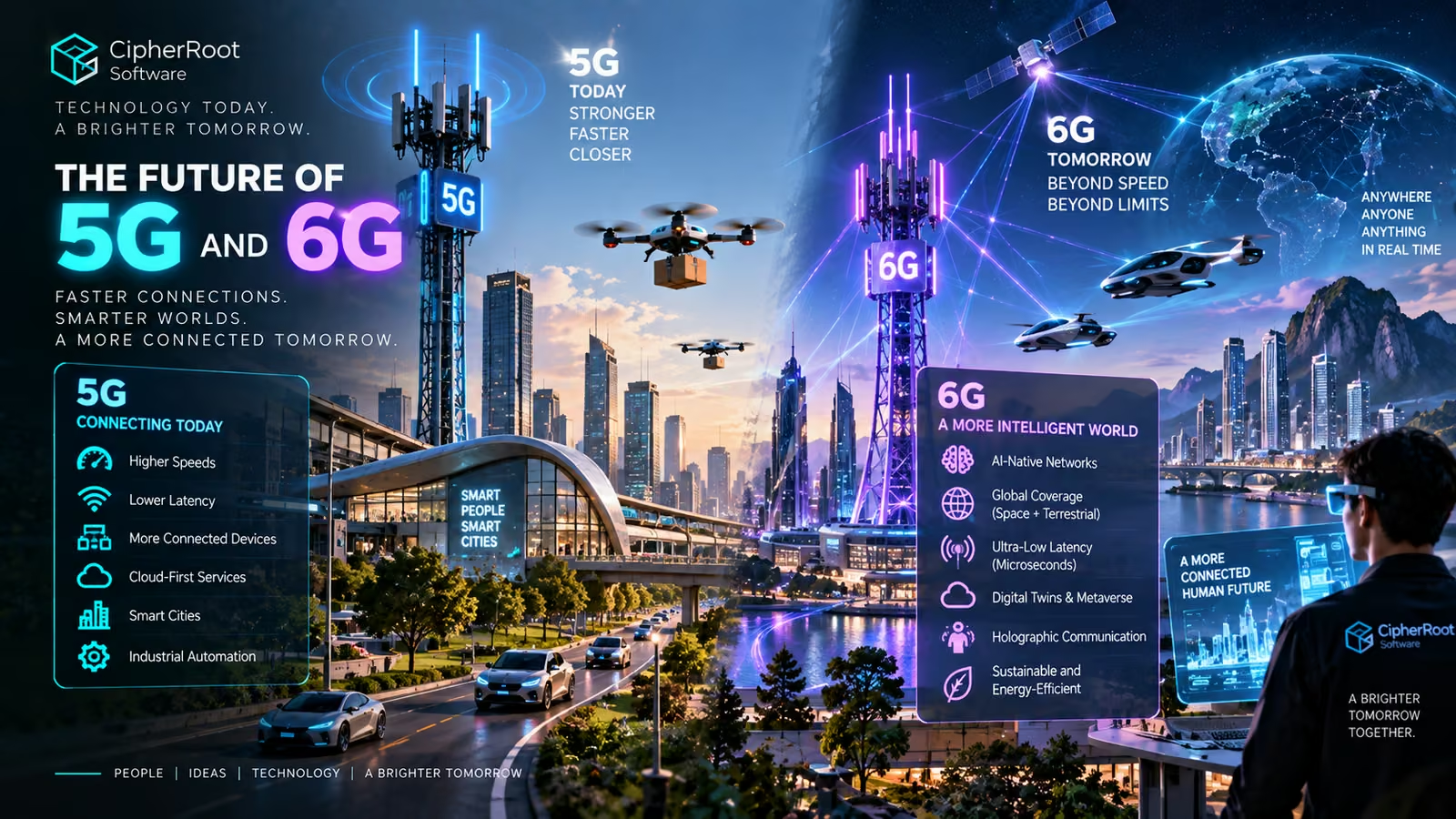
The Next Era of Connectivity
Mobile networks have evolved far beyond making phone calls.
4G helped turn smartphones into powerful computing platforms. 5G expanded connectivity into factories, vehicles, smart cities, IoT systems, and other industrial environments. Now the telecommunications industry is working toward the next generation.
That future is commonly called 6G.
The International Telecommunication Union refers to the next generation as IMT-2030. In 2026, the technology is still being standardized, with technical requirements and evaluation methods being developed for candidate radio technologies.
At the same time, 5G itself is continuing to evolve through 5G-Advanced.
The story of 5G and 6G is therefore not simply about replacing one generation with another.
It is about gradually transforming wireless networks into increasingly intelligent digital infrastructure.
Where 5G Is Going
5G introduced major improvements in speed, latency, capacity, reliability, and the ability to connect large numbers of devices.
But the technology did not stop with the initial 5G specifications.
3GPP's Release 18 established the first release branded as 5G-Advanced, extending 5G with new capabilities across areas such as AI and machine learning, network automation, industrial applications, positioning, XR, and energy efficiency.
This means the future of 5G is still being developed.
5G-Advanced can be viewed as an important bridge between today's 5G systems and the technologies being explored for 6G.
5G-Advanced and Intelligent Networks
One of the most important developments is the increasing role of intelligence inside the network itself.
Traditional networks depend heavily on predefined configurations and operational rules.
More advanced networks can use analytics and automation to understand traffic, optimize resources, and respond to changing conditions.
AI and machine learning are already part of 5G-Advanced standardization work, including areas related to radio networks and network management.
This creates a significant shift.
The network becomes more than a transport layer.
It becomes an adaptive computing and communication environment.
What Is 6G?
6G is the proposed sixth generation of mobile communication technology.
Unlike previous generations, its development is being framed around more than simply improving data rates.
The ITU's IMT-2030 framework includes six usage scenarios:
Immersive communication Hyper-reliable and low-latency communication Massive communication Ubiquitous connectivity AI and communication Integrated sensing and communication
These scenarios show that 6G is being designed as a broader platform connecting communication, intelligence, sensing, and computing.
Beyond Faster Internet
The most interesting part of 6G may not be raw speed.
Future networks are being designed to support new kinds of interaction between people, machines, and the physical environment.
Imagine a network that does not simply transmit information but also helps systems understand:
Where objects are.
How environments are changing.
Which computing resources are available.
How applications should adapt.
How AI workloads should be distributed.
This vision moves wireless connectivity closer to becoming an intelligent infrastructure layer.
AI-Native Networks
Artificial intelligence is expected to play a much deeper role in future mobile networks.
Instead of treating AI as an application running on top of the network, future architectures may integrate AI more directly into network operations and services.
The IMT-2030 framework explicitly identifies AI and communication as one of its usage scenarios. The framework also includes AI-related capabilities such as distributed learning, data processing, and AI model inference.
This could enable networks that dynamically adapt to application requirements.
An autonomous vehicle may need extremely reliable low-latency communication.
A factory may need deterministic connections for robots.
An immersive application may require high-capacity communication.
A future network could optimize resources according to the task instead of treating every connection identically.
Integrated Sensing and Communication
One of the most interesting ideas in 6G is Integrated Sensing and Communication, often abbreviated as ISAC.
Today's wireless networks primarily communicate.
Future systems may increasingly use radio signals for sensing as well.
The ITU has included integrated sensing and communication as one of the six proposed IMT-2030 usage scenarios. Its ongoing evaluation work includes test environments and channel models specifically related to sensing capabilities.
This could eventually allow networks to help detect objects, estimate locations, map environments, or understand movement.
In other words:
The network could become part of the sensor system.
More Precise Positioning
Next-generation wireless systems are also expected to improve positioning capabilities.
The IMT-2030 framework includes high-precision positioning among the potential enhanced capabilities of 6G.
This could matter for robotics, autonomous transportation, industrial systems, emergency response, augmented reality, and location-aware applications.
Instead of simply knowing that a device is connected, future infrastructure could provide much richer information about where it is and how it is moving.
Connecting Remote Areas
Another important objective for 6G is broader connectivity.
The IMT-2030 framework emphasizes ubiquitous connectivity and specifically considers remote, rural, and underserved areas. It also highlights the goal of helping reduce the digital divide.
Future networks may therefore combine terrestrial infrastructure with other communication systems to extend coverage.
This could be particularly valuable for:
Rural communities Agriculture Remote industrial sites Maritime operations Disaster response Environmental monitoring
Connectivity is becoming less about where a cell tower exists and more about creating a broader communication ecosystem.
6G and Autonomous Systems
Autonomous machines will require increasingly sophisticated communication.
Robots, drones, vehicles, industrial systems, and other autonomous platforms need to exchange information quickly and reliably.
A future network could support communication between machines while also providing positioning, sensing, and AI services.
This could create environments where machines do not operate as isolated systems.
Instead, they become participants in a connected intelligent ecosystem.
An autonomous vehicle could communicate with infrastructure.
A delivery robot could communicate with other robots.
An industrial machine could coordinate with a digital twin.
A drone could share environmental information with a wider sensing network.
The network becomes part of the intelligence of the environment.
5G and the Internet of Things
5G has already expanded the role of cellular networks in IoT and industrial connectivity.
5G-Advanced continues this evolution with work involving IoT platforms, industrial applications, autonomous networks, positioning, and other capabilities.
The next step is likely to involve even larger and more diverse collections of connected devices.
Instead of connecting only phones and computers, future networks may support vast ecosystems of:
Sensors.
Robots.
Vehicles.
Wearables.
Industrial machines.
Smart infrastructure.
Agricultural systems.
Environmental monitoring devices.
This creates an enormous challenge for network management.
Automation will become increasingly important simply because humans cannot manually manage billions of interactions.
The Role of Edge Computing
Future connectivity will also be closely connected to edge computing.
Some applications cannot afford to send every piece of data to a distant cloud server.
Autonomous machines, industrial control systems, augmented reality, and real-time analytics often require very low latency.
Edge computing allows processing to happen closer to the user or device.
A future 5G or 6G network could therefore combine:
Device + Network + Edge + Cloud + AI
into one coordinated computing environment.
This could make distributed applications faster and more responsive.
Immersive Communication
Another major area of interest is immersive communication.
The ITU's IMT-2030 framework includes immersive communication as one of its six usage scenarios.
This could involve much richer forms of digital interaction than today's video calls.
Future systems may support highly immersive AR and VR experiences, spatial communication, advanced real-time collaboration, and other forms of extended reality.
The underlying requirement is not simply high bandwidth.
The network must also deliver low latency, reliability, synchronization, and consistent performance.
Digital Twins and Future Networks
The development of digital twins makes advanced connectivity even more interesting.
A digital twin may continuously receive information from a physical machine or environment.
If communication networks become faster, more reliable, and more aware of context, the connection between the physical and digital worlds can become increasingly continuous.
A factory digital twin could receive real-time machine information.
A smart-city model could receive infrastructure data.
A vehicle could maintain a continuously updated digital representation of its operating condition.
5G-Advanced and future 6G systems could help provide the communication layer required for these environments.
Sustainability and Energy Efficiency
More connected devices do not automatically mean a more sustainable digital world.
Networks consume energy, and future systems will need to balance performance with efficiency.
Energy efficiency is already part of the evolution of 5G-Advanced, while sustainability is one of the overarching principles of the IMT-2030 framework.
Future networks could use AI to dynamically adjust resources according to demand.
During periods of low traffic, parts of the network could operate at reduced capacity.
During high-demand periods, resources could be allocated where they are most needed.
The goal is not simply more connectivity.
It is more intelligent connectivity.
Security Will Become Even More Important
As networks become more intelligent, they also become more critical.
Future infrastructures may connect vehicles, factories, hospitals, homes, robots, sensors, and public infrastructure.
A security problem could therefore have consequences beyond a simple loss of internet access.
Future network architectures will need strong identity management, authentication, encryption, privacy protection, resilience, monitoring, and secure software updates.
The IMT-2030 framework explicitly identifies security and resilience as important design principles for next-generation networks.
When Will 6G Arrive?
6G should not be treated as a technology that is already commercially standardized and deployed everywhere.
As of 2026, the industry is still working through the technical and standardization process.
ITU's current IMT-2030 work includes technical requirements and evaluation guidelines, while 3GPP's planning identifies Release 21 as the expected starting point for the first 6G technical specifications.
The ITU roadmap anticipates candidate radio interface submissions beginning in 2027, with the possibility of final 6G standards being approved around 2030.
That means many details of commercial 6G systems are still being developed.
The exact capabilities consumers eventually experience will depend on the standards, spectrum, hardware, network deployments, economics, and regulatory environment that emerge over the coming years.
5G Will Not Simply Disappear
A common misconception is that 6G will immediately replace 5G.
In reality, mobile generations evolve gradually.
5G networks will continue to serve users while 5G-Advanced extends their capabilities.
6G will likely emerge alongside existing infrastructure rather than appearing as an instant global replacement.
This evolution is similar to previous generations.
Old and new technologies often coexist for years while networks and devices transition.
The Connected World of Tomorrow
The long-term vision is larger than faster smartphones.
Imagine a world where communication networks connect physical and digital systems continuously.
Factories communicate with robots.
Cities communicate with vehicles.
Agricultural fields communicate with autonomous machines.
Buildings communicate with energy systems.
Digital twins receive continuous real-world data.
AI systems operate across devices, edge servers, and cloud infrastructure.
And people interact with all of these systems through increasingly immersive interfaces.
This is the larger promise behind the evolution from 5G toward 6G.
Conclusion
The future of 5G and 6G is not simply a race for higher download speeds.
5G-Advanced is expanding today's network capabilities through greater intelligence, automation, industrial connectivity, positioning, and other advanced functions.
6G, meanwhile, is being shaped around a broader concept of connectivity—one that brings together communication, artificial intelligence, sensing, computing, immersive experiences, and ubiquitous access.
The technology is still being developed, so some of today's 6G concepts may change before commercial systems become widespread.
But the direction is clear.
The wireless network of the future may not simply connect people to the internet.
It may connect people, machines, environments, intelligence, and the physical world itself.
Faster connections were only the beginning.
The next revolution is intelligent connectivity.