
Future & Research
The First Billion-Dollar Humanoid Robot Company: Who Will Lead the AI Revolution?
CipherRoot Software4 min read
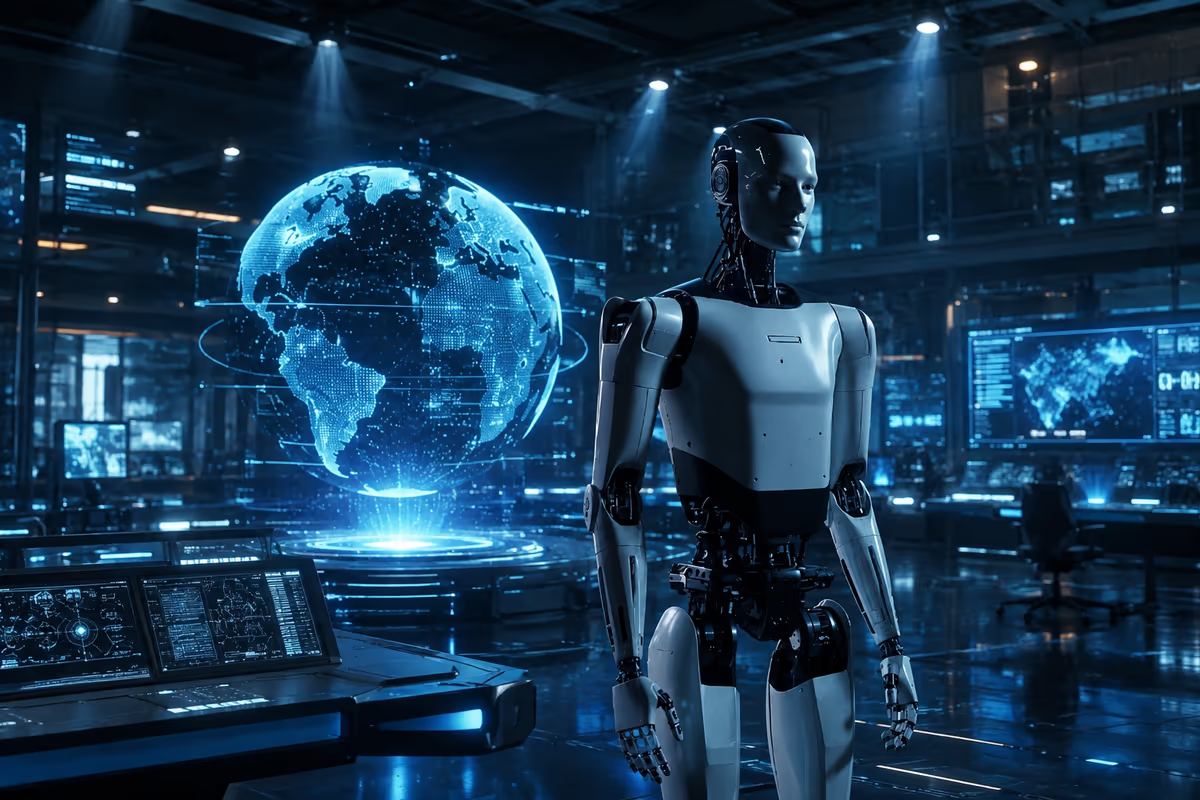
Artificial Intelligence has already transformed how we search the web, write software, create art, and communicate. But the next technological revolution won't remain trapped behind computer screens. It will walk, carry objects, solve real-world problems, and eventually become part of our everyday lives.
Welcome to the age of humanoid robots.
Over the past few years, robotics has accelerated at an astonishing pace. Companies that once focused only on software are now investing billions into machines capable of understanding the physical world. As AI models become smarter and hardware becomes more affordable, the dream of intelligent robotic assistants is quickly becoming reality.
The race has already begun—and the company that builds the first truly successful humanoid robot platform may become the world's next trillion-dollar technology leader.
Why Humanoid Robots Matter
Factories have relied on industrial robots for decades, but those machines were built for repetitive tasks inside controlled environments.
Humanoid robots represent something entirely different.
Designed with two arms, two legs, cameras, microphones, and advanced AI systems, these robots can operate in environments originally designed for humans. They don't require buildings or cities to be redesigned. Instead, they adapt to the world we already live in.
Imagine a robot capable of:
- Delivering packages
- Assisting elderly people
- Working in warehouses
- Helping during natural disasters
- Performing dangerous industrial inspections
- Supporting healthcare professionals
- Learning new skills simply by observing humans
This flexibility is what makes humanoid robotics one of the most exciting industries of the decade.
The Companies Leading the Race
Several major technology companies are competing to build the future of intelligent robotics.
Tesla continues developing Optimus, aiming to create a general-purpose humanoid robot capable of performing everyday tasks.
Figure AI has attracted significant investment from technology giants while focusing on warehouse automation and commercial applications.
Boston Dynamics remains famous for creating some of the world's most advanced mobile robots, constantly pushing the limits of balance and movement.
Chinese robotics companies are rapidly increasing production, supported by strong manufacturing infrastructure and growing AI capabilities.
Unlike previous robotics generations, today's robots are no longer powered by simple programmed behaviors. Instead, they rely on advanced AI models capable of reasoning, understanding language, and making decisions.
Artificial Intelligence Is the Real Brain
A robot without intelligence is simply an expensive machine.
The real breakthrough comes from combining robotics with modern large language models, computer vision, and reinforcement learning.
Future humanoid robots will likely be able to:
- Understand spoken instructions naturally
- Recognize people and objects
- Navigate unfamiliar environments
- Learn from experience
- Collaborate safely with humans
- Adapt without constant programming
Rather than following fixed scripts, these machines will continuously improve through learning.
The robot's body is important.
Its AI brain is revolutionary.
Industries That Will Change Forever
Humanoid robots won't replace every job overnight.
Instead, they will first enter industries facing labor shortages or dangerous working conditions.
Some of the earliest applications include:
Manufacturing
Factories can operate around the clock with robotic assistants performing repetitive or hazardous work.
Healthcare
Robots may assist nurses by transporting equipment, delivering medication, and monitoring patients.
Logistics
Warehouses increasingly rely on automation, and humanoid robots could become the next evolution in inventory management.
Construction
Robots may eventually handle heavy lifting, inspections, and repetitive assembly work on construction sites.
Home Assistance
One of the biggest long-term goals is creating affordable personal robots capable of helping families with everyday household tasks.
Challenges Still Ahead
Despite impressive progress, several major obstacles remain.
Battery technology limits operating time.
Robots still struggle with highly unpredictable environments.
Human-like dexterity remains difficult to achieve.
Production costs remain extremely high.
Safety regulations are still evolving.
Perhaps the biggest challenge is trust.
People must feel comfortable living and working alongside intelligent machines before widespread adoption becomes possible.
The Next Ten Years
Many experts believe the next decade will define the future of robotics.
By 2030, humanoid robots may become common in warehouses, hospitals, factories, and research facilities.
By 2035, consumer models could become significantly more affordable, opening the possibility of personal robotic assistants inside ordinary homes.
Just as smartphones transformed society in the early 2000s, intelligent robots may become the defining technology of the 2030s.
Beyond Hardware
The future isn't simply about building better robots.
It's about creating an ecosystem.
Robots will connect with cloud AI, edge computing, autonomous vehicles, smart homes, wearable devices, and future digital assistants.
Every improvement in artificial intelligence makes humanoid robots more capable.
Every improvement in robotics creates new opportunities for AI.
Together, these technologies reinforce one another, accelerating innovation faster than ever before.
Final Thoughts
Humanity stands at the beginning of a new technological era.
The companies leading today's AI and robotics race aren't simply building machines—they're creating the foundation for tomorrow's workforce.
The first company to successfully combine affordability, safety, intelligence, and large-scale manufacturing could reshape entire industries and redefine how humans interact with technology.
Whether that leader emerges from Silicon Valley, Europe, or Asia remains uncertain.
One thing, however, seems increasingly clear:
The future won't just be powered by artificial intelligence.
It will walk beside us.