
Future & Research
Robots in Disaster Response: How Robotics Can Save Lives
CipherRoot Software6 min read
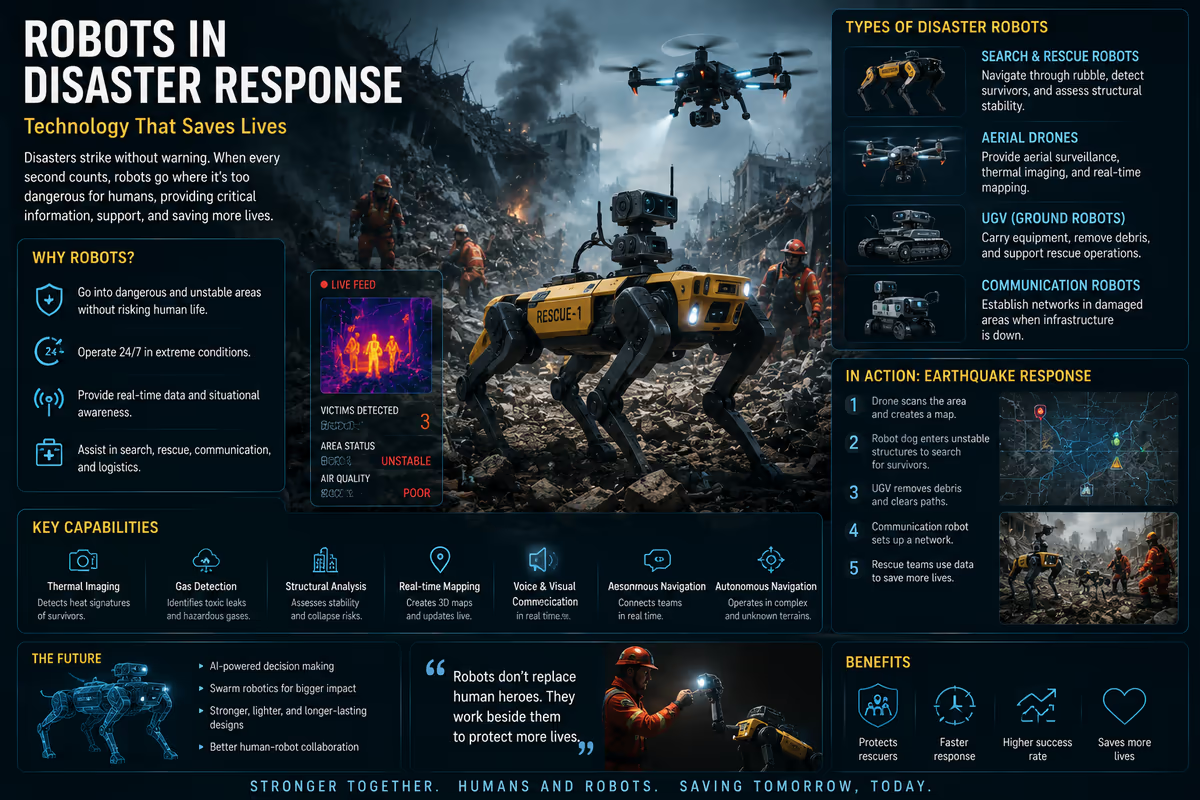
Natural disasters can change an environment within minutes. Earthquakes, floods, wildfires, landslides, and industrial accidents can leave buildings unstable and create conditions that are extremely dangerous for rescue teams.
In these situations, robots can provide something incredibly valuable: the ability to enter dangerous environments before humans do.
Modern rescue robots can explore collapsed structures, detect heat signatures, map damaged areas, carry equipment, and provide real-time information to emergency teams.
The future of disaster response could increasingly involve humans and robots working together.
Why Use Robots During Disasters?
Search-and-rescue operations often involve unstable buildings, smoke, fire, toxic gases, flooding, and difficult terrain.
Sending a human into such an environment without sufficient information can be extremely dangerous.
Robots can be deployed first to investigate the area.
They can provide information such as:
- Is the structure stable?
- Are there signs of survivors?
- Is there dangerous gas?
- Which areas are accessible?
- Where are the safest routes?
- What parts of the building have collapsed?
This information can help rescue teams make better decisions.
Search-and-Rescue Robots
Ground robots can navigate areas that are difficult or dangerous for humans.
Tracked robots can move across rubble, while legged robots can potentially navigate uneven terrain.
Some systems can carry cameras, thermal sensors, microphones, and other equipment.
A robot could enter a partially collapsed building and send video back to a rescue team without putting another person at immediate risk.
Drones From Above
Drones provide an entirely different perspective.
After an earthquake or flood, an aerial drone can quickly survey a large area.
High-resolution cameras can create maps of damaged locations, while thermal cameras can potentially help identify heat signatures associated with people.
Drones can also help emergency teams understand how roads, bridges, buildings, and other infrastructure have been affected.
Instead of spending hours surveying an area manually, responders can receive an aerial overview much faster.
Thermal Imaging
One of the most useful technologies for rescue robots is thermal imaging.
Thermal cameras detect differences in infrared radiation and can help identify heat signatures.
In certain situations, this can assist rescuers in locating people when visibility is poor.
For example, after a building collapse, normal cameras may struggle to see through darkness, dust, or smoke.
Thermal information can provide another source of evidence for rescue teams.
It is not a magic solution, however. Environmental conditions and debris can significantly affect what a thermal sensor can detect.
Detecting Dangerous Gases
Some disasters involve hazardous substances.
Industrial accidents, fires, and damaged infrastructure can release dangerous gases into the environment.
Robots equipped with appropriate chemical or gas sensors can enter these areas and collect measurements.
This allows emergency teams to understand environmental risks before sending personnel into potentially hazardous locations.
Creating Real-Time Maps
Robots can also help create detailed maps of disaster zones.
Sensors such as cameras, LiDAR, and other navigation systems can be combined to create three-dimensional representations of damaged environments.
A rescue team could use these maps to understand:
- Building layouts
- Accessible pathways
- Structural obstacles
- Potential hazards
- Robot locations
- Areas requiring further investigation
Real-time mapping can turn an unfamiliar disaster site into a much more understandable environment.
Communication Robots
Disasters can damage communication infrastructure.
Cell towers, electricity networks, and internet connections may become unavailable.
Specialized robots or drones could potentially help establish temporary communication networks.
This could allow rescue teams and other emergency personnel to communicate even when conventional infrastructure has been damaged.
Reliable communication is often just as important as physical rescue equipment.
AI-Powered Rescue Robots
Artificial intelligence can make rescue robots considerably more capable.
Instead of simply transmitting video, an AI-powered robot could analyze what it sees.
Computer vision could help identify:
- People
- Vehicles
- Structural damage
- Obstacles
- Fire
- Smoke
- Important objects
AI could also help robots navigate unfamiliar environments and determine which areas should be investigated first.
However, autonomous decisions in life-critical situations require extremely careful validation.
Human rescue teams should remain responsible for critical decisions.
Robots Working Together
The future may not involve one giant rescue robot.
Instead, multiple specialized machines could work together.
For example:
Drone → surveys the disaster area.
Ground robot → enters the damaged structure.
Robot dog → navigates unstable terrain.
Communication unit → establishes a network.
AI system → combines information from all machines.
Human rescue team → uses the information to plan the operation.
This creates a coordinated human-robot rescue system.
Earthquake Response
Earthquakes are an especially important application.
Immediately after an earthquake, buildings may be unstable and roads may be blocked.
A possible robotic response could involve several stages:
1. Aerial Survey
Drones map the affected area.
2. Damage Assessment
AI analyzes imagery to identify heavily damaged structures.
3. Robotic Search
Ground robots enter selected areas to search for survivors.
4. Sensor Analysis
Thermal cameras, microphones, and other sensors provide additional information.
5. Human Rescue
Rescue teams use the collected data to determine where intervention is most urgently required.
Robots do not replace rescue workers.
They give them better information and potentially reduce unnecessary exposure to danger.
Wildfires and Extreme Environments
Robotic systems could also support wildfire response.
Drones can monitor fire boundaries and provide aerial information.
Ground robots designed for extreme environments could potentially operate near dangerous areas where human access is difficult.
AI systems could analyze environmental data and help responders understand how conditions are changing.
Weather, wind, terrain, and fire behavior remain unpredictable, so human expertise is still essential.
The Future of Disaster Robotics
Future rescue robots are likely to become:
- Smaller
- More autonomous
- More energy efficient
- More capable of navigating complex terrain
- Better at understanding their surroundings
- Better connected
- More capable of working in groups
AI could allow multiple robots to share information and coordinate their actions.
A disaster zone could eventually contain an intelligent network of aerial and ground robots continuously collecting information for emergency teams.
Challenges and Limitations
Robots are not perfect.
They can lose communication.
Batteries can run out.
Sensors can be affected by dust, smoke, water, or extreme temperatures.
Rubble can make navigation difficult.
AI can also make mistakes.
For this reason, rescue robotics should be treated as a tool for emergency professionals rather than a replacement for human judgment.
Reliability is especially important when lives are at stake.
Human and Robot Collaboration
The most realistic future is not robots replacing rescuers.
It is robots protecting rescuers.
A robot can enter the dangerous area.
A human can interpret the broader situation.
The robot can collect information.
The rescue team can decide what to do.
Together, they can accomplish things that would be much more difficult separately.
Final Thoughts
Disasters are chaotic, unpredictable, and dangerous.
Robotics can bring something extremely valuable to these environments: information and capability without immediately putting another human life at risk.
Drones can survey enormous areas.
Ground robots can explore rubble.
Thermal cameras can assist searches.
Sensors can detect environmental hazards.
AI can help process the enormous amount of information generated during an emergency.
The future of disaster response will likely not be entirely human or entirely robotic.
It will be a partnership.
Robots go where humans cannot. Humans make the decisions that matter. Together, they can save more lives.