
Systems & Infrastructure
Robotics in Manufacturing: How Robots Are Transforming Modern Industry
CipherRoot Software11 min read
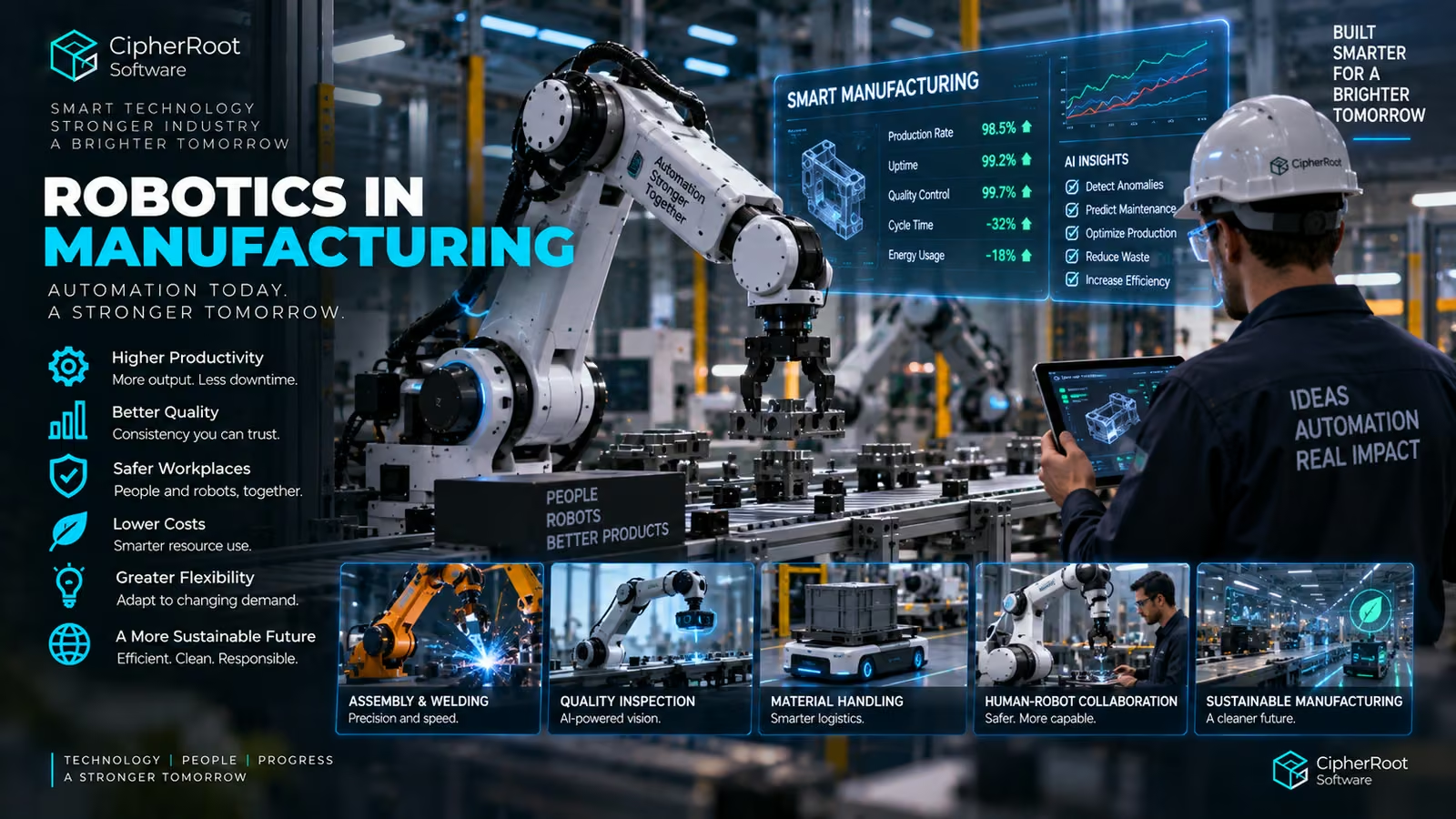
The Factory Is Becoming More Robotic
Manufacturing has always been closely connected to technological innovation.
Machines helped factories increase production. Computers introduced digital control. Industrial automation improved consistency and efficiency.
Now robotics is taking another major step forward.
Modern manufacturing robots are becoming more intelligent, more flexible, and increasingly capable of working alongside people.
Robotic arms, autonomous mobile robots, machine vision systems, collaborative robots, and AI-powered software are changing how factories assemble, inspect, transport, and manage products.
The modern factory is no longer simply a collection of machines.
It is becoming a connected system of humans, robots, software, and data.
What Is Robotics in Manufacturing?
Robotics in manufacturing refers to the use of programmable machines and robotic systems to perform physical tasks within production environments.
These systems can be designed for activities such as:
Assembly Welding Painting Packaging Material handling Quality inspection Machine tending Palletizing Sorting Internal transportation
Some robots perform the same highly repetitive task thousands of times.
Others can adapt their behavior based on sensors, cameras, software, or changing production requirements.
This flexibility is one of the biggest reasons robotics continues to expand across manufacturing.
Why Manufacturers Use Robots
Factories operate under constant pressure to improve productivity while maintaining quality and controlling costs.
Robots can help address some of these challenges.
A robot does not become tired in the same way a human worker does.
It can repeat precise movements consistently.
It can operate in environments that may be uncomfortable or hazardous.
It can also perform tasks at a predictable cycle time.
These characteristics make robotics particularly useful for repetitive and physically demanding operations.
But the value of robotics is not simply about replacing manual work.
It is also about creating more consistent and controllable processes.
Industrial Robot Arms
Robotic arms remain one of the most recognizable technologies in manufacturing.
They are widely used for applications where precise and repeatable movement is required.
A robotic arm can:
Pick up a component. Move it to a precise location. Perform an assembly or processing operation. Place the finished part on a conveyor. Repeat the process continuously.
Modern robotic arms can be configured for different payloads, reach distances, tools, and production environments.
With the right sensors and software, they can also become part of larger intelligent manufacturing systems.
Robotics and Artificial Intelligence
Traditional robots generally follow predefined instructions.
Artificial intelligence adds another layer.
AI can allow robotic systems to interpret information from cameras, sensors, and other sources.
This can help robots recognize objects, identify defects, adjust movements, and respond to changes in their environment.
For example, a vision system can identify the position of a component on a conveyor.
The robot can then adjust its movement automatically rather than assuming that every component will arrive at exactly the same location.
This makes robotic systems more adaptable.
The combination is powerful:
Robotics provides physical action. AI provides additional intelligence.
Computer Vision in Manufacturing
Computer vision is one of the most important technologies supporting modern industrial robotics.
Cameras can capture images of products, components, machines, and production environments.
AI models can then analyze those images.
Computer vision can be used for:
Defect detection Object recognition Position estimation Assembly verification Barcode and label reading Surface inspection Robot guidance
This allows machines to react to visual information in ways that were previously difficult to automate.
A robot does not need to rely entirely on a rigid mechanical setup.
It can use vision to understand what is actually in front of it.
Automated Quality Inspection
Quality control is a critical part of manufacturing.
A small defect can lead to product returns, waste, or customer dissatisfaction.
Robotic inspection systems can continuously examine products as they move through the production line.
High-resolution cameras combined with AI can identify visual differences that may be difficult to detect consistently through manual inspection.
The system can flag suspicious products for further review or automatically remove them from the production flow.
This creates a powerful production principle:
Inspect continuously instead of waiting until the end.
Collaborative Robots
Not every robot needs to operate behind a protective barrier.
Collaborative robots, often called cobots, are designed for applications where humans and robots work in closer proximity.
A cobot may assist with:
Assembly Picking Packaging Machine tending Screwdriving Inspection
Instead of replacing an entire workstation, the robot can handle one repetitive part of the process while the human worker performs tasks requiring dexterity, judgment, or flexibility.
This creates a different model of industrial automation.
The worker and robot become part of the same workflow.
Robots for Material Handling
Manufacturing involves much more than making products.
Materials constantly need to move between storage areas, production stations, inspection points, and shipping zones.
Autonomous mobile robots can handle some of these transportation tasks.
Using cameras, sensors, maps, and navigation software, mobile robots can move materials through facilities without requiring a fixed conveyor route for every movement.
This can make factories more flexible.
Production layouts can change without necessarily rebuilding the entire transportation infrastructure.
Autonomous Mobile Robots
Autonomous mobile robots, or AMRs, are increasingly important in modern logistics and manufacturing.
Unlike traditional automated guided vehicles that often follow fixed paths, AMRs are designed to navigate more dynamically.
They can potentially:
Map their environment Avoid obstacles Select routes Recalculate paths Receive new assignments
A fleet of AMRs can also be coordinated by software.
The system can decide which robot should handle a particular task based on location, battery level, workload, and priority.
This turns material movement into an intelligent optimization problem.
Robotic Welding and Assembly
Welding and assembly are classic applications for industrial robotics.
Robots can perform precise movements repeatedly while maintaining consistent process parameters.
This is particularly useful in industries where large numbers of similar parts are produced.
Robotic welding can help create consistent weld paths.
Automated assembly can ensure that components are positioned according to defined specifications.
When combined with sensors and machine vision, these systems can also detect certain variations and compensate for them.
Robotics in Automotive Manufacturing
The automotive industry has long been one of the major users of industrial robotics.
Robots can assist with:
Welding Painting Assembly Inspection Material handling
Modern vehicle manufacturing increasingly combines robots with sensors, software, AI, and connected production systems.
As vehicle designs become more complex and manufacturing becomes more flexible, robotics can help factories adapt to changing production requirements.
Robotics in Electronics Manufacturing
Electronics manufacturing presents a different challenge.
Components can be extremely small and require precise handling.
Robotic systems can perform assembly and inspection tasks with high accuracy.
Machine vision can help identify component positions.
Robotic systems can place or manipulate parts with precise movements.
Automated inspection can check whether components are correctly positioned.
This combination of robotics and computer vision is particularly useful when production volumes are high and tolerances are small.
Predictive Maintenance for Robots
Robots also need maintenance.
Motors, joints, gears, tools, sensors, and other components can wear over time.
Instead of waiting for a mechanical failure, factories can monitor robot performance continuously.
Sensors can provide information about:
Temperature Vibration Motor load Movement accuracy Cycle time Energy consumption
AI systems can analyze these patterns and identify unusual behavior.
Maintenance teams can then investigate potential issues before they develop into serious failures.
The robot becomes part of the factory's predictive-maintenance system.
Digital Twins and Robotics
Digital twins can also play an important role in robotic manufacturing.
A digital twin can represent a robot, production cell, or entire factory digitally.
Engineers can simulate:
Robot movements Production layouts Cycle times Collision risks Material flow Equipment utilization
This allows teams to evaluate changes before applying them to the real production environment.
The concept is straightforward:
Build digitally. Test virtually. Deploy physically.
Robots and Flexible Manufacturing
Traditional production lines are often designed around specific products.
Changing the product may require expensive reconfiguration.
Modern robotics can help make production more flexible.
A robot can switch between tasks when its software, tools, or programming are changed.
AI-powered vision can also help systems recognize different product types.
This creates the possibility of manufacturing environments that adapt more easily to changing demand.
Flexible automation can be particularly valuable when companies produce multiple product variations rather than millions of identical units.
Human-Robot Collaboration
The future of manufacturing is unlikely to be purely robotic.
Humans remain important for:
Engineering Product development Maintenance Quality management Process improvement Safety Troubleshooting Strategic decisions
Robots are extremely effective at repeatable physical tasks.
Humans are better suited to many situations involving creativity, judgment, communication, and unexpected circumstances.
Combining these strengths can create a more capable production environment.
The question is no longer simply:
“What can the robot do?”
It is also:
“What should the human do, and what should the robot do?”
Safety Is Fundamental
Industrial robotics requires careful safety engineering.
Robots can move quickly and carry significant loads.
Factories therefore need appropriate physical safeguards, safety sensors, emergency systems, operating procedures, and risk assessments.
Collaborative systems also require careful design and validation to ensure that human-robot interaction is appropriate for the specific application.
Automation should never be treated as a shortcut around safety.
The more powerful the machine becomes, the more important its safety architecture becomes.
Cybersecurity in Robotic Factories
Modern robots are increasingly connected to networks and software systems.
This creates cybersecurity considerations.
A connected robot may communicate with production databases, industrial controllers, cloud services, monitoring platforms, and other machines.
A compromised system could potentially disrupt physical production.
Manufacturers therefore need strong authentication, network segmentation, access controls, secure software updates, monitoring, and other cybersecurity measures.
A connected factory must be designed as both a physical system and a digital system.
Robots and Sustainability
Robotics can also contribute to resource efficiency.
Precise robotic processes can reduce material waste.
Automated systems can improve production consistency.
AI can optimize machine operation.
Autonomous logistics can reduce unnecessary movement.
Predictive maintenance can help extend equipment lifetimes.
However, robotics itself consumes energy and requires manufacturing resources.
The overall environmental impact depends on the complete system design, including how efficiently machines operate and how effectively they are utilized.
Technology is not automatically sustainable.
It has to be engineered that way.
The Economics of Industrial Robotics
Robotics requires investment.
Businesses may need to purchase robots, sensors, software, safety equipment, integration services, and maintenance infrastructure.
The return on investment depends on factors such as:
Production volume Labor requirements Machine utilization Maintenance costs Product complexity Automation reliability Deployment costs
For high-volume repetitive production, automation can potentially deliver significant operational benefits.
For low-volume or highly variable production, a different automation strategy may be more appropriate.
There is no single robotic solution for every factory.
Small and Medium Manufacturers Can Use Robotics Too
Industrial robotics is no longer limited to enormous automotive plants.
Smaller manufacturers can increasingly explore compact robotic systems, collaborative robots, modular automation, and robotic workstations.
A small company might automate one process rather than an entire factory.
For example, it could begin with:
Packaging
then add:
Quality inspection
and later introduce:
Material handling.
This gradual approach can reduce the complexity of adoption.
The factory does not have to become fully autonomous overnight.
The Future of Intelligent Manufacturing
The next generation of manufacturing will combine multiple technologies rather than rely on robotics alone.
We can expect increasing integration between:
Robots
Artificial intelligence
Computer vision
Industrial sensors
Digital twins
Cloud and edge computing
Autonomous logistics
Manufacturing software
When these systems communicate continuously, the factory becomes much more than an automated production line.
It becomes an intelligent ecosystem.
The Factory of Tomorrow
Imagine a manufacturing facility where robots automatically receive production tasks.
Computer vision systems inspect every product.
AMRs transport components between stations.
AI monitors machine health.
Digital twins simulate production changes.
Software optimizes energy and material use.
Human engineers supervise the entire operation from connected dashboards.
When demand changes, production schedules adapt.
When a machine begins behaving abnormally, maintenance teams receive an alert.
When a product fails inspection, the system immediately identifies it.
The factory does not simply execute instructions.
It continuously observes, analyzes, and adapts.
Conclusion
Robotics is transforming manufacturing by bringing greater automation, precision, flexibility, and connectivity into the production environment.
Industrial robots can handle repetitive tasks.
Collaborative robots can work alongside humans.
Autonomous mobile robots can transform internal logistics.
Computer vision can automate inspection.
AI can help robots interpret their environments and optimize operations.
Digital twins can help engineers simulate changes before applying them.
Together, these technologies are creating a new generation of intelligent manufacturing.
The future factory will not simply contain more robots.
It will contain better-connected robots that understand more, adapt more, and work more effectively with people and software.
Automation started by teaching machines to repeat.
AI is helping teach machines to understand.
Robotics is turning that understanding into physical action.
Smarter machines. Better production. A new industrial future.