
Future & Research
Robotics and Ethics: How Should We Build the Robots of Tomorrow?
CipherRoot Software12 min read
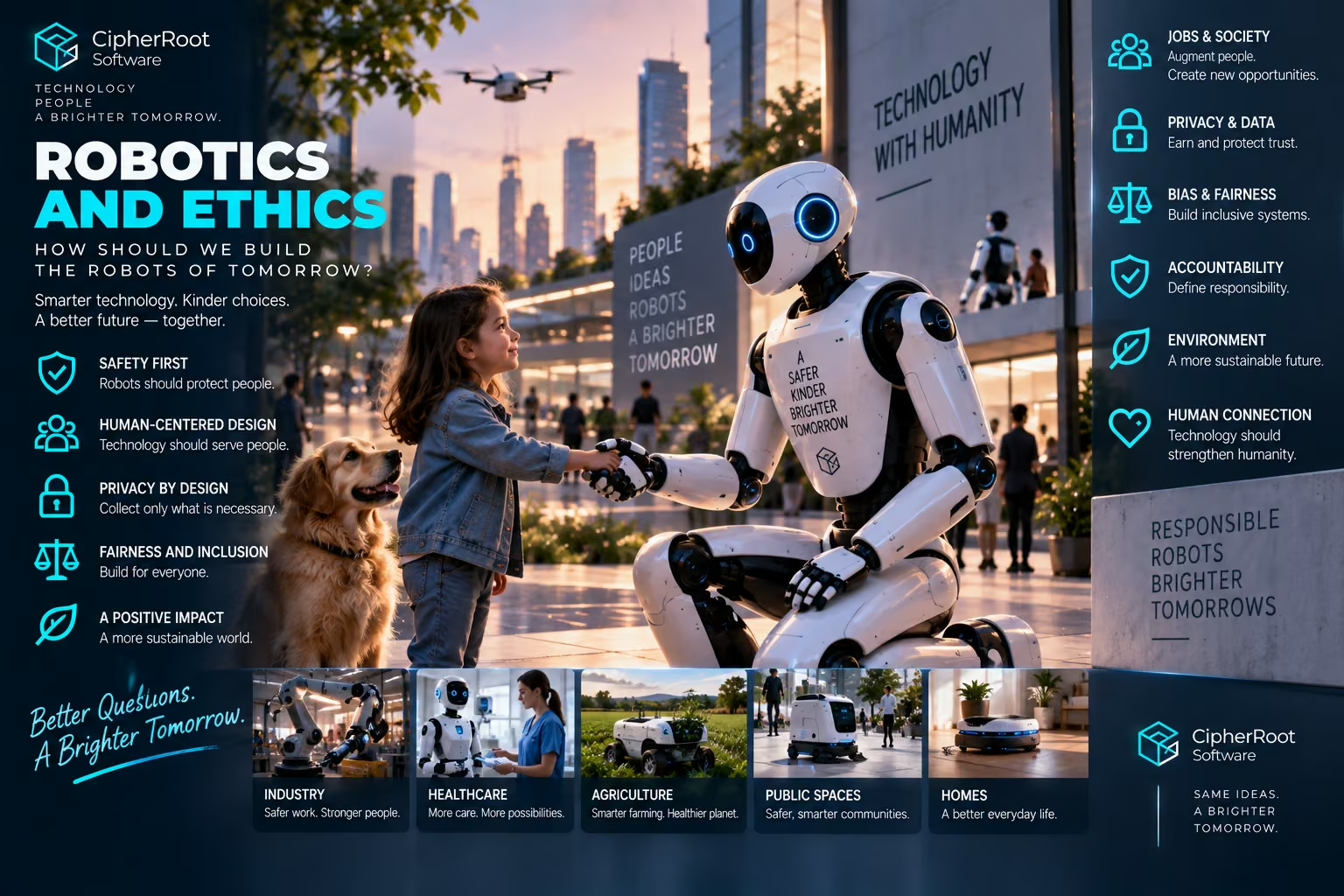
Robotics Is Entering Everyday Life
Robots were once primarily associated with factories and science fiction.
Today, they are becoming part of homes, warehouses, hospitals, farms, transportation systems, and public spaces.
Robotic vacuum cleaners navigate apartments.
Industrial robots assemble products.
Autonomous systems move goods.
Service robots assist customers.
Humanoid robots are being developed for environments designed for people.
As robots become more capable, an important question becomes impossible to ignore:
How should we build machines that increasingly interact with humans and the world around them?
This is where robotics meets ethics.
Building a robot is an engineering challenge.
Deciding how that robot should behave around people is also a human responsibility.
What Is Robotics Ethics?
Robotics ethics is the study of the moral, social, legal, and practical questions created by robotic systems.
These questions can include:
How should robots behave around humans? Who is responsible when an autonomous system makes a mistake? How should robots protect privacy? What information should a robot be allowed to collect? How should robots be designed for vulnerable users? How should automation affect workers? When should a human be able to override a machine?
There is no single answer that applies to every robot.
A factory robot, hospital robot, delivery robot, and household robot can have completely different responsibilities and risks.
Ethical design therefore needs to consider the environment in which the machine operates.
Safety Must Come First
The first ethical principle of robotics is simple:
Robots should be designed to operate safely.
A robot can move faster and lift heavier objects than a person.
That can be useful.
It can also create risks.
Industrial robots need appropriate safeguards.
Mobile robots need reliable obstacle detection.
Service robots need to behave predictably around pedestrians.
Humanoid robots need to operate safely around people in homes and workplaces.
Safety should not be treated as a feature added near the end of development.
It should be part of the architecture from the beginning.
Autonomous Decisions
As robots become more autonomous, they increasingly need to make decisions without direct human instructions.
A robot may have to decide:
Where should I move?
Which route should I take?
Should I stop?
Is this object safe to approach?
Should I continue operating?
The ethical difficulty increases when there is no perfect answer.
A robot operating in a busy environment may encounter situations where every available action carries some level of risk.
Developers therefore need to define how the system should behave under uncertainty.
The machine should not simply optimize for efficiency.
It also needs to respect safety constraints.
Human Oversight
Not every decision should be left entirely to a machine.
Human oversight can provide an important layer of accountability.
A robot may operate autonomously under normal conditions while allowing a human to intervene when unusual situations occur.
For example, a service robot could request assistance if:
Its path is blocked It cannot identify an object A safety condition is unclear It encounters an unexpected situation A technical failure occurs
This creates a useful principle:
Autonomy where appropriate. Human control where necessary.
Who Is Responsible When a Robot Makes a Mistake?
Responsibility becomes complicated when a robotic system causes harm.
Imagine an autonomous machine makes an unexpected decision.
Who should be responsible?
The manufacturer?
The software developer?
The system operator?
The company deploying the robot?
The person supervising it?
The answer can depend on the specific system, circumstances, and applicable law.
This is why accountability should be designed into robotic systems.
Organizations need clear records of:
System decisions Human interventions Software versions Configuration changes Maintenance events Operational conditions
Good logging does not prevent every accident.
But it can make investigation and accountability much more practical.
Robots and Privacy
Modern robots can contain cameras, microphones, GPS, LiDAR, and other sensors.
This allows them to understand their surroundings.
It also means they can collect enormous amounts of information.
Consider a household robot.
It could potentially know the layout of a home.
A service robot in a hotel could observe guests.
A delivery robot could record information about public spaces.
A healthcare robot could operate in an extremely sensitive environment.
This raises an important question:
Just because a robot can collect information, does it mean it should?
Ethical design should minimize unnecessary data collection.
Data Minimization
One useful privacy principle is data minimization.
A robotic system should collect the information it actually needs for its intended task rather than gathering everything available.
For example, a cleaning robot may need a map of a home.
It may not need to store every conversation that happens in that home.
A delivery robot may need to understand obstacles.
It may not need to permanently retain identifiable images of every person it passes.
Collecting less information can reduce privacy risk.
Local Processing and Privacy
Robotics can also benefit from processing certain information locally.
When sensor data can be analyzed directly on the robot, less information may need to leave the device.
This can potentially improve privacy and reduce communication requirements.
Cloud systems remain useful for larger models and centralized analysis.
Future robotic architectures may therefore combine:
Local intelligence + secure cloud services
to balance capability, latency, cost, and privacy.
Robotics and Employment
Automation has always changed the workplace.
Robotics can automate repetitive physical tasks that previously required human workers.
This can improve productivity and reduce exposure to dangerous environments.
But it can also change employment patterns.
Some roles may decline.
Other roles may grow.
New jobs can emerge around:
Robot maintenance Fleet management System integration AI supervision Robotics engineering Safety Training Operations
The effects will differ by industry, region, occupation, and the way companies deploy automation.
The ethical discussion should therefore go beyond the simple question:
“Will robots take jobs?”
A more useful question is:
“How should organizations manage the transition as work changes?”
Reskilling and Human Adaptation
When robotics changes an industry, workers may need new skills.
A production worker may increasingly interact with robotic systems.
A logistics employee may supervise autonomous vehicles.
A technician may maintain sophisticated robotic equipment.
This creates an opportunity for training and reskilling.
Technology can change what humans do.
Education can help people adapt to those changes.
Responsible automation should therefore consider not only machine capability but also the people affected by implementation.
Robots and Human Dignity
A robot can make work more efficient.
But efficiency is not the only value.
People should not be reduced to simple productivity measurements simply because machines can measure more aspects of their work.
For example, a workplace system that constantly monitors employees could become intrusive even if the technology technically improves efficiency.
Robotics and AI should be designed to support human dignity rather than treating people as another data source.
Humanoid Robots and Social Interaction
Humanoid robots create additional ethical questions because they resemble humans.
People naturally respond socially to faces, voices, movement, and gestures.
A humanoid robot may therefore influence human emotions in ways that a conventional machine does not.
This raises questions such as:
Should robots clearly identify themselves as machines?
Should they imitate emotions?
Should they use human-like voices?
Should companies design robots to encourage emotional attachment?
These questions become particularly important when robots interact with children, elderly people, or other vulnerable groups.
The Psychology of Human-Robot Interaction
People may develop attachment to machines.
This is not necessarily harmful.
Humans already form emotional relationships with pets, virtual characters, and digital assistants.
But designers should understand the difference between creating a friendly interface and deliberately manipulating emotional dependence.
A robot can be warm and approachable without pretending to be a human being.
Clear communication about the robot's capabilities and limitations can help maintain realistic expectations.
Robots and Children
Children may find robots fascinating.
Educational robots can support learning, creativity, and experimentation.
Social robots can also become part of games and interactive experiences.
But children may be especially likely to trust or anthropomorphize machines.
Robots designed for children should therefore receive careful attention regarding:
Privacy Safety Content Data collection Advertising Emotional influence Parental controls
A robot interacting with a child should be held to a higher standard than an ordinary household appliance.
Robotics in Healthcare
Healthcare robotics presents some of the most sensitive ethical issues.
Robots can assist with logistics, rehabilitation, monitoring, surgery, and other tasks.
But patients are not simply another engineering environment.
Medical decisions can have serious consequences.
Patients also need communication, trust, dignity, and informed participation.
Robotic systems in healthcare should therefore be designed around clearly defined roles.
A robot may assist a medical professional.
That does not mean the robot should automatically become the final authority over a patient's care.
Ethical Robotics in Public Spaces
Public robots create another challenge.
A robot operating in a shopping center, airport, or street interacts with people who did not choose to use it.
Those people may still be recorded by cameras and sensors.
This creates a difference between:
User consent
and
Being present in the environment.
Designers need to consider how public robots can minimize unnecessary collection of information from people who are simply nearby.
Bias in Robotic Systems
Robots increasingly depend on AI models.
AI models can inherit limitations from their training data.
For example, a computer-vision system may perform differently across demographic groups or environmental conditions if its training data is unbalanced.
In robotics, this can become a physical safety issue.
A perception system that fails to correctly identify an object or person can cause a robot to behave incorrectly.
Testing therefore needs to consider diverse real-world conditions rather than only ideal laboratory environments.
Transparency and Explainability
People need to know what a robot is doing.
A robot that suddenly changes direction without explanation can be difficult to trust.
Simple communication mechanisms can help.
A robot might:
Display its current task Indicate when it is recording Signal that it is stopping Explain why it needs assistance Provide clear error messages
The more autonomous the system becomes, the more valuable understandable communication becomes.
Security Is Part of Ethics
Cybersecurity is not separate from robotics ethics.
A robot connected to a network can potentially be attacked.
If attackers gain control of a physical machine, the consequences can be very different from a compromised website.
Security should therefore include:
Strong authentication Secure communications Access controls Software updates Network segmentation Monitoring Safe failure mechanisms
A robot that is intelligent but insecure is not responsibly designed.
Robots Should Fail Safely
No system operates perfectly.
Sensors can fail.
Software can crash.
Batteries can become depleted.
Networks can disappear.
Unexpected environmental conditions can occur.
Ethical robotics therefore requires safe failure modes.
When the robot cannot reliably determine what to do, stopping or entering a controlled state may be safer than making an uncertain decision.
The goal is not to eliminate every possible failure.
It is to prevent failures from becoming unnecessary harm.
Should Robots Have Rights?
As robots become more sophisticated, philosophical questions will become more common.
Could an extremely advanced machine deserve some kind of rights?
Could a robot experience consciousness?
Could a machine have moral status?
These are serious philosophical questions, but current robots should not automatically be treated as conscious beings simply because they can communicate or display human-like behavior.
A machine can simulate emotion without necessarily experiencing emotion.
For now, the practical ethical priority is how humans design, deploy, and control robotic systems.
Robotics and Environmental Responsibility
Robots require materials, energy, batteries, electronics, and manufacturing infrastructure.
Large robotic fleets can therefore have environmental costs.
Ethical robotics should consider the complete lifecycle of a machine:
Design → Manufacturing → Deployment → Maintenance → Reuse → Recycling
Energy efficiency is important.
Repairability can also matter.
A robot that is difficult to repair may create unnecessary electronic waste.
Responsible design therefore extends beyond what the robot can do.
It includes how the robot is made and what happens when its useful life ends.
Open Standards and Accountability
Robotics ecosystems will increasingly involve hardware from one company, software from another, AI models from another, and infrastructure from another.
This can complicate responsibility.
Clear interfaces and standards can help establish how systems communicate and who controls specific functions.
Well-designed standards can also improve safety and interoperability.
The more interconnected robotics becomes, the more important clear system boundaries become.
The Principle of Human-Centered Robotics
A useful philosophy for robotics is simple:
Build technology around human needs, not the other way around.
This means asking:
Does the robot solve a real problem?
Does it improve safety?
Does it respect privacy?
Can users understand it?
Can people override it when necessary?
What happens when it fails?
Who is responsible?
How does it affect workers?
How does it affect the environment?
These questions should be asked before deployment, not after something goes wrong.
The Future of Ethical Robotics
Future robots will likely become more autonomous and more deeply integrated into everyday life.
We may see:
AI-powered household robots Autonomous delivery systems Humanoid assistants Robotic healthcare systems Intelligent industrial machines Agricultural robots Autonomous transportation Robotic public services
As these systems become more capable, ethics will become part of engineering rather than a separate discussion.
Software architecture, mechanical design, cybersecurity, AI training, privacy, and human factors will all influence how responsibly a robot behaves.
Building Robots People Can Trust
Trust is earned through predictable behavior.
A trustworthy robot should not hide what it is doing.
It should behave within clearly defined limits.
It should protect sensitive information.
It should fail safely.
It should provide meaningful human control.
And organizations deploying it should remain accountable for how the system is used.
Trust does not come from making a robot look human.
It comes from making the system reliable, understandable, and responsible.
Conclusion
Robotics is moving from controlled industrial environments into the places where people live, work, travel, shop, and receive care.
That transition creates enormous possibilities.
Robots can perform dangerous tasks.
They can automate repetitive work.
They can assist workers.
They can improve accessibility.
They can support healthcare and logistics.
But greater capability also creates greater responsibility.
The future of robotics should therefore not be measured only by speed, intelligence, or autonomy.
It should also be measured by safety, privacy, accountability, transparency, sustainability, and respect for human dignity.
The goal is not to create robots that simply can do more.
It is to create robots that know how to operate responsibly in a human world.
Technology gives robots capability.
Engineering gives them reliability.
Ethics gives us the principles for deciding how those capabilities should be used.
Smarter robots. Responsible design. Human-centered innovation.
The future of robotics is not only about what machines can become.
It is about what kind of world we choose to build with them.