
Future & Research
Robot Pets: The Next Generation of Companionship
CipherRoot Software8 min read
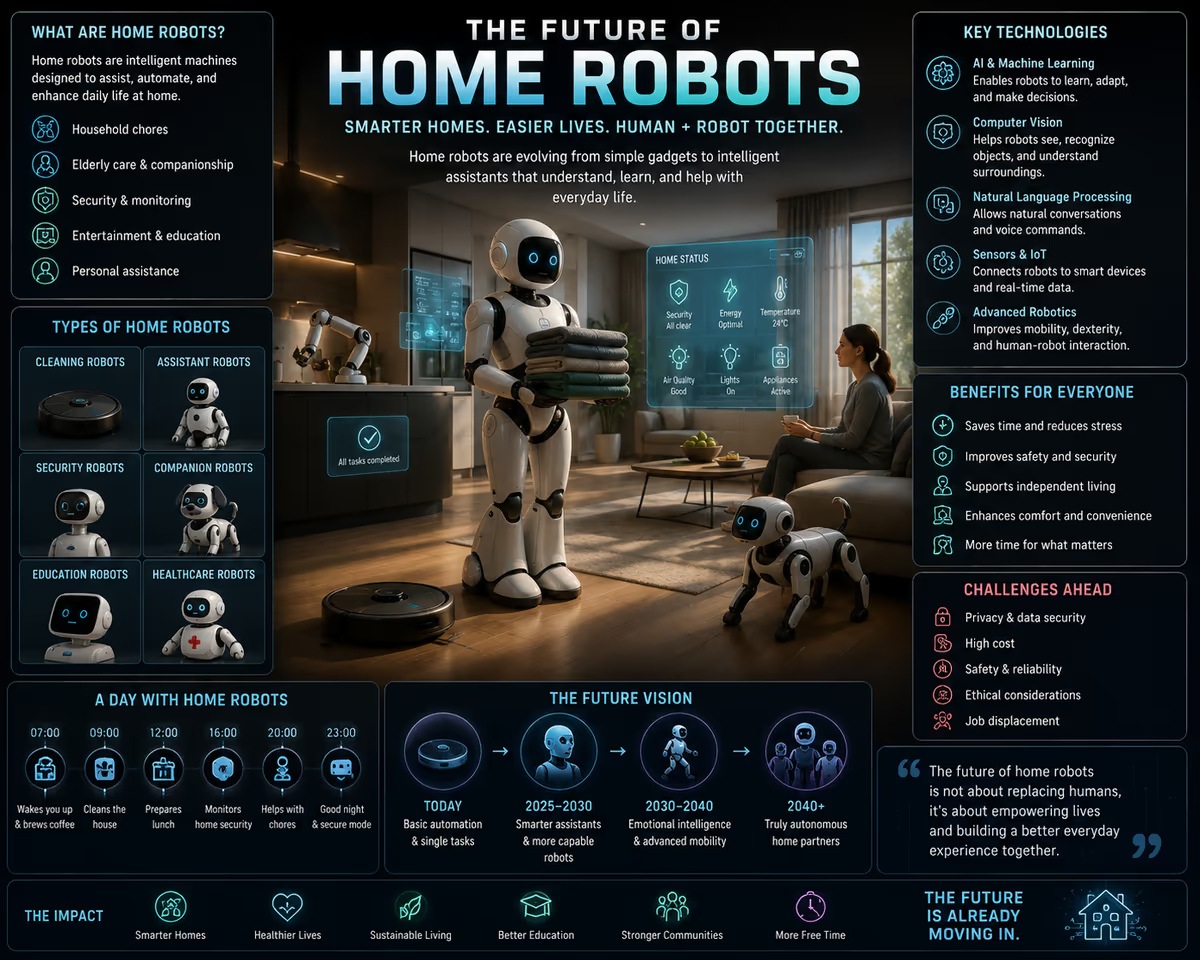
For thousands of years, humans have shared their homes with animals.
Dogs, cats, birds, and other pets provide companionship, entertainment, and emotional connection. But advances in robotics and artificial intelligence are creating a new possibility: robotic companions designed to behave like pets.
Modern robotic pets are no longer simply mechanical toys.
With artificial intelligence, cameras, microphones, sensors, motors, and increasingly sophisticated software, future robot pets could recognize people, respond to voices, learn routines, and develop increasingly personalized behaviors.
The question is no longer simply whether a machine can imitate an animal.
The bigger question is:
- Can technology create a new form of companionship?
- What Are Robot Pets?
Robot pets are robotic systems designed to provide interaction and companionship.
They can take many forms, including:
- Robotic dogs
- Robotic cats
- Robotic birds
- Robotic rabbits
- Robotic turtles
- Experimental humanoid or animal-like robots
Some existing systems focus primarily on movement and entertainment.
Future generations could combine physical robotics with sophisticated AI to create much more interactive companions.
How Do Robot Pets Work?
A robotic pet combines several technologies.
Artificial Intelligence
AI provides the ability to interpret information and generate appropriate responses.
Computer Vision
Cameras allow the robot to recognize people, objects, and parts of its environment.
Microphones
Voice recognition allows the robot to respond to spoken commands.
Sensors
Touch, movement, distance, and environmental sensors help the robot understand what is happening around it.
Motors
Motors allow the robot to walk, turn, move its head, wag its tail, or perform other behaviors.
Together, these technologies create a machine capable of interacting with the physical world.
From Toy to Companion
Early robotic pets were mostly designed as electronic toys.
Their behavior was limited.
They could move, make sounds, or respond to a few predefined commands.
Modern AI changes the possibilities.
A future robot pet could potentially understand:
"Come here."
Then recognize the person speaking, locate them, navigate around furniture, and approach them.
It could also learn that the same person prefers certain games or interactions.
This creates a much more personalized experience.
Robot Dogs
Robotic dogs are among the most recognizable forms of robot pets.
Their four-legged structure provides a useful platform for mobility.
A future AI-powered robot dog could potentially:
- Follow its owner
- Recognize family members
- Explore the home
- Respond to voice commands
- Play interactive games
- Monitor its surroundings
- Learn household routines
The technology could eventually make robotic dogs useful for both companionship and practical assistance.
Robot Cats
Robotic cats could focus more heavily on social interaction.
They could respond to touch, sounds, movement, and voices.
Imagine a robotic cat that recognizes when its owner enters the room and approaches them automatically.
It could learn which interactions the owner enjoys and adjust its behavior over time.
The goal would not necessarily be to perfectly reproduce a biological cat.
Instead, it could create a new type of interactive companion.
Robot Birds and Other Companions
Robotic pets do not have to imitate traditional household animals.
Future designers could create entirely new forms of companions.
Robotic birds could fly or hover.
Small robotic creatures could explore the home.
Some could be designed for entertainment and education.
Others could combine companionship with useful household functions.
The possibilities are much broader than simply copying existing animals.
AI Gives Robots Personality
One of the most interesting possibilities is personality.
A robot pet could potentially develop recognizable behavioral characteristics.
For example, one robot might be energetic and playful.
Another might be calm and quiet.
Another might enjoy exploring.
AI could allow these behaviors to change based on interactions with the owner.
This would make every robot potentially different.
Can Robot Pets Feel Emotions?
This is an important distinction.
A robot can simulate emotional behavior without necessarily experiencing emotions like a biological animal or human.
It could recognize that someone sounds sad and respond with comforting behavior.
It could become more active during play.
It could appear excited when its owner returns.
But these behaviors should not automatically be interpreted as proof that the machine is actually experiencing emotions.
Understanding this distinction will become increasingly important as AI companions become more convincing.
Robot Pets for Children
Robotic pets could have educational applications.
Children could interact with them while learning about:
- Programming
- Robotics
- Artificial intelligence
- Responsibility
- Problem solving
- Science
A programmable robot pet could become an interactive learning platform.
However, children's privacy and safety would need to be carefully protected, particularly if the robot contains cameras, microphones, or internet connectivity.
Robot Pets for Older Adults
Companion robots could potentially help older adults maintain engagement and daily routines.
A robot might provide reminders, entertainment, conversation, or simple interactive activities.
It could also potentially alert caregivers when something unusual occurs.
Such systems should be viewed as support tools, not replacements for human relationships or professional care.
Human contact remains fundamentally important.
Robot Pets and Loneliness
One potential application is companionship.
People may live alone, travel frequently, or be unable to care for a biological animal.
A robotic companion could provide interaction without some of the practical responsibilities associated with a living pet.
It would not require food or veterinary care, and it could potentially operate for many years with maintenance and battery replacement.
But whether a machine can provide the same emotional value as a living animal remains an open question.
The Benefits of Robot Pets
Future robotic companions could provide several practical advantages.
Low Maintenance
They would not require food or biological care.
Interactive
They could respond to voice, touch, and movement.
Personalized
AI could adapt behavior to individual users.
Educational
They could teach children about technology.
Accessible
They could potentially provide companionship to people who cannot keep traditional pets.
The Challenges
Robot pets also have limitations.
Important challenges include:
- Battery life
- Durability
- Cost
- Maintenance
- AI reliability
- Privacy
- Cybersecurity
- Emotional dependency
A robotic pet connected to the internet could potentially become a security risk if poorly designed.
Manufacturers will need to treat cybersecurity as seriously as mechanical engineering.
Privacy in the Home
A sophisticated robot pet could have access to cameras, microphones, and information about household routines.
That creates an important question:
Who controls the data?
Users should understand what information their robot collects, where it is stored, and whether it is transmitted to cloud servers.
Privacy controls should be built into the system from the beginning.
Robot Pets vs Real Animals
Robot pets are not necessarily replacements for biological animals.
A real dog experiences the world as a living organism.
A robotic dog operates through sensors, software, motors, and AI.
They provide fundamentally different forms of interaction.
A robotic pet could be useful for someone who cannot care for a real animal.
But for many people, the unpredictability and biological nature of a real animal is precisely what makes the relationship meaningful.
The two may ultimately coexist.
The Future of Robot Companions
Future robot pets could become significantly more capable.
They may be able to:
- Recognize individual family members
- Remember previous interactions
- Understand natural speech
- Learn routines
- Navigate entire homes
- Respond to emotional cues
- Play complex games
- Connect with smart-home systems
Some could potentially become part of the household's digital ecosystem.
Robot Pets and Smart Homes
A future robot pet could communicate with other devices.
For example:
Robot detects that someone has arrived home. → Smart lights activate. → Thermostat adjusts the temperature. → Robot welcomes the owner. → Home security system changes state.
The robot becomes more than a companion.
It becomes a physical interface for the smart home.
AI Memory Could Change Everything
Memory could be one of the most important future features.
Imagine a robot that remembers:
- Your name
- Your daily schedule
- Favorite games
- Family members
- Household rules
- Previous conversations
- Places it has explored
This could create a much stronger sense of continuity.
Instead of restarting its behavior every day, the robot could gradually develop a history with its owner.
Could Robot Pets Become Truly Autonomous?
The long-term goal of robotics is greater autonomy.
A future robot pet might be able to decide what to do without constant commands.
It could explore the house, entertain itself, interact with its owner, recharge when necessary, and respond to unexpected situations.
This would make the robot feel less like a remote-controlled machine and more like an independent artificial companion.
The Future of Companionship
Robot pets represent something larger than robotics.
They raise questions about how humans will interact with artificial beings.
If a machine can recognize you, remember your interactions, respond to your voice, and adapt its behavior to you, the relationship may feel surprisingly personal.
The technology will force society to reconsider the meaning of companionship itself.
Final Thoughts
Robot pets are moving from simple mechanical toys toward increasingly intelligent companions.
Artificial intelligence, computer vision, speech recognition, sensors, and advanced robotics are creating machines capable of much more natural interaction.
They may never completely replace the experience of living with a real animal.
They don't need to.
Robot pets could become their own category of companion—one designed from the beginning around artificial intelligence and robotics.
The future may contain homes with dogs and cats, humans and robots, all existing together.
The next generation of pets may not be born.
They may be engineered.