
Future & Research
Robot Pets: The Next Companions
CipherRoot Software7 min read
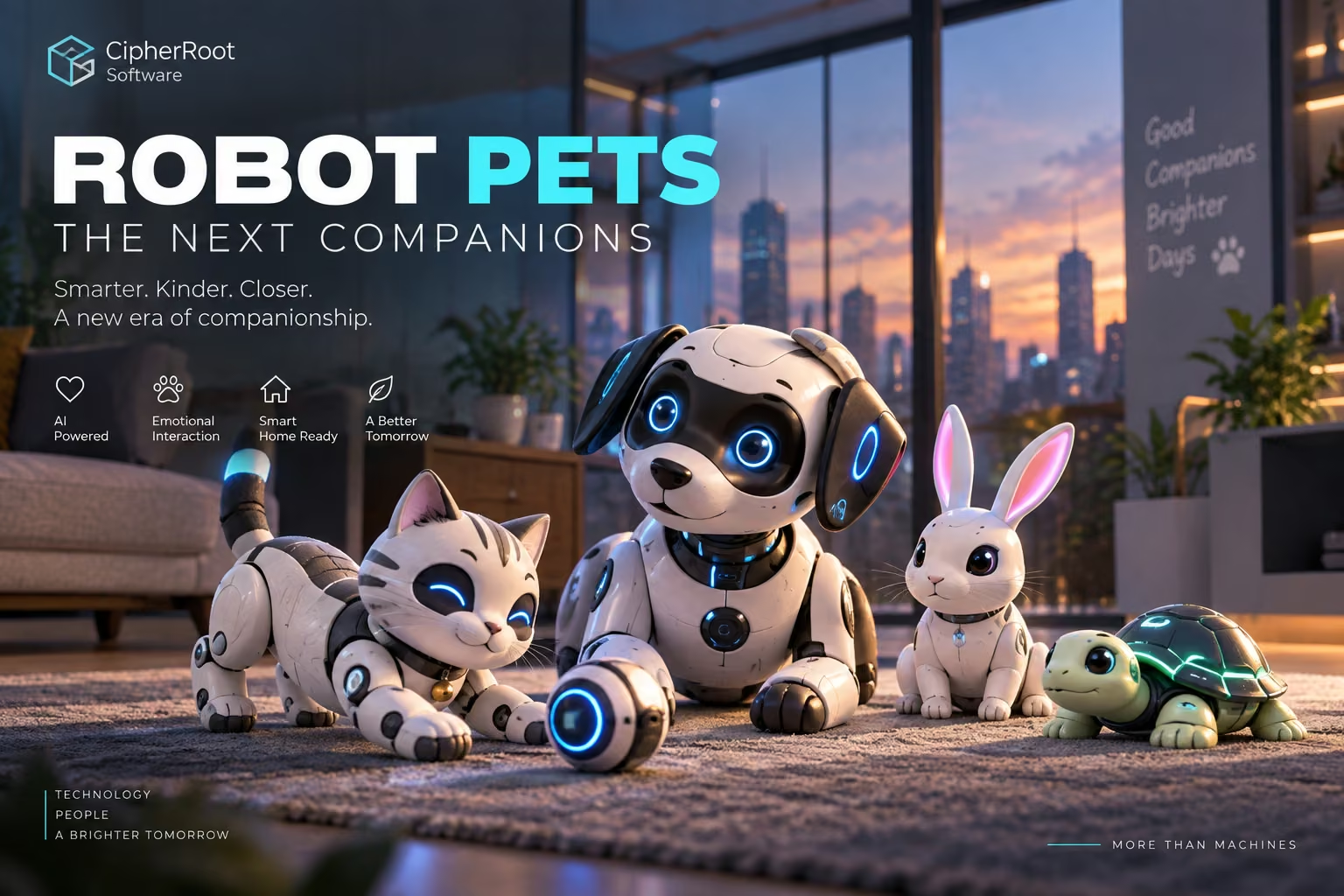
Robot Pets Are Changing the Meaning of Companionship
For generations, pets have been an important part of everyday life. Dogs, cats, birds, and other animals provide companionship, comfort, entertainment, and a unique emotional connection.
Now, technology is creating a new possibility: robot pets.
Modern robotics and artificial intelligence are making it possible to build machines that can move, react to their environment, recognize people, respond to voices, and simulate surprisingly natural social behavior. These systems are no longer limited to following simple commands. Developers are working toward robots that can learn routines, recognize emotional cues, and create personalized interactions with their owners.
Robot pets may become one of the most interesting forms of consumer robotics in the coming years.
What Is a Robot Pet?
A robot pet is an interactive robotic device designed to behave, at least in some ways, like a traditional companion animal.
Instead of biological needs, a robot pet relies on hardware, sensors, software, batteries, and artificial intelligence.
Depending on its design, a robot pet may include:
- Cameras and environmental sensors
- Microphones for voice recognition
- Speakers for sounds and responses
- Motors for walking, turning, or expressive movement
- AI systems for conversation and interaction
- Facial or motion recognition
- Internet connectivity and cloud-based services
- Learning systems that adapt to the user's habits
The goal is not necessarily to perfectly imitate a living animal. Instead, robot pets can create their own type of companionship by combining technology with personality and interaction.
Artificial Intelligence Gives Robots Personality
The biggest difference between older robotic toys and modern robot pets is artificial intelligence.
Traditional robotic toys often follow a limited set of predefined behaviors. They may bark when touched, move when a button is pressed, or repeat the same phrases.
AI-powered robot pets can potentially go much further.
A future companion could recognize its owner's voice, remember previous interactions, notice daily routines, and respond differently depending on the situation. For example, a robot pet might become more active when its owner returns home or change its behavior after learning that the user prefers quiet mornings.
This creates something more interesting than automation.
It creates personalization.
Instead of every robot behaving exactly the same way, each device could gradually develop a behavior profile based on its interactions with its owner.
Emotional Interaction Could Become a Major Feature
One of the most fascinating areas of robotic companionship is emotional interaction.
Humans naturally respond to movement, sound, facial expressions, and social cues. Robot designers can use these same principles to make machines feel more expressive.
A robot dog could tilt its head when it hears a strange sound. A robotic cat could react differently to gentle or energetic interaction. A small humanoid-style companion might use facial animations, sounds, and body language to communicate.
Artificial intelligence could also help robots interpret signals such as:
- Voice tone
- Facial expressions
- Spoken language
- Movement patterns
- Interaction frequency
This does not mean that a machine experiences emotions in the same way a living creature does. It means that technology can be designed to recognize and respond to human behavior in increasingly convincing ways.
That distinction will become increasingly important as robotic companions become more sophisticated.
Robot Pets Can Offer Practical Advantages
One reason robot pets could become popular is convenience.
Traditional pets require food, veterinary care, cleaning, exercise, and long-term responsibility. Robot pets do not eliminate all maintenance, but their requirements can be fundamentally different.
A robotic companion does not need to be fed or taken outside. It may also be suitable for environments where traditional pets are difficult to keep, such as small apartments or certain workplaces.
For some people, this could make robot pets an interesting alternative for companionship.
They could also be useful in educational environments, technology demonstrations, and interactive entertainment.
A New Generation of Smart Home Companions
Robot pets could eventually become part of the smart home ecosystem.
Imagine a robotic companion that does more than interact with its owner. It could communicate with lights, speakers, cameras, smart appliances, and other connected devices.
For example, a robot pet might recognize that someone has returned home and trigger a personalized home routine. It could provide reminders, act as a mobile interface for smart devices, or follow its owner from one room to another.
In this scenario, the robot is not just a pet.
It becomes a mobile AI interface for the home.
This could create an entirely new category of consumer technology somewhere between smart speakers, personal assistants, toys, and domestic robots.
Different Forms of Robot Pets
Robot pets do not have to look like traditional dogs or cats.
Developers can experiment with completely new designs.
Some may resemble familiar animals, while others could take inspiration from fictional creatures, insects, marine animals, or futuristic machines.
We could eventually see:
Robotic Dogs Designed for active movement, voice interaction, security features, and expressive behavior.
Robotic Cats Smaller companions focused on personality, autonomous exploration, and indoor interaction.
Robotic Birds Designed around flight, sound, and lightweight movement.
Robotic Turtles and Reptiles Slow-moving companions with unique personalities and environmental sensors.
AI Companion Creatures Entirely fictional robotic species that do not exist in nature.
This last category could become particularly exciting. Unlike traditional pet robots, fictional AI creatures are not restricted by biological anatomy.
The Challenge of Making Robots Feel Natural
Creating a convincing robot pet is much harder than simply putting wheels or legs on a machine.
Movement must feel believable. Sounds must feel appropriate. Responses need to happen quickly enough to appear natural.
An overly predictable robot feels like a toy.
A robot that behaves randomly can feel frustrating.
The challenge is finding the balance between predictability, personality, and autonomy.
Developers are therefore working across multiple fields at once: robotics, artificial intelligence, computer vision, speech technology, animation, human-computer interaction, and mechanical engineering.
The best robot pets may eventually combine all of these technologies into one seamless experience.
Privacy Will Matter
As robot pets become smarter, privacy will become an important consideration.
A connected robot may contain microphones, cameras, sensors, and software capable of processing personal information. A device that moves around a home could potentially observe an enormous amount of data about its environment.
Manufacturers will therefore need to think carefully about:
- Local versus cloud AI processing
- Data retention
- Camera and microphone controls
- User permissions
- Encryption
- Software security
- Transparent privacy policies
The more intelligent the robot becomes, the more important responsible data handling becomes.
Could Robot Pets Become Truly Autonomous?
The long-term question is how much independence these machines will eventually have.
Today's robots operate within carefully designed boundaries. Future systems could become significantly more autonomous.
A sophisticated robot pet could potentially decide where to move, what to investigate, how to interact with its owner, and when to enter different behavioral modes.
This introduces a new concept: machine companionship based on continuous interaction.
Instead of pressing a button and receiving a response, the relationship could feel more like an ongoing digital presence within the home.
The Future of Companionship
Robot pets will not necessarily replace traditional animals.
Instead, they may create an entirely new category of companions.
Some people will always prefer the unpredictability and biological connection of a living animal. Others may prefer the flexibility, technology, and interactive possibilities of robotics.
There is also a middle ground.
A robot pet can provide entertainment, interaction, and a sense of presence without requiring the same responsibilities as caring for a biological animal.
As artificial intelligence continues to improve, the distinction between a simple machine and an interactive companion may become increasingly blurred.
More Than Machines
The most interesting future of robot pets is not about building machines that simply look like animals.
It is about creating technology that can interact, adapt, communicate, and participate in everyday life.
A successful robot pet may not need to perfectly imitate a real dog or cat. It may become something entirely new: a technological companion with its own appearance, behavior, personality, and role.
The next generation of robotics could therefore bring companionship into a new era—one where intelligence is built not only into our phones and computers, but also into the machines that share our homes.
Robot pets are still evolving, but one thing is becoming clear: the future of companionship may have four legs, two wheels, or perhaps something we have never imagined before.