
Future & Research
Quantum Computing Explained: The Next Revolution in Computing Power
CipherRoot Software4 min read
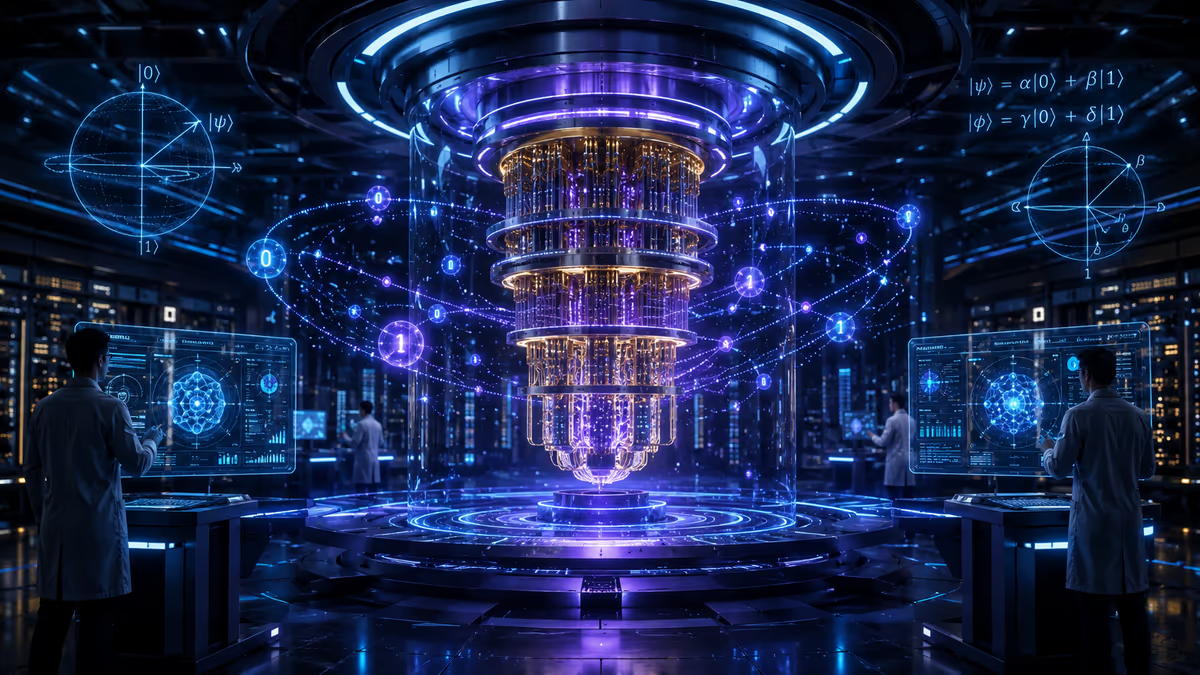
For decades, computers have become faster, smaller, and more powerful. From smartphones to supercomputers, modern technology relies on billions of tiny transistors that process information at incredible speeds. Yet some problems remain so complex that even the world's fastest supercomputers would need thousands—or even millions—of years to solve them.
This is where quantum computing enters the picture.
Rather than replacing today's computers, quantum computers represent an entirely new way of processing information. Built upon the principles of quantum mechanics, these extraordinary machines could transform industries ranging from medicine and cybersecurity to artificial intelligence and space exploration.
What Is Quantum Computing?
Traditional computers process information using bits, where each bit is either 0 or 1.
Quantum computers use qubits, which behave very differently.
Instead of existing only as 0 or 1, qubits can exist in multiple quantum states simultaneously through a phenomenon known as superposition.
This allows quantum computers to explore many possible solutions at once, making certain calculations dramatically faster than classical computers.
The Power of Superposition
Imagine searching for the correct key to unlock a door.
A traditional computer would test one key after another until it found the correct one.
A quantum computer can evaluate many possibilities simultaneously.
Although this is a simplified explanation, it illustrates why quantum computing has the potential to solve highly complex problems much more efficiently.
Quantum Entanglement
Another remarkable property of quantum mechanics is entanglement.
When two qubits become entangled, they remain connected regardless of the distance between them.
Changes affecting one qubit are correlated with the other, allowing quantum algorithms to process information in ways impossible for classical computers.
Entanglement is one of the foundations of quantum computing's extraordinary potential.
Why Quantum Computers Matter
Quantum computing is not simply about making computers faster.
It enables solutions to problems that are currently beyond the reach of even the most advanced supercomputers.
Potential applications include:
- Drug discovery
- Climate modeling
- Financial forecasting
- Artificial intelligence
- Materials science
- Logistics optimization
- Cybersecurity
- Space exploration
As quantum hardware improves, these applications may revolutionize countless industries.
Quantum Computing and Artificial Intelligence
Artificial intelligence relies on enormous computational resources.
Training advanced AI models requires processing massive datasets containing billions of parameters.
Quantum computing could dramatically accelerate optimization tasks, improve machine learning algorithms, and solve mathematical problems that currently demand enormous computing power.
Although quantum AI remains an emerging field, many researchers believe the combination could redefine intelligent computing.
Medical Breakthroughs
Healthcare may become one of the greatest beneficiaries of quantum computing.
Researchers hope quantum simulations will accurately model complex molecules that are impossible for traditional computers to simulate efficiently.
This capability could accelerate:
- Drug development
- Cancer research
- Vaccine discovery
- Personalized medicine
- Protein folding analysis
Reducing years of laboratory research to months—or even weeks—could transform global healthcare.
Cybersecurity Challenges
Quantum computing also presents significant cybersecurity concerns.
Many modern encryption systems rely on mathematical problems that are extremely difficult for classical computers.
Powerful future quantum computers may eventually solve these problems much more quickly, potentially threatening current encryption standards.
As a result, researchers are actively developing post-quantum cryptography designed to remain secure in the quantum era.
Current Challenges
Despite remarkable progress, quantum computing remains in its early stages.
Current systems face several obstacles:
- Extremely low operating temperatures
- High hardware costs
- Qubit instability
- Error correction challenges
- Limited scalability
Building reliable quantum computers requires engineering solutions unlike anything used in conventional computing.
The Next Decade
Technology companies, universities, and governments continue investing billions of dollars into quantum research.
Over the next decade, quantum computers are expected to become increasingly capable while remaining specialized tools for solving complex scientific and industrial problems.
Most people will likely access quantum computing through cloud platforms rather than owning quantum computers at home.
Traditional computers and quantum computers will work together, each solving the types of problems they handle best.
Final Thoughts
Quantum computing represents one of the most ambitious technological revolutions of the modern age.
Although practical large-scale quantum computers are still under development, their potential is enormous.
From accelerating scientific discoveries to advancing artificial intelligence and transforming medicine, quantum technology may redefine what computers are capable of achieving.
The quantum era has not fully arrived—but its foundations are already being built.
As researchers continue unlocking the mysteries of quantum mechanics, the future of computing is becoming more extraordinary than ever imagined.