
Future & Research
Nanotechnology: The Next Revolution
CipherRoot Software7 min read
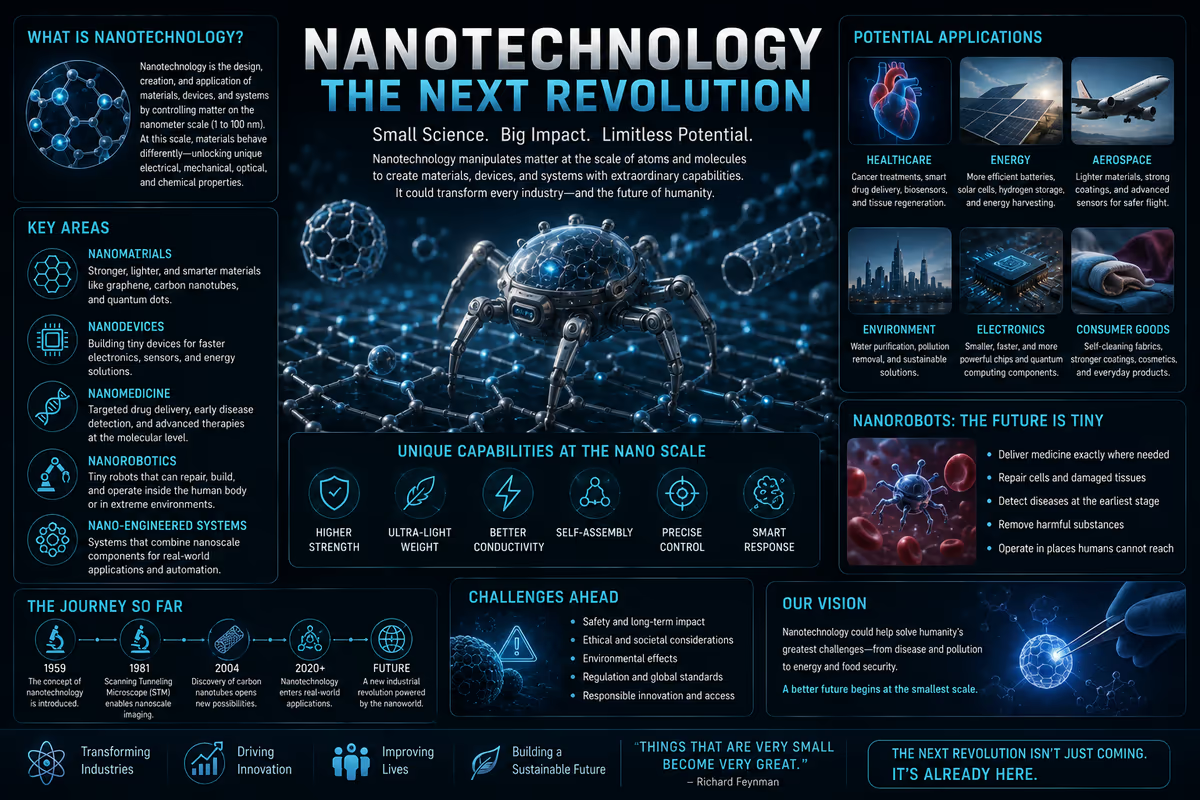
Nanotechnology operates at an extraordinarily small scale—roughly the scale of atoms, molecules, and structures measured in nanometers. Although these dimensions are almost impossible to see, their potential impact could be enormous.
By controlling matter at the nanoscale, scientists can create materials and devices with properties that are very different from their conventional counterparts.
Nanotechnology could influence medicine, electronics, energy, manufacturing, environmental protection, and many other industries.
The next technological revolution may be happening at a scale too small for the human eye to see.
What Is Nanotechnology?
A nanometer is one billionth of a meter.
At this scale, materials can behave differently because their physical, chemical, electrical, and optical properties can change dramatically.
Nanotechnology focuses on designing and manipulating structures at this extremely small scale to create useful materials, devices, and systems.
The field includes areas such as:
- Nanomaterials
- Nanomedicine
- Nanoelectronics
- Nanorobotics
- Nanophotonics
- Nanosensors
- Nanomanufacturing
- Why Is the Nanoscale So Important?
When materials become extremely small, their behavior can change.
A material that behaves one way at normal dimensions may have different properties when engineered at the nanoscale.
This can allow scientists to develop materials that are:
- Stronger
- Lighter
- More conductive
- More reactive
- More efficient
- More precisely controlled
This is one reason nanotechnology has attracted attention across so many industries.
Nanomaterials
One of the most established areas of nanotechnology is the development of advanced materials.
Examples include graphene, carbon nanotubes, nanoparticles, and quantum dots.
These materials can have unusual combinations of strength, conductivity, flexibility, and optical properties.
Potential applications include stronger composites, advanced batteries, electronic components, sensors, coatings, and lightweight structures.
Nanotechnology in Healthcare
Medicine could become one of the most important applications of nanotechnology.
Researchers are investigating nanoparticles and other nanoscale systems for targeted drug delivery.
Instead of distributing a medicine throughout the entire body, future systems could potentially deliver therapeutic compounds more precisely to specific tissues or cells.
Nanotechnology is also being studied for diagnostic technologies, imaging, biosensors, and regenerative medicine.
The objective is greater precision.
Targeted Drug Delivery
One of the most interesting concepts in nanomedicine is targeted drug delivery.
A nanoscale carrier could potentially transport a therapeutic substance and release it under specific biological conditions.
This could help researchers develop treatments that target particular tissues while reducing exposure to healthy areas.
However, many advanced applications remain under research, and safety, effectiveness, and long-term biological effects must be carefully evaluated.
Nanorobotics
The idea of microscopic robots operating inside the human body sounds like science fiction.
Yet researchers are investigating increasingly sophisticated nanoscale and microscale systems.
Future technologies could potentially use tiny engineered structures for tasks such as:
- Delivering therapeutic compounds
- Detecting biological signals
- Performing localized interventions
- Monitoring specific environments
The concept of fully autonomous medical nanorobots remains much more futuristic than today's practical nanomedicine, but research continues to explore what may eventually be possible.
Nanoelectronics
As conventional electronics become smaller, manufacturers increasingly encounter physical limitations.
Nanotechnology could help develop new generations of electronic components.
Nanoscale materials may enable:
- Smaller components
- Faster electronics
- More efficient sensors
- New transistor architectures
- Flexible electronics
- Advanced computing technologies
Nanotechnology could therefore play an important role in the continued evolution of computing hardware.
Nanotechnology and Energy
Energy storage is another major area of research.
Nanostructured materials could potentially improve aspects of batteries and other energy-storage technologies.
Researchers are exploring ways to improve:
- Energy density
- Charging speed
- Durability
- Conductivity
- Material efficiency
Nanotechnology could also contribute to solar cells and other energy-generation technologies.
Small changes at the material level can potentially produce significant improvements at the system level.
Environmental Applications
Nanotechnology could also contribute to environmental protection.
Engineered nanomaterials are being investigated for applications such as water purification, pollutant detection, and environmental remediation.
Highly reactive or selective materials could potentially help remove certain contaminants from water or identify pollutants at very low concentrations.
As with medical applications, environmental nanotechnology must be evaluated carefully to understand potential ecological risks.
Nanotechnology in Aerospace
Space exploration places extreme demands on materials.
Every kilogram launched into space is valuable.
Nanotechnology could contribute to lighter and stronger materials, advanced sensors, protective coatings, and improved energy systems.
Lightweight nanostructured materials could eventually help spacecraft reduce mass while maintaining structural performance.
Advanced nanosensors could also provide more detailed information about spacecraft systems and environments.
Smart Materials
Nanotechnology could help create materials that respond to their environment.
Imagine materials capable of changing their properties in response to temperature, pressure, light, chemicals, or electrical signals.
Such materials could eventually become useful in:
- Wearable technology
- Medical devices
- Aerospace systems
- Construction
- Electronics
- Robotics
This could transform materials from passive objects into active technological components.
The Connection Between AI and Nanotechnology
Artificial intelligence could accelerate nanotechnology research.
Designing new nanoscale materials requires exploring enormous numbers of possible structures and combinations.
AI can analyze large scientific datasets and help researchers identify promising candidates.
A future research workflow could look like:
AI prediction → Computer simulation → Laboratory experiment → Data analysis → Improved design
This feedback loop could dramatically accelerate materials research.
The Future of Manufacturing
Nanotechnology could eventually change how products are manufactured.
Rather than simply shaping large blocks of material, advanced manufacturing systems could increasingly control matter at smaller and smaller scales.
Combined with robotics, automation, AI, and advanced materials, this could lead to manufacturing systems capable of producing highly precise structures.
The long-term vision is sometimes described as molecular manufacturing, although truly atom-by-atom manufacturing at industrial scale remains a highly challenging research problem.
The Challenges Ahead
Nanotechnology has enormous potential, but it is not without risks.
Important challenges include:
- Long-term health effects
- Environmental impact
- Manufacturing complexity
- High development costs
- Regulatory requirements
- Safe handling of nanomaterials
- Responsible use of advanced technologies
Just because something can be engineered at a tiny scale does not automatically mean it is safe.
Careful research and testing are essential.
Nanotechnology and the Future of Humanity
The most exciting aspect of nanotechnology is its ability to connect multiple technological fields.
Imagine a future where:
AI designs a new nanomaterial.
Robots manufacture it with extreme precision.
Nanotechnology enables a new medical device.
Biotechnology integrates it with living tissue.
Advanced computing controls the resulting system.
These technologies could increasingly reinforce one another.
What Could Nanotechnology Look Like in 2035?
By the mid-2030s, nanotechnology could be increasingly visible in everyday products even if consumers never see the nanoscale structures themselves.
Potential areas of growth include:
- Advanced batteries
- Medical diagnostics
- Drug-delivery systems
- High-performance materials
- Flexible electronics
- Precision sensors
- Water purification
- Advanced manufacturing
Some futuristic concepts will remain experimental, while others may quietly become part of ordinary technology.
The Smallest Scale, the Biggest Impact
The most fascinating thing about nanotechnology is the contrast between scale and impact.
A structure measured in billionths of a meter can influence the performance of an entire battery, medical device, computer, or spacecraft.
This is why nanotechnology could become one of the major enabling technologies of the coming decades.
It does not necessarily replace other technologies.
It makes them better.
Final Thoughts
Nanotechnology represents a fundamental shift in how humanity thinks about materials and machines.
Instead of working only with objects we can see, scientists can increasingly engineer structures at scales approaching individual molecules.
Combined with AI, biotechnology, robotics, and advanced manufacturing, nanotechnology could unlock new possibilities across medicine, energy, electronics, aerospace, and environmental protection.
The revolution may not arrive as one spectacular invention.
It may emerge through thousands of tiny improvements that eventually transform entire industries.
The technology of tomorrow may be built at a scale smaller than we can see.
The next revolution isn't just coming. It's already being engineered at the nanoscale.