
AI & Machine Learning
Machine Learning vs Deep Learning: What Is the Difference?
CipherRoot Software12 min read
Machine Learning and Deep Learning Are Not the Same Thing
Artificial intelligence is often described as a single technology.
In reality, AI is a broad field containing many different methods, algorithms, and systems.
Two of the most important terms are machine learning (ML) and deep learning (DL).
They are closely related, but they are not identical.
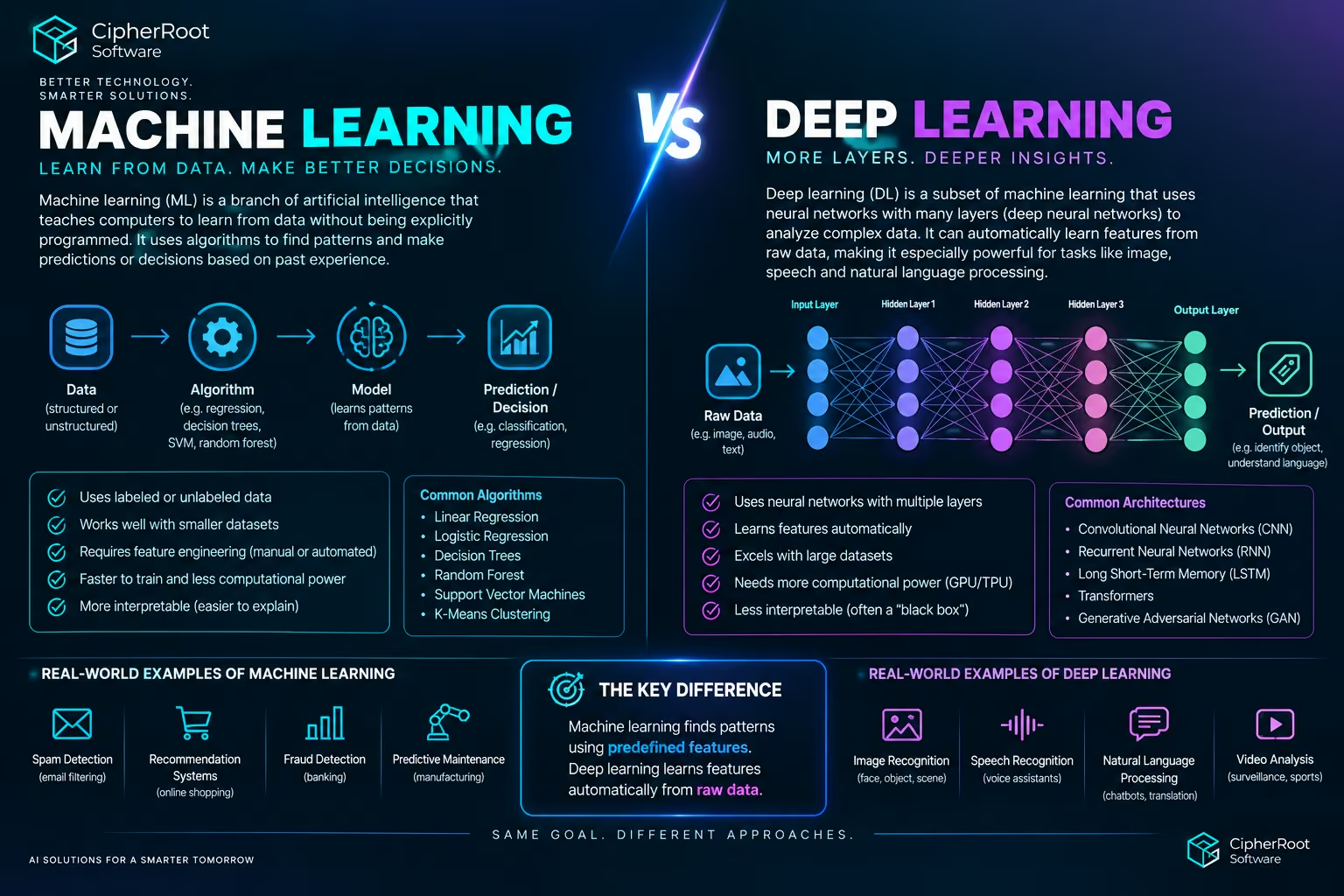
Machine learning is a broad field of AI in which systems learn patterns from data and use those patterns to make predictions or decisions.
Deep learning is a subset of machine learning that uses multi-layer neural networks to learn increasingly complex representations from data.
Understanding this relationship makes the distinction much easier:
Artificial Intelligence → Machine Learning → Deep Learning
Deep learning is part of machine learning, but not every machine-learning system is a deep-learning system.
What Is Machine Learning?
Machine learning allows computers to learn patterns from data instead of relying entirely on explicitly programmed rules.
A machine-learning workflow usually involves:
Data → Algorithm → Model → Prediction
The algorithm learns relationships within the available data.
Once trained, the resulting model can be used to make predictions on new data.
For example, a company might train a model using previous sales records to estimate future demand.
A bank could use machine learning to identify unusual transaction patterns.
A website could use it to recommend products based on customer behavior.
Machine learning can work with many kinds of data and many different algorithms.
Common Machine-Learning Algorithms
Machine learning is not a single algorithm.
It includes many approaches, such as:
Linear regression Logistic regression Decision trees Random forests Support vector machines K-nearest neighbors K-means clustering
Different algorithms are suited to different problems.
Some are useful for classification.
Others are designed for prediction, clustering, or discovering patterns in data.
The choice of algorithm depends on the problem, the data, the performance requirements, and the desired level of interpretability.
What Is Deep Learning?
Deep learning uses artificial neural networks with multiple layers to learn complex patterns.
These networks are inspired loosely by the structure of biological neural systems, but they are mathematical computing models rather than digital copies of the human brain.
A deep neural network can contain:
Input layer → Hidden layers → Output layer
Each layer transforms the information before passing it to the next layer.
With enough data and appropriate training, the network can learn highly complex relationships.
Deep learning has become particularly important for unstructured data such as:
Images Audio Video Natural language
This is one reason deep learning has played such a major role in modern computer vision, speech recognition, and generative AI.
The Biggest Difference: Feature Engineering
One of the classic differences between traditional machine learning and deep learning is feature engineering.
In many machine-learning projects, useful characteristics of the data need to be selected or prepared before the model is trained.
Imagine a system designed to identify houses that are likely to sell quickly.
A machine-learning model might use features such as:
Location Floor area Number of rooms Building age Price
These features are prepared from the original information before the model learns from them.
Deep learning can often learn useful representations directly from less-processed input.
For example, a deep-learning image model can start with pixel data and gradually learn patterns representing edges, shapes, textures, and increasingly complex visual structures.
This reduces the need for manually designing every useful feature.
A Simple Example: Recognizing a Cat
Imagine building an AI system that recognizes cats in photographs.
Traditional Machine Learning
A conventional machine-learning pipeline might first extract useful characteristics from the image.
The developer may need to design or select features that describe shapes, textures, edges, colors, or other properties.
The machine-learning algorithm then uses those features to classify the image.
Deep Learning
A deep neural network can receive the image pixels directly.
Early layers may learn simple visual patterns.
Later layers can combine those patterns into more complex representations.
Eventually, the network can learn patterns associated with objects such as cats.
The important difference is that deep learning can learn the representations automatically.
Data Requirements
Data is important for both machine learning and deep learning.
However, deep-learning systems often benefit from very large datasets, particularly for highly complex tasks.
A traditional machine-learning model can sometimes perform well with a relatively modest dataset if the problem is structured and the features are informative.
Deep-learning systems can become increasingly powerful as the amount and diversity of training data increase.
This is one reason improvements in data availability, computing hardware, and storage have contributed so strongly to the growth of deep learning.
Computing Power
Another major difference is computational demand.
Many classical machine-learning algorithms can run efficiently on CPUs and may require relatively limited computational resources.
Deep-learning models can involve millions, billions, or even more adjustable parameters.
Training them can therefore require substantial computing resources.
GPUs and specialized accelerators are especially useful because neural-network training involves enormous numbers of mathematical operations that can be processed in parallel.
This does not mean every deep-learning model requires a huge data center.
Smaller models can run on consumer hardware and edge devices.
But large-scale deep learning can be computationally intensive.
Interpretability
Interpretability is another important consideration.
Some traditional machine-learning models are relatively easy to understand.
A small decision tree, for example, can be inspected by a human and its decision process can be followed.
Deep neural networks are generally more difficult to interpret.
A model may contain many layers and a very large number of parameters.
It can be possible to analyze why a model produced a particular output, but explaining every internal representation in simple human terms can be difficult.
This is sometimes described as the black-box problem.
The importance of interpretability depends on the application.
For some use cases, high predictive performance may be the primary goal.
For others, understanding how the model reached a result may be essential.
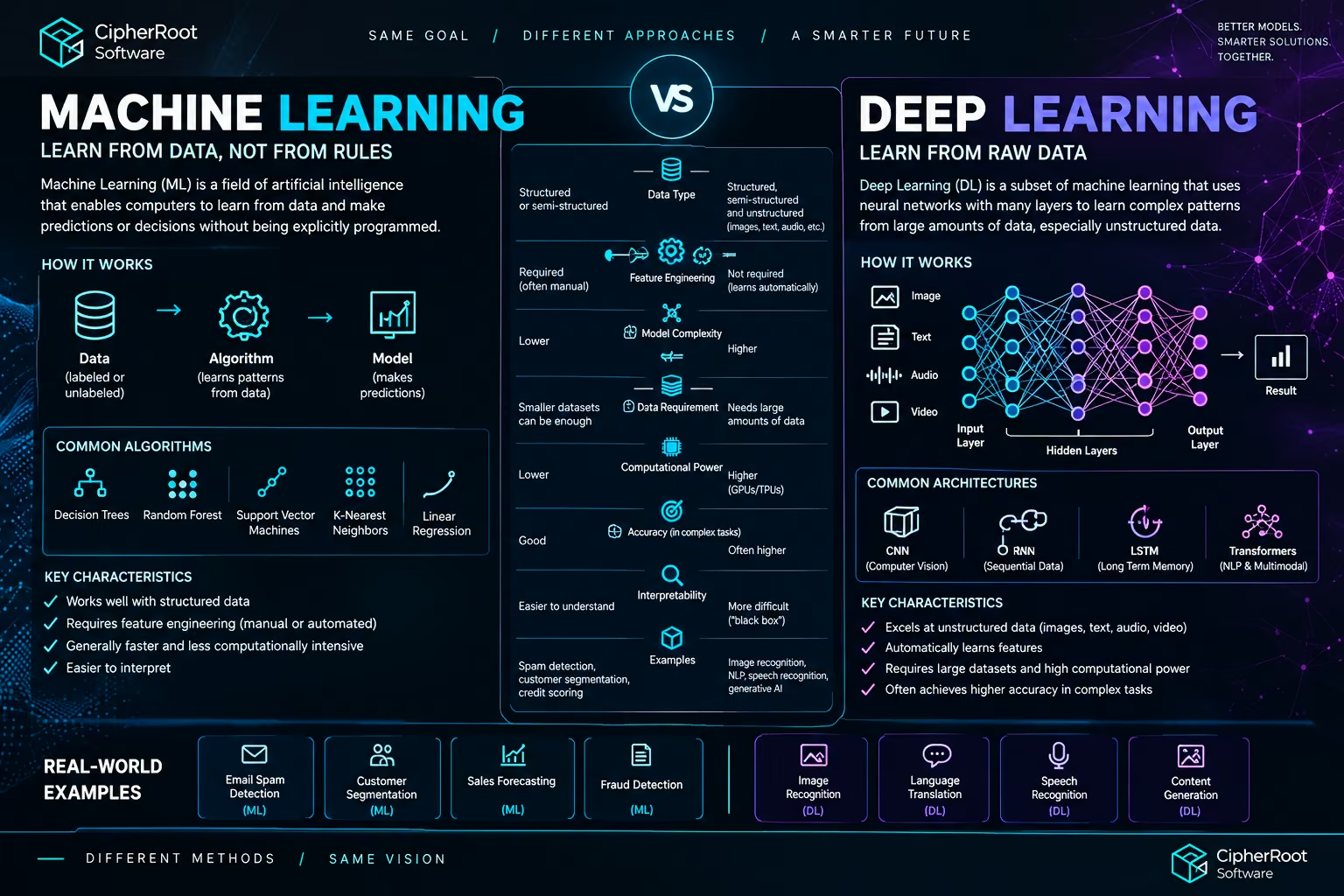
Machine Learning vs Deep Learning at a Glance Feature Machine Learning Deep Learning Relationship to AI Broad AI approach Subset of machine learning Typical data Structured or semi-structured Often strong with unstructured data Feature engineering Often important Often learned automatically Dataset size Can work with smaller datasets Often benefits from large datasets Computing requirements Often lower Often higher Interpretability Often easier Often more difficult Training complexity Varies Often higher Common applications Forecasting, classification, fraud detection Vision, speech, NLP, generative AI
This table is a general comparison rather than an absolute rule. Modern machine learning and deep learning overlap considerably.
When Machine Learning Makes Sense
Machine learning can be a strong choice when the data is structured and the problem is relatively well defined.
Examples include:
Sales forecasting
Predict future demand using historical sales data.
Fraud detection
Identify unusual financial behavior.
Customer segmentation
Group customers according to patterns in their behavior.
Predictive maintenance
Estimate when equipment may require maintenance.
Risk modeling
Estimate the likelihood of specific outcomes.
For these types of problems, traditional machine-learning algorithms can be effective without requiring the complexity of a large neural network.
When Deep Learning Makes Sense
Deep learning becomes particularly useful when the problem involves complex, high-dimensional, or unstructured information.
Examples include:
Image recognition
Identifying objects, faces, scenes, or defects.
Speech recognition
Converting spoken language into text.
Natural language processing
Understanding and generating human language.
Video analysis
Detecting events, objects, or actions in video.
Generative AI
Generating text, images, audio, video, or other content.
These applications often require models capable of learning complex representations from raw or minimally processed data.
Neural Networks Come in Different Forms
Deep learning is not one single architecture.
Different neural-network designs are optimized for different tasks.
Convolutional Neural Networks
Convolutional neural networks, or CNNs, became especially important in computer vision.
They can learn spatial patterns within images and have been widely used for image classification and visual recognition.
Recurrent Neural Networks
RNNs were designed for sequential data and have been used for tasks involving time series and language.
Variants such as LSTM networks were developed to handle longer-term dependencies more effectively.
Transformers
Transformers introduced a highly influential architecture for processing sequential and multimodal information.
They have become central to modern natural-language systems and many generative AI models.
Transformers can process relationships between elements of a sequence efficiently, making them particularly powerful for large-scale language and multimodal applications.
Machine Learning Does Not Mean Simple
It is important not to interpret the comparison as:
Machine learning = basic
Deep learning = advanced
That is too simplistic.
Machine-learning systems can be extremely sophisticated.
They can combine large datasets, ensemble methods, advanced optimization, feature engineering, and complex pipelines.
Likewise, a deep-learning model may be relatively small and designed for a very specific task.
The distinction is mainly about the methods used to learn representations and model patterns, not a simple ranking of complexity.
Deep Learning Is Still Machine Learning
This is the most important concept to remember.
If someone asks:
“Is deep learning machine learning?”
The answer is yes.
Deep learning is a branch of machine learning focused on neural networks with multiple layers.
It does not represent a separate field completely disconnected from machine learning.
A useful mental model is:
AI
contains
Machine Learning
which contains
Deep Learning
Understanding this hierarchy removes much of the confusion around AI terminology.
How Training Works
Both machine learning and deep learning generally require training.
During training, the model is exposed to data.
It produces predictions.
The predictions are compared with expected outcomes or training objectives.
The model is then adjusted to reduce its error.
This process is repeated many times.
In deep learning, the process typically involves optimizing many parameters across multiple neural-network layers.
The goal is to learn parameters that produce useful outputs on data the system has not seen before.
Generalization Matters
A model is not useful simply because it performs well on its training data.
It needs to work on new examples.
This ability is known as generalization.
A model that memorizes its training data too closely may perform poorly when presented with unfamiliar information.
This is known as overfitting.
Machine-learning and deep-learning engineers therefore use techniques such as validation datasets, regularization, data augmentation, and careful model evaluation to improve generalization.
A good AI system must learn patterns.
It must not merely memorize examples.
The Importance of Data Quality
More data is not always better.
Poor-quality training data can lead to poor results.
Data can contain:
Errors Missing values Duplicates Bias Incorrect labels Irrelevant information
Both machine learning and deep learning depend heavily on the quality of the training data.
A sophisticated neural network cannot magically turn unreliable data into reliable knowledge.
In many real-world projects, preparing and understanding the data takes as much work as selecting the model.
Machine Learning and Deep Learning in Everyday Life
These technologies are already part of many digital experiences.
When an email service identifies spam, machine-learning techniques may be involved.
When an online store recommends products, machine learning can be part of the recommendation system.
When a smartphone recognizes speech, deep-learning models may be involved.
When a photo application detects objects or people, computer-vision models can use deep learning.
When a generative AI system produces text or images, deep neural networks are central to the process.
The technologies may be invisible to users, but they increasingly shape digital products.
Can They Work Together?
Absolutely.
Real-world AI systems often combine multiple techniques.
A business platform might use traditional machine learning for structured customer data while using a deep-learning model to process customer messages.
A manufacturing system might combine statistical methods, classical machine learning, and computer vision.
A recommendation system might use several models at different stages of the pipeline.
The choice does not always have to be one or the other.
The best architecture is often a combination of methods.
The Role of Human Expertise
Even highly automated AI systems require human expertise.
People define the problem.
People select the data.
People decide what success means.
People evaluate mistakes.
People determine how the system should be used.
An algorithm can optimize according to an objective, but humans still need to decide whether that objective is appropriate.
This is especially important in systems that influence financial, medical, legal, industrial, or other high-impact decisions.
What About Generative AI?
Modern generative AI has brought deep learning into the public spotlight.
Large neural networks can learn complex patterns from huge datasets and generate new content.
Large language models can generate text.
Image models can generate images.
Audio models can generate speech or music.
Multimodal systems can work across several types of information.
Many of these systems rely heavily on deep-learning architectures, particularly transformer-based models and related techniques.
This is one reason the distinction between machine learning and deep learning has become increasingly important.
The Future of Machine Learning
Machine learning will continue to evolve.
Models are becoming more efficient.
Training pipelines are becoming more automated.
AI tools are becoming easier to integrate into everyday software.
Edge devices are becoming capable of running increasingly sophisticated models.
At the same time, deep learning continues to expand into vision, language, robotics, science, manufacturing, and other fields.
The future will likely involve both classical machine learning and deep learning rather than one completely replacing the other.
Choosing the Right Approach
There is no universal winner between machine learning and deep learning.
The appropriate method depends on the problem.
A structured business dataset may work extremely well with a classical machine-learning model.
A large image or audio dataset may benefit from deep learning.
A small dataset with a need for clear explanations may favor a simpler model.
A complex multimodal application may require a large neural network.
The right question is not:
“Which technology is more advanced?”
The better question is:
“Which approach is appropriate for the data, problem, resources, and requirements?”
Conclusion
Machine learning and deep learning are closely connected technologies, but they serve different roles within the AI landscape.
Machine learning provides a broad collection of methods for learning patterns from data.
Deep learning is a specialized branch that uses multi-layer neural networks to learn complex representations, often directly from raw or minimally processed data.
Machine learning can work extremely well for structured problems, smaller datasets, and applications where interpretability and efficiency matter.
Deep learning can be especially powerful for complex data such as images, audio, video, and language, particularly when large datasets and substantial computing resources are available.
The future of AI will likely use both.
Sometimes the smartest solution is a sophisticated neural network.
Sometimes a simpler algorithm is exactly what the problem needs.
Different methods. Same vision: turning data into useful intelligence.