
Company
Immersive Experience Engine at CipherRoot Software: From Concept to a Living Web Experience
CipherRoot Software11 min read
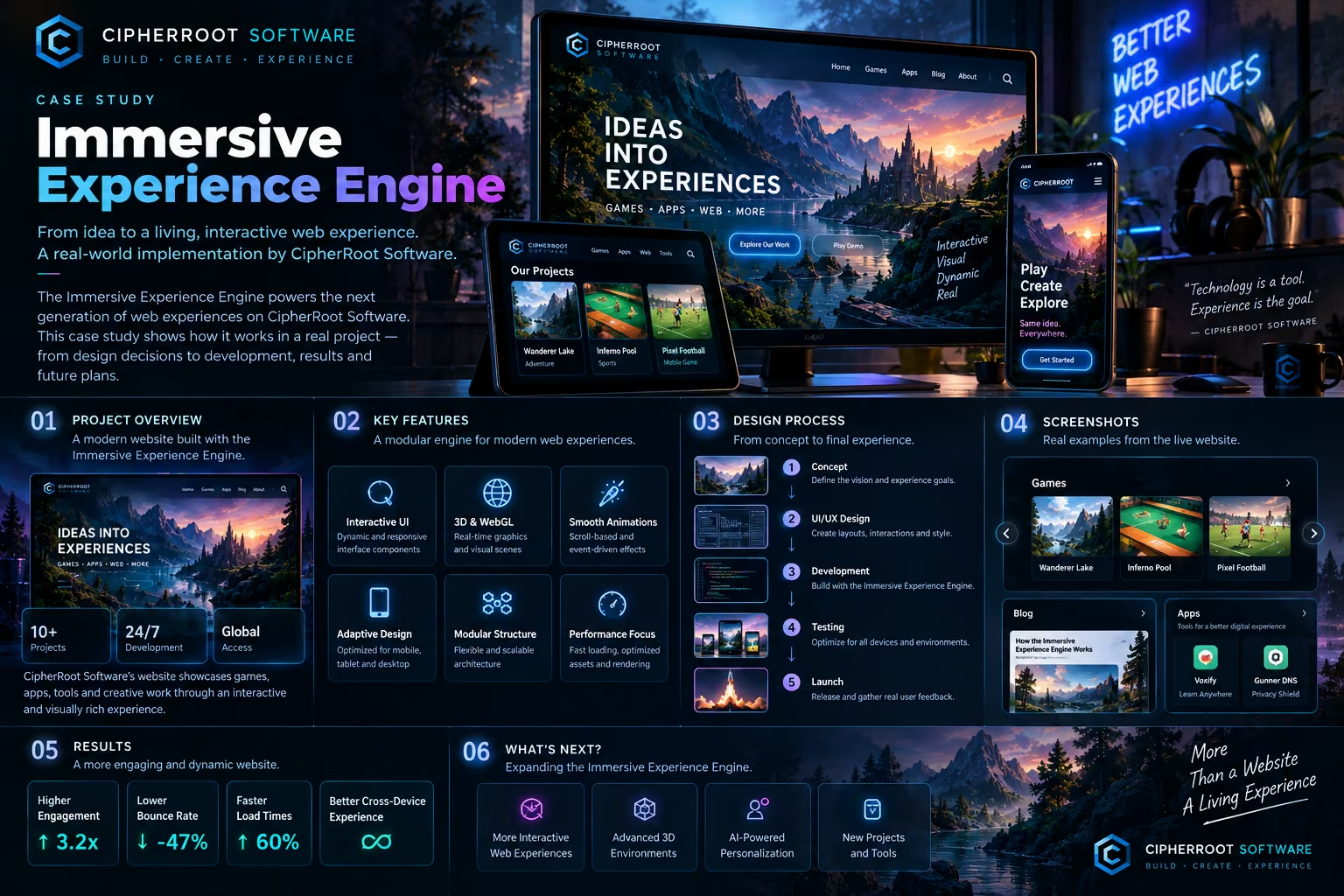
A website can do more than present information.
It can guide attention, respond to interaction, create visual depth, connect different types of content, and make visitors feel that they are exploring a digital environment rather than simply navigating a collection of pages.
At CipherRoot Software, this idea has become the foundation of our Immersive Experience Engine — a modular approach to designing and developing modern web experiences.
This case study explores how the concept is applied to a real CipherRoot Software project, the design decisions behind it, the systems involved, and where the experience can evolve next.
The Starting Point
CipherRoot Software brings together several types of digital work:
Games Applications Creative tools Blog content Experimental projects Interactive experiences
A traditional website structure could display these projects as simple grids of cards and links.
That approach is functional, but it does not necessarily communicate the character of the projects themselves.
A game should feel different from a software tool.
A technical article should feel different from a product showcase.
An experimental project should be able to have its own visual identity while still belonging to the same ecosystem.
This created the central design challenge:
How can one website support many different types of content while still feeling like one connected digital experience?
The Immersive Experience Engine became our answer to that question.
From Pages to Experiences
The first design decision was to stop thinking exclusively in terms of individual pages.
Instead, we began thinking about the site as a collection of experiences and systems.
The structure can be represented as:
CipherRoot Software │ ├── Home ├── Games │ ├── Inferno Pool │ └── Retro Pixel Football ├── Apps ├── Blog ├── About └── Contact
Each section has a different purpose, but the underlying design language connects them.
Navigation remains familiar.
Content remains accessible.
The visual system, however, becomes more dynamic.
This allows a visitor to move from a game showcase to an interactive game, from a software project to a technical article, or from a blog post to another part of the site without feeling like they have entered a completely unrelated product.
The Architecture Behind the Experience
The Immersive Experience Engine is organized around several connected layers.
UI ↓ Interaction Layer ↓ Visual Effects ↓ Content ↓ Performance Management
This separation is important.
The interface should not contain all of the interaction logic.
The content should not be tightly coupled to one visual presentation.
Advanced effects should not determine whether a page remains usable.
Performance should be considered throughout the system rather than only after the interface has been designed.
This modular structure gives the experience room to evolve.
01 — The UI Layer
The UI provides the foundation.
At CipherRoot Software, this includes the global navigation, project cards, buttons, typography, content sections, responsive containers, and reusable components.
The goal is not to hide the interface behind visual effects.
The interface must remain understandable.
A visitor should quickly know:
Where am I?
What can I explore?
What can I interact with?
Where can I go next?
Immersion is added on top of this foundation rather than replacing it.
02 — The Interaction Layer
The next step is making the interface responsive to the visitor.
Interactions can include:
Clicking Scrolling Hovering Touch input Dragging Opening interactive sections Entering games Exploring visual content
For example, the Inferno Pool showcase on the Games section is not simply an image and a description.
The visitor can move from the game card into a dedicated showcase and then launch the playable web version directly from the site.
The interaction becomes part of the presentation.
Discover ↓ Explore ↓ Interact ↓ Play
The content itself becomes interactive.
03 — Visual Layers
Visual design plays an important role in the CipherRoot experience.
Rather than relying on one flat background, we use layers of visual information to create depth and hierarchy.
Depending on the section, this can include:
Background imagery Gradients Glow effects Cards Image galleries Motion Layered content Game artwork Product imagery
The important principle is restraint.
Not every section needs to move.
Not every component needs a glow.
Not every page needs a cinematic animation.
Visual effects should support the content and guide attention.
04 — Content as an Experience
Another important decision was separating content from presentation.
For example, the Inferno Pool project has its own structured content describing:
The game Features Platforms Global chat Gallery content Web play functionality Future releases
This information can then be presented through different components without rewriting the underlying content.
That makes the system easier to maintain.
When a project changes, the content can change without requiring the entire visual system to be rebuilt.
A Real Example: Inferno Pool
Inferno Pool became a useful example of how the Immersive Experience Engine can connect different parts of the website.
Instead of displaying only:
Inferno Pool → Coming Soon
the Games experience now presents the project as a developing product.
Visitors can see:
Global Chat
The site communicates that the global chat server is live.
Multiplayer
The project is presented as a real-time multiplayer pool game.
Platform Development
Google Play, CrazyGames, Yandex Games, PixiDust, and Facebook Instant Games can be represented as platform destinations with their current release status.
Visual Gallery
Gameplay, multiplayer, and community visuals help communicate what the project looks and feels like.
Play on Web
The playable web version can be launched directly from the CipherRoot Software website.
This creates a journey from discovery to interaction rather than simply showing a project card.
Bringing the Game Into the Website
One of the more important technical decisions was allowing the web version of Inferno Pool to run inside the CipherRoot experience.
The production game is hosted separately, while the website provides the presentation layer around it.
Conceptually:
CipherRoot Software ↓ Inferno Pool Detail Page ↓ Embedded Web Game ↓ Render-hosted Game ↓ WebSocket Multiplayer Server
This separation provides an important architectural advantage.
The website can evolve independently from the game server.
The game can receive updates without requiring the entire website to be rebuilt.
The website can also present additional information around the game without modifying the game itself.
Keeping the Experience Responsive
The Immersive Experience Engine is designed for multiple screen sizes.
The same project may be viewed on:
Desktop
Large visual compositions, wider layouts, detailed galleries, and expanded navigation.
Tablet
A balanced combination of visual space and touch interaction.
Mobile
Focused layouts, touch-friendly controls, simplified navigation, and optimized content density.
The goal is not to make every device look identical.
Instead:
The identity remains consistent while the experience adapts.
This becomes especially important for interactive content.
A desktop interface may provide room for several panels at once.
On mobile, those panels can become a sequential experience.
Performance as a Design Requirement
Immersive interfaces can easily become unnecessarily heavy.
Large images, animations, 3D assets, and embedded experiences all require resources.
For this reason, performance is treated as part of the design process.
The implementation can use techniques such as:
Optimized Images
Images are prepared in appropriate formats and dimensions for web delivery.
Lazy Loading
Content that is not immediately required can be loaded later.
Progressive Experiences
Heavy interactive content can be initialized when the visitor actually chooses to use it.
This is particularly useful for the Inferno Pool integration.
Rather than immediately loading the game engine for everyone who visits the Games page, the website can present the project first and start the playable experience when the visitor chooses to interact with it.
That reduces unnecessary work during the initial page load.
Designing Without Losing Usability
One of the biggest lessons from building the system is that immersion should never become an obstacle.
An interface can be visually impressive and still be difficult to use.
That is not the objective.
CipherRoot's approach is based on a balance:
Visual Expression + Interaction + Usability + Performance = Better Experience
Navigation needs to remain clear.
Text needs to remain readable.
Controls need to remain understandable.
Interactive sections need to communicate what they do.
Advanced visual effects should never prevent users from reaching the information or functionality they came for.
Design Decisions That Shaped the System
Several decisions became particularly important during development.
Modular Components
Reusable components allow individual experiences to evolve without duplicating the entire website structure.
Separate Content Models
Project information is structured independently from visual presentation.
Progressive Loading
Heavy content is introduced when it becomes relevant.
Responsive Interaction
Touch, mouse, and different screen sizes are treated as different interaction contexts.
Independent Game Hosting
The web game and its server can evolve separately from the company website.
Clear Platform States
Projects can communicate whether a platform is live, in development, or coming soon without creating misleading links.
These decisions make the system more maintainable while preserving room for experimentation.
The Immersive Experience Engine Is Not One Visual Theme
It would be easy to think of the Immersive Experience Engine as a specific visual style.
It is not.
The engine is a design and technical architecture.
One project might use:
Dark interfaces Neon accents Motion 3D environments
Another might use:
Minimal typography Soft transitions Interactive diagrams
Another might use:
Game-inspired interfaces Dynamic backgrounds Interactive media
The system should adapt to the project.
The architecture remains modular even when the visual language changes.
From Concept to Real Implementation
The development process can be viewed as a sequence:
01 Concept ↓ 02 Experience Architecture ↓ 03 UI / UX Design ↓ 04 Component Development ↓ 05 Interactive Systems ↓ 06 Performance Optimization ↓ 07 Responsive Testing ↓ 08 Launch & Iteration
This process allows design decisions and technical decisions to influence each other.
A visual concept may reveal a performance issue.
A technical limitation may inspire a different interaction.
A mobile test may lead to a different layout.
An actual user flow may reveal that a certain animation is unnecessary.
The system evolves through this feedback loop.
What We Learned
Building the Immersive Experience Engine reinforced several principles.
Interaction Is More Important Than Decoration
A visual effect becomes valuable when it communicates something or improves exploration.
Performance Starts Early
Optimizing assets after everything is built is more difficult than designing a lightweight architecture from the beginning.
Mobile Requires Its Own Thinking
A desktop interface cannot simply be compressed into a phone-sized layout.
Content and Design Should Be Separated
This makes the system easier to maintain and allows projects to evolve faster.
Immersion Needs Restraint
More effects do not automatically create a better experience.
The strongest experiences usually know when to add visual complexity and when to stay simple.
What's Next?
The current architecture provides a foundation, but the concept can continue to expand.
Future directions for the Immersive Experience Engine could include:
More Interactive Web Experiences
Interfaces that respond more deeply to user behavior.
Advanced 3D Environments
More sophisticated browser-based environments and interactive visual scenes.
Adaptive Experiences
More detailed device and performance-aware behavior.
Interactive Storytelling
Content that unfolds through user exploration rather than traditional scrolling.
New Projects and Tools
Applying the architecture to new CipherRoot Software products, games, creative applications, and experimental projects.
The objective is not to lock the system into one implementation.
It is to create a foundation that can support many different experiences.
More Than a Website
The most important idea behind the Immersive Experience Engine is simple:
A website does not have to be treated as a collection of static documents.
It can become a living layer around the products, projects, and stories it represents.
At CipherRoot Software, this approach allows games, applications, articles, visual projects, and interactive technologies to exist within the same ecosystem while still having their own identity.
The technology supports the experience.
The content gives it meaning.
The interaction gives it movement.
The design gives it personality.
And performance keeps it accessible.
Conclusion
The Immersive Experience Engine is an ongoing evolution of the way we approach web development at CipherRoot Software.
It combines:
UI
Interaction
Visual Systems
Content
Responsive Design
Performance Management
into a modular architecture for modern digital experiences.
Inferno Pool is one example of how this approach can connect a project showcase, community features, platform development, visual storytelling, and a playable web experience within the same website.
The engine will continue to evolve as new projects introduce new challenges and new possibilities.
The goal remains the same:
Build experiences, not just pages.
The web should feel alive.