
AI & Machine Learning
How Large Language Models Work: A Simple Guide to Modern AI
CipherRoot Software9 min read
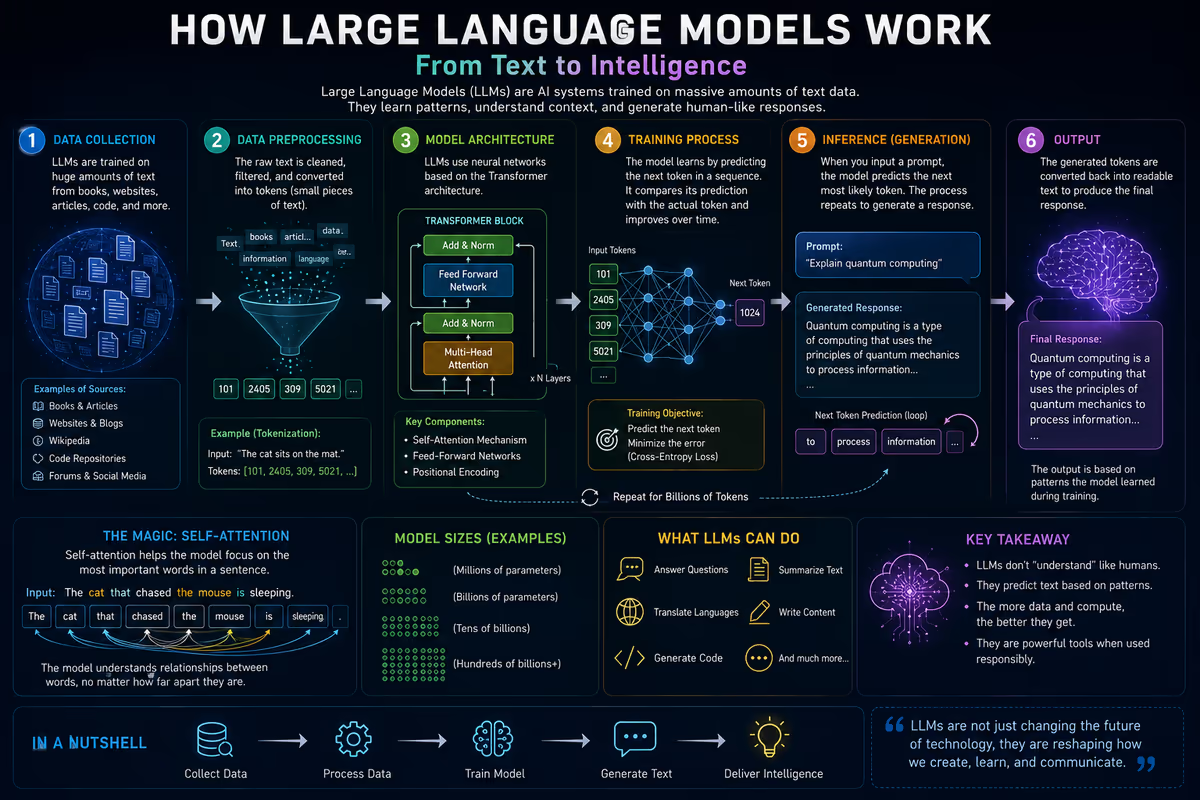
Large Language Models, commonly known as LLMs, have become one of the most important technologies in modern artificial intelligence.
They power AI assistants, coding tools, translation systems, content-generation platforms, search experiences, and many other applications.
But what actually happens when you type a question into an AI system and receive an answer within seconds?
Behind that simple interaction is a complex process involving data, tokenization, neural networks, Transformers, training, probability, and enormous amounts of computing power.
Let's break it down.
What Is a Large Language Model?
A Large Language Model is an artificial intelligence system trained to process and generate language.
Instead of being programmed with a list of responses, an LLM learns statistical patterns from very large collections of data.
These datasets can contain different types of material, such as:
- Books
- Articles
- Websites
- Documentation
- Code
- Educational material
- Publicly available text
During training, the model learns relationships between words, phrases, concepts, and patterns in language.
The result is a system capable of generating new text based on an input prompt.
Step 1: Collecting Training Data
The first major stage is gathering data.
An AI model needs enormous quantities of examples to learn language patterns.
The quality of this data matters just as much as its quantity.
Raw datasets may contain:
- Duplicate information
- Low-quality text
- Spam
- Incorrect information
- Formatting problems
- Unwanted material
For that reason, data generally needs to be processed and filtered before it becomes useful for training.
Step 2: Turning Text Into Tokens
Computers don't process sentences exactly the way humans do.
Before text can be processed by an LLM, it is divided into smaller units called tokens.
A token can represent:
- A complete word
- Part of a word
- Punctuation
- A number
A symbol
For example, a sentence such as:
"Artificial intelligence is changing technology."
may be divided into several tokens.
The model then converts those tokens into numerical representations that neural networks can process.
This is called tokenization.
Step 3: Neural Network Architecture
Modern LLMs are primarily based on a neural-network architecture called the Transformer.
Transformers became extremely important because they can process relationships between different parts of a sequence efficiently.
A Transformer contains several important components, including:
- Attention mechanisms
- Feed-forward neural networks
- Normalization layers
- Positional information
These components work together to transform input tokens into increasingly useful internal representations.
The Key Innovation: Attention
One of the most important ideas behind modern LLMs is self-attention.
Consider the sentence:
"The cat chased the mouse because it was hungry."
To interpret the sentence correctly, a model needs to determine what "it" refers to.
Attention mechanisms allow the model to examine relationships between different tokens and determine which pieces of information are important to one another.
Instead of treating every word as completely independent, the model can consider relationships across the sequence.
This is one reason Transformers are so effective at handling language.
Step 4: Training the Model
The next stage is training.
One common training objective for language models is next-token prediction.
Imagine the model receives:
"The spacecraft entered the..."
The model attempts to predict what comes next.
Possible predictions might include:
"atmosphere"
"orbit"
"planet"
"station"
The model compares its prediction with the actual training data.
When the prediction is wrong, the training process adjusts the model's internal parameters.
This happens again and again across enormous quantities of training examples.
Billions of Parameters
LLMs contain many numerical values called parameters.
These parameters are adjusted during training.
They essentially determine how information flows through the neural network.
Modern models can contain billions or more parameters.
More parameters do not automatically guarantee a better AI system, but large models can provide substantial capacity for representing complex patterns when combined with appropriate data and training methods.
Step 5: Learning Patterns
An LLM does not memorize every possible sentence that it could encounter.
Instead, training allows it to learn statistical relationships and representations from its data.
It can learn patterns involving:
- Grammar
- Syntax
- Programming
- Facts
- Writing styles
- Languages
- Concepts
- Relationships between words
This allows the model to generate responses to prompts it has never encountered word-for-word.
Step 6: Receiving a Prompt
After training, the model can be used for inference.
The user provides a prompt.
For example:
"Explain quantum computing in simple terms."
The system converts the prompt into tokens.
Those tokens are processed through the model.
The model then calculates probabilities for possible next tokens.
Step 7: Predicting the Next Token
This is one of the most important concepts to understand.
An LLM generates text one token at a time.
It predicts what token should come next based on the context available to it.
For example:
"The capital of France is..."
The model assigns different probabilities to possible continuations.
"Paris" would receive a very high probability in an appropriate context.
After selecting a token, the model uses the expanded sequence to predict the next one.
This process continues repeatedly.
From Tokens to a Complete Answer
Imagine the model generating:
The → capital → of → France → is → Paris
The system doesn't necessarily generate the entire sentence at once.
It repeatedly predicts the next token until the response is complete.
Thousands of these tiny decisions can produce a long answer.
This process happens extremely quickly on modern hardware.
Why Does the Model Appear to Understand?
This is where things become especially interesting.
LLMs can produce remarkably coherent answers because they have learned extremely complex patterns in language and information.
They can maintain context across long conversations, explain concepts, translate languages, generate code, and adapt their writing style.
But this should not automatically be interpreted as human-like understanding or consciousness.
The internal mechanisms of an LLM are fundamentally different from human cognition.
It is more accurate to think of an LLM as a highly sophisticated system for processing and generating information based on learned patterns.
Why Can LLMs Make Mistakes?
LLMs can sometimes generate incorrect information with impressive confidence.
These errors are often called hallucinations.
A model may produce a statement that sounds convincing but is unsupported or incorrect.
Why?
Because generating fluent language and determining truth are not exactly the same problem.
The model is optimized to generate useful sequences of tokens, not to possess perfect knowledge of reality.
This is why important information should be independently verified.
The Role of Computing Power
Training a modern LLM requires enormous computational resources.
Specialized processors such as GPUs and other AI accelerators perform huge numbers of mathematical operations during training.
Large-scale training can involve:
Data → Neural Network → Prediction → Error → Parameter Update
This cycle is repeated across enormous datasets.
The computational requirements can be substantial.
Training vs Inference
It is useful to distinguish between two different processes.
Training
Training is when the model learns its parameters.
It can require enormous datasets and substantial computational resources.
Inference
Inference happens when the trained model generates an answer to a user's prompt.
Inference can be much less computationally expensive than training, although large models serving many users still require significant infrastructure.
Why GPUs Are Important
AI workloads involve enormous numbers of mathematical operations that can be performed in parallel.
GPUs are particularly well suited to these operations.
This is one reason modern AI development has become closely connected to specialized computing hardware.
Large AI systems may use many accelerators working together.
What Can LLMs Do?
Once trained and integrated into applications, LLMs can perform many tasks.
They can assist with:
- Answering questions
- Summarizing documents
- Writing content
- Translating languages
- Generating code
- Explaining technical concepts
- Brainstorming ideas
- Analyzing text
- Conversational interfaces
Additional tools can give AI systems access to information, software, databases, or other capabilities beyond the language model itself.
LLMs and Coding
One of the most transformative applications is software development.
An LLM can generate code from natural-language instructions.
For example:
"Create a responsive login page with a dark theme."
The model can generate a starting implementation.
Developers can then review, modify, test, and integrate the code.
This changes programming from purely writing code manually toward a combination of designing, directing, reviewing, and engineering.
LLMs and Multimodal AI
Modern AI systems are also moving beyond text.
Some models can work with combinations of:
- Text
- Images
- Audio
- Video
- Code
This is often described as multimodal AI.
A user could potentially provide an image and ask the system to analyze it, then ask follow-up questions using natural language.
The boundary between different forms of digital information is becoming increasingly fluid.
What Happens Inside an LLM?
At a simplified level, the process looks like this:
User Prompt → Tokenization → Token Embeddings → Transformer Layers → Attention + Neural Network Processing → Probability Distribution → Next Token Selection → Repeat → Generated Response
The actual mathematics and architecture are considerably more complex, but this provides a useful conceptual model.
The Future of Large Language Models
LLMs are likely to become more capable, efficient, and specialized.
Future systems may combine language models with:
- Long-term memory
- Real-time information
- Computer vision
- Robotics
- Autonomous agents
- Specialized tools
- Local AI hardware
- Cloud infrastructure
This could transform AI from something that simply answers questions into something that can help complete complex tasks.
Smaller Models Are Also Important
The future is not necessarily only about making models larger.
Smaller and more efficient models can run directly on devices such as smartphones, computers, vehicles, and robots.
This connects LLM technology with the rise of Edge AI.
Local AI can provide lower latency and potentially better privacy for certain applications.
The future could therefore include both enormous cloud models and highly optimized local models.
Final Thoughts
Large Language Models may appear mysterious when viewed from the outside.
But their basic workflow can be understood:
Data is collected and processed.
Text is converted into tokens.
A Transformer learns patterns through training.
The trained model receives a prompt.
It predicts the next token repeatedly.
Those tokens become the final response.
The technology is far more sophisticated than simple autocomplete, but it is also important not to confuse fluent language generation with human consciousness.
LLMs are powerful computational systems capable of representing and generating remarkably complex patterns.
And this technology is still evolving.
The next generation of AI will likely combine language models with vision, audio, robotics, tools, memory, and real-world interaction.
The fascinating part isn't simply that machines can generate language.
It's that language is becoming a new interface between humans and machines.