
AI & Machine Learning
How AI Is Changing Healthcare: The Future of Medicine
CipherRoot Software5 min read
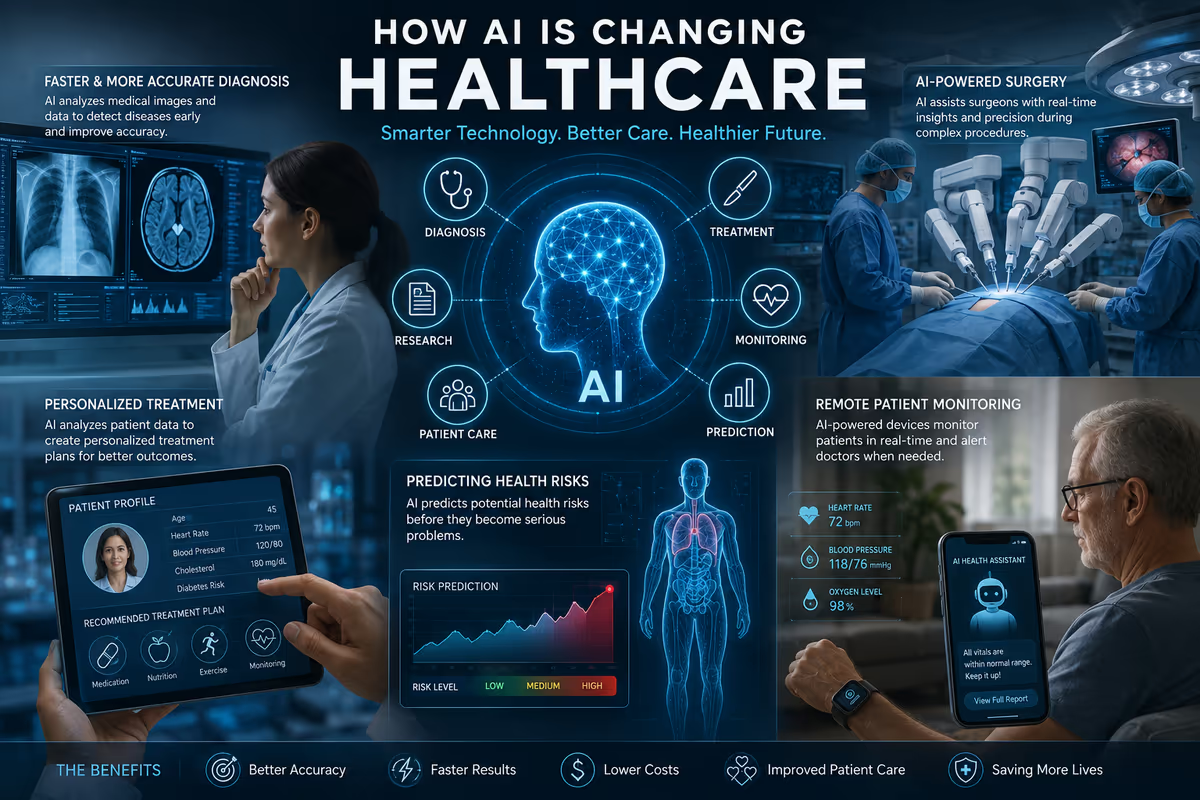
Artificial intelligence is transforming healthcare faster than many people expected. From analyzing medical images to helping doctors discover new treatments, AI is becoming an increasingly important part of modern medicine.
The technology is not designed simply to replace doctors. Its greatest potential may come from giving medical professionals powerful tools that can process enormous amounts of information, identify patterns, and support difficult decisions.
As AI systems become more capable, healthcare could become faster, more personalized, and increasingly focused on prevention.
AI-Powered Diagnosis
One of the most important applications of AI in healthcare is medical diagnosis.
Doctors often need to examine large amounts of information before reaching a diagnosis. AI systems can analyze medical images and patient data extremely quickly, helping identify patterns that may require further investigation.
AI can assist with the analysis of:
- X-rays
- CT scans
- MRI images
- Ultrasound scans
- Pathology images
- Medical records
- Laboratory results
This does not mean that an AI system should independently diagnose every patient. Instead, it can provide another layer of analysis for trained healthcare professionals.
Earlier Detection of Disease
Early detection can make a major difference in healthcare.
AI can analyze patterns across large datasets and identify potential warning signs before a condition becomes more advanced.
Researchers are investigating AI applications for detecting diseases such as cancer, cardiovascular conditions, neurological disorders, and eye diseases.
The long-term goal is to move healthcare from simply treating illness toward predicting and preventing disease.
Personalized Treatment
No two patients are exactly alike.
Age, genetics, medical history, lifestyle, medications, and many other factors can influence how a person responds to treatment.
AI can analyze these variables simultaneously and help doctors develop more personalized treatment strategies.
Instead of relying exclusively on generalized treatment approaches, physicians may increasingly use AI-generated insights to determine which options are most appropriate for individual patients.
Human medical expertise remains essential, but AI can provide another powerful source of information.
AI-Assisted Surgery
Robotic and AI-assisted surgical systems are also changing operating rooms.
Modern surgical robots can provide surgeons with highly precise instruments and enhanced visualization. AI can potentially assist by analyzing surgical information and identifying important structures during procedures.
The surgeon remains responsible for the operation, while robotic technology can improve precision and control.
Future systems may become even more sophisticated, helping surgeons plan procedures and respond to changing conditions in real time.
Predicting Health Risks
One of the most exciting possibilities is predictive healthcare.
Instead of waiting for a patient to become seriously ill, AI systems could analyze medical information and identify elevated risks earlier.
For example, AI could examine combinations of:
- Medical history
- Vital signs
- Laboratory results
- Lifestyle information
- Genetic data
- Wearable-device measurements
This could allow doctors to focus more attention on patients who require closer monitoring.
AI and Remote Patient Monitoring
Healthcare is increasingly moving beyond hospitals.
Smartwatches, medical sensors, and connected devices can continuously collect information such as heart rate, activity levels, and other health measurements.
AI can analyze this information and detect unusual patterns.
For patients with chronic conditions, continuous monitoring could help healthcare professionals identify potential problems before they become emergencies.
This approach could also reduce unnecessary hospital visits and make healthcare more accessible.
Accelerating Medical Research
Developing a new medicine traditionally requires years of research and testing.
AI is now being used to analyze biological data, study molecules, predict potential drug interactions, and identify promising candidates for further research.
The ability to process enormous datasets could help researchers explore possibilities that would be difficult to investigate manually.
AI will not eliminate the need for clinical trials and scientific validation, but it could make the discovery process more efficient.
AI Assistants for Doctors
Doctors spend significant amounts of time on administrative work.
Writing notes, organizing records, reviewing information, and preparing documentation can take hours every week.
AI assistants could automate portions of this workload.
For example, an AI system could summarize a patient's medical history, organize clinical notes, or prepare draft documentation for a physician to review.
Reducing administrative work could give doctors more time to focus on what matters most: their patients.
The Human Element Still Matters
Despite its capabilities, AI cannot replace the human side of medicine.
Healthcare involves empathy, communication, ethical judgment, and understanding the emotional needs of patients.
A medical decision is not always a mathematical problem.
Patients need someone who can listen to them, explain difficult information, understand their concerns, and make responsible decisions in complex situations.
The most realistic future is therefore not AI versus doctors.
It is AI working alongside doctors.
Privacy and Security Challenges
The more healthcare depends on AI, the more important data security becomes.
Medical information is extremely sensitive. AI systems need access to large amounts of data to become useful, but that data must be handled responsibly.
Future healthcare systems will need strong security, transparent data policies, appropriate access controls, and clear rules regarding how patient information is stored and processed.
Trust will be just as important as technological capability.
The Future of Healthcare
Over the next decade, AI could become integrated into almost every stage of healthcare.
Patients may interact with intelligent health assistants before seeing a doctor. Hospitals may use AI systems to optimize operations and monitor patients. Doctors may receive real-time decision support during complex procedures.
Wearable devices could continuously analyze health information and provide early warnings.
Medical researchers could use AI to accelerate the discovery of new treatments.
The healthcare system could gradually shift from a reactive model toward a more predictive and personalized approach.
Final Thoughts
Artificial intelligence is not going to make human doctors obsolete.
Instead, it has the potential to give them something incredibly valuable: more information, more precision, and more time to care for patients.
From diagnosis and surgery to drug discovery and remote monitoring, AI is already changing how healthcare works.
The biggest transformation may come when all of these technologies begin working together.
The hospital of the future may not simply be a place where people go when they become sick.
It could become an intelligent healthcare environment capable of continuously monitoring health, predicting risks, supporting doctors, and helping people stay healthier for longer.
The future of healthcare will not be human or artificial intelligence. It will be human intelligence enhanced by AI.