
Future & Research
Future Tech Predictions 2040: 12 Technologies That Could Transform the World
CipherRoot Software14 min read
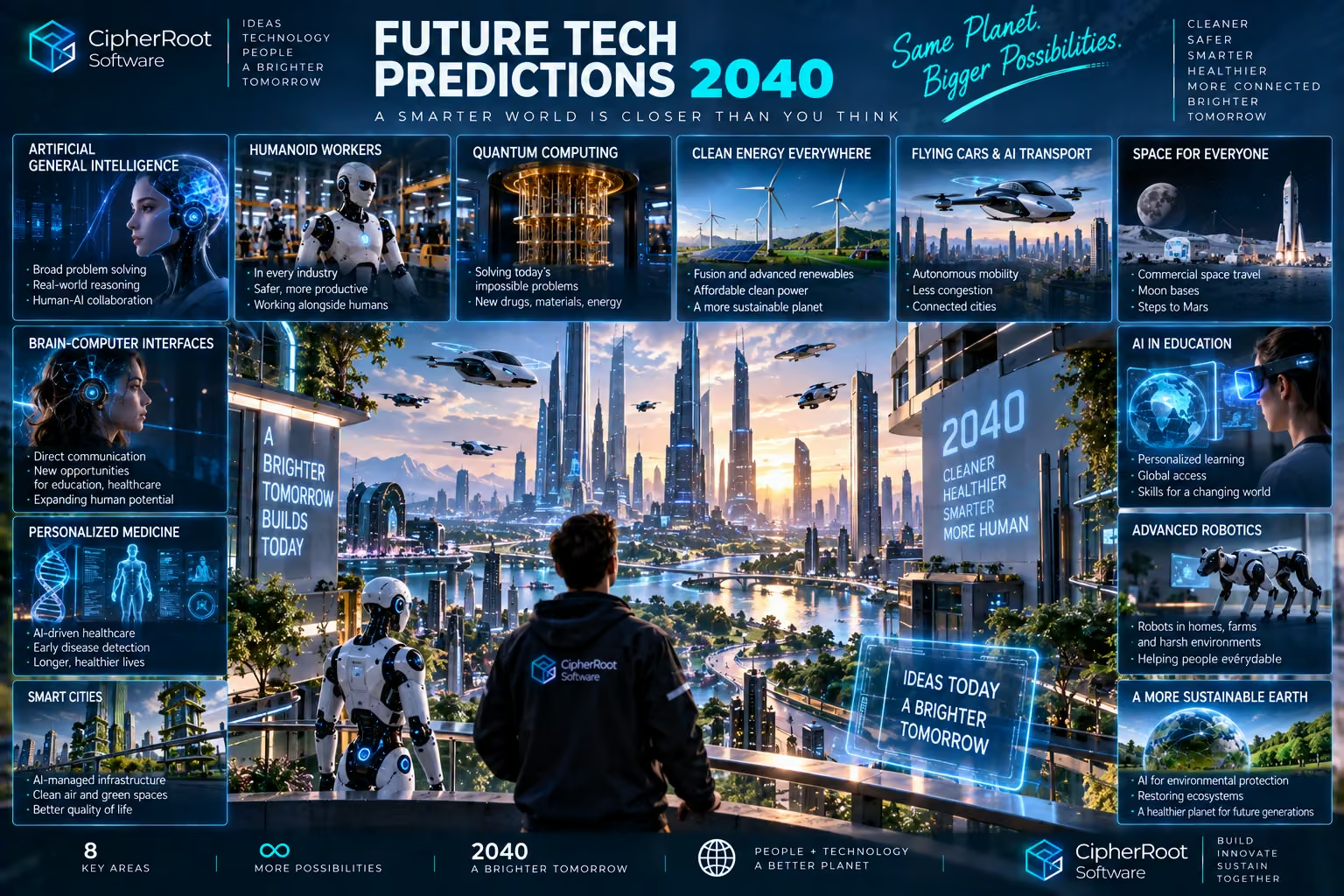
What Could Technology Look Like in 2040?
Predicting the future is difficult.
Technology rarely develops in a straight line.
Some ideas arrive earlier than expected.
Others take decades.
Some technologies disappear entirely while unexpected innovations replace them.
Still, looking at current developments in artificial intelligence, robotics, computing, energy, biotechnology, transportation, and space technology allows us to imagine what the world of 2040 could look like.
The following predictions are not promises.
They are possible scenarios built around one central idea:
Technology is becoming more intelligent, connected, autonomous, and deeply integrated into everyday life.
By 2040, the biggest transformation may not come from one invention.
It may come from several technologies becoming interconnected.
1. Artificial Intelligence Becomes More General
Artificial intelligence is moving from specialized tools toward systems capable of handling increasingly broad tasks.
By 2040, AI systems could potentially become significantly more capable at:
Reasoning Planning Multimodal understanding Scientific research Software development Robotics Personal assistance
One possible direction is the development of systems approaching what researchers and companies describe as artificial general intelligence.
Whether true AGI will exist by 2040 is uncertain.
The larger trend is more predictable:
AI systems are likely to become capable of handling a wider variety of tasks without requiring completely separate systems for each one.
Instead of using ten different intelligent tools, users may increasingly interact with a single general-purpose system connected to many capabilities.
2. Humanoid Robots Become More Common
Humanoid robotics could become one of the most visible technological changes of the 2030s and 2040s.
The reason is practical.
Many human environments are already designed around the human body.
Stairs.
Doors.
Shelves.
Factories.
Warehouses.
Tools.
Vehicles.
A humanoid robot can potentially operate in these environments without requiring everything to be redesigned.
By 2040, humanoid robots could potentially perform selected tasks across:
Manufacturing Logistics Agriculture Construction Hospitality Healthcare support Household assistance
The most important development may not be making robots look more human.
It may be making them more useful and adaptable.
3. AI and Robotics Merge
Artificial intelligence and robotics are increasingly becoming connected fields.
AI provides:
Perception
Planning
Language understanding
Decision support
Robotics provides:
Movement
Manipulation
Physical interaction
By 2040, these technologies could form integrated systems capable of understanding instructions and performing physical tasks.
Imagine telling a household robot:
“Prepare the room for tonight's guests.”
The system could potentially interpret the request, inspect the environment, plan a sequence of actions, and coordinate multiple devices.
This would represent a transition from robotic automation to physical AI.
4. Quantum Computing Enters More Specialized Fields
Quantum computing is another technology surrounded by both excitement and uncertainty.
It is unlikely to replace conventional computers for everyday tasks.
Instead, its value may emerge in specific problems where quantum approaches can provide meaningful advantages.
Potential areas could include:
Materials research Molecular simulation Scientific computing Optimization Cryptography Drug discovery
By 2040, quantum systems could potentially work alongside classical computing infrastructure.
A future workflow might look like:
Classical computers → AI systems → Quantum processors → Scientific results
The important change would not be replacing computers.
It would be adding a new computational layer for selected problems.
5. Clean Energy Becomes More Intelligent
Energy systems are likely to become more digital.
Renewable generation, batteries, electric vehicles, smart buildings, and connected grids can produce complex energy-management requirements.
AI can help coordinate these systems.
A future energy network may continuously optimize:
Generation Storage Consumption Charging Distribution
Homes could become active parts of the energy system.
A building might generate solar power, store electricity, charge vehicles, and automatically adjust consumption.
The future energy system may therefore be not only cleaner.
It could also be more intelligent and responsive.
6. Autonomous Transportation Expands
By 2040, transportation could contain multiple levels of automation.
Autonomous systems may operate in specific environments such as:
Highways Warehouses Industrial sites Airports Campuses Dedicated urban routes
Cars, trucks, buses, delivery robots, drones, and autonomous ships could increasingly operate as part of connected networks.
The important transformation may be the combination of:
Autonomy + Connectivity + AI + Infrastructure
A vehicle does not simply drive.
It becomes part of a larger transportation system.
7. Smart Cities Become More Adaptive
Future cities may contain much greater integration between infrastructure and software.
Buildings.
Roads.
Public transportation.
Energy networks.
Water systems.
Environmental sensors.
Waste-management systems.
These systems can increasingly exchange information.
AI could help cities analyze:
Traffic patterns Energy demand Pollution Infrastructure conditions Public-transport usage
The goal is not to create a city that monitors everything.
It is to create a city that can respond more intelligently to changing conditions.
8. Personal AI Becomes a Digital Companion
Today's AI assistants primarily answer requests.
By 2040, personal AI systems could potentially become much more persistent.
A personal AI might understand:
Long-term goals Preferences Projects Learning interests Daily routines
It could help organize information across work, education, creativity, and personal tasks.
This could create a new computing model:
Your AI does not simply answer questions. It understands the context of your digital life.
That would also create major privacy questions.
A highly capable personal AI could become one of the most sensitive pieces of software a person owns.
9. Brain-Computer Interfaces Become More Practical
Brain-computer interfaces remain a challenging field.
But by 2040, more practical neural interfaces could potentially emerge for selected applications.
Possible areas include:
Assistive communication Prosthetic control Rehabilitation Accessibility Human-computer interaction
The earliest successful applications may focus on restoring or assisting specific functions rather than creating science-fiction-style superhuman abilities.
Over time, however, the boundary between biological and digital interfaces could become increasingly interesting.
10. Augmented Reality Replaces Some Screens
The traditional computer screen may become less dominant.
Smart glasses and augmented-reality systems could place information directly into the user's environment.
Instead of looking down at a phone to navigate, a user could see directions in their field of view.
Instead of opening a manual, a technician could see instructions next to a machine.
Instead of looking at a flat 3D model, an engineer could interact with it in physical space.
By 2040, computing could become increasingly spatial.
The interface changes from:
Screen
to:
Environment.
11. Digital Twins Become Standard Infrastructure
Digital twins are likely to become increasingly important across industry and infrastructure.
A digital twin can represent a physical object or environment digitally.
By 2040, digital twins could potentially model:
Buildings Factories Vehicles Energy systems Ports Cities Industrial equipment
These systems could be used to simulate changes before applying them physically.
A city could model a new transportation system.
A factory could simulate a new production line.
An engineer could test maintenance scenarios.
The result is a world where physical decisions are increasingly tested in digital environments first.
12. AI Accelerates Scientific Discovery
Scientific research may be one of the areas most deeply transformed by AI.
Future systems could help researchers:
Search scientific literature Analyze huge datasets Generate hypotheses Simulate complex systems Design experiments Operate laboratory equipment
The laboratory could become increasingly automated.
A scientist defines the research objective.
AI analyzes available knowledge.
Robotic systems perform experiments.
The results return to the AI system.
The next experiment is selected.
The cycle continues.
This creates a new model:
Research → Experiment → Data → AI → New Research
Scientific discovery becomes a more continuous computational process.
Technology Prediction 2040: Healthcare Becomes More Personalized
Healthcare could also become more data-driven.
AI systems may integrate information from:
Medical records Imaging Laboratory results Wearable devices Genomic research
This could support more personalized analysis and treatment planning.
Medical professionals would remain essential.
AI would function as an additional analytical layer.
The most important innovation may therefore not be an autonomous medical machine.
It may be better information arriving at the right moment.
Technology Prediction 2040: Homes Become Autonomous Systems
The smart home of 2040 could be substantially different from today's connected homes.
Instead of controlling individual devices, users may interact with one intelligent home system.
The home could coordinate:
Lighting.
Temperature.
Security.
Energy.
Appliances.
Robots.
Entertainment.
Electric vehicles.
The home becomes a system that understands context.
The user does not need to control every device manually.
The infrastructure handles coordination.
Technology Prediction 2040: Robots Become Part of Everyday Services
Service robots could become increasingly normal.
Hotels may use robots for delivery.
Warehouses may use robotic fleets.
Airports may use autonomous systems.
Retail stores may use robotic inventory platforms.
Buildings may use cleaning and maintenance robots.
The important moment will come when robots stop looking like experimental technology.
They simply become part of the environment.
Technology Prediction 2040: Autonomous Agriculture
Agriculture could become increasingly automated.
AI-powered systems may combine:
Drones Computer vision Autonomous vehicles Soil sensors Weather information Robotic equipment
A farm could continuously monitor crop conditions and adjust certain operations.
Precision agriculture may reduce unnecessary use of:
Water.
Fertilizer.
Energy.
Machine time.
The long-term objective would be to produce more efficiently while using fewer resources.
Technology Prediction 2040: Environmental Intelligence
Environmental monitoring could become planet-scale.
Satellites.
Sensors.
Drones.
Ocean monitoring systems.
Weather stations.
AI models.
These technologies could work together to create a continuously updated picture of environmental conditions.
AI could help identify:
Forest changes Pollution Wildlife movement Wildfires Water-quality changes Ecosystem stress
The goal would be to detect environmental problems earlier.
A future environmental network could function as a kind of planetary early-warning system.
Technology Prediction 2040: Space Becomes More Commercial
Space technology could also become increasingly accessible.
Possible developments by 2040 may include:
More commercial launches Advanced satellite networks Robotic lunar missions Expanded space research New orbital infrastructure
Humans living permanently in space or on the Moon remains uncertain.
But robotics may play an important role before large-scale human settlements become practical.
Autonomous systems could construct infrastructure, transport materials, perform scientific experiments, and prepare environments for future missions.
Technology Prediction 2040: The Rise of Machine-to-Machine Economies
One of the most interesting future possibilities involves machines conducting transactions with other machines.
Imagine:
An autonomous vehicle pays for charging.
A robot pays for maintenance.
An AI agent purchases computing resources.
A factory automatically orders materials.
A software system pays for access to a specialized service.
This could create new forms of machine-to-machine commerce.
Humans would establish the permissions and rules.
Software could execute transactions automatically.
Technology Prediction 2040: Physical and Digital Worlds Merge
By 2040, the distinction between the physical and digital worlds may become less obvious.
A building could have a digital twin.
A worker could use augmented reality.
A vehicle could communicate with infrastructure.
A robot could interact with a human through natural language.
AI could interpret information from both physical and digital environments.
The result is a more integrated world.
Digital systems no longer sit outside reality.
They become embedded within it.
Technology Prediction 2040: The End of Traditional Software Interfaces?
The classic software interface is built around:
Menus
Buttons
Forms
Windows
Future software may rely more heavily on natural-language interaction.
Instead of learning how the software works, users could tell the system what they want.
For example:
“Analyze this project and show me the main risks.”
“Design a new version of this room.”
“Find the most efficient route.”
“Build a prototype from this idea.”
The software handles the underlying complexity.
This could radically reduce the technical barrier to using advanced tools.
Technology Prediction 2040: The One-Person Digital Studio
AI could also change creative work.
A single creator might have access to intelligent tools for:
Writing Design Video Audio Animation Research Publishing Analytics
The result could be a powerful one-person studio.
A creator does not need a large production team for every project.
The individual becomes the director of a collection of AI-powered tools.
The competitive advantage becomes creativity, taste, storytelling, and originality.
Technology Prediction 2040: The Return of Human Skills
Ironically, increasing automation could make certain human abilities more valuable.
Creativity.
Leadership.
Communication.
Critical thinking.
Empathy.
Scientific curiosity.
Strategic judgment.
As machines become better at repetitive work, humans may spend more time on work that requires context and meaning.
The future may therefore be highly automated without becoming less human.
The Biggest Risk: Technology Moves Faster Than Institutions
Technological progress can be fast.
Institutions often move more slowly.
By 2040, societies may need new approaches to:
AI governance Privacy Cybersecurity Digital identity Robotics Employment Data ownership Autonomous systems
The technology itself is only one part of the equation.
Rules and institutions need to evolve as well.
The Energy Problem
Advanced technology requires energy.
AI data centers need electricity.
Robots need batteries.
Connected infrastructure needs computing.
Space systems require manufacturing and launches.
This means future technology will need to become increasingly efficient.
The next generation of innovation may therefore focus not only on capability.
It may focus on capability per unit of energy and resources.
The Importance of Cybersecurity
By 2040, more systems may be connected to the internet.
That means more potential attack surfaces.
Cars.
Robots.
Factories.
Homes.
Hospitals.
Energy systems.
AI agents.
Security will need to be integrated into the architecture of these systems.
The more the physical world depends on software, the more important cybersecurity becomes.
What Could Go Wrong?
Future technology will create benefits and risks at the same time.
AI can increase productivity.
It can also produce incorrect information.
Robots can perform dangerous tasks.
They can also malfunction.
Autonomous vehicles can reduce some forms of human error.
They also introduce new software and infrastructure risks.
Connected cities can improve efficiency.
They can also create privacy concerns.
Technology does not automatically produce a good future.
Design choices matter.
The Future Is Not Guaranteed
Predictions about 2040 should be treated carefully.
Technology can surprise us.
A completely unexpected invention could change the direction of the industry.
A promising technology could fail.
Economic conditions can change.
Regulations can change.
Public acceptance can change.
Scientific breakthroughs can accelerate progress.
The best way to think about future technology is not as a fixed timeline.
It is a set of possible paths.
A Day in 2040
Imagine waking up in 2040.
Your home has already adjusted the environment according to your schedule.
Your personal AI summarizes your priorities.
Your wearable device provides contextual information.
You leave in an autonomous vehicle.
Traffic infrastructure communicates with the car.
At work, humanoid robots handle selected physical tasks.
AI systems analyze production data.
A digital twin simulates a planned factory change.
Later, you collaborate with researchers in a virtual environment.
An AI assistant helps analyze new scientific information.
In the evening, you return home.
Your energy system coordinates solar generation, storage, and vehicle charging.
A household robot completes routine tasks.
The technology is everywhere.
But much of it remains invisible.
The Most Important Prediction
The most important prediction for 2040 is not that one specific technology will dominate.
It is that technologies will increasingly work together.
AI connects to robotics.
Robotics connects to smart infrastructure.
Smart infrastructure connects to energy.
Energy connects to transportation.
Transportation connects to cities.
Digital twins connect physical systems with software.
Wearables connect humans with digital environments.
The true revolution is the network between technologies.
The 2040 Technology Stack
A future system could contain:
Artificial Intelligence
For reasoning, perception, and decision support.
Robotics
For physical action.
Connected Infrastructure
For communication.
Edge Computing
For real-time processing.
Cloud Computing
For large-scale intelligence.
Quantum Computing
For selected advanced computational problems.
Renewable Energy
For increasingly efficient power.
Spatial Computing
For interaction with digital information in the physical world.
These technologies are not isolated.
They form a stack.
The Human Role in 2040
Even in an extremely technological future, humans will remain essential.
People define goals.
People create culture.
People establish values.
People decide what matters.
Machines can optimize.
They can calculate.
They can generate.
They can act.
But technology does not automatically determine purpose.
That remains a human question.
Conclusion
The world of 2040 could look dramatically different from the world of today.
Artificial intelligence may become more general.
Humanoid robots may enter more workplaces.
Autonomous transportation may become increasingly common.
Quantum computing may solve selected problems beyond the reach of conventional systems.
Smart cities may become more adaptive.
Clean energy may become more intelligent.
Digital twins may become standard infrastructure.
Augmented reality may reshape how people interact with information.
Scientific discovery may become increasingly AI-assisted.
Space technology may expand beyond today's boundaries.
But the most important change may be the convergence of all these systems.
The future will not be defined by AI alone.
It will not be defined by robotics alone.
It will not be defined by quantum computing alone.
It will be shaped by how these technologies connect with one another and with people.
2040 is still ahead of us.
That means the future has not been written yet.
We are building it now.
Think further. Build smarter. Create responsibly.
The technology of 2040 may begin with the ideas we develop today.