
AI & Machine Learning
Digital Humans Explained: How AI Is Creating Virtual People
CipherRoot Software7 min read
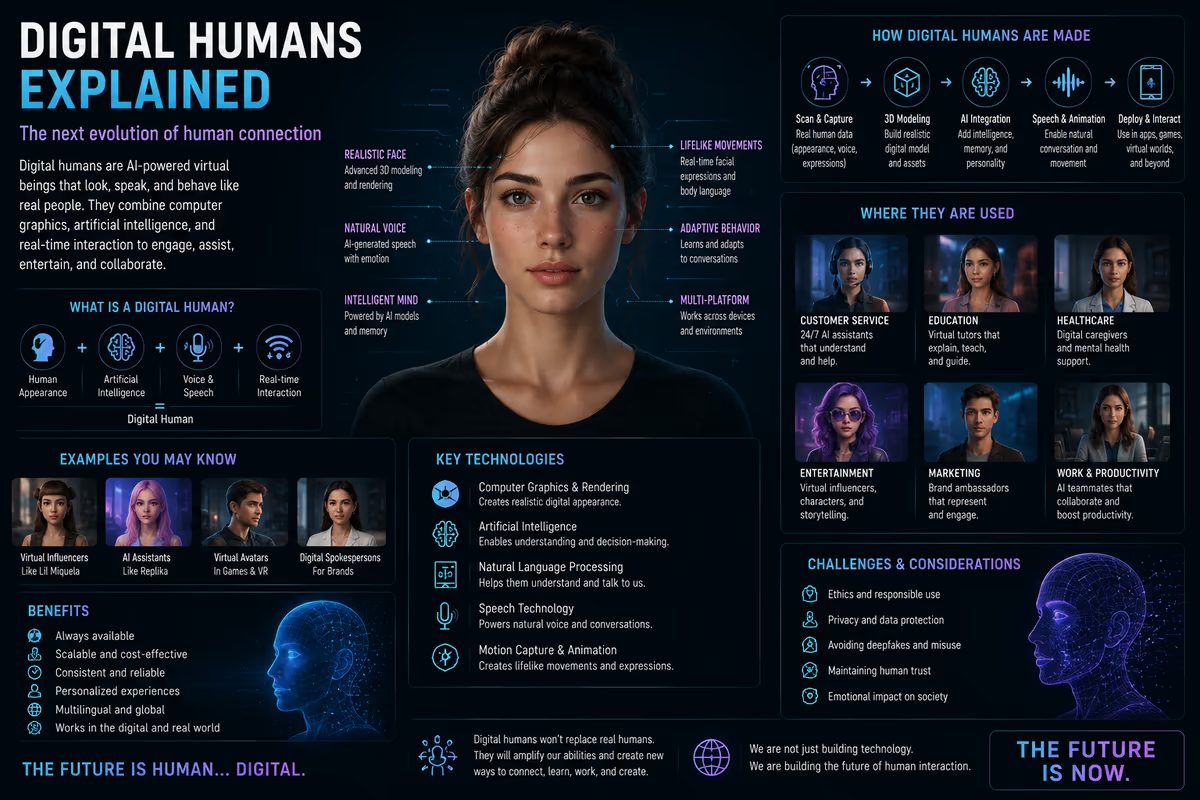
Digital humans are becoming one of the most fascinating developments at the intersection of artificial intelligence, computer graphics, speech technology, and robotics.
Unlike traditional computer-generated characters, modern digital humans can look, speak, move, and interact in increasingly realistic ways.
They can appear in customer service applications, educational platforms, virtual environments, games, marketing campaigns, and AI-powered assistants.
But what exactly is a digital human?
And how close are we to virtual people that can genuinely interact with us like humans?
What Is a Digital Human?
A digital human is a computer-generated human-like character designed to interact with people through artificial intelligence and digital technology.
A sophisticated digital human can combine:
- Realistic 3D appearance
- Facial expressions
- Natural speech
- Artificial intelligence
- Memory and context
- Body and hand movements
- Real-time interaction
The important difference is that a digital human is not simply an animated character.
It can potentially understand information, respond to questions, express emotions, and adapt its behavior.
How Are Digital Humans Created?
Creating a convincing digital human requires several technologies working together.
1. 3D Modeling
Artists and developers create a detailed digital body and face.
Modern rendering technologies can reproduce skin, hair, eyes, clothing, and other visual details with increasing realism.
2. Artificial Intelligence
An AI model provides the digital human with the ability to understand language and generate responses.
3. Speech Technology
Text-to-speech systems give the digital human a voice.
Advanced systems can control pronunciation, rhythm, tone, and emotional expression.
4. Facial Animation
Facial animation systems synchronize expressions with speech and emotional context.
The character can smile, blink, move its eyebrows, and change its facial expression.
5. Motion and Animation
Body movements can be generated through animation systems, motion capture, or AI-based motion generation.
When all these technologies work together, a digital human can become remarkably convincing.
Digital Humans vs. Traditional Avatars
A traditional avatar may simply represent a user inside a game or virtual world.
A digital human is more ambitious.
It is designed to behave like an interactive character.
For example, a traditional avatar might simply repeat predefined dialogue.
An AI-powered digital human could understand a question and generate a new response.
This makes the experience much more dynamic.
Digital Humans in Customer Service
Businesses are already exploring AI-powered virtual representatives.
A digital human could answer common questions, guide customers through a website, explain products, or provide assistance around the clock.
Unlike a traditional chatbot, the interaction could happen through a face and voice.
Instead of reading:
"How can we help you?"
a customer could see and speak directly with a virtual representative.
This could make digital customer service feel more natural.
Digital Humans in Education
Education is another promising application.
A digital teacher could explain concepts, answer questions, demonstrate examples, and adapt explanations to a student's level.
For example, a language-learning platform could create an AI tutor capable of holding realistic conversations.
Students could practice speaking without needing another person to be available.
Digital humans could therefore become a visual and conversational interface for AI-powered education.
Digital Humans in Healthcare
Healthcare could also benefit from virtual human technology.
Digital assistants could potentially help patients navigate information, explain procedures, provide reminders, or assist with administrative tasks.
However, healthcare applications require particularly strong safeguards.
A digital human should not be confused with a qualified medical professional, and AI-generated information must be handled carefully.
The technology should support healthcare professionals rather than replace clinical judgment.
Digital Humans in Games and Virtual Worlds
Gaming could be transformed by AI-powered digital characters.
Traditional non-player characters often follow predefined dialogue and behavior.
Future characters could potentially understand natural language and react dynamically to players.
Imagine entering a virtual city where every character has a different personality, memory, and history.
Instead of repeating the same dialogue, characters could have conversations that evolve naturally.
This could make virtual worlds feel significantly more alive.
Digital Humans and Artificial Intelligence
AI is the component that gives a digital human its intelligence.
A digital character can have an appearance without being intelligent.
An AI model can provide the reasoning and language capabilities.
Memory systems can provide continuity.
Speech technology provides a voice.
Animation systems provide movement.
Together, these components create something much more sophisticated than a simple animated character.
The Rise of AI Companions
Another emerging possibility is the development of personal AI companions represented by digital humans.
A user could interact with an AI through a persistent virtual character that remembers preferences, conversations, and ongoing projects.
The character could appear on a computer, smartphone, smart glasses, or eventually a humanoid robot.
This creates an interesting possibility:
One AI personality, multiple physical and digital forms.
Digital Humans and Humanoid Robots
The connection between digital humans and physical robots could become especially important.
A digital human could exist entirely inside software today.
Tomorrow, a similar AI system could control a physical humanoid robot.
The digital personality could provide:
- Conversation
- Memory
- Decision-making
- Voice
- Facial expressions
- Personalized interaction
The robot would provide the physical body.
This could eventually create AI systems that move seamlessly between digital and physical environments.
The Uncanny Valley
One of the biggest challenges is the uncanny valley.
When a digital human looks almost—but not completely—real, people can sometimes find it uncomfortable.
Small imperfections in facial expressions, eye movement, skin texture, or body motion can make a character feel artificial.
Developers therefore need to focus not only on visual realism but also on natural movement and behavior.
Sometimes a slightly stylized character can feel more believable than an imperfect photorealistic one.
Ethics and Digital Identity
Digital humans also raise important ethical questions.
What happens when an AI looks exactly like a real person?
Who owns a digital likeness?
Can someone's face or voice be used without permission?
How should companies prevent digital humans from being used for deception?
These questions will become increasingly important as synthetic media becomes more realistic.
Consent, transparency, and identity protection will need to be fundamental parts of the technology.
Privacy and Data
Interactive digital humans can potentially collect significant amounts of information about users.
Voice recordings, conversations, preferences, behavioral patterns, and interaction histories could all become valuable data.
Companies developing these systems will need to establish clear policies about how information is collected, stored, and used.
The more personalized a digital human becomes, the more important privacy becomes.
What Will Digital Humans Look Like in the Future?
Future digital humans could become significantly more realistic and intelligent.
They may be able to:
- Hold long conversations
- Remember previous interactions
- Recognize emotional context
- Generate realistic facial expressions
- Speak multiple languages
- Adapt their personalities
- Control virtual environments
- Interact with physical robots
They could become a standard interface for AI services.
Instead of opening an application and navigating menus, users could simply talk to an intelligent digital person.
From Digital Human to Physical Humanoid
The most interesting possibility may be the convergence of digital humans and robotics.
The AI brain could exist in the cloud or on a local computer.
The digital human could provide the personality and interaction model.
A humanoid robot could provide the physical body.
This creates a potential future architecture:
AI Brain → Digital Personality → Voice & Vision → Robotic Body
The same underlying intelligence could potentially exist across phones, computers, virtual environments, and humanoid robots.
Final Thoughts
Digital humans are more than realistic computer-generated faces.
They represent the convergence of AI, 3D graphics, speech technology, animation, computer vision, and human-computer interaction.
Their applications could range from customer service and education to entertainment, virtual worlds, and eventually physical robotics.
The technology is still developing, and many challenges remain.
But one thing is becoming clear:
The future of artificial intelligence may not always appear as a chatbot inside a window.
Sometimes, it may look back at you.
Digital humans are not replacing human beings. They are creating a new interface through which humans can interact with intelligent machines.