
Security & Privacy
Cybersecurity in the Age of AI: The New Digital Battlefield
CipherRoot Software5 min read
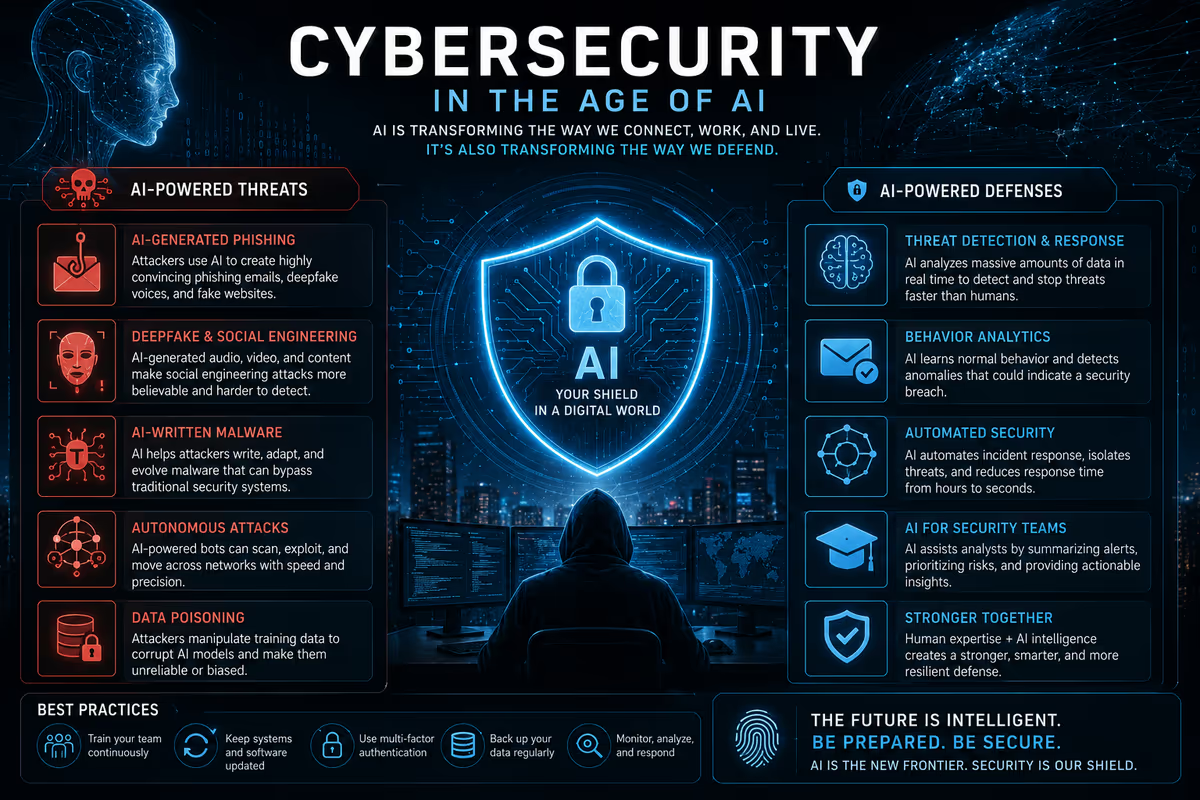
Artificial intelligence is changing almost every part of the digital world. Businesses use AI to automate processes, developers use it to build software, and individuals rely on intelligent systems for communication, research, and everyday tasks.
But the same technology that makes digital systems smarter can also make cyber threats more sophisticated.
AI is creating a new cybersecurity environment where attackers can automate operations, generate convincing social-engineering content, and adapt their strategies faster than ever. At the same time, cybersecurity professionals are using AI to detect threats, analyze enormous amounts of data, and respond to attacks more quickly.
The result is an evolving technological arms race between intelligent attacks and intelligent defenses.
How AI Is Changing Cyber Threats
Traditional cyberattacks often required significant manual effort.
Attackers had to research targets, create convincing messages, analyze systems, and adapt their strategies.
AI can automate portions of this process.
Modern AI tools can potentially help attackers produce convincing phishing messages, analyze publicly available information, generate fraudulent content, and automate repetitive activities.
This does not mean that AI automatically creates unstoppable hackers.
However, it can lower the technical and operational barriers for certain types of attacks.
AI-Powered Phishing
Phishing remains one of the most common cybersecurity threats.
AI can make phishing attempts more convincing by generating messages that are better written and more personalized.
Instead of receiving an obviously suspicious email, a victim could encounter a message that appears professionally written and closely matches the communication style of a legitimate organization.
AI-generated voice and video can make social engineering even more difficult to recognize.
This makes human awareness increasingly important.
Deepfakes and Social Engineering
Deepfake technology can generate realistic images, voices, and videos.
In the wrong hands, these technologies could be used to impersonate executives, employees, public figures, or even family members.
Imagine receiving a video call that appears to show your manager asking you to approve an urgent transaction.
The visual evidence may look convincing, but it could be completely artificial.
Organizations therefore need verification procedures that do not depend solely on someone's voice, face, or video presence.
AI and Malware
AI can also change the way malicious software is developed and adapted.
Instead of relying entirely on static techniques, future threats could become more adaptive, changing their behavior based on the environment they encounter.
This creates a difficult challenge for traditional security systems.
Cybersecurity tools must increasingly look at behavior, not just known signatures.
AI-Powered Cyber Defense
Fortunately, AI is also becoming one of cybersecurity's most powerful defensive technologies.
Security systems can analyze enormous amounts of network and system activity much faster than human analysts.
AI can help identify:
- Unusual login behavior
- Suspicious network activity
- Abnormal file access
- Potential account compromise
- Unusual device behavior
- Coordinated attack patterns
Instead of waiting for a known attack signature, AI systems can search for behavior that differs from normal activity.
Faster Threat Detection
Speed is critical during a cyberattack.
The longer an attacker remains inside a network, the greater the potential damage.
AI-powered security systems can continuously analyze activity and generate alerts when suspicious behavior appears.
In more advanced environments, automated systems can also help isolate affected systems or accounts while security teams investigate the incident.
The goal is simple:
Detect faster. Respond faster. Recover faster.
AI for Security Teams
AI does not necessarily replace cybersecurity professionals.
Instead, it can act as a powerful assistant.
Security analysts may receive thousands of alerts every day. Manually investigating every alert can be extremely time-consuming.
AI can help summarize events, group related alerts, identify patterns, and prioritize incidents that deserve immediate attention.
This allows human analysts to spend more time on complex investigations and strategic decisions.
The Human Element
Technology alone cannot solve cybersecurity.
Employees still need to recognize suspicious messages, protect their accounts, use strong authentication, and follow security procedures.
Even the most sophisticated security system can be weakened by a compromised account or careless handling of sensitive information.
The strongest approach combines:
Human expertise + AI-powered security + strong organizational policies.
Protecting Against AI-Driven Threats
Organizations can take several practical steps to improve their security posture.
Use Multi-Factor Authentication
Passwords alone are increasingly insufficient.
Multi-factor authentication adds another layer of protection when accounts are compromised.
Keep Systems Updated
Security vulnerabilities are constantly discovered. Keeping operating systems, applications, and security software updated reduces exposure to known weaknesses.
Train Employees
Regular security awareness training can help employees recognize phishing, impersonation, and other social-engineering attempts.
Monitor Unusual Behavior
Organizations should monitor accounts, devices, and networks for abnormal activity.
Maintain Backups
Reliable backups can significantly reduce the impact of data loss and ransomware incidents.
The Future of AI and Cybersecurity
The relationship between AI and cybersecurity will continue to evolve.
Attackers will develop new techniques.
Defenders will develop new detection systems.
The advantage may repeatedly shift between both sides.
Future security platforms could continuously learn what normal activity looks like across an organization and immediately identify deviations.
AI may also help security teams predict potential vulnerabilities before attackers exploit them.
Cybersecurity could gradually move from a reactive discipline toward a more predictive model.
A New Digital Arms Race
The cybersecurity landscape is entering a new era.
AI gives attackers more automation and sophistication, but it also gives defenders unprecedented analytical capabilities.
The winners will not necessarily be the organizations with the largest security teams.
They may be the organizations capable of combining intelligent automation with experienced human decision-making.
AI will become increasingly important, but trust, verification, privacy, and security fundamentals will remain essential.
Final Thoughts
Artificial intelligence is changing cybersecurity from both sides of the battlefield.
It can make attacks more convincing, automated, and adaptive—but it can also make defenses faster, smarter, and more proactive.
The future of cybersecurity will therefore not be about eliminating AI.
It will be about learning how to use AI responsibly while ensuring that humans remain in control of critical security decisions.
The digital world is becoming more intelligent.
Our defenses must become equally intelligent.
The future is AI-powered. Security must be too.