
Future & Research
Brain-Computer Interfaces: Connecting the Human Brain With Technology
CipherRoot Software7 min read
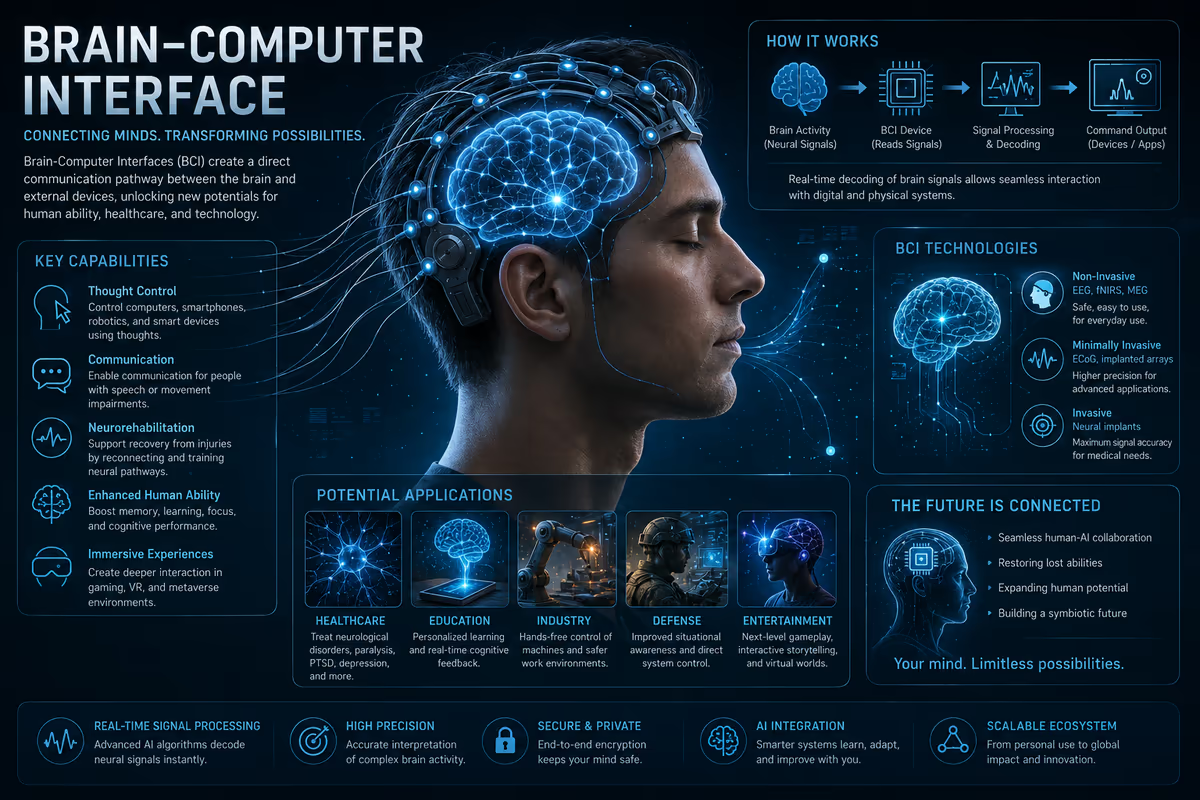
For decades, the idea of controlling a computer with nothing more than a person's thoughts belonged largely to science fiction.
Today, brain-computer interfaces (BCIs) are turning parts of that idea into reality.
A brain-computer interface creates a communication pathway between brain activity and an external device. Instead of relying entirely on keyboards, touchscreens, or physical movement, a person can potentially interact with computers and machines through signals generated by the brain.
The technology is still developing, but its potential could reshape healthcare, accessibility, robotics, gaming, and the relationship between humans and computers.
What Is a Brain-Computer Interface?
A BCI is a system designed to detect and interpret patterns of brain activity and translate them into commands.
The basic process can be thought of as:
Brain activity → Signal detection → Signal processing → AI interpretation → Digital command
For example, a BCI might detect a neural pattern associated with an intended movement and translate it into a command that moves a cursor on a computer screen.
The technology does not necessarily "read thoughts" in the science-fiction sense.
Instead, many BCI systems are designed to recognize specific measurable patterns associated with intended actions.
How Do BCIs Work?
BCI systems generally involve several stages.
1. Detecting Brain Signals
Sensors measure electrical or other forms of neural activity.
Some systems use sensors placed outside the head, while others use implanted electrodes positioned closer to neural tissue.
2. Processing the Signals
Raw brain signals are complex and contain noise.
Computers process these signals to identify useful patterns.
3. Interpreting Neural Activity
Machine-learning algorithms can be trained to associate certain signal patterns with intended actions.
For example, a system may learn the difference between neural activity associated with attempting to move a cursor left or right.
4. Producing an Output
The interpreted command can then control software, a robotic device, communication system, or another machine.
This creates a direct communication channel between the brain and technology.
Non-Invasive and Implantable BCIs
There are several approaches to building brain-computer interfaces.
Non-Invasive BCIs
Non-invasive systems use sensors positioned outside the body.
One example is EEG-based technology, which measures electrical activity from the scalp.
The major advantage is that these systems do not require brain surgery.
However, signals measured outside the skull can be weaker and more difficult to interpret precisely.
Implantable BCIs
Implantable systems place electrodes closer to neural tissue.
Because the sensors are closer to the source of neural activity, they can potentially capture more detailed signals.
However, implantation involves significant medical and engineering challenges.
The long-term safety, reliability, maintenance, and performance of implanted systems remain important areas of research.
Helping People Communicate
One of the most promising applications of BCI technology is communication assistance.
People who cannot reliably use conventional keyboards or speech may potentially use neural signals to interact with communication software.
A BCI could allow a user to select letters, control a cursor, or operate an assistive device.
For someone who has lost significant motor function, even a relatively simple interface could provide a major improvement in independence.
Neurorehabilitation
BCIs are also being investigated as tools for rehabilitation.
After certain neurological injuries, the brain may still generate signals associated with movement even when the corresponding physical movement is difficult or impossible.
A BCI can potentially detect these signals and connect them to visual feedback, robotic assistance, or other rehabilitation technologies.
The objective is not simply to control a machine.
Researchers are also investigating whether repeated interaction between neural activity and feedback can support rehabilitation processes.
Controlling Robotic Devices
BCIs could eventually create a new form of human-robot interaction.
A person could potentially control:
- Robotic arms
- Computer cursors
- Wheelchairs
- Assistive devices
- Prosthetic systems
- Smart-home controls
Instead of physically operating a traditional controller, the user could provide commands through neural activity.
This could be especially valuable for people with severe mobility limitations.
AI and Brain-Computer Interfaces
Artificial intelligence is becoming increasingly important to BCI development.
Brain signals are highly complex and vary between individuals.
Machine-learning systems can analyze these signals and identify patterns that would be difficult to interpret manually.
AI can help BCIs adapt to individual users and potentially improve their accuracy over time.
This creates an interesting technological combination:
Human brain + neural interface + AI + robotics
Together, these technologies could create entirely new forms of interaction.
BCIs and the Future of Gaming
Gaming could eventually become another major application.
Imagine controlling aspects of a game through neural signals rather than a conventional controller.
Players might interact with virtual environments using intended actions, attention patterns, or other measurable neural activity.
Combined with virtual reality and artificial intelligence, BCIs could create much more immersive experiences.
However, fully controlling complex games through thought alone remains a challenging technological problem.
Beyond Healthcare
The potential applications of BCIs extend beyond medicine.
Future research could explore their use in:
- Education
- Industrial robotics
- Virtual reality
- Accessibility
- Human-computer interaction
- Scientific research
- Assistive technology
The technology could eventually change how people interact with computers.
Instead of adapting ourselves to computer interfaces, interfaces could increasingly adapt to the way humans naturally communicate.
Privacy and "Neural Data"
BCIs introduce an entirely new category of privacy concerns.
Brain activity is deeply personal information.
As technology becomes better at interpreting neural signals, important questions emerge:
- Who owns neural data?
- Who can access it?
- How should it be protected?
- Can users permanently delete their neural information?
- Could companies use neural data for advertising or behavioral analysis?
These questions need to be addressed before BCI technology becomes widely integrated into everyday life.
Security Challenges
Cybersecurity will also become increasingly important.
A connected BCI is ultimately a technological system, which means it must be designed to resist unauthorized access and manipulation.
The consequences of compromising an ordinary application can already be serious.
A system connected directly to assistive technology or neural interfaces could introduce even greater risks.
Strong authentication, encryption, secure software design, and strict access controls will therefore be essential.
Will BCIs Read Our Thoughts?
This is one of the biggest misconceptions surrounding brain-computer interfaces.
Current BCI technology should not be viewed as a machine that simply "reads someone's mind."
Most systems are designed for specific, measurable neural patterns and particular tasks.
For example, a system may be trained to distinguish signals associated with intended cursor movements.
Understanding the full complexity of someone's thoughts, memories, emotions, or inner experiences is a vastly more difficult problem.
The difference between decoding a specific neural signal and reading a person's mind is enormous.
The Future of Human-Computer Interaction
Today, we communicate with computers primarily through physical interfaces.
We type.
We touch screens.
We speak.
We move a mouse.
BCIs introduce another possibility:
The computer could respond directly to neural activity.
In the long term, BCIs could become part of a broader ecosystem involving AI, augmented reality, robotics, and wearable technology.
The objective would not necessarily be to replace traditional interfaces.
Instead, different interfaces could work together depending on the user's needs.
The Challenges Ahead
BCI technology still faces major scientific and engineering challenges.
Researchers need to improve:
- Signal quality
- Accuracy
- Long-term reliability
- User adaptability
- Hardware safety
- Battery life
- Data security
- Neural-data privacy
For implantable systems, biological compatibility and long-term stability are particularly important.
For non-invasive systems, extracting useful information from relatively noisy signals remains a major challenge.
Progress will likely be gradual rather than instantaneous.
Final Thoughts
Brain-computer interfaces represent one of the most fascinating intersections between neuroscience, artificial intelligence, and computing.
Their greatest near-term potential may be helping people regain communication and control after serious neurological or physical impairments.
But the technology could eventually go much further.
As AI becomes better at interpreting neural signals, humans may gain entirely new ways to communicate with computers, robots, and digital environments.
The future may not be about making computers more human.
It may be about creating technology capable of communicating with the human brain in ways that were once considered impossible.
The interface of the future may not be in our hands. It may be in our minds.