
Future & Research
Autonomous Ships: The Future of Intelligent Maritime Transportation
CipherRoot Software12 min read
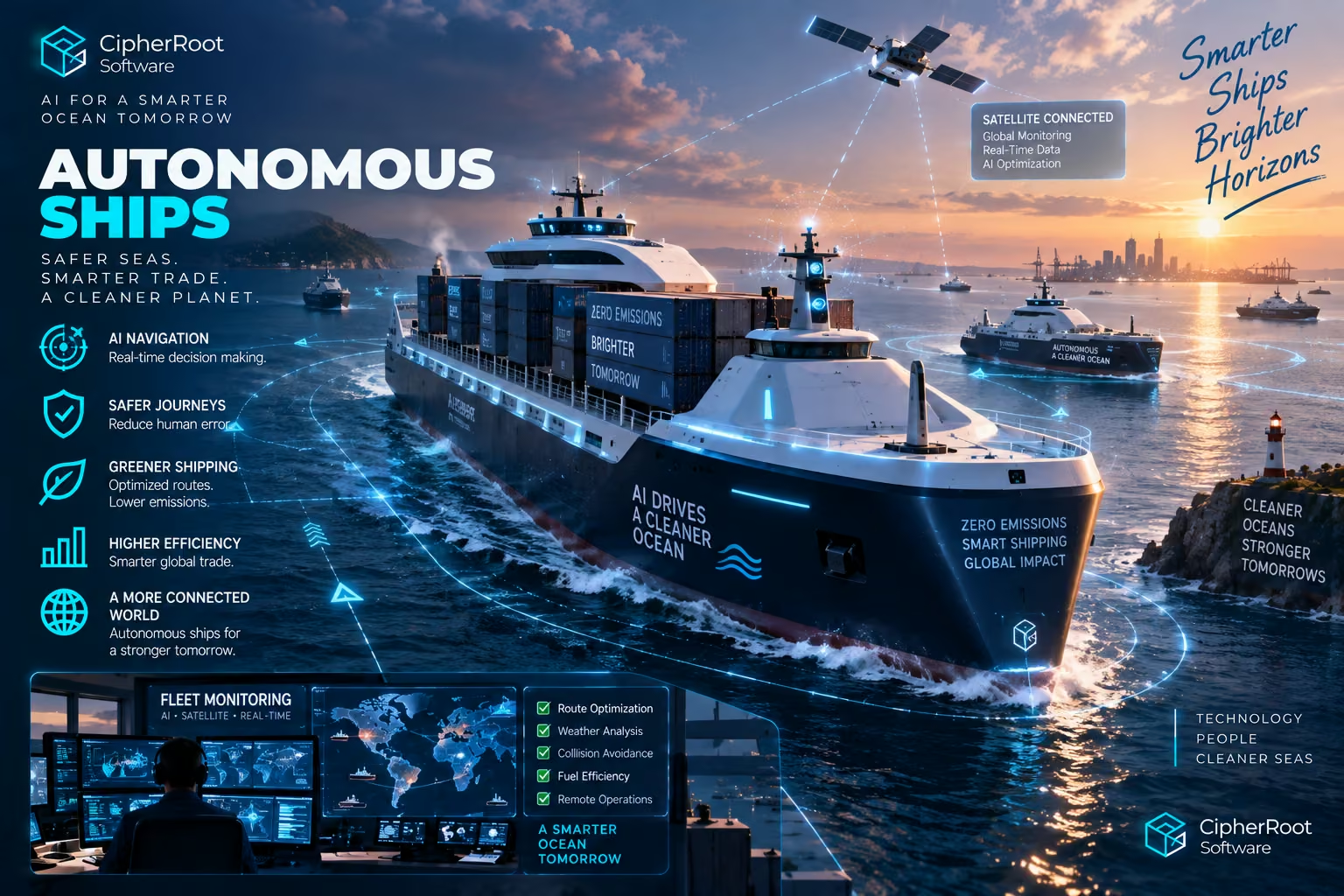
The Ocean Is Becoming Intelligent
For centuries, ships have connected countries, transported goods, carried passengers, and supported global trade.
Modern vessels already use advanced navigation systems, satellite communication, automated engines, radar, and digital monitoring.
Now another transformation is beginning.
Ships are becoming increasingly capable of sensing their surroundings, analyzing information, planning routes, and operating with less direct human intervention.
This is the idea behind autonomous ships.
Autonomous vessels combine artificial intelligence, navigation systems, sensors, communication technologies, robotics, and maritime engineering to create a new generation of intelligent transportation.
The goal is not simply to build ships that can move without a person continuously controlling every action.
It is to create vessels that can understand conditions and make operational decisions within clearly defined safety limits.
What Are Autonomous Ships?
An autonomous ship is a vessel capable of performing some navigation or operational tasks with limited human intervention.
The exact level of autonomy can vary.
Some systems may only automate selected functions.
Others may support remote supervision.
More advanced concepts aim for vessels capable of performing many navigation tasks independently.
An autonomous ship can use technologies such as:
Radar Cameras LiDAR and other sensing systems GPS and positioning technologies Automatic identification systems Satellite communication Weather information Artificial intelligence Route-planning software Autonomous control systems
The combination of these technologies allows the vessel to build a more detailed understanding of its environment.
AI Becomes the Navigator
Navigation at sea is a complex problem.
Ships must account for other vessels, weather, currents, visibility, sea conditions, restricted areas, ports, and changing traffic.
Artificial intelligence can help process these variables.
An AI navigation system can potentially analyze:
Where is the ship?
Where are other vessels?
What is the weather doing?
What route is available?
What risks exist?
What should happen next?
This turns navigation into a continuous decision-making problem rather than a fixed route-following task.
Sensors Give Ships Eyes and Ears
Autonomous vessels need to perceive their surroundings.
No single sensor is perfect.
Radar can provide valuable information about surrounding objects.
Cameras can provide visual information.
Other sensors can contribute positioning, motion, environmental, or equipment data.
By combining multiple sources, autonomous systems can create a more complete picture of the environment.
This approach is often called sensor fusion.
The vessel does not rely on one signal.
It combines multiple signals to estimate what is happening around it.
Avoiding Collisions
One of the most important challenges in autonomous shipping is collision avoidance.
A ship needs to identify nearby vessels, understand their movement, and determine whether their paths could intersect.
An intelligent system can continuously evaluate:
Distance Relative speed Direction Vessel type Predicted trajectories Navigation constraints
It can then determine whether an adjustment may be required.
The difficult part is not simply recognizing another ship.
It is understanding what that ship is likely to do next.
Autonomous Route Planning
A traditional route may be planned before a journey begins.
Autonomous systems can make routing more dynamic.
A vessel could potentially adjust its course based on:
Weather Sea conditions Traffic Fuel or energy levels Port conditions Temporary restrictions Operational priorities
This can turn navigation into a continuously optimized process.
The route is no longer simply:
Point A → Point B
It becomes:
Point A → continuously evaluate → adapt → Point B
Weather-Aware Navigation
Weather can dramatically influence maritime operations.
Strong winds, large waves, storms, reduced visibility, and changing sea conditions can affect both safety and efficiency.
Autonomous systems can combine weather information with vessel performance data.
An AI system may identify routes that reduce exposure to unfavorable conditions.
It could also alert a remote operator when conditions become outside the vessel's predefined operational limits.
The goal is not to eliminate bad weather.
It is to make the ship more responsive to it.
Satellite Connectivity
Ships operate across enormous distances.
Continuous communication is therefore essential for autonomous and remotely supervised systems.
Satellite networks can help provide:
Position information Fleet monitoring Remote communication Weather updates Operational data Software services
This creates a connection between the vessel and shore-based infrastructure.
The autonomous ship is not necessarily alone.
It can remain part of a larger digital network.
Remote Operations Centers
Some autonomous ships may still rely on humans—but humans who are no longer physically on board.
A remote operations center can monitor one or multiple vessels from shore.
Operators can receive:
Navigation information Sensor feeds Equipment status Alerts Weather information Camera views
The human can intervene when the vessel encounters a situation that requires additional judgment.
This creates an important model:
Autonomous at sea. Human-supervised when necessary.
The Digital Ship
Autonomous ships can also become digital twins of themselves.
A digital model can represent:
Engines Navigation systems Cargo Fuel or energy usage Equipment condition Environmental conditions
This model can receive information from the physical vessel in near real time.
Engineers on shore can then monitor the ship's condition without being physically present.
This can support maintenance, optimization, and operational planning.
Predictive Maintenance at Sea
Mechanical failures at sea can be expensive and dangerous.
Traditional maintenance often follows schedules.
Predictive maintenance takes a condition-based approach.
Sensors can monitor components such as engines, pumps, generators, bearings, and other systems.
AI can analyze changes in:
Vibration Temperature Pressure Energy consumption Performance Operating cycles
If a system begins behaving abnormally, maintenance teams may receive an early warning.
This can allow repairs to be planned before a failure becomes a major problem.
Smarter Cargo Operations
Autonomous shipping is not only about navigation.
Cargo management can also become more intelligent.
Software can monitor:
Cargo location Weight distribution Loading schedules Port arrivals Container movement
The ship can become part of a larger digital logistics network.
A cargo vessel does not simply transport goods.
It communicates its status continuously to ports, warehouses, logistics systems, and fleet operators.
Autonomous Ports
The future of autonomous shipping may require autonomous or highly automated ports.
A ship arriving at a port could communicate its estimated arrival time digitally.
Automated systems could prepare:
Docking operations Cargo equipment Loading areas Tugboats Inspection processes
Autonomous cranes and mobile robots could coordinate with the vessel.
This creates a much larger vision:
Ship + Port + Warehouse + Logistics Network
all connected through intelligent software.
Energy Efficiency
Maritime transportation consumes significant amounts of energy.
Autonomous systems can potentially help optimize vessel operation.
For example, AI could consider:
Speed Route Weather Engine performance Sea conditions
A more efficient route or operating profile can reduce unnecessary energy use.
The actual benefits depend on vessel design, route characteristics, energy source, operating conditions, and the quality of the optimization system.
Autonomy does not automatically make a ship efficient.
Better decisions can.
Autonomous Electric and Hybrid Ships
As battery and alternative propulsion technologies develop, autonomous vessels may increasingly use different forms of energy.
Smaller vessels operating on shorter routes may be suitable for electric or hybrid systems.
Larger ocean-going ships face very different energy requirements.
The future may therefore contain several propulsion models rather than one universal solution.
Autonomy can sit above these technologies and help optimize whichever propulsion system the vessel uses.
Reducing Human Exposure to Dangerous Conditions
Life at sea can involve difficult and hazardous environments.
Autonomous systems can potentially reduce the need for humans to perform certain repetitive or dangerous tasks directly on a vessel.
This does not mean human expertise disappears.
It can move toward:
Remote supervision Maintenance Fleet management Engineering Emergency response System oversight
Robotics can take on certain physical risks while humans remain responsible for higher-level operations.
Human Expertise Still Matters
Fully autonomous does not mean fully independent from people.
Humans are still needed to:
Define operational limits Design safety systems Monitor performance Investigate unusual events Maintain hardware Manage regulations Respond to emergencies
Autonomy changes the role of humans.
It does not make human expertise irrelevant.
The future maritime operator may spend less time manually controlling a vessel and more time supervising intelligent systems.
The Challenge of Unpredictable Situations
The ocean is not a perfectly controlled environment.
A floating object may appear unexpectedly.
A vessel may behave unpredictably.
A sensor may fail.
Communications may be interrupted.
Weather may change rapidly.
An autonomous ship therefore needs robust fallback behavior.
When confidence is low, the safest action may be to slow down, alter course, stop, or request human assistance.
Autonomous systems need to know not only how to act.
They also need to know when not to act.
Cybersecurity at Sea
Autonomous ships are highly connected digital systems.
This creates a significant cybersecurity challenge.
Potential attack surfaces can include:
Navigation systems Satellite communication Fleet-management software Onboard networks Remote-access systems Sensors Software updates
A cybersecurity incident could affect physical operations.
That means maritime cybersecurity needs to be treated as part of vessel safety.
Strong authentication, encrypted communication, network segmentation, monitoring, and secure software updates are becoming increasingly important.
Communication Failure
What happens if an autonomous ship loses communication with shore?
This is an important design question.
A properly designed autonomous system cannot assume that connectivity will always be available.
The vessel needs local capabilities that allow it to remain in a safe operational state.
This could include predefined fallback procedures, local navigation systems, and automated emergency behavior.
The system should degrade gracefully rather than suddenly becoming helpless.
Autonomous Ships and Maritime Regulations
Ships operate within complex international and national regulatory frameworks.
Rules govern areas such as:
Navigation Safety Crew responsibilities Collision avoidance Communication Port operations
Autonomous shipping therefore requires technical development alongside regulatory development.
A ship may be technically capable of performing an operation long before the legal framework fully defines how that operation should be handled.
The future of autonomous shipping will depend on solving both problems.
Insurance and Liability
Autonomy also raises questions about responsibility.
If an autonomous vessel causes an accident, the relevant legal and insurance questions can become complex.
Responsibility could potentially involve:
Vessel operators Manufacturers Software providers System integrators Remote operators
Clear operational records will become increasingly important.
Autonomous ships may need detailed logs showing:
What the system detected.
What decisions it made.
Which software version was operating.
Whether a human intervened.
What environmental conditions existed.
This can support investigation when something goes wrong.
Autonomous Ships and Global Trade
A large percentage of global trade moves by sea.
This makes maritime logistics a critical part of the global economy.
Even small improvements in route optimization, fuel efficiency, port coordination, and maintenance can have large effects when applied across major shipping networks.
Autonomous shipping could therefore become part of a broader digital transformation of global trade.
The ship becomes a connected node in a massive logistics ecosystem.
The Future of Fleet Management
The next step may be managing fleets rather than individual ships.
Imagine a control center monitoring dozens or hundreds of autonomous vessels.
AI could analyze:
Fleet locations Weather conditions Cargo priorities Vessel health Port availability Energy consumption
Software could recommend task assignments and route changes.
Human operators could focus on exceptions.
This is similar to how autonomous delivery fleets and robotic warehouses are beginning to transform other forms of logistics.
Autonomous Ships and Sustainability
Autonomous ships may contribute to more efficient maritime transportation through optimized routing, speed management, maintenance, and logistics.
However, sustainability depends on more than autonomy.
The vessel's propulsion technology, fuel source, construction, maintenance, cargo efficiency, and lifecycle all matter.
Autonomy is a tool.
The environmental outcome depends on how that tool is used.
The Ocean as a Smart Environment
The long-term vision is larger than autonomous ships.
Imagine a maritime environment where:
Ships communicate with one another.
Ports communicate with ships.
Weather systems provide continuous updates.
Satellites provide global monitoring.
AI coordinates routes.
Digital twins represent vessels and infrastructure.
Autonomous systems manage logistics.
Humans supervise the overall network.
The ocean itself becomes part of a connected digital ecosystem.
This could create a new generation of smart maritime infrastructure.
What Will Autonomous Ships Look Like?
Future autonomous vessels may not all look futuristic.
Some may resemble today's ships but contain significantly more intelligent software.
Others may use completely different designs.
Smaller vessels may operate without traditional crews.
Cargo ships may be optimized around autonomous operation from the beginning.
Ports may be redesigned around robotic loading and unloading.
Ships could also become more modular, making upgrades to navigation, sensors, computing, and propulsion easier over their lifetimes.
The biggest difference may therefore be inside the vessel.
The ship becomes increasingly controlled by software.
A Day in the Autonomous Maritime Network
Imagine a cargo vessel leaving port.
Its navigation system evaluates weather, traffic, and the planned route.
AI continuously analyzes sensor data.
A remote operations center monitors the voyage.
A maintenance system identifies an unusual engine pattern.
The vessel adjusts its operating plan.
A port receives the ship's updated arrival information.
Automated systems prepare cargo operations.
As the ship approaches the harbor, navigation systems coordinate with port infrastructure.
The entire journey becomes a continuous digital workflow.
The ship does not operate as an isolated machine.
It operates as part of a connected maritime network.
Conclusion
Autonomous ships represent the convergence of artificial intelligence, robotics, navigation, satellite connectivity, sensors, digital twins, and maritime engineering.
They have the potential to transform how vessels navigate, how cargo is managed, how maintenance is performed, and how fleets communicate with ports and logistics networks.
But autonomy also creates serious challenges.
Safety must remain central.
Cybersecurity must be strong.
Human oversight must be clearly defined.
Communication failures must be anticipated.
Regulations and liability frameworks must evolve alongside the technology.
The future of shipping is therefore unlikely to be a simple story about removing people from ships.
It is more accurately a story about moving intelligence into the entire maritime system.
Ships can sense.
AI can analyze.
Software can optimize.
Robots can act.
Humans can supervise and make high-level decisions.
Together, these technologies could transform the world's oceans into a more connected and intelligent transportation environment.
Smarter ships. Safer journeys. More intelligent logistics.
The future of maritime transportation may not be crewed or uncrewed in the traditional sense.
It may be human-supervised, AI-powered, and increasingly autonomous.