
Systems & Infrastructure
Autonomous Factories: The Future of Intelligent Manufacturing
CipherRoot Software8 min read
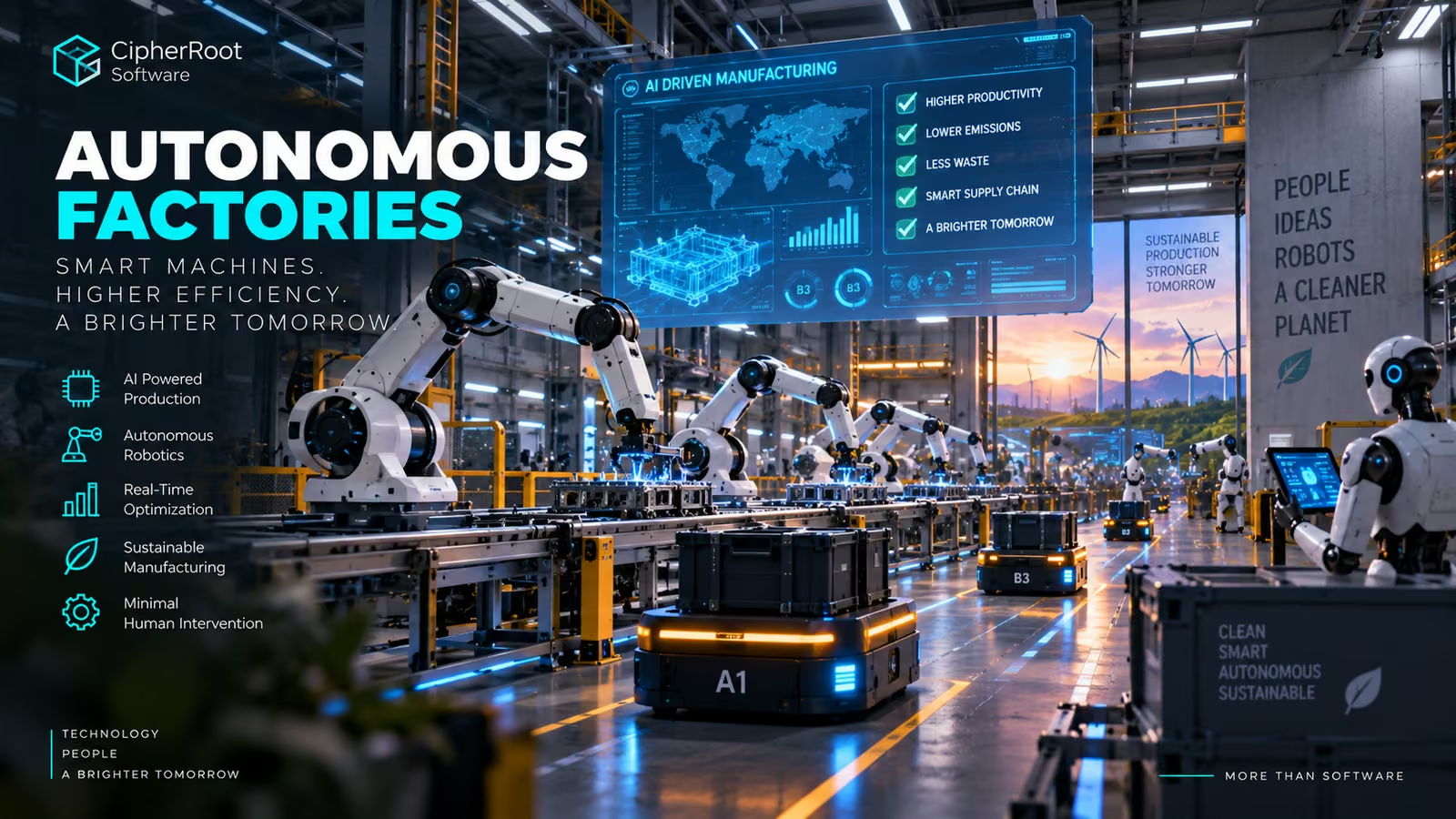
The Factory Is Becoming Intelligent
For more than a century, factories have continuously evolved.
Machines replaced some manual processes. Computers introduced digital control. Industrial robots transformed assembly lines. Automation increased production speed and consistency.
Now, another transformation is taking place.
The modern factory is becoming increasingly autonomous.
An autonomous factory is designed to use artificial intelligence, robotics, sensors, software, and real-time data to make manufacturing operations more independent and adaptive.
Instead of simply following fixed instructions, machines can increasingly monitor their environment, analyze information, adjust processes, and respond to changing conditions.
The result is a new vision of manufacturing:
Machines that do not simply work automatically, but systems that can understand what is happening and react accordingly.
What Is an Autonomous Factory?
An autonomous factory is a manufacturing environment where a significant portion of operational decisions and physical processes are handled by interconnected intelligent systems.
These systems can include:
Industrial robots Autonomous mobile robots Computer vision Artificial intelligence Industrial sensors Digital twins Automated quality inspection Predictive maintenance systems Smart warehouse technology Real-time production analytics Automated logistics
The individual components are important, but the real power comes from connecting them.
A robot working alone is automation.
A factory where robots, software, sensors, logistics systems, and production planning continuously communicate is something much closer to autonomous manufacturing.
From Automation to Autonomy
There is an important difference between automation and autonomy.
Traditional automation usually follows predefined instructions.
For example, a robotic arm might repeat the same movement thousands of times. It performs extremely well as long as the environment remains predictable.
Autonomous systems aim to operate under changing conditions.
A more advanced system might detect that a component has changed, recognize an abnormal production condition, adjust machine parameters, and continue operating without requiring immediate human intervention.
This does not mean humans disappear from the factory.
Instead, their role can shift from performing repetitive operations toward supervision, engineering, maintenance, quality control, and strategic decision-making.
Artificial Intelligence Becomes the Brain
Artificial intelligence can act as the analytical layer of an autonomous factory.
A modern manufacturing environment can generate enormous amounts of data from machines, sensors, cameras, inventory systems, and production software.
AI can analyze this information continuously.
Machine learning models can identify unusual behavior, detect production patterns, estimate equipment conditions, and help optimize processes.
For example, if a machine begins producing vibration patterns associated with potential mechanical problems, an AI-powered monitoring system could flag the issue before a major failure occurs.
This creates an important shift.
Instead of asking:
“What went wrong?”
manufacturers can increasingly ask:
“What is likely to go wrong next?”
Predictive Maintenance
Unexpected equipment failure can interrupt production and create significant costs.
Traditional maintenance often relies on fixed schedules.
A machine may be inspected every certain number of hours regardless of its actual condition.
Predictive maintenance takes a different approach.
Sensors can continuously collect information such as:
Temperature Vibration Pressure Motor performance Energy consumption Operating speed Acoustic signals
AI systems can analyze these signals and identify patterns associated with abnormal conditions.
Maintenance teams can then investigate potential problems before they develop into expensive breakdowns.
This approach can improve equipment reliability while reducing unnecessary maintenance.
Robots That Move Around the Factory
Industrial robots have traditionally been installed in fixed locations.
They perform highly specialized tasks inside defined work areas.
Autonomous factories are expanding this concept through mobile robotics.
Autonomous mobile robots can transport materials, components, tools, and finished products around a facility.
Using cameras, sensors, mapping technology, and navigation algorithms, these robots can move through dynamic environments rather than following a simple fixed route.
A factory could therefore have robotic systems that:
Receive a task. Navigate to a location. Collect materials. Deliver them to a workstation. Return for the next assignment.
This can turn internal logistics into an intelligent and continuously optimized system.
Computer Vision and Automated Quality Control
Quality inspection is another area where intelligent systems can make a major difference.
Human inspectors can perform extremely valuable work, but examining large quantities of products continuously can be difficult and repetitive.
Computer vision allows cameras and AI models to inspect products automatically.
A system can be trained to identify issues such as:
Surface defects Incorrect assembly Missing components Shape abnormalities Color inconsistencies Packaging problems
Rather than inspecting only random samples, manufacturers can potentially monitor production continuously.
This creates a production environment where quality control is integrated directly into the manufacturing process.
Digital Twins: A Virtual Factory
One of the most interesting technologies supporting autonomous manufacturing is the digital twin.
A digital twin is a virtual representation of a physical system.
A factory can be represented digitally using information about machines, processes, production schedules, energy usage, and other operational parameters.
Manufacturers can use this virtual environment to simulate changes before applying them to the real factory.
For example, engineers could test a new production layout digitally and study how it affects material movement and production times.
As real-world data continuously flows into the digital model, the virtual representation can become increasingly useful for monitoring and optimization.
Real-Time Decision Making
Traditional manufacturing often relies on scheduled reports and periodic analysis.
Autonomous factories are designed around continuous information.
Production systems can monitor operations in real time.
If demand changes, the system may adjust production priorities.
If a machine becomes unavailable, scheduling software can potentially reorganize workloads.
If a material delivery is delayed, logistics systems can respond by adjusting internal movement.
This makes the factory more flexible.
The production line is no longer treated as something static.
It becomes a dynamic system that can react to changing conditions.
Smart Warehouses and Autonomous Logistics
Manufacturing does not stop at the production line.
Raw materials need to arrive.
Components need to be stored.
Finished products need to be moved.
Autonomous factories can connect production systems with smart warehouse infrastructure.
Robotic storage systems, automated guided vehicles, autonomous mobile robots, barcode systems, RFID technologies, and inventory software can communicate with one another.
A warehouse system could automatically identify which material is needed, locate it, and send a robot to retrieve it.
The production system could then receive the component without requiring every step to be manually coordinated.
Energy Efficiency and Sustainable Manufacturing
Autonomous factories can also focus on resource efficiency.
Manufacturing consumes electricity, water, materials, and other resources.
AI systems can analyze usage patterns and identify opportunities to reduce waste.
Production schedules can potentially be optimized around energy demand.
Machines can be monitored for inefficient behavior.
Heating, cooling, and ventilation systems can be adjusted based on real-time conditions.
Waste streams can also be analyzed to identify where material losses are occurring.
The combination of automation and intelligent optimization could therefore contribute to more efficient manufacturing operations.
Humans Still Have an Important Role
The idea of a factory without humans sounds futuristic, but completely removing people is not necessarily the objective.
Manufacturing involves creativity, engineering judgment, safety decisions, maintenance, product development, and handling unexpected situations.
Autonomous technology is better understood as a way to reduce repetitive work and improve decision support.
Humans can focus on higher-level responsibilities while machines handle predictable physical and analytical tasks.
The future factory may therefore look less like a workforce being replaced and more like a human-machine collaboration environment.
Cybersecurity Becomes Critical
More connected machines also create a larger digital attack surface.
An autonomous factory may depend on networks, cloud platforms, industrial control systems, robotic controllers, APIs, sensors, and software.
A cybersecurity incident could therefore affect physical operations as well as digital information.
Security must be designed into the factory from the beginning.
Strong authentication, network segmentation, monitoring, secure updates, access controls, and industrial cybersecurity practices become increasingly important as factories become more connected.
A smarter factory must also become a more secure factory.
The Challenge of Fully Autonomous Manufacturing
Autonomous manufacturing has enormous potential, but it also introduces difficult engineering problems.
Machines must operate safely around people.
AI systems need reliable data.
Robots need to handle unexpected situations.
Software and physical systems must communicate reliably.
Factories also need to remain operational during network failures, hardware problems, or sensor errors.
This means autonomy cannot simply be added through a single AI model.
It requires an entire architecture of hardware, software, safety systems, connectivity, monitoring, and human oversight.
The Factory of Tomorrow
A future autonomous factory could look very different from the traditional production facility.
Imagine entering a manufacturing plant where robotic arms assemble products, autonomous vehicles transport components, drones inspect difficult-to-reach areas, AI systems monitor production health, and software continuously optimizes the entire operation.
The factory could analyze its own performance throughout the day.
It could detect a problem before production stops.
It could adjust schedules when demand changes.
It could identify defective products automatically.
It could manage inventory with minimal manual coordination.
And it could continuously learn from the data generated by its own operations.
That is the core idea behind autonomous manufacturing.
Conclusion
Autonomous factories represent the next stage in the evolution of industrial automation.
The combination of artificial intelligence, robotics, computer vision, sensors, real-time analytics, digital twins, and automated logistics is creating manufacturing systems that can become increasingly adaptive and intelligent.
The goal is not simply to make machines faster.
It is to make the entire production environment more aware, more flexible, more efficient, and more resilient.
The factory of the future may not simply execute a production plan.
It may continuously observe, analyze, optimize, and adapt to the world around it.
The industrial revolution gave machines power.
Automation gave machines precision.
Autonomy may give machines the ability to make decisions within the systems they operate.
And that could change manufacturing forever.
Smart machines. Intelligent production. A new industrial era.