
Future & Research
Augmented Reality in Everyday Life: How AR Is Changing the World Around Us
CipherRoot Software6 min read
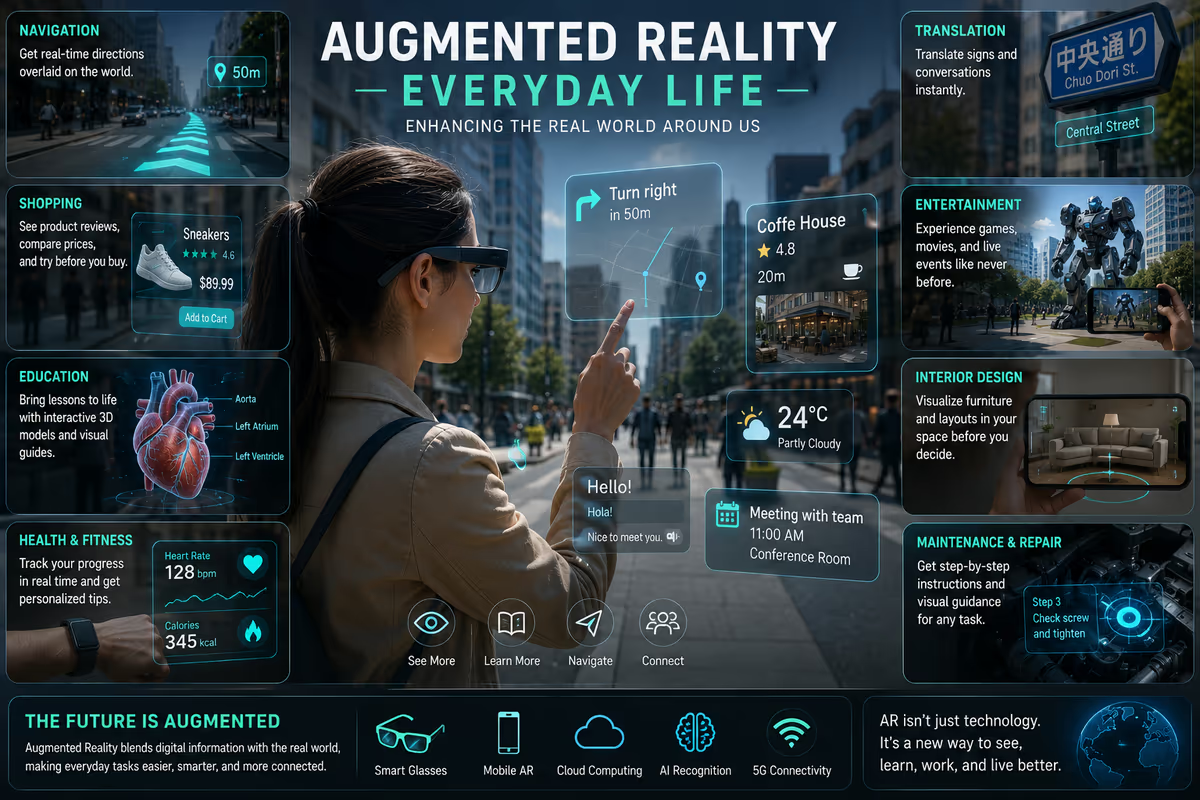
Augmented Reality (AR) is changing the way people interact with the world around them.
Unlike Virtual Reality, which places users inside a completely digital environment, augmented reality adds digital information to the physical world. Using smartphones, cameras, smart glasses, and other devices, AR can display information, directions, objects, translations, and interactive content directly over what we see.
What once looked like science fiction is gradually becoming part of everyday technology.
What Is Augmented Reality?
Augmented reality combines the physical world with computer-generated information.
An AR system can use cameras and sensors to understand the surrounding environment and then place digital objects or information into that environment.
For example, you might point your phone at a street and see navigation directions displayed directly on the road.
The physical world remains visible.
Digital information is simply added to it.
AR and Navigation
Navigation is one of the most practical applications of augmented reality.
Instead of constantly looking down at a traditional map, an AR system could display directions directly in front of you.
Imagine walking through an unfamiliar city while smart glasses show:
Turn right in 50 meters.
The route could appear directly on the street.
This could make navigation more intuitive, especially for pedestrians and tourists.
Real-Time Translation
Language barriers could also become easier to overcome.
An AR device could recognize signs, menus, and other text and display translations directly over the original words.
Imagine traveling to another country and looking at a restaurant menu through smart glasses.
The system could automatically translate the menu while preserving its original position and appearance.
Conversations could potentially receive similar treatment through real-time speech recognition and translation.
Shopping With AR
Augmented reality is already changing online and physical shopping.
Instead of imagining how a product might look in your home, you could use AR to see a digital representation of it in your actual environment.
For example:
- Place furniture inside a room
- Try different interior designs
- Preview clothing and accessories
- Examine products in 3D
- Compare different options
This could make online shopping much more interactive.
AR in Education
Education could benefit enormously from augmented reality.
Instead of studying a flat diagram of the human heart, students could examine a three-dimensional model floating in front of them.
A history lesson could display historical buildings over their real-world locations.
A science class could transform a classroom into an interactive laboratory.
AR makes information more visual and interactive.
Instead of simply reading about something, students can potentially see it and interact with it.
Health and Fitness
AR could also become useful for health and fitness applications.
Smart glasses or mobile AR systems could display information such as:
- Exercise instructions
- Workout progress
- Heart-rate information
- Movement guidance
- Training statistics
An AR fitness application could show a virtual trainer in the user's environment and provide visual guidance during exercises.
Entertainment and Gaming
Gaming helped introduce AR to millions of people.
However, future AR games could become significantly more sophisticated.
Instead of looking at a screen, players could see digital characters and objects interacting with their physical surroundings.
A city street could become part of a game.
A living room could become an arena.
A park could become a virtual battlefield.
The real world itself becomes part of the game environment.
Interior Design
AR can make designing physical spaces much easier.
Before purchasing furniture, users could visualize how it would look inside their homes.
A sofa, table, television, or decoration could be digitally placed in the room.
Users could change colors, sizes, positions, and styles before making a purchase.
This reduces uncertainty and could make interior design more accessible.
Maintenance and Repair
One particularly useful application of AR is technical assistance.
Imagine repairing a machine while smart glasses display instructions directly next to the component you are working on.
The system could show:
Step 1 — Remove the panel.
Step 2 — Disconnect the cable.
Step 3 — Replace the component.
This could help technicians work more efficiently and reduce errors.
AR could become especially valuable in industrial environments where workers need access to complex technical information.
Smart Glasses
Smartphones currently dominate AR.
But smart glasses could eventually make augmented reality much more natural.
Instead of holding a phone in front of your face, digital information could appear directly within your field of view.
Smart glasses could potentially provide:
- Navigation
- Translation
- Notifications
- Communication
- Object recognition
- Real-time information
- AI assistance
The technology could eventually make AR feel like a natural part of everyday life.
Artificial Intelligence and AR
AI could dramatically improve augmented reality.
Computer vision allows systems to understand physical environments, while AI can interpret what the user is seeing.
Imagine looking at an unfamiliar machine and asking:
"What is this component?"
An AI-powered AR system could recognize it and provide relevant information directly in your field of view.
The combination of:
AI + AR + Computer Vision + Smart Glasses
could create a powerful new interface between humans and information.
Privacy and Security
The future of AR also raises serious privacy questions.
AR devices may constantly observe the user's surroundings.
Cameras could capture people, buildings, signs, conversations, and other sensitive information.
This creates important questions:
- Who controls the captured data?
- Is the information stored?
- Can companies analyze what users see?
- How is facial recognition handled?
- Can people opt out?
Privacy protections will need to evolve alongside AR technology.
What Will AR Look Like in the Future?
Future AR devices could become smaller, lighter, and more powerful.
Smart glasses may eventually look almost like ordinary glasses.
AI could continuously understand the user's surroundings and provide useful information without requiring explicit commands.
Instead of opening an application, the user could simply look at something and interact with it.
Information could become contextual.
The right information would appear when and where it is needed.
AR and the Future of Computing
For decades, humans have interacted with computers through screens.
AR introduces another possibility.
Instead of bringing the physical world into the computer, AR brings digital information into the physical world.
The environment itself becomes the interface.
A wall could become a screen.
A street could become a navigation system.
A table could become a workspace.
A classroom could become an interactive laboratory.
This could represent one of the biggest changes in computing since the smartphone.
Final Thoughts
Augmented reality is gradually moving from entertainment and experimental technology into everyday applications.
Navigation, education, shopping, healthcare, maintenance, communication, and entertainment could all benefit from AR.
The combination of AR with artificial intelligence could make these systems even more powerful by allowing computers to understand what we see and provide information based on context.
The ultimate goal is not to hide the real world.
It is to enhance it.
The future may not require us to constantly look down at screens for information.
Instead, information could appear naturally around us.
The world is already augmented. The next step is making it intelligent.