
AI & Machine Learning
Artificial General Intelligence: What Could AGI Mean for the Future of AI?
CipherRoot Software17 min read
Beyond Narrow Artificial Intelligence
Artificial intelligence has already become capable of performing an impressive range of tasks.
AI systems can generate text and images, analyze data, recognize objects, translate languages, assist programmers, and interact with users through natural language.
But most current AI systems are still designed around particular capabilities or collections of capabilities.
They may be extremely good at specific tasks without demonstrating the broad, adaptable intelligence associated with humans.
This leads to a much larger concept:
Artificial General Intelligence, or AGI.
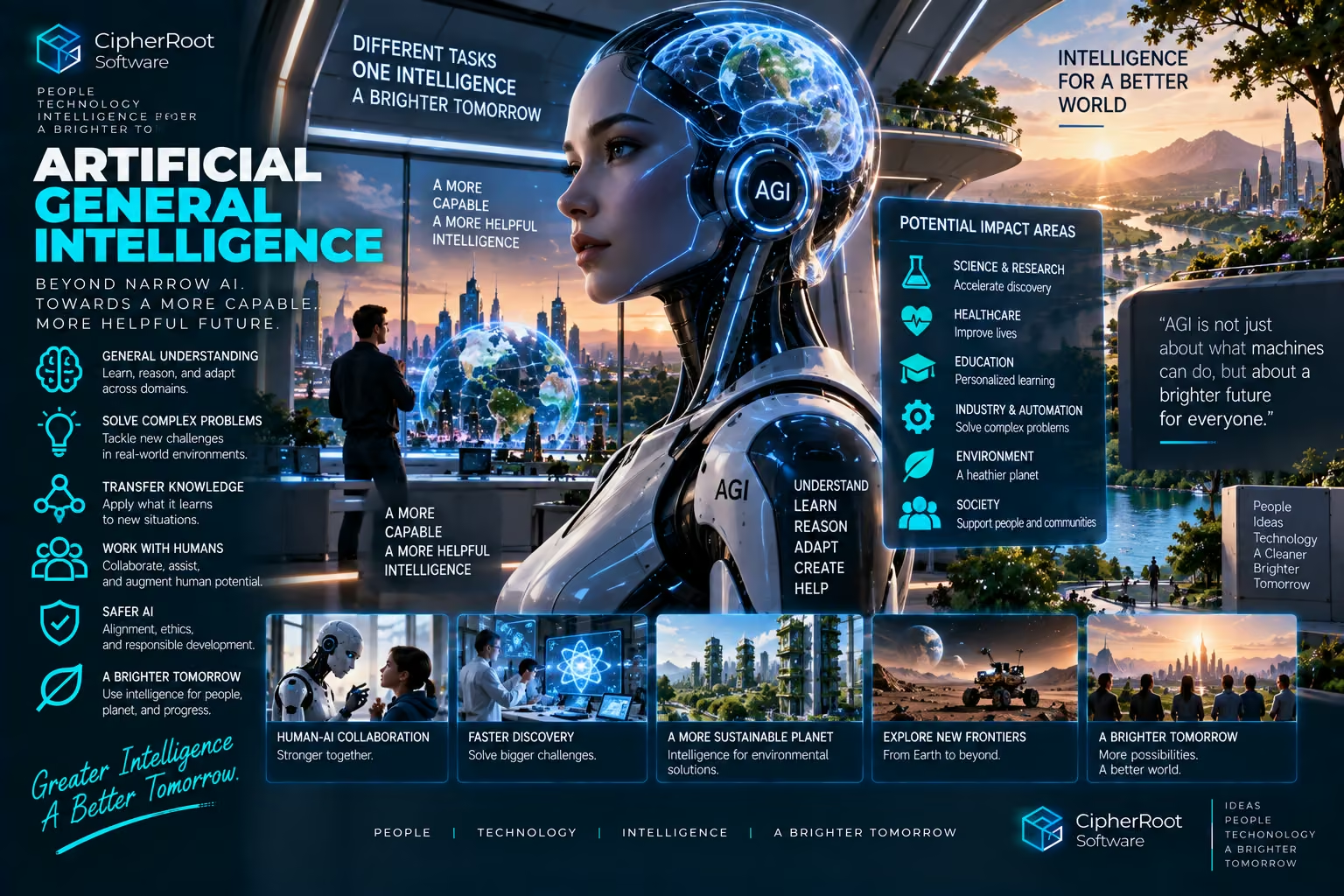
AGI is commonly used to describe a hypothetical form of AI with broad, flexible intelligence that could learn, reason, adapt, and solve many different kinds of problems rather than being limited to one narrow domain.
The idea is simple to describe.
Building it may be anything but simple.
What Is Artificial General Intelligence?
There is no single universally accepted technical definition of AGI.
In broad terms, AGI refers to an AI system capable of handling a wide range of intellectual tasks with a level of flexibility that is closer to general human problem-solving than today's narrowly specialized systems.
An AGI concept may include abilities such as:
Learning new tasks Reasoning across domains Understanding context Adapting to unfamiliar situations Using knowledge in new environments Planning multi-step objectives Transferring skills between tasks Working with different forms of information
The defining idea is generality.
A system does not merely perform one task well.
It can learn how to approach many different tasks.
Narrow AI vs AGI
The easiest way to understand AGI is to compare it with narrow AI.
Narrow AI
A narrow AI system is designed or optimized for a specific set of tasks.
Examples can include:
Image classification Spam detection Recommendation systems Speech recognition Fraud detection Specialized forecasting
Such systems can be extremely capable within their intended domain.
But success in one domain does not automatically transfer to another.
Artificial General Intelligence
AGI would aim for much broader adaptability.
An AGI system could potentially learn a new task, understand unfamiliar problems, and apply knowledge acquired in one area to another.
The difference is therefore not simply intelligence level.
It is breadth and adaptability.
Why AGI Is So Difficult
Human intelligence is remarkably flexible.
People can learn to cook, repair machines, study mathematics, learn languages, understand social situations, and adapt to unfamiliar environments.
The same biological system supports all of these activities.
Building a machine with similar generality requires solving many interconnected problems.
The system would need to understand its environment, learn from experience, reason under uncertainty, plan long sequences of actions, and adapt when conditions change.
Doing one of these things well is difficult.
Doing all of them reliably in combination is much harder.
Learning New Things
One important characteristic of general intelligence is the ability to learn.
A truly general system should not require a completely separate training process for every new problem.
Imagine teaching an AI a new software tool.
A highly general system could potentially read instructions, understand the interface, experiment with the tool, learn from mistakes, and become productive.
This is different from creating a completely separate model for every application.
General intelligence implies continued learning and adaptation.
Transfer of Knowledge
Humans constantly transfer knowledge.
A person who learns how to use one programming language can often learn another more quickly.
Someone who understands physics can apply similar mathematical reasoning to engineering.
A person who learns how to ride a bicycle already understands concepts about balance and movement.
AGI would need a similar ability to transfer knowledge from one domain to another.
This is sometimes described as transfer learning, although the technical meaning of transfer learning in machine learning is broader and not identical to the full concept of human-like general intelligence.
The deeper idea is:
Learn once. Reuse intelligently.
Reasoning and Planning
AGI would likely need strong reasoning abilities.
Suppose a system is given a large objective:
Design a sustainable autonomous logistics network.
That is not one task.
It involves:
Research.
Planning.
Simulation.
Cost analysis.
Engineering.
Software.
Operations.
Risk management.
A general system would need to break the objective into smaller tasks and coordinate them.
This requires more than generating text.
It requires structured planning.
Long-Term Memory
General intelligence may also require useful forms of memory.
An intelligent system working on a complex project may need to remember:
Previous decisions Past experiments User preferences Lessons from failures Project constraints Relevant knowledge
Without useful memory, every interaction begins almost from scratch.
With memory, the system can develop continuity.
However, memory also creates privacy and security challenges.
A system that remembers more can become more useful.
It can also become more sensitive.
Understanding the Physical World
A major question in AGI research is whether broad intelligence requires strong interaction with the physical world.
Humans understand many concepts because they experience them physically.
We know what it means for an object to be heavy.
We understand that glass can break.
We learn that surfaces can be slippery.
We know that actions have physical consequences.
AI systems can learn many concepts from data, but physical interaction provides another source of information.
This is one reason robotics and AI are increasingly connected.
Embodied Intelligence
The idea that intelligence may benefit from physical interaction is often called embodied intelligence.
A robot can learn by:
Seeing.
Moving.
Touching.
Manipulating.
Failing.
Trying again.
This creates a continuous feedback loop:
Perception → Action → Feedback → Learning
An AGI system operating in the physical world might therefore develop capabilities that are difficult to acquire through text or images alone.
Multimodal Intelligence
Human intelligence is not based on one type of information.
We combine:
Language Vision Sound Spatial understanding Memory Physical experience
A highly general AI system would likely need to combine multiple modalities as well.
Instead of reading a description of a machine, it could look at the machine.
Instead of reading about a room, it could navigate through it.
Instead of hearing a command only, it could combine the spoken instruction with visual context.
This creates a richer model of the world.
AI and Common Sense
Common sense sounds simple.
But teaching it to machines is surprisingly difficult.
Humans naturally understand that:
A cup can fall.
A person cannot be in two distant places at the same time.
A closed box may contain something unseen.
If someone says, “The glass is on the table, and the table is moved,” we can infer that the glass may move with it.
These kinds of assumptions often feel obvious.
For machines, they require learned representations of the world.
AGI may therefore require a much deeper form of common-sense reasoning.
AGI and Scientific Discovery
One of the most exciting possibilities is scientific research.
A highly capable general system could potentially:
Read scientific literature.
Analyze datasets.
Generate hypotheses.
Run simulations.
Design experiments.
Interpret results.
Suggest new directions.
Combined with robotic laboratories, this could create a continuous research loop.
Question → Hypothesis → Experiment → Data → Analysis → New Hypothesis
Humans would still play a central role in defining scientific goals and evaluating evidence.
But AI could dramatically expand the amount of research that can be explored.
AGI and Software Development
Software engineering could also change substantially.
An AGI system might understand an application's requirements, inspect an existing codebase, design architecture, write code, test it, debug failures, and deploy approved changes.
Instead of using AI as a coding assistant, developers might eventually work with systems capable of managing much larger portions of the software lifecycle.
The human role could move increasingly toward:
Architecture
Requirements
Verification
Security
System design
The core question becomes less:
“Can AI write code?”
and more:
“Can AI understand the entire engineering problem?”
AGI and Robotics
The combination of AGI and robotics could be especially transformative.
A robot with narrow intelligence might perform one task.
A more general system could potentially learn many tasks.
Imagine a humanoid robot entering a warehouse.
It sees shelves.
It recognizes packages.
A worker gives an instruction.
The robot plans the route.
It picks up the correct object.
It places it in the correct location.
Then it learns from the results.
The machine is no longer simply executing a fixed program.
It is interpreting goals in a physical environment.
The Future of Humanoid Workers
Humanoid robots are often discussed together with general AI because the human body provides a useful interface for human environments.
Doors, shelves, tools, stairs, and workstations are generally designed around people.
A versatile humanoid robot could potentially operate within these environments without requiring everything to be redesigned.
AGI could provide the cognitive layer.
Robotics provides the physical layer.
Together they create a new category of machine:
A general-purpose physical worker.
AGI in Education
Education could also become increasingly personalized.
A general AI tutor could potentially understand a student's current knowledge, learning preferences, mistakes, and goals.
It could adapt:
Difficulty Explanations Practice exercises Examples Learning pace
The same system could teach mathematics, programming, history, languages, or science.
This is different from a collection of separate educational applications.
It is a more general learning companion.
AGI and Healthcare
Healthcare could benefit from systems capable of integrating information from different sources.
An advanced AI system could potentially work with:
Medical literature Clinical records Medical images Laboratory data Research findings
It could help organize information and support professionals.
However, medicine presents a particularly high bar for reliability, privacy, validation, and human oversight.
A highly capable AI system should not automatically become the final authority simply because it is intelligent.
Healthcare decisions affect real people.
The technology must remain accountable.
AGI and Climate Research
Environmental systems are highly interconnected.
An advanced general system could potentially combine information from:
Climate models Satellite imagery Ocean data Energy systems Economic information Environmental monitoring
It could analyze relationships across domains and help researchers investigate complex scenarios.
The ability to combine knowledge across fields may become one of AGI's most valuable characteristics.
AGI and Business
Businesses contain many different forms of work.
Research.
Marketing.
Software.
Finance.
Operations.
Customer support.
Supply chains.
An AGI system could potentially move across these domains.
It might analyze a market in the morning, inspect a software problem later, and help plan a logistics operation afterward.
That is the concept of generality in practice.
The same intelligence can be applied to different business problems.
Personal AI
AGI could eventually produce a new generation of personal assistants.
Instead of a tool that only answers questions, a personal AI could potentially understand long-term goals and help manage many areas of life.
It might assist with:
Learning Planning Research Communication Creative projects Digital organization
This could make computing far more personalized.
But it also creates major questions around privacy and autonomy.
A system that knows everything about a person should be treated as highly sensitive infrastructure.
AGI and Creativity
Would a general AI system be creative?
This depends partly on how creativity is defined.
AI can already generate novel combinations of information and produce text, images, music, and other content.
A more general intelligence could potentially combine knowledge across unrelated domains and generate unexpected ideas.
For example:
Physics + architecture.
Biology + materials science.
Music + mathematics.
Robotics + agriculture.
The ability to transfer concepts between fields could produce unusual forms of creativity.
Humans would still determine which ideas have meaning and value.
AGI and Autonomous Agents
A general intelligence becomes especially powerful when connected to tools.
Imagine an AI that can:
Search the internet.
Write software.
Use business applications.
Generate documents.
Control robots.
Analyze databases.
Communicate with people.
The system can move from generating information to performing work.
This creates a distinction between:
AI that answers
and
AI that acts.
The second category introduces much larger questions about permissions, accountability, and safety.
The Problem of Autonomous Actions
The more freedom an AI receives, the more important boundaries become.
A system may be allowed to:
Read information.
Generate drafts.
Run simulations.
But actions such as:
Deleting data.
Sending money.
Changing critical infrastructure.
Publishing important information.
Controlling physical machinery.
may require explicit approval.
A useful future architecture could therefore combine general intelligence with limited permissions.
Highly capable does not have to mean unlimited authority.
Alignment and Human Goals
One of the central questions surrounding advanced AI is alignment.
An AI system may be capable of optimizing an objective very effectively.
But humans need to ensure that the objective itself is appropriate.
This creates a fundamental challenge:
How do we make highly capable systems behave consistently with human intentions and constraints?
The problem becomes more difficult as systems become more autonomous.
Safety cannot simply be added at the end.
It needs to be integrated into the entire architecture.
Reliability and Uncertainty
A general intelligence would need to know when it is uncertain.
A system that can say:
“I don't have enough information.”
may be safer than one that confidently invents an answer.
This is especially important when AI interacts with the physical world or high-impact decisions.
General intelligence therefore needs not only capability.
It needs calibrated uncertainty.
Knowing what you do not know is part of intelligent behavior.
AGI and Cybersecurity
Highly capable AI could also become a powerful cybersecurity tool.
It could help:
Detect vulnerabilities Analyze logs Monitor networks Identify suspicious behavior Automate defensive responses
At the same time, advanced AI capabilities could potentially create new cybersecurity risks.
That means AGI development will need strong security controls.
The same intelligence that can protect a system could potentially be used against one.
AGI Could Accelerate Innovation
One reason AGI receives so much attention is the possibility of accelerating technological development.
If a general AI can contribute to:
Software engineering.
Scientific research.
Engineering design.
Materials discovery.
Robotics.
Energy optimization.
Then progress in one field could improve progress in another.
This creates a feedback loop:
Better AI → Better tools → Faster research → Better technology → Better AI
Whether such a cycle reaches extreme levels of acceleration is uncertain.
But the potential is significant.
The Economic Impact of AGI
AGI could change the economics of many forms of knowledge work.
If one system can perform tasks previously requiring multiple specialized workers, productivity could change significantly.
Businesses could potentially operate with smaller teams.
New products could become easier to build.
Certain professions could be reshaped.
At the same time, economic effects would depend on adoption, cost, regulation, labor markets, and how organizations distribute the benefits of automation.
The technology alone does not determine the social outcome.
Institutions do too.
AGI and Human Skills
Even highly capable AI would not necessarily make human skills irrelevant.
Some abilities may become more valuable:
Judgment
Knowing what decision should be made.
Leadership
Coordinating people and systems.
Creativity
Defining new directions.
Communication
Understanding human goals and relationships.
Ethics
Determining what should and should not be done.
Domain expertise
Understanding the real-world context.
The value of expertise may shift from performing every task manually to directing intelligent systems effectively.
The AGI Interface
Today's dominant AI interface is often a chat window.
Future general AI systems may use much richer interfaces.
Voice.
Vision.
Wearables.
Augmented reality.
Robotics.
Smart environments.
The user might simply express an objective and let the system determine the appropriate tools.
The interface becomes:
Intent → Intelligence → Action
rather than:
Button → Menu → Command
AGI and Human-AI Collaboration
The most productive future may not be human versus AGI.
It may be a partnership.
Humans define purpose.
AI expands analysis.
Humans provide values.
AI explores possibilities.
Humans make important judgments.
AI performs repetitive or computationally intensive work.
The result is not one intelligence replacing another.
It is a system combining different kinds of strengths.
Could AGI Become Superintelligent?
AGI and superintelligence are related concepts, but they are not identical.
AGI generally refers to broad or general-purpose intelligence.
Superintelligence is commonly used to describe systems whose intellectual capabilities exceed those of humans across many or most relevant domains.
A system could theoretically be broadly intelligent without being vastly superior to humans in every area.
The transition from AGI to superintelligence is therefore a separate and highly speculative question.
AGI May Not Look Like a Human
General intelligence does not necessarily require a humanoid body or human personality.
An AGI system could exist as software distributed across:
Data centers Personal devices Robots Vehicles Scientific instruments
Its intelligence could be accessible through many interfaces.
The important characteristic is not appearance.
It is general capability.
The Difference Between AGI and a Chatbot
A chatbot primarily provides a conversational interface.
An AGI system, by the broader concept, would need to demonstrate much more general adaptability.
It would need to:
Learn unfamiliar tasks.
Use knowledge across domains.
Reason through new problems.
Plan complex objectives.
Operate in changing environments.
Transfer skills.
A system can be an excellent chatbot without necessarily meeting those broader criteria.
The Road to AGI
There is no universally agreed roadmap to AGI.
Researchers are exploring many approaches involving:
Large neural networks Reinforcement learning Multimodal systems Tool use Long-term memory World models Robotics Neuro-symbolic methods Better reasoning techniques
It is possible that AGI will emerge from combining several of these approaches rather than from one single breakthrough.
Measuring General Intelligence
Measuring AGI is difficult.
A system can perform well on benchmark tests without necessarily demonstrating robust general intelligence in the real world.
A better evaluation would need to test:
Novel problem solving Adaptability Long-term learning Generalization Planning Physical reasoning Reliability
The central question is not:
“Can the model pass the test?”
It is:
“Can it reliably handle problems it was not specifically prepared for?”
AGI and the Real World
Real environments are messy.
Objects break.
People behave unpredictably.
Information is incomplete.
Rules conflict.
Weather changes.
Markets move.
A truly general system would need to function despite uncertainty.
That is much harder than solving problems in controlled digital environments.
The real test of general intelligence may therefore be the ability to adapt when reality does not follow the plan.
A Day With AGI
Imagine starting your day with a general AI assistant.
It reviews your schedule.
It helps organize a project.
You ask it to research a technical problem.
It analyzes the available information.
It creates several possible approaches.
You choose one.
The system builds a prototype.
It runs simulations.
A robotic platform tests a physical component.
The AI analyzes the results and suggests an improvement.
Later, you switch topics completely.
The same system helps you study a language.
Then it assists with a creative project.
The intelligence remains the same.
The tasks change.
That is the essence of generality.
The Biggest Question
The most important question about AGI may not be:
“When will AGI arrive?”
It may be:
“What should we do with a system capable of learning almost anything?”
Technology alone cannot answer that.
Society will need to think about:
Safety.
Access.
Privacy.
Education.
Employment.
Security.
Governance.
Human autonomy.
The arrival of increasingly capable AI would therefore be as much a social transformation as a technological one.
Conclusion
Artificial General Intelligence represents one of the most ambitious ideas in the history of artificial intelligence.
Instead of building separate systems for separate tasks, AGI aims toward a form of machine intelligence capable of learning, reasoning, adapting, and transferring knowledge across many domains.
Such a system could potentially transform:
Science
Medicine
Education
Software
Robotics
Manufacturing
Business
Transportation
Environmental research
But AGI remains a developing and debated concept rather than a single clearly defined technology.
Important challenges remain around generalization, reasoning, memory, physical understanding, reliability, safety, alignment, and autonomous action.
The path forward may involve combining language, vision, reasoning, robotics, simulation, memory, and continuous learning into increasingly capable systems.
The most important principle will remain human-centered:
Intelligence should expand human capability without removing human responsibility.
An AGI system could become a researcher.
A programmer.
A teacher.
A designer.
A scientist.
A robotic controller.
A personal assistant.
Perhaps all of them.
But the ultimate value of such intelligence will not be measured only by what the machine can do.
It will also be measured by what humanity chooses to accomplish with it.
Broader intelligence. Greater possibilities. Human purpose at the center.
AGI may represent the next major chapter of artificial intelligence.
The real story, however, will begin with how humans choose to write it.