
AI & Machine Learning
AI vs Human Creativity: Can Artificial Intelligence Really Create?
CipherRoot Software7 min read
Artificial intelligence can write stories, compose music, generate images, design products, and produce software in seconds.
This raises an increasingly important question:
Can AI actually be creative, or is it simply combining things created by humans?
The answer is more complicated than a simple yes or no.
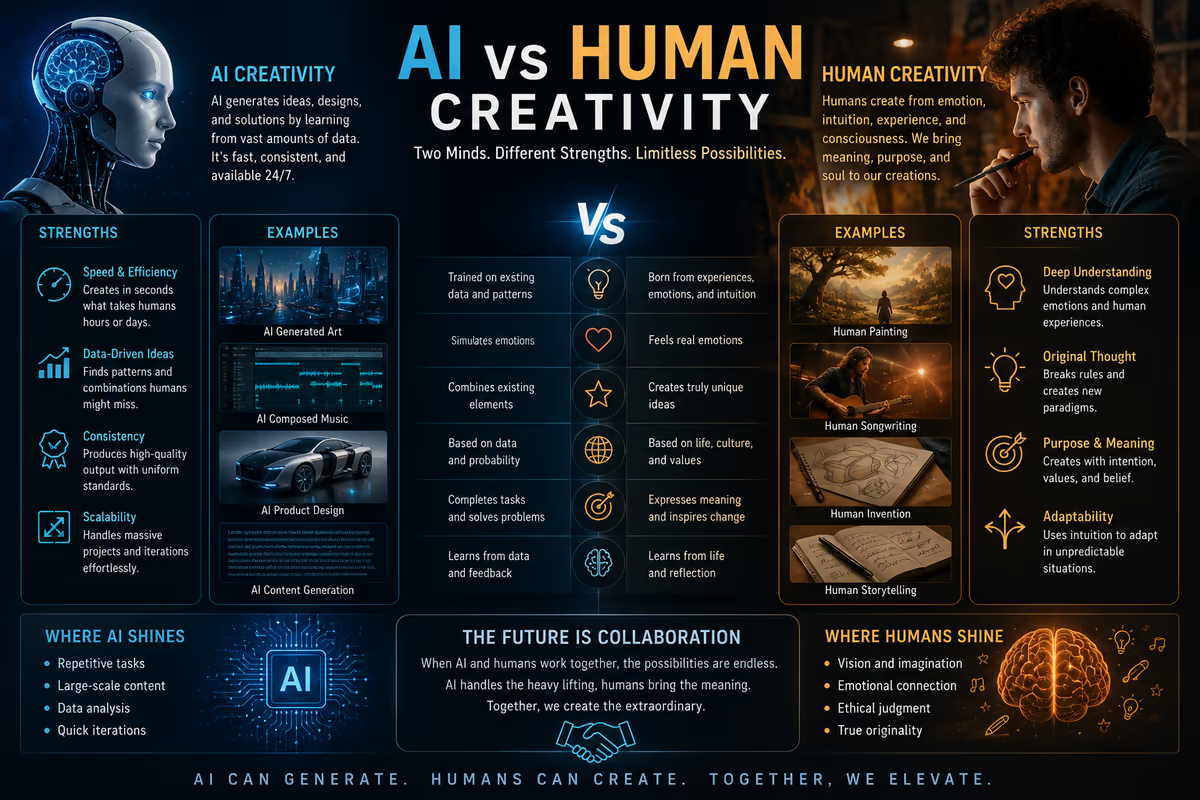
AI and human creativity work in fundamentally different ways. AI can process enormous amounts of information and generate countless possibilities, while humans bring emotions, experiences, intuition, personal values, and meaning to the creative process.
The future may therefore not be about choosing between AI and human creativity.
It may be about discovering what happens when both work together.
What Is Creativity?
Creativity is often described as the ability to produce something new and valuable.
Humans create from many different sources:
- Personal experiences
- Emotions
- Memories
- Culture
- Curiosity
- Imagination
- Mistakes
- Observation
- Intuition
A musician may write a song after experiencing heartbreak.
A filmmaker may create a story inspired by childhood memories.
An artist may transform a personal experience into a painting.
Human creativity is therefore deeply connected to life.
How Does AI Create?
AI systems work differently.
Modern generative AI models learn patterns from enormous datasets.
They analyze relationships between words, images, sounds, code, and other forms of information.
When a user provides a prompt, the model generates an output based on those learned patterns.
AI can therefore produce something that looks highly original even though its underlying process is fundamentally different from human imagination.
It does not need to experience the world in the same way a human does to generate creative-looking results.
AI's Greatest Creative Strength: Speed
One area where AI clearly has an advantage is speed.
A human artist may spend hours creating a concept.
An AI system can generate multiple concepts within seconds.
This makes experimentation much easier.
A designer can explore dozens of visual directions.
A writer can test different story structures.
A musician can experiment with different arrangements.
Instead of spending most of the creative process producing the first version, creators can spend more time selecting, refining, and improving ideas.
AI Can Generate Thousands of Possibilities
Human creativity is limited by time and energy.
AI can generate enormous numbers of variations.
For example, a designer working on a futuristic city could ask AI to explore different architectural styles, lighting conditions, environments, and compositions.
The AI becomes a rapid idea-generation engine.
But generating possibilities is not the same as knowing which possibility is meaningful.
That distinction is extremely important.
Where Humans Have the Advantage
Human creativity is strongly connected to experience.
Humans understand emotions because they experience them.
They understand loss, love, fear, humor, nostalgia, ambition, frustration, and hope.
These experiences influence what people create.
A human filmmaker doesn't simply understand the technical structure of a movie.
They may understand what it feels like to lose someone.
A songwriter may understand loneliness.
An artist may understand the feeling of returning to a place remembered from childhood.
These experiences can influence creative decisions in ways that are difficult to reduce to data patterns.
Original Ideas and Unexpected Connections
Humans can make strange connections between seemingly unrelated ideas.
A childhood memory can inspire a science-fiction story.
A dream can become a painting.
A conversation can become a song.
A mistake can lead to a new invention.
Human creativity often emerges from unexpected experiences.
AI can also generate unusual combinations, but the process behind them is fundamentally different.
The human creator can decide why an unexpected idea matters.
AI Doesn't Need to Replace the Artist
One of the biggest misconceptions about generative AI is that it must replace human creators.
It doesn't have to.
AI can function as a creative tool.
A filmmaker can use AI to explore visual concepts.
A game developer can use it for environment ideas.
A writer can use it for brainstorming.
A designer can use it for prototypes.
The final creative direction can remain human.
In this model, AI becomes something closer to a powerful creative assistant.
AI as a Creative Amplifier
Imagine having an assistant that never gets tired.
You say:
"Give me ten different concepts."
It generates them.
You select one.
"Make it darker."
It generates another version.
"Combine the second concept with the atmosphere of the fifth."
Another version appears.
This allows creators to experiment much faster.
AI can therefore amplify human creativity by reducing the cost of experimentation.
The Importance of Human Judgment
AI can generate a beautiful image.
But beauty alone doesn't guarantee meaning.
A human needs to decide:
- Does this communicate the intended idea?
- Does it fit the story?
- Is it emotionally effective?
- Is it original enough?
- Does it represent the creator's vision?
The ability to judge and refine creative work remains extremely important.
The future creator may therefore spend less time manually producing every element and more time directing the creative process.
AI and Music
Music provides another interesting example.
AI can generate melodies, harmonies, rhythms, and entire compositions.
It can experiment with different genres and arrangements extremely quickly.
But human musicians still bring something unique: personal experience.
A song written from a real emotional experience can carry a meaning that goes beyond its technical composition.
AI can help produce the sound.
The human can provide the story behind it.
AI and Visual Art
AI image generation has already transformed digital art workflows.
Artists can use AI to:
- Explore compositions
- Generate concepts
- Experiment with styles
- Create references
- Develop environments
- Produce prototypes
But skilled artists still play an important role in choosing direction, correcting errors, refining details, and creating a coherent visual identity.
AI can produce millions of images.
The challenge is producing the right image.
AI and Filmmaking
The film industry may experience one of the most significant transformations.
AI can potentially assist with:
- Concept development
- Storyboarding
- Visual effects
- Character design
- Environment creation
- Voice generation
- Editing
- Previsualization
A small creative team could potentially produce content that previously required much larger production resources.
This could lower the barrier to filmmaking and allow independent creators to experiment with ambitious ideas.
The Risk of Creative Homogenization
There is also a danger.
If everyone uses similar AI models, prompts, styles, and datasets, creative work could begin to look increasingly similar.
The technology that makes creation easier could accidentally make creative output less distinctive.
This is why personal experience and individual artistic direction remain important.
AI can generate possibilities.
Human taste determines identity.
Who Is More Creative?
There may never be a simple answer.
AI is exceptionally good at:
- Speed
- Scale
- Pattern recognition
- Rapid experimentation
- Generating variations
Processing large amounts of information
Humans are exceptionally good at:
- Meaning
- Emotion
- Intuition
- Personal experience
- Purpose
- Cultural understanding
- Ethical judgment
They are different strengths.
Comparing them directly may therefore miss the bigger opportunity.
The Future Is Collaboration
The most powerful creative workflow may combine both.
Human: Defines the vision.
AI: Generates possibilities.
Human: Selects the strongest idea.
AI: Produces variations.
Human: Refines the concept.
AI: Helps execute repetitive tasks.
Human: Makes the final creative decision.
This creates a continuous loop between human imagination and machine intelligence.
Will AI Replace Human Creativity?
AI may replace some creative tasks.
Certain repetitive design, writing, editing, and production jobs may become increasingly automated.
But creativity itself is unlikely to disappear.
In fact, the easier it becomes to generate content, the more valuable original ideas, personal identity, taste, and storytelling may become.
When everyone can generate an image in seconds, the person with a genuinely interesting idea becomes even more important.
Final Thoughts
AI can generate.
AI can remix.
AI can experiment.
AI can produce astonishingly complex creative outputs.
But human beings bring something different to the process: experience, intention, emotion, and meaning.
The future of creativity will probably not be a battle between humans and machines.
It will be a partnership.
AI can handle the enormous amount of experimentation required to explore an idea.
Humans can decide which ideas are worth bringing into the world.
AI can generate. Humans can create. Together, they can build something neither could achieve as efficiently alone.