
AI & Machine Learning
AI-Powered Education: How Artificial Intelligence Is Transforming Learning
CipherRoot Software5 min read
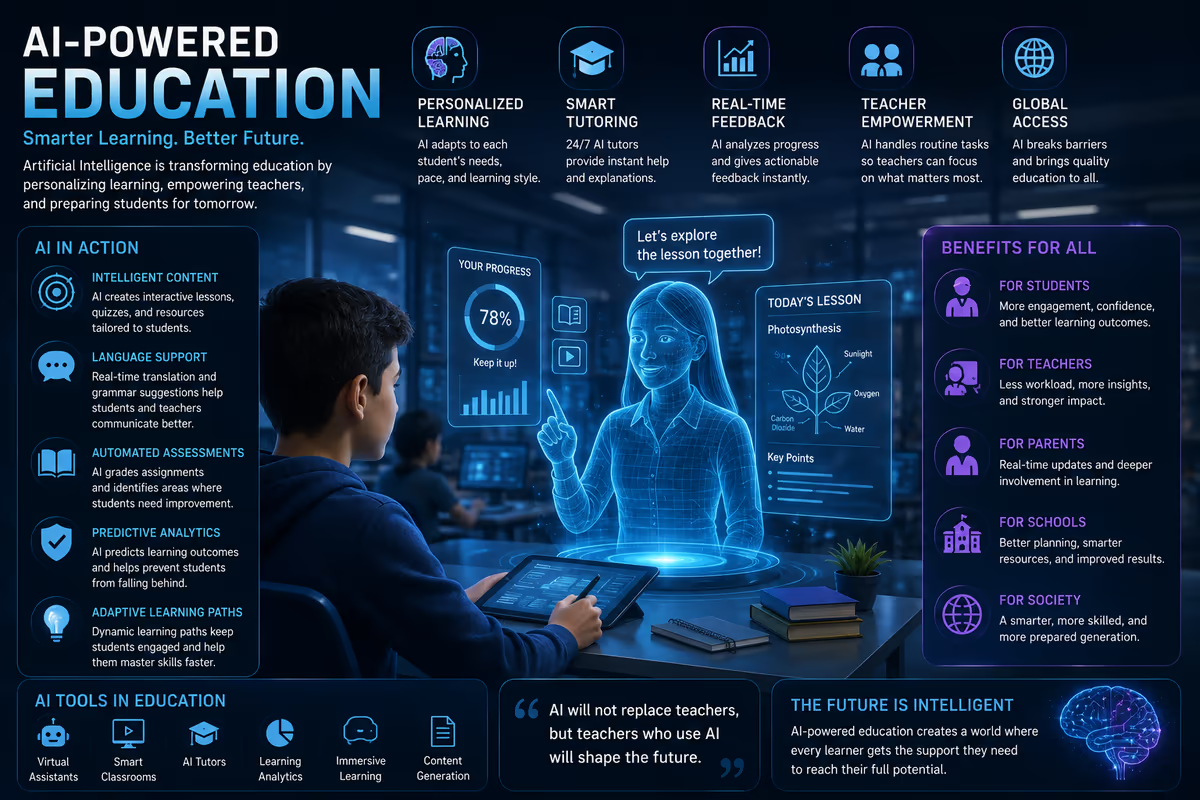
Education has always evolved alongside technology. The classroom moved from blackboards to computers, from printed textbooks to online resources, and now toward a new generation of intelligent learning systems.
Artificial intelligence is becoming one of the most significant technologies in this transformation.
AI-powered education can personalize lessons, provide instant feedback, assist teachers, translate educational content, and help students learn at their own pace.
The goal is not to replace teachers.
The real opportunity is to give students and teachers better tools for learning and teaching.
What Is AI-Powered Education?
AI-powered education uses artificial intelligence to improve educational experiences.
AI systems can analyze learning patterns and adapt educational content to individual students.
Instead of every student following exactly the same learning path, an intelligent system can potentially identify where a student is struggling and provide additional explanations or exercises.
This creates a more personalized learning experience.
Personalized Learning
Every student learns differently.
Some students understand a concept immediately, while others need additional examples and practice.
Traditional classrooms can make personalization difficult because teachers may have dozens of students to support simultaneously.
AI can help by analyzing student performance and identifying areas that need additional attention.
For example, an AI learning platform could recognize that a student is struggling with fractions and automatically provide simpler explanations, visual examples, and additional exercises.
The learning path adapts to the student.
AI Tutors
AI tutors can provide students with assistance at almost any time.
A student working on a difficult mathematics problem could ask an AI tutor for an explanation.
Instead of simply providing the answer, a well-designed educational AI can guide the student through the reasoning process.
AI tutors can potentially support:
- Mathematics
- Science
- Languages
- Programming
- History
- Writing
- Research
This could make additional learning support available to students who may not have access to private tutoring.
Real-Time Feedback
Feedback is an essential part of learning.
Students need to understand not only whether an answer is correct, but also why it is correct or incorrect.
AI systems can analyze assignments and provide immediate feedback.
For language learning, an AI system could identify grammatical mistakes.
For programming education, it could explain why a piece of code does not work.
For mathematics, it could identify the step where a student made an error.
Immediate feedback can help students correct misunderstandings before they become permanent.
Supporting Teachers
AI-powered education is not only about students.
Teachers can also benefit significantly.
AI can assist with repetitive tasks such as:
- Preparing lesson materials
- Creating quizzes
- Organizing educational content
- Summarizing student performance
- Generating practice exercises
- Translating materials
- Creating personalized learning resources
This can reduce administrative workload and give teachers more time to focus on students.
AI and Language Learning
Language education is particularly well suited to AI.
An intelligent language-learning system can provide conversational practice, pronunciation feedback, vocabulary exercises, grammar explanations, and personalized lessons.
Students can practice conversations without worrying about making mistakes in front of other people.
AI can also adapt conversations to the student's skill level.
A beginner might practice simple sentences, while an advanced learner could discuss complex subjects.
Adaptive Learning
Traditional education often follows a fixed curriculum.
AI makes it possible to create adaptive learning paths.
The system continuously evaluates performance and changes the difficulty or subject matter accordingly.
If a student performs well, the system can introduce more advanced material.
If the student struggles, it can provide additional practice.
This creates a learning experience that evolves with the individual.
Predictive Analytics
AI can also analyze educational data to identify students who may need additional support.
Patterns in attendance, assignments, assessments, and learning progress could help schools identify potential problems earlier.
The purpose should not be to label students permanently.
Instead, predictive systems should help teachers provide support before students fall significantly behind.
Human judgment remains essential when interpreting these predictions.
Making Education More Accessible
AI has the potential to make education more accessible.
Students can potentially benefit from:
- Real-time translation
- Text-to-speech
- Speech recognition
- Automated subtitles
- Personalized explanations
- Assistive technologies
Students with different learning needs may be able to interact with educational content in ways that better suit them.
AI could therefore help reduce some barriers to education.
Smart Classrooms
The classroom of the future may combine physical and digital learning environments.
Interactive displays, AI tutors, connected devices, virtual reality, and learning analytics could work together.
A teacher could monitor overall class progress through an intelligent dashboard while students work through personalized exercises.
Technology would support the classroom without eliminating the human teacher.
The Risks of AI in Education
AI-powered education also introduces important challenges.
Students may become overly dependent on AI instead of developing their own problem-solving abilities.
AI systems can sometimes provide incorrect information.
Privacy is another major concern because educational platforms may process sensitive student data.
Schools must therefore establish clear rules regarding AI usage, data protection, academic integrity, and responsible technology use.
AI should be a learning tool—not a shortcut around learning.
Will AI Replace Teachers?
The most likely answer is no.
Teaching involves much more than delivering information.
Teachers motivate students, understand emotions, manage classrooms, recognize individual circumstances, and provide human encouragement.
AI can provide information and assistance, but it does not replace the relationships that make education meaningful.
The future is more likely to involve teachers working with AI rather than teachers being replaced by AI.
The Future of Education
Over the next decade, AI could become a standard component of educational technology.
Students may have personalized AI tutors.
Teachers may use intelligent assistants to prepare lessons and analyze progress.
Schools may use AI to identify learning gaps and optimize resources.
Virtual and augmented reality could create immersive educational experiences.
Education could become more personalized, interactive, and accessible than ever before.
Final Thoughts
Artificial intelligence is changing education by making learning more adaptive, accessible, and personalized.
AI tutors can provide assistance.
Intelligent platforms can adapt lessons.
Teachers can use AI to reduce repetitive work.
Students can receive immediate feedback and additional support.
But technology should remain a tool rather than the center of education.
The most successful educational systems will combine the strengths of artificial intelligence with the experience, empathy, and judgment of human teachers.
AI may transform how we learn, but human curiosity will remain the reason we learn.
The future of education is intelligent—and it is still deeply human.