
AI & Machine Learning
AI in Video Game Development: How Artificial Intelligence Is Changing Game Creation
CipherRoot Software8 min read
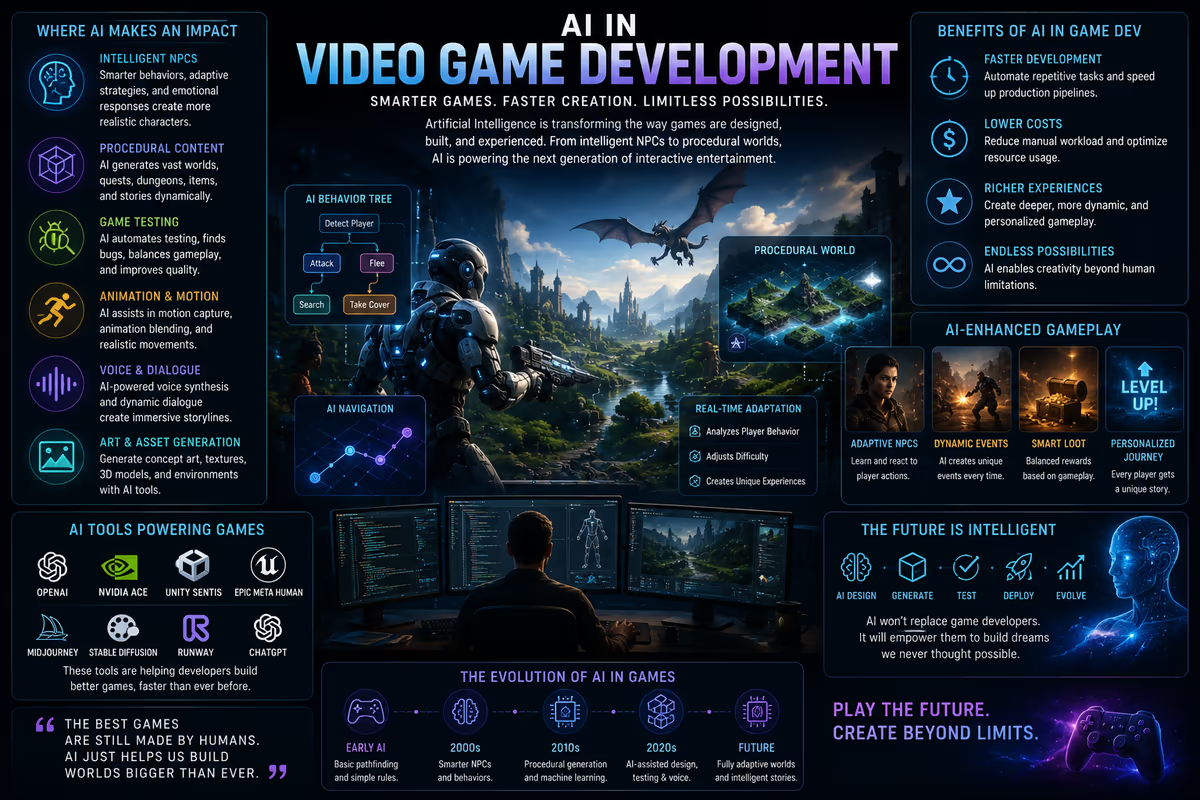
Artificial intelligence is changing the way video games are designed, developed, tested, and experienced.
For decades, game development depended heavily on manually creating characters, environments, animations, dialogue, quests, and gameplay systems. AI is now becoming a powerful tool that can assist developers with many of these tasks.
But the most interesting part of this transformation is not simply creating games faster.
AI could help developers create larger, more dynamic, and more responsive game worlds.
How Is AI Used in Game Development?
AI can support almost every stage of game development.
Modern AI tools can assist with:
- Game design
- Programming
- Character behavior
- Procedural generation
- Animation
- Voice and dialogue
- Concept art
- Testing
- Level design
- Player analytics
AI does not have to replace the development team.
Instead, it can act as an intelligent assistant that accelerates repetitive and experimental work.
Intelligent NPCs
One of the most exciting applications is improving non-player characters, commonly known as NPCs.
Traditional NPCs usually follow predefined rules.
For example:
Player detected → Attack
Player disappears → Search
Health becomes low → Retreat
AI can potentially make these behaviors much more dynamic.
An NPC could analyze the situation, react to the player's actions, cooperate with other characters, and change its strategy.
This could make virtual characters feel less predictable.
AI-Driven Game Worlds
AI can also help generate environments.
Instead of manually designing every building, road, landscape, or interior, developers can use procedural and AI-assisted generation to create large amounts of content.
This can be especially useful for open-world games.
AI could help generate:
- Landscapes
- Buildings
- Roads
- Dungeons
- Objects
- Weather systems
- Environmental details
Human developers still need to control the artistic direction and quality of the world.
AI simply makes experimentation and production much faster.
Dynamic Quests and Stories
Imagine a game where quests are not completely predetermined.
An AI system could analyze what the player has done and generate new situations based on their actions.
For example, if a player repeatedly helps a particular village, that village could develop a different relationship with the player.
If the player betrays an important character, future events could change.
This could create game stories that feel more personal.
Instead of every player experiencing exactly the same journey, different players could create different narratives.
AI and Game Testing
Game testing is one of the most time-consuming parts of development.
A modern game can contain thousands of interactions and enormous numbers of possible player behaviors.
AI agents can potentially play games repeatedly and look for problems.
They can test:
- Movement
- Combat
- Menus
- Level boundaries
- Quest progression
- Physics
- Performance
- Gameplay exploits
This does not eliminate human testers, but it can help developers discover problems much earlier.
AI-Assisted Programming
AI coding assistants can also help game developers write and understand code.
A developer might ask an AI to create a basic inventory system, explain an error, optimize a function, or generate a prototype.
This can be particularly useful during early development.
Instead of spending hours writing repetitive code, developers can focus more on architecture, gameplay, and creative decisions.
However, AI-generated code still needs to be reviewed and tested.
A fast wrong solution is still a wrong solution.
AI and Animation
Character animation can require enormous amounts of work.
AI-assisted animation tools can help generate or refine movement, motion transitions, and other animation data.
Developers can potentially use AI to accelerate:
- Character movement
- Facial animation
- Motion capture cleanup
- Animation blending
- NPC reactions
This could be especially valuable for smaller development teams.
AI-Generated Voice and Dialogue
Voice technology is another rapidly developing area.
AI can generate speech and assist developers in creating temporary dialogue during development.
AI-powered characters could potentially generate dynamic conversations instead of relying entirely on thousands of pre-recorded lines.
However, voice rights and consent are extremely important.
Using someone's voice without appropriate authorization can create serious legal and ethical problems.
Responsible game development must respect performers and intellectual-property rights.
AI and Game Art
Game artists can use AI tools during the concept and prototyping stages.
AI can help explore:
- Character concepts
- Environment ideas
- Props
- Color palettes
- Visual styles
- Background elements
The important distinction is between generating an idea and creating a finished game asset.
Professional developers still need to ensure consistency, technical quality, optimization, and a unified art direction.
Personalized Gameplay
AI could make games increasingly responsive to individual players.
A game could potentially analyze gameplay behavior and adjust:
- Difficulty
- Enemy behavior
- Rewards
- Quest structure
- Tutorial systems
- Pacing
A player who struggles could receive additional assistance.
An experienced player could encounter more challenging situations.
The result could be a more personalized experience.
AI in Open-World Games
Large open-world games require enormous amounts of content.
AI could help developers create more dynamic ecosystems.
Imagine a world where:
Animals behave differently depending on the environment.
NPCs follow daily routines.
Weather changes gameplay.
Factions respond to player decisions.
Cities evolve over time.
Events occur dynamically.
Instead of a world that simply waits for the player, the game world could feel like it is operating independently.
AI-Powered Game Design
AI can also help developers experiment with game mechanics.
A developer could describe a gameplay idea and ask an AI system to propose several possible implementations.
For example:
"Create a stealth system where enemies communicate with each other and gradually become more alert."
The AI could help generate possible behavior structures, algorithms, or prototypes.
The developer then decides which ideas actually belong in the game.
Small Teams Can Build Bigger Games
Perhaps the biggest opportunity is for independent developers.
Large studios can have hundreds or thousands of employees.
Independent developers usually have much smaller teams.
AI tools can reduce the amount of manual work required for certain tasks.
A small team could potentially produce:
- More environments
- More dialogue
- More prototypes
- More animations
- More gameplay experiments
This could allow independent developers to attempt projects that would previously have required much larger teams.
The Risks of AI in Game Development
AI also introduces challenges.
If developers rely too heavily on generated content, games could begin to feel repetitive.
AI-generated assets may lack a coherent artistic identity.
Generated code can introduce bugs or security problems.
AI-generated dialogue may feel unnatural.
Copyright and licensing issues can also arise depending on how AI systems and training data are used.
The technology needs responsible implementation.
Will AI Replace Game Developers?
Probably not.
Game development involves far more than producing assets and code.
Someone still needs to decide:
- What is the game about?
- What should the player feel?
- What makes the gameplay fun?
- What is the artistic identity?
- What story is worth telling?
AI can generate possibilities, but human developers provide direction.
The strongest future workflows are likely to combine both.
The Future: AI + Human Creativity
A future game-development pipeline could look something like this:
Human designer → defines the vision → AI → generates concepts → Developer → selects the best ideas → AI → creates prototypes → Human team → refines the gameplay → AI → performs automated testing → Human team → makes final decisions
This creates a development cycle where AI accelerates production while humans maintain creative control.
AI Could Create Living Game Worlds
The most exciting possibility is not simply faster development.
It is the creation of worlds that can continuously change.
Imagine a game where every NPC has memory.
Every faction reacts to the player's actions.
Cities develop over time.
Quests are generated dynamically.
Characters have different personalities.
The environment responds to the player.
The game becomes less like a fixed sequence of events and more like a living simulation.
What Could Games Look Like in the Future?
Future games could combine:
- Generative AI
- Advanced physics
- Realistic animation
- Intelligent NPCs
- Procedural worlds
- Voice interaction
- Personalized storytelling
- Real-time content generation
A player might no longer simply select dialogue from a menu.
They could speak naturally to a character.
The character could understand the conversation and respond according to its personality, history, and relationship with the player.
That could fundamentally change interactive storytelling.
Final Thoughts
Artificial intelligence is becoming one of the most powerful tools available to game developers.
It can accelerate programming, generate concepts, assist with animation, improve testing, create dynamic characters, and help developers experiment with larger worlds.
But AI is not the heart of game development.
The player is.
The technology should serve the experience.
The best games will still require imagination, design, storytelling, gameplay expertise, and human judgment.
AI can make the development process faster and more ambitious.
But the creative vision must come from somewhere.
AI can build the pieces.
Humans decide what world those pieces belong to.
And that partnership could define the next generation of video games.