
Future & Research
AI in Space Exploration: How Artificial Intelligence Is Expanding Humanity's Reach Beyond Earth
CipherRoot Software4 min read
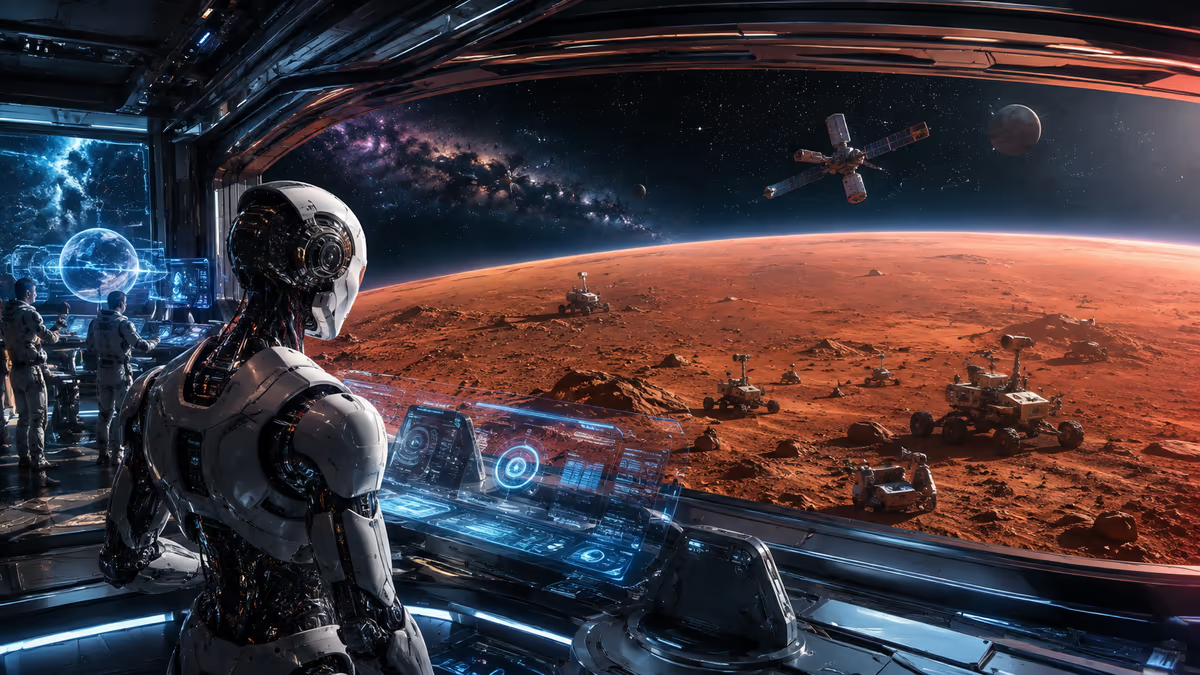
Space exploration has always pushed the limits of human innovation. From the first satellites orbiting Earth to ambitious missions targeting Mars and beyond, every leap into space has required remarkable advances in science and engineering.
Today, artificial intelligence is becoming one of the most powerful tools driving this new era of exploration. AI enables spacecraft to make autonomous decisions, assists scientists in analyzing massive amounts of data, and helps robotic explorers operate millions of kilometers away from Earth.
As missions become more distant and complex, intelligent machines are no longer optional—they are essential.
Why Space Missions Need AI
Communication between Earth and distant spacecraft is not instantaneous.
Signals traveling between Earth and Mars can take anywhere from several minutes to over twenty minutes, depending on the planets' positions. During that delay, robots and spacecraft must often make critical decisions without waiting for human instructions.
Artificial intelligence allows these systems to:
- Navigate hazardous terrain
- Avoid obstacles
- Detect equipment failures
- Optimize energy usage
- Prioritize scientific discoveries
- Continue operating independently
Autonomy dramatically increases both mission safety and scientific productivity.
Intelligent Robotic Explorers
Robotic explorers have become humanity's eyes and hands across the Solar System.
Modern AI allows planetary rovers to identify interesting rock formations, choose safer travel routes, and efficiently manage limited battery power.
Future robotic explorers may work together as coordinated teams capable of exploring caves, mountains, and underground environments that remain inaccessible today.
These intelligent machines extend human exploration far beyond what astronauts can currently accomplish.
AI Inside Spacecraft
Artificial intelligence is also transforming spacecraft themselves.
Instead of relying entirely on commands from mission control, future spacecraft will continuously monitor their own systems.
AI can identify abnormal behavior, predict equipment failures before they occur, and automatically adjust spacecraft operations to conserve resources.
This capability becomes increasingly important during missions lasting months or even years.
Searching for Life Beyond Earth
One of humanity's greatest scientific questions is whether life exists elsewhere in the universe.
Artificial intelligence accelerates this search by analyzing enormous volumes of scientific data collected from telescopes, planetary probes, and space observatories.
AI can detect unusual atmospheric signatures, classify distant planets, identify potentially habitable worlds, and discover subtle patterns that human researchers might overlook.
As telescope technology improves, AI will become an indispensable partner in the search for extraterrestrial life.
AI and Human Astronauts
Artificial intelligence will not replace astronauts—it will support them.
Future crews traveling to the Moon, Mars, or deep space may rely on AI assistants capable of:
- Monitoring spacecraft systems
- Managing life-support equipment
- Assisting scientific experiments
- Planning daily schedules
- Predicting maintenance needs
- Providing emergency decision support
These intelligent assistants reduce workload and allow astronauts to focus on exploration and research.
Building Bases on the Moon and Mars
Before humans establish permanent settlements beyond Earth, robots will likely arrive first.
AI-powered construction robots may prepare landing zones, assemble habitats, install solar panels, and extract local resources before astronauts even land.
Using autonomous machines reduces mission risk while making long-term space habitation more practical.
Future lunar and Martian colonies may depend heavily on robotic workers operating around the clock.
Deep Space Exploration
The farther spacecraft travel, the more independent they must become.
Future interstellar probes could spend decades traveling through deep space without direct human supervision.
Artificial intelligence will enable these spacecraft to:
- Repair minor system failures
- Adjust flight paths
- Prioritize scientific observations
- Manage onboard resources
- Respond to unexpected discoveries
Without AI, such long-duration missions would be nearly impossible.
Challenges Ahead
Despite rapid progress, significant challenges remain.
Space radiation can damage electronic systems.
Computing hardware must operate reliably under extreme temperatures.
AI algorithms require rigorous testing to ensure safe decision-making.
Engineers must also protect autonomous systems against software failures and cybersecurity risks.
Building trustworthy AI remains one of the most important objectives for future space missions.
Looking Toward the Future
Over the next few decades, artificial intelligence will become deeply integrated into nearly every aspect of space exploration.
AI will guide robotic explorers across distant worlds, assist astronauts during long-duration missions, support planetary research, and help build humanity's first extraterrestrial settlements.
As technology advances, intelligent machines will continue expanding humanity's reach far beyond our home planet.
Final Thoughts
Artificial intelligence is transforming space exploration from reactive mission control into intelligent autonomous discovery.
From robotic explorers navigating alien landscapes to spacecraft making independent decisions millions of kilometers from Earth, AI is becoming the backbone of modern space missions.
The future of exploration will not belong solely to astronauts or robots—it will belong to both working together.
As humanity prepares to explore the Moon, Mars, asteroids, and eventually worlds beyond our Solar System, artificial intelligence will be one of the greatest companions ever created.
The next giant leap for mankind may very well be powered by AI.