
AI & Machine Learning
AI in Medicine: How Artificial Intelligence Is Transforming Healthcare
CipherRoot Software13 min read
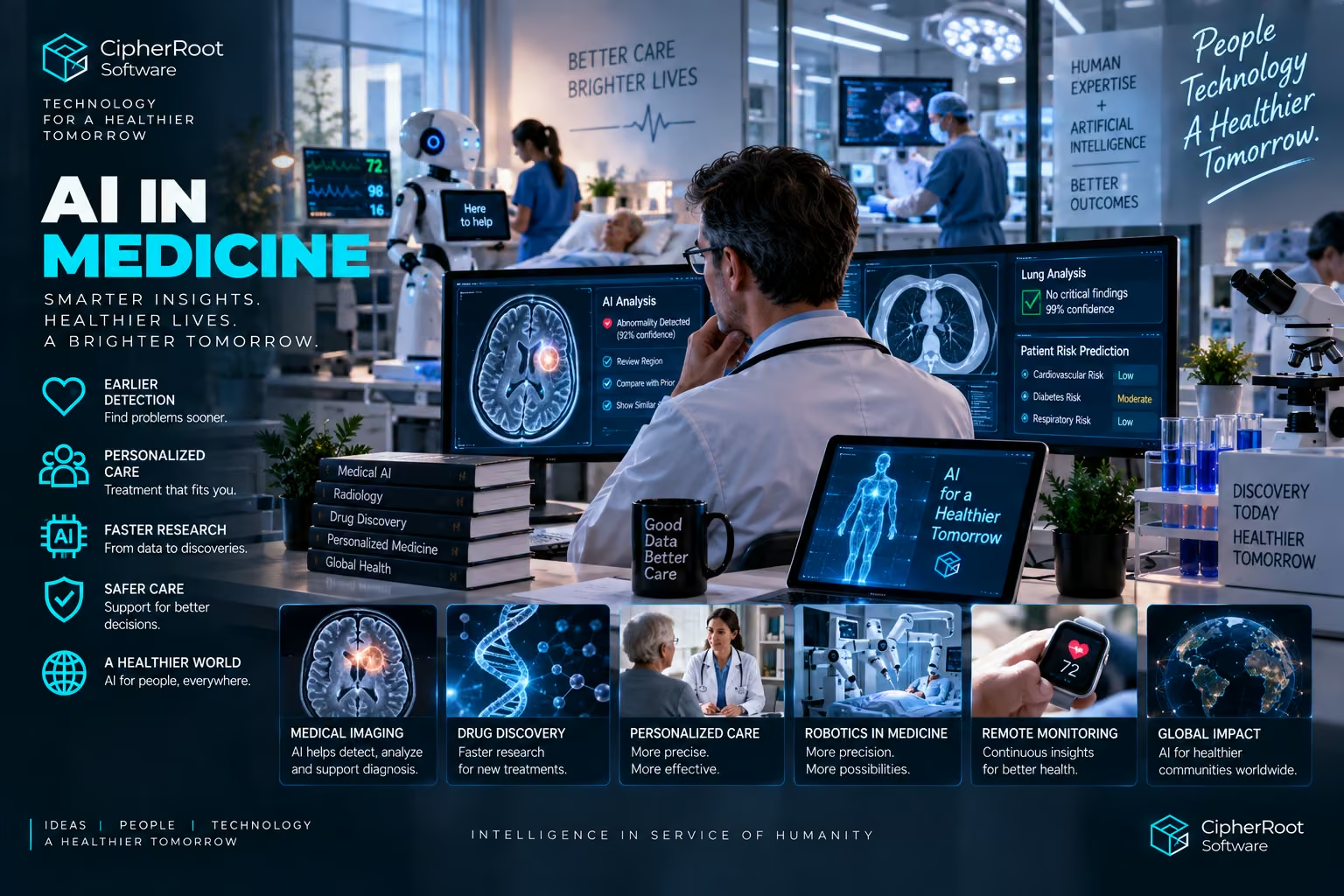
Medicine Is Entering an AI Era
Medicine has always depended on information.
Doctors examine patients, researchers analyze scientific evidence, laboratories process samples, and hospitals manage enormous amounts of clinical data.
Modern healthcare produces more information than ever before.
Medical images, electronic health records, laboratory results, genomic information, wearable-device data, scientific publications, and administrative records can create an enormous information-management challenge.
Artificial intelligence offers new ways to process this complexity.
AI systems can recognize patterns, analyze large datasets, assist with image interpretation, summarize information, support research, and automate selected workflows.
The World Health Organization identifies applications of AI across diagnosis and clinical care, drug development, disease surveillance, outbreak response, and health-system management.
The future of medicine may therefore involve a closer partnership between medical expertise and machine intelligence.
What Is AI in Medicine?
AI in medicine refers to the use of artificial intelligence and related technologies in healthcare, biomedical research, and clinical workflows.
These technologies can include:
Machine learning Deep learning Computer vision Natural language processing Generative AI Predictive analytics Multimodal AI
Applications range from analyzing medical images to assisting with documentation and scientific research.
However, not every AI system used in healthcare has the same level of validation.
Some tools are research prototypes.
Some support administrative tasks.
Others are regulated medical devices with specific intended uses.
This distinction is essential when discussing medical AI.
AI and Medical Imaging
Medical imaging is one of the most established areas for healthcare AI.
Radiology and other imaging fields generate large quantities of visual information.
Deep-learning systems can analyze images and identify patterns that may be relevant to a clinical assessment.
Potential applications include:
X-ray analysis CT image analysis MRI analysis Mammography Ultrasound Pathology images
AI can help highlight suspicious regions, prioritize cases, or provide additional analysis for clinicians.
The U.S. Food and Drug Administration maintains a public list of AI-enabled medical devices authorized for marketing in the United States, with many current entries in areas such as radiology.
The important point is that AI-assisted imaging is not merely a theoretical concept.
Specific AI-enabled medical devices are already being reviewed and authorized for defined clinical uses.
AI Does Not Replace the Clinician
A common misunderstanding is that AI in medicine means a computer independently diagnosing every patient.
Real healthcare is more complicated.
A medical diagnosis can involve symptoms, medical history, physical examination, laboratory results, imaging, treatment history, and many other contextual factors.
AI can assist with parts of this process, but clinical decisions often require professional judgment.
WHO emphasizes that AI for health needs human oversight, accountability, ethical safeguards, and appropriate governance.
The more useful model is therefore:
AI provides additional information. Healthcare professionals interpret it. Patients remain part of the decision-making process.
Clinical Decision Support
AI can also assist clinicians by organizing information and identifying patterns in medical data.
A decision-support system could potentially help identify relevant information from a patient's record or highlight potential issues for further review.
Machine-learning models can analyze patterns associated with particular outcomes.
Generative AI can assist with information retrieval and document summarization.
But these systems must be evaluated for accuracy and appropriate use.
A model that performs well in one hospital or population may not necessarily perform equally well in another setting.
Clinical AI must therefore be validated in the context in which it will actually be used.
Generative AI in Healthcare
Generative AI has introduced new possibilities in healthcare.
Large language and multimodal models can work with text, images, and other forms of information.
Potential applications include:
Medical-document summarization Clinical note assistance Patient-information drafts Research support Knowledge retrieval Administrative communication Information extraction
WHO's 2025 guidance on large multimodal models specifically discusses their potential use in healthcare, scientific research, public health, and drug development, while emphasizing that their broad capabilities and limitations require careful governance.
The technology can be useful, but generated medical information still needs appropriate verification.
AI and Drug Discovery
Developing a new medicine can take years and requires large amounts of scientific research.
Researchers need to understand biological mechanisms, identify promising molecules, evaluate interactions, and conduct extensive testing.
AI can assist by analyzing large datasets and identifying patterns that may help researchers prioritize promising candidates.
Potential applications include:
Molecular analysis Drug candidate screening Protein-related research Biomarker discovery Trial design support Literature analysis
AI does not remove the need for laboratory experiments or clinical trials.
Instead, it can help researchers navigate the enormous search space involved in biomedical discovery.
Personalized Medicine
Patients do not all respond to treatments in exactly the same way.
Genetics, medical history, age, lifestyle, environment, and other factors can influence outcomes.
AI can analyze multiple data sources and help researchers explore relationships between patient characteristics and treatment outcomes.
This contributes to the broader goal of personalized medicine.
In the future, healthcare systems may increasingly use AI to help identify which approaches are more appropriate for particular groups of patients.
Such systems must be carefully validated because incorrect predictions can have serious consequences.
AI and Early Detection
Early detection can be important for many diseases.
AI systems may be trained to recognize patterns associated with specific conditions or risk factors.
For example, image-analysis systems can help identify potentially suspicious findings that require further clinical review.
AI may also analyze combinations of data that are difficult to evaluate manually at large scale.
The goal is not to create a machine that knows everything.
It is to create tools that can help healthcare professionals notice potentially important signals earlier.
AI and Remote Patient Monitoring
Wearable devices and connected medical technologies can continuously generate information.
Heart-rate measurements, movement data, oxygen-related measurements, glucose information, and other signals can potentially be analyzed over time.
AI can help identify unusual changes or long-term patterns.
Remote monitoring could therefore become more proactive.
Instead of waiting for a scheduled appointment, healthcare teams may be able to receive alerts when certain monitored parameters change significantly.
The specific usefulness and reliability of such systems depends on the device, measurement, patient population, and clinical workflow.
AI in Hospital Operations
Not every medical AI application involves diagnosis.
Hospitals contain many complex operational processes.
AI can help with tasks such as:
Scheduling Resource planning Patient-flow analysis Documentation Demand forecasting Inventory management Administrative automation
Improving these processes can reduce operational friction and allow healthcare workers to spend more time on patient care.
WHO also identifies health-systems management as an area in which AI can contribute.
Medical Documentation
Healthcare professionals often spend significant amounts of time documenting information.
AI-based tools can assist with transcription, summarization, and organization of clinical notes.
This may reduce some administrative workload.
However, medical documentation is highly sensitive.
AI-generated notes need appropriate review, because an inaccurate statement in a medical record can have consequences far beyond a normal writing error.
The ideal system should therefore make it easy for clinicians to verify and correct generated information.
AI and Biomedical Research
Scientific research produces enormous amounts of information.
Researchers may need to review thousands of publications, compare datasets, analyze experimental results, and identify relevant relationships.
AI can assist by accelerating parts of this information-processing process.
Researchers can use AI for:
Literature discovery Data analysis Hypothesis exploration Document summarization Image analysis Pattern detection
AI can increase research capacity, but scientific conclusions still require rigorous experimentation and independent validation.
Public Health and Disease Surveillance
AI can also operate at a population level.
Healthcare systems generate data that can help researchers understand disease trends and public-health patterns.
AI may assist with:
Disease surveillance Outbreak analysis Risk modeling Health-resource planning Population-level data analysis
WHO identifies disease surveillance and outbreak response among the areas where AI can support health systems.
These applications can be particularly valuable when large amounts of information must be processed quickly.
AI and Mental Health: A Special Challenge
AI systems are increasingly being used in conversations involving emotional support.
This creates special risks.
Healthcare-oriented AI should not automatically be treated as a substitute for qualified professionals, especially in situations involving severe distress or urgent safety concerns.
WHO has specifically highlighted the need for safety, accountability, and human well-being when AI interacts with people experiencing emotional vulnerability.
This is an important reminder that medical AI is not simply an engineering problem.
It is also a human and ethical problem.
Medical AI Needs Reliable Data
AI models depend on data.
If training data is incomplete, biased, poorly labeled, or not representative of the population in which the system will be used, performance can suffer.
Healthcare data can be especially complicated because populations differ across:
Age Geography Genetics Medical history Healthcare access Clinical practices Equipment
A model must therefore be evaluated in the context of its intended use.
More data does not automatically mean better medicine.
Better data and better validation matter.
Bias in Medical AI
AI systems can reproduce patterns present in their training data.
If certain groups are underrepresented, a model may perform differently across populations.
This creates an important concern in healthcare.
A system that works well for one group may not work equally well for another.
AI developers and healthcare organizations therefore need to evaluate performance across relevant populations and monitor systems after deployment.
Fairness is not something that can simply be assumed because an algorithm is mathematical.
Privacy Is Fundamental
Medical information is among the most sensitive forms of personal data.
AI systems can process:
Medical records Imaging Laboratory information Genetic information Voice recordings Wearable-device data
This creates significant privacy responsibilities.
Healthcare AI systems need appropriate protections for data access, storage, processing, and sharing.
Patients should also have clear information about how their data is being used.
WHO emphasizes that privacy, human rights, accountability, and equitable access should be central to AI governance in health.
Cybersecurity in Medical AI
Healthcare systems are attractive targets for cyberattacks.
As AI becomes connected to clinical systems, security becomes even more important.
Medical AI infrastructure may include:
Hospital networks Cloud services Medical devices Databases APIs User accounts Remote-access systems
Security weaknesses can affect both digital information and real-world healthcare operations.
Medical AI therefore needs strong cybersecurity from the beginning.
AI Models Can Make Mistakes
No AI system is perfect.
A model may produce a false positive.
It may miss an important finding.
It may misunderstand context.
A generative system may produce information that sounds plausible but is incorrect.
This is why AI should not be treated as an unquestionable authority in medicine.
The appropriate level of human oversight depends on the specific application and its risks.
The higher the consequences of an error, the stronger the validation and oversight need to be.
Medical Device Regulation Matters
Healthcare AI is different from an ordinary consumer application.
Some AI-enabled systems are medical devices and are subject to regulatory requirements.
The FDA's public AI-enabled medical-device list is intended to provide transparency around devices authorized for marketing in the United States and notes that listed devices have met applicable premarket requirements for their intended use.
Regulation does not make an AI system perfect.
But it creates an important framework for evaluating specific medical technologies before they are marketed for defined uses.
AI and the Future Doctor
The doctor of the future may use many more AI tools than doctors do today.
An AI assistant might summarize a patient's record.
A vision model might analyze an image.
A monitoring system might identify an unusual trend.
A research assistant might find relevant scientific literature.
A predictive model might support risk analysis.
The doctor would still need to integrate these inputs with clinical knowledge and the patient's circumstances.
The role of the clinician may therefore become less about manually processing every piece of information and more about interpreting information and making context-aware decisions.
AI Could Help Reduce Information Overload
One of the biggest advantages of AI in medicine may simply be information management.
Healthcare professionals have to deal with enormous amounts of data.
AI can help organize that information so that important details are easier to find.
Instead of spending large amounts of time searching through records, clinicians may increasingly have tools that surface relevant information automatically.
This can improve workflow efficiency without requiring AI to make the final medical decision.
AI and Medical Robotics
AI is also connected to robotics.
Robotic systems can assist with physical tasks in healthcare environments.
Applications can include:
Hospital logistics Pharmacy automation Rehabilitation systems Robotic surgery platforms Laboratory automation
Here again, the level of autonomy varies considerably.
Some systems are highly controlled tools operated by professionals.
Others are designed for increasingly autonomous tasks.
The combination of robotics and AI could eventually create healthcare environments in which machines assist with both information and physical work.
The Hospital of the Future
Imagine a hospital where AI systems work quietly throughout the facility.
Medical imaging is automatically analyzed.
Patient information is organized for clinicians.
Robots transport supplies.
AI assistants help prepare documentation.
Monitoring systems identify important changes in patient data.
Researchers use AI to analyze scientific information.
The human healthcare team remains at the center.
Technology handles more of the repetitive information and logistical work.
People focus on diagnosis, treatment, communication, empathy, and decisions.
That is a more realistic vision of medical AI than a hospital run entirely by machines.
Responsible AI Is Essential
The WHO has repeatedly emphasized that healthcare AI needs responsible governance, ethical safeguards, and evidence-based implementation.
That means medical AI should be developed with attention to:
Safety
Systems need appropriate validation for their intended use.
Transparency
Users should understand what the system is designed to do.
Human oversight
Important decisions should have appropriate professional review.
Privacy
Sensitive health information must be carefully protected.
Equity
Systems should be evaluated across relevant populations.
Accountability
There should be clear responsibility for how the technology is deployed and used.
The Future of AI-Powered Medicine
The next generation of medical technology may connect AI with almost every layer of healthcare.
AI-powered imaging.
Smart monitoring.
Intelligent hospital systems.
Drug-discovery platforms.
Robotic systems.
Medical research assistants.
Personalized medicine.
Clinical documentation tools.
Connected medical devices.
These technologies will not all develop at the same speed.
Some applications are already being used in specific clinical environments.
Others remain experimental.
The future will depend on evidence, regulation, infrastructure, economics, and trust.
What AI Cannot Replace
Medicine is not only about information.
Patients need to be heard.
Doctors need to understand context.
Families need explanations.
Treatment decisions often involve values and preferences.
Some situations require empathy and human communication that cannot be reduced to pattern recognition.
AI can process information.
It cannot simply become a replacement for the human relationship at the center of healthcare.
The most useful future may therefore be one where AI handles more of the complexity while people remain responsible for the human side of medicine.
Conclusion
Artificial intelligence is transforming medicine by changing how healthcare professionals analyze information, conduct research, manage operations, and interact with medical technology.
AI-enabled medical devices are already being authorized for specific uses, while research continues across imaging, drug development, clinical support, monitoring, and many other areas.
But medical AI must be approached differently from ordinary consumer software.
Accuracy matters.
Validation matters.
Privacy matters.
Security matters.
Human oversight matters.
And the consequences of an incorrect result can be significant.
The future of medicine is therefore unlikely to be AI instead of doctors.
It is more likely to be:
Doctors + researchers + nurses + patients + intelligent tools.
AI can process enormous amounts of information.
Healthcare professionals provide context, judgment, communication, and responsibility.
Together, these capabilities can create a healthcare system that is more data-driven and potentially more efficient—while keeping people at the center.
Smarter tools. Better information. Human-centered medicine.
The future of healthcare may not belong to machines alone.
It may belong to people who know how to use intelligent machines responsibly.